
Rotating proxies used to be a niche tool for scrapers and growth hackers. Not anymore.
In 2026, they sit inside serious data pipelines. SaaS teams use them for price monitoring, SERP tracking, ad verification, brand protection, lead enrichment, cybersecurity research, travel fare monitoring, and AI training data collection.
The difference between a good rotating proxy provider and a weak one is not just speed. It is block rate, IP freshness, geo accuracy, session control, cost predictability, protocol support, and how much engineering time your team loses fixing failed requests.
The tricky part is that almost every proxy company now claims a huge IP pool, clean residential traffic, low latency, and “advanced rotation.” Those words sound nice, but buyers need harder questions. Can you rotate per request? Can you hold a sticky session long enough to complete a checkout flow or localized search? Does the provider support HTTP, HTTPS, and SOCKS5? Is bandwidth monthly, pay-as-you-go, or non-expiring? Are you paying for premium infrastructure or just a nice dashboard sitting on a resold pool?
This guide breaks down the 9 best rotating proxy providers in 2026 for professional use cases, from enterprise-scale AI pipelines to lean scraping teams that need affordable bandwidth without getting buried in commitment-heavy contracts.
What Are Rotating Proxies and Why Do They Matter?
A rotating proxy changes the IP address used for your internet requests based on a defined rule. That rule can be every request, every few minutes, every session, or after a custom duration. Instead of sending 10,000 requests from one IP and getting blocked quickly, rotating proxies distribute those requests across a wider pool of IPs.
That matters because modern websites monitor request frequency, IP reputation, location mismatch, header behavior, browser fingerprinting, session consistency, and unusual access patterns. A proxy alone does not solve every anti-bot issue, but a strong rotating proxy network gives your scraping or automation system a cleaner base to work from.
The main rotating proxy types are:
Rotating residential proxies: These use IP addresses assigned by real internet service providers to residential users. They are usually better for difficult targets, localized data, ad verification, eCommerce scraping, and account-sensitive workflows.
Rotating datacenter proxies: These come from servers in data centers. They are faster and cheaper, but easier to detect on protected websites.
Rotating mobile proxies: These use mobile carrier networks. They are expensive, but useful for app testing, mobile ad verification, and mobile-first platforms.
ISP proxies with rotation: These combine ISP-registered IP reputation with datacenter-like stability. They are often used when you need cleaner IP reputation but longer sessions.
The best rotating proxy setup is not always the biggest one. A 400 million IP network sounds impressive, but your actual success rate depends on pool quality, rotation logic, target website, session design, concurrency, request headers, and retry strategy.
9 Best Rotating Proxy Providers 2026
#1 — Oxylabs: Best Rotating Proxy for Enterprise and AI Pipelines
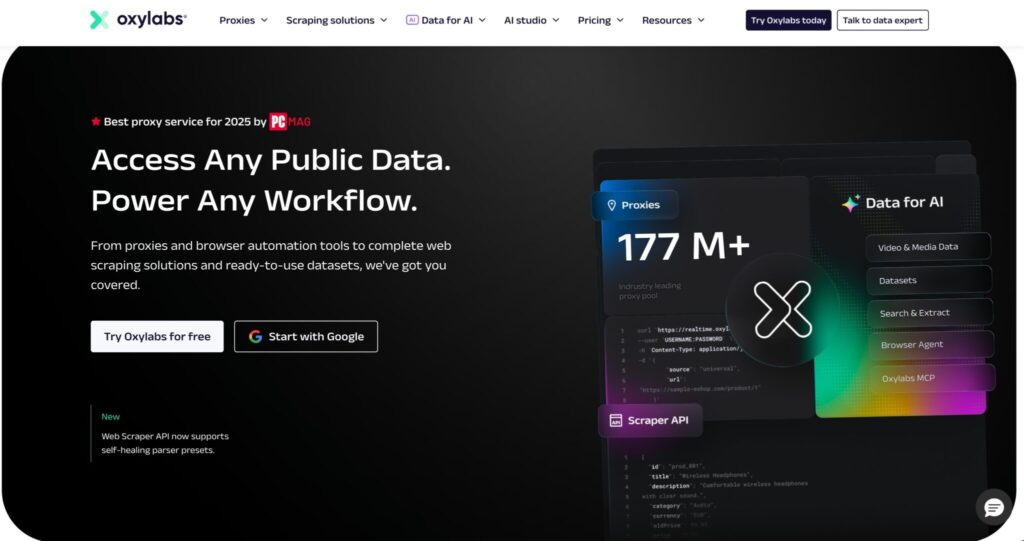
Oxylabs is built for teams that treat web data as infrastructure, not as a side experiment. Its network includes a large residential proxy pool, datacenter proxies, ISP proxies, mobile proxies, SOCKS5 options, and scraping tools such as Web Unblocker and Web Scraper API. Oxylabs states that it offers 175M+ residential IPs and 2M datacenter IPs, which makes it one of the largest proxy providers in the market.
Where Oxylabs stands out is reliability at scale. If your team is collecting competitive pricing, travel fares, marketplace listings, public SERP data, or product intelligence across multiple countries, Oxylabs gives you the controls needed for large request volumes. Residential proxy pricing currently starts at $6/GB on its Starter plan, with lower per-GB pricing available on larger plans such as $5/GB for 20GB, $4/GB for 125GB, and $2.50/GB for 1TB monthly plans.
For rotating use cases, Oxylabs is especially strong when you need a mix of rotation, geotargeting, and enterprise support. It supports advanced proxy products beyond basic residential access, including Web Unblocker and scraping APIs. That matters for teams that do not want to build every retry, fingerprint, CAPTCHA, and browser-layer workaround in-house.
The downside is price. Oxylabs is not the cheapest provider in this list. Small teams scraping low-value public pages may find better economics with Webshare, IPRoyal, Proxy-Cheap, or DataImpulse. But if failed requests cost your team real money, the premium can make sense.
Best for: enterprise scraping, AI data pipelines, ad verification, price intelligence, SERP collection, compliance-heavy teams.
Pro Tip: Use Oxylabs when the project has production pressure. If a failed scraping job affects reporting, revenue, or model freshness, the stability and account support can be worth more than saving $2 per GB.
#2 — Decodo (formerly Smartproxy): Best Value Rotating Proxies for Growing Teams
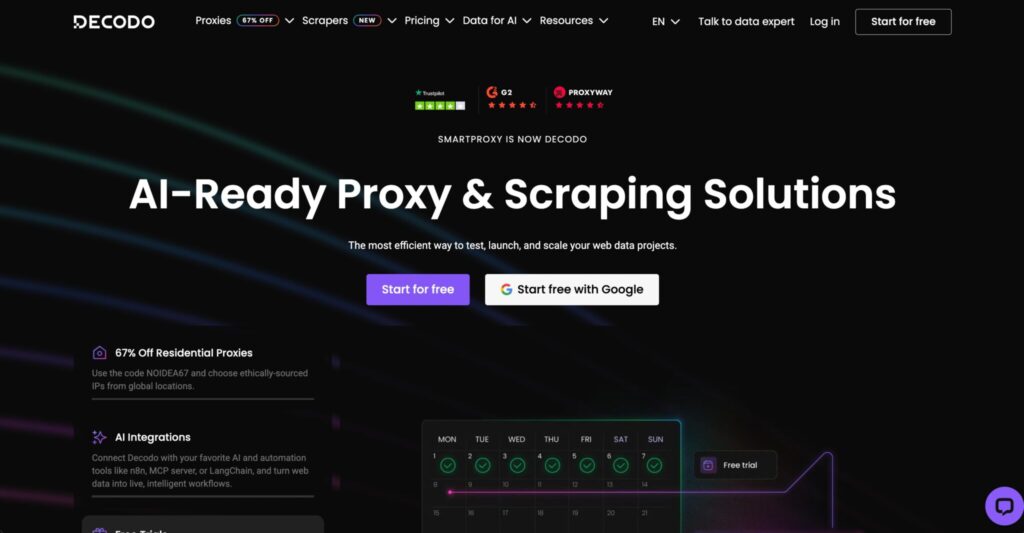
Decodo, formerly Smartproxy, has become one of the strongest middle-ground options in the rotating proxy market. It is more accessible than most enterprise-first platforms, but still powerful enough for professional scraping, SEO monitoring, ad verification, market research, and automation workflows.
Decodo says its residential proxy network includes 115M+ IPs across 195+ locations, with rotating and sticky session options, 99.99% uptime, and 24/7 tech support. Its homepage also states that Smartproxy has officially rebranded to Decodo and references 125M+ IPs, 195+ locations, and LLM-compatible infrastructure.
Pricing is one of Decodo’s biggest advantages. Its residential proxy pricing starts from $3.75/GB on the 3GB plan, $3.50/GB on the 10GB plan, $3.25/GB on the 25GB plan, and $3/GB on the 50GB plan, with lower rates available at higher volumes. For growing SaaS teams, that gives Decodo a sweet spot: strong enough for professional workloads, but not as expensive as some premium enterprise alternatives.
Its dashboard is also beginner-friendly. That matters more than many engineers admit. When your marketing ops team, SEO team, or data analyst needs to create endpoints, rotate sessions, or check usage, a clean interface reduces support tickets and wasted engineering time.
The main trade-off is that Decodo may not have the same enterprise compliance depth or custom infrastructure feel as Oxylabs or Bright Data. Still, for many teams, it hits the best balance between price, performance, coverage, and ease of use.
Best for: growing SaaS teams, SEO data, eCommerce scraping, ad verification, market research, agencies.
Pro Tip: Start Decodo with a mid-sized plan rather than the smallest test plan if your project needs meaningful benchmarking. Tiny datasets often make proxy tests misleading because you do not see rotation behavior under real load.
#3 — Webshare: Best Free Rotating Proxy Entry Point
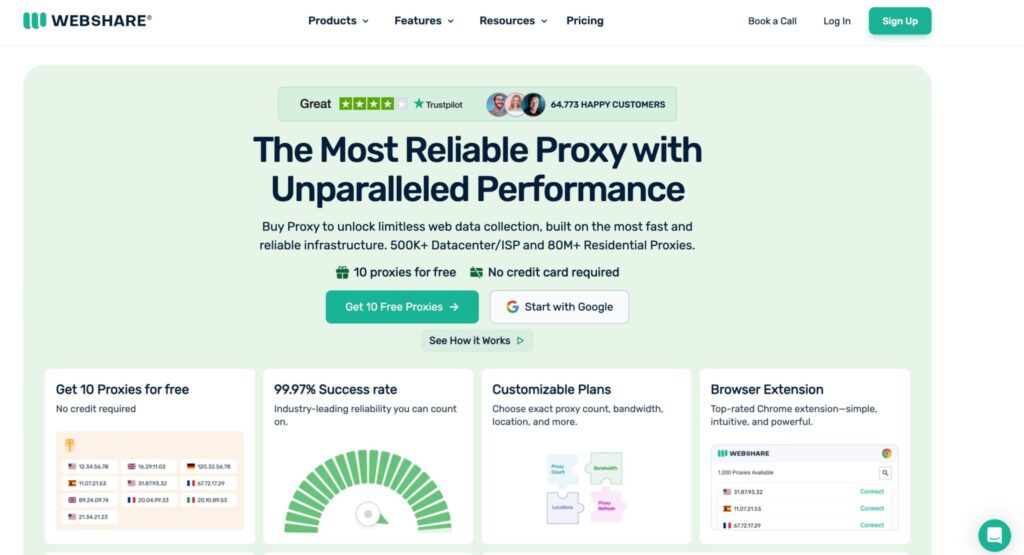
Webshare is the most approachable provider on this list for users who want to test proxies before committing budget. It offers a free entry point, simple pricing, and a dashboard that does not feel intimidating.
Webshare’s rotating residential proxy page says it offers 80M+ ethically sourced residential IPs, HTTP/SOCKS5 endpoints, and pricing as low as $1.40/GB. Its rotating proxy page also says users can get 10 free proxies with up to 1GB per month for free, with no credit card required and no trial period.
That makes Webshare ideal for developers, freelancers, small agencies, and early-stage teams that need to validate a workflow before buying a larger pool. If you want to test a script, check proxy authentication, run a proof of concept, or compare residential versus datacenter behavior, Webshare makes the starting point easy.
Webshare also offers datacenter, static residential, and rotating residential options, so you can build a simple cost ladder. Use datacenter proxies for low-risk, speed-sensitive tasks. Move to residential proxies when blocks increase. Use static residential when you need IP consistency.
The limitation is that Webshare is less of an all-in-one scraping platform than Bright Data, Oxylabs, or Decodo. It is better as a proxy infrastructure provider than a complete data extraction stack. If your team wants managed unblockers, advanced scraping APIs, or enterprise support workflows, Webshare may feel light.
Best for: free testing, small teams, developers, basic scraping, budget-conscious residential proxy usage.
Pro Tip: Use Webshare as your baseline test. If Webshare works reliably on your target, you may not need a premium provider. If it struggles, move up to Decodo, Oxylabs, SOAX, or Bright Data and compare success rates against the same URLs.
#4 — Bright Data: Best Rotating Proxy for AI Agents and Real-Time Data
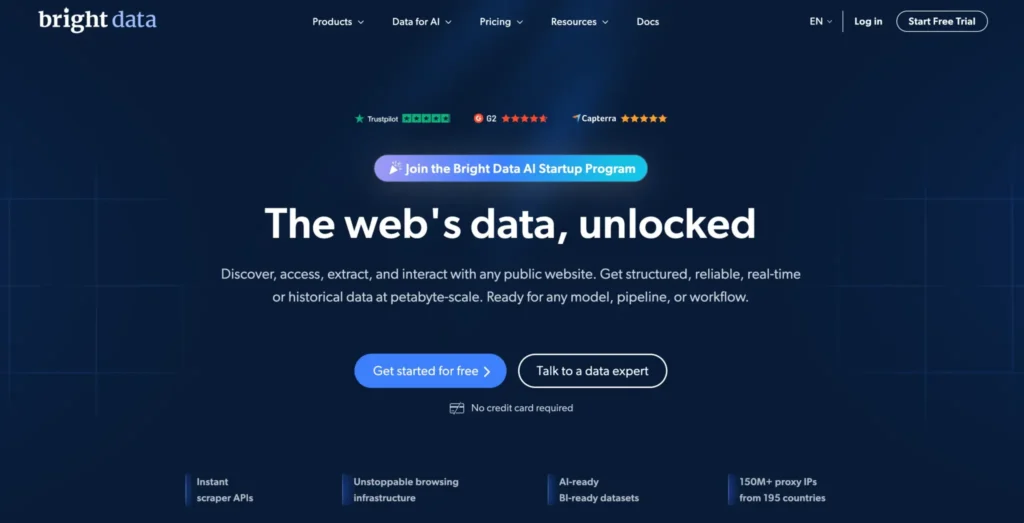
Bright Data remains one of the most advanced proxy providers for serious data operations. Its strength is not just proxy access. It is the surrounding infrastructure: proxy networks, scraping APIs, browser tools, datasets, and data collection workflows.
Bright Data says its residential proxy network includes over 400M monthly ethical residential IPs from 195 countries, with sticky and rotating sessions, geo-location targeting, and a reported 99.95% success rate. Its residential proxy pricing page lists residential proxies starting from $5.88/GB, while its rotating proxies page shows a promotional pay-as-you-go residential rate of $4/GB with a discount code at the time of research.
Bright Data is particularly useful for AI agents and real-time data systems because it offers more than raw proxies. If you are building workflows that involve automated browsing, public data extraction, search monitoring, marketplace intelligence, or AI-driven research agents, Bright Data’s tooling can reduce the amount your team has to build from scratch.
The platform also gives strong controls around geo-targeting and session behavior. That matters when you need to see localized results exactly as a user in a specific city, country, or network type would see them.
The downside is complexity. Bright Data is powerful, but it can feel heavy for beginners. Pricing can also climb quickly if you use premium products without tight monitoring. For a casual user, it may be more platform than needed.
Best for: AI agents, enterprise data collection, real-time market intelligence, complex scraping, localized monitoring.
Pro Tip: Bright Data is a strong choice when your team needs both proxies and data collection tools. If you only need basic rotating IPs, compare the total monthly cost carefully against Decodo, Webshare, SOAX, and DataImpulse.
#5 — SOAX: Best Rotating Proxy with the Cleanest IP Pool
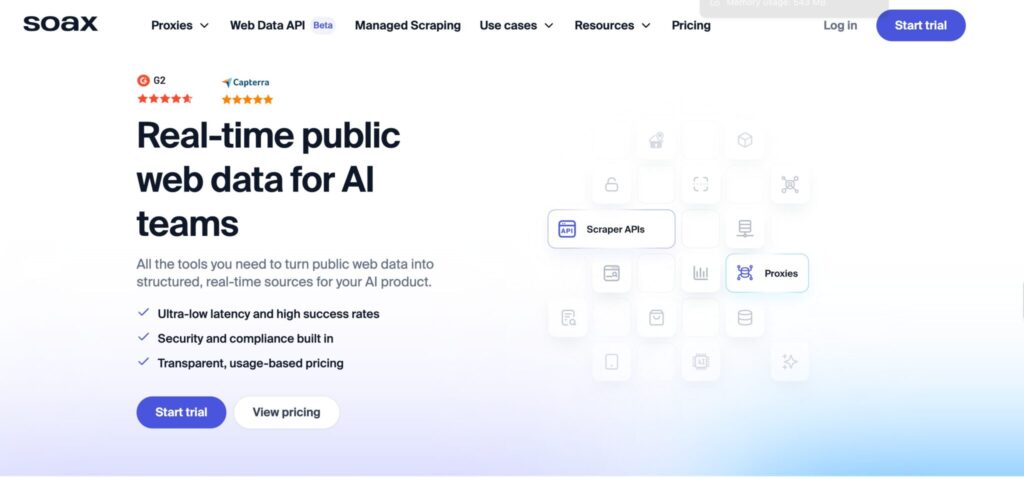
SOAX is often chosen by teams that care about clean targeting, session control, and flexible proxy access across different proxy types. Its pricing model gives users access to residential, mobile, ISP, datacenter proxies, and Web Data API under one plan, which can be convenient when your team tests multiple target types.
SOAX states that its residential proxy product includes 155M+ IPs in 195+ locations, with sticky and rotating sessions. It lets users rotate IPs on every request, keep the same IP for longer periods, or set custom session lengths.
That level of session control is important. Some scraping jobs work best with fast rotation. Others break if the IP changes mid-flow. For example, checking a product page may work with per-request rotation, but logging into a test account, completing multi-step navigation, or collecting localized marketplace results may need sticky sessions.
SOAX pricing starts at $3.60/GB on the Starter plan with 25GB included, $3.40/GB on the Advanced plan with 50GB included, and lower rates on higher-volume plans. It is not the cheapest provider here, but it offers a polished experience for teams that value targeting and clean pool management.
The main drawback is the minimum monthly spend. Users with very small or irregular projects may prefer DataImpulse, IPRoyal, Proxy-Cheap, or Webshare.
Best for: clean residential pools, precise targeting, sticky sessions, mixed proxy testing, teams that need flexible session lengths.
Pro Tip: Test SOAX on location-sensitive tasks. Its value becomes clearer when your project needs accurate geo-targeting, not just cheap traffic.
#6 — IPRoyal: Best Rotating Proxy with Non-Expiring Bandwidth
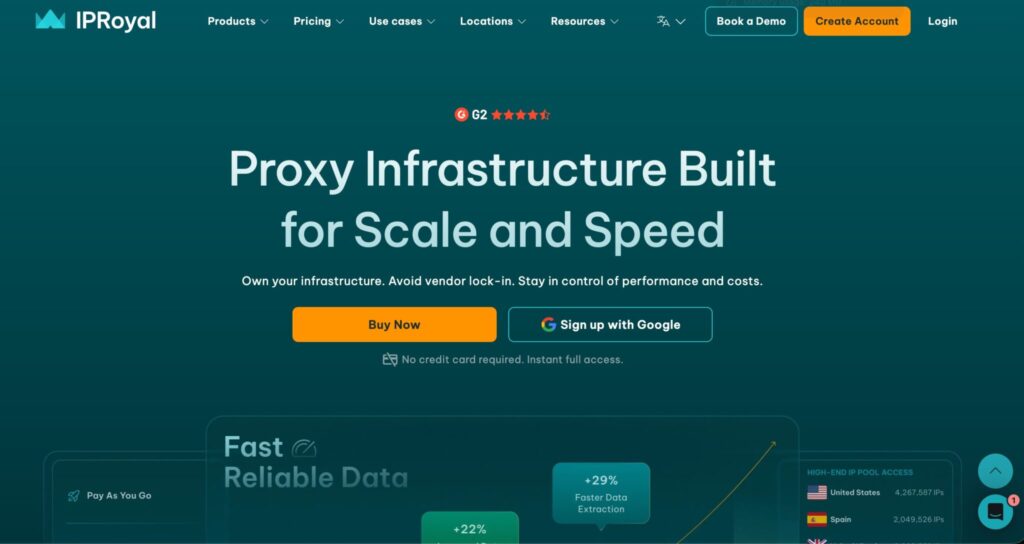
IPRoyal is a strong fit for buyers who hate losing unused bandwidth at the end of the month. Its positioning is simple: flexible pricing, non-expiring traffic, and usage-based plans. The company highlights “non-expiring traffic” on its website, which is a major benefit for teams with irregular scraping cycles.
IPRoyal’s residential proxy page says custom packages start at $1.75, with on-demand purchasing and adjustable traffic volumes. Its rotating proxy page also references flexible pricing with subscription traffic that rolls over or pay-as-you-go top-ups.
The product is especially attractive for smaller teams, affiliate marketers, SEO operators, ad verification users, and developers who do not run constant high-volume jobs every day. If your scraping workload comes in bursts, non-expiring bandwidth can be more valuable than a slightly lower monthly rate that resets.
IPRoyal also keeps the product fairly easy to understand. You buy traffic, configure proxies, and run your tasks. It does not feel as enterprise-heavy as Bright Data or Oxylabs.
The trade-off is that IPRoyal may not be the best option for highly complex enterprise pipelines where dedicated support, custom architecture, or advanced data extraction tools matter. It is more of a practical, affordable rotating proxy provider than a full data platform.
Best for: non-expiring traffic, budget-conscious teams, irregular scraping, SEO tasks, small businesses.
Pro Tip: IPRoyal is useful when your monthly usage is unpredictable. If you scrape heavily one month and lightly the next, rollover or non-expiring traffic can keep your real cost lower than a cheaper-looking monthly plan.
#7 — Proxy-Cheap: Best Budget Rotating Proxy for Cost-Conscious Teams

Proxy-Cheap is built around affordability. It offers rotating residential proxies, datacenter proxies, static residential proxies, IPv6 options, and mobile proxies, with pricing aimed at users who want usable proxy infrastructure without enterprise pricing.
Its homepage lists rotating residential proxies starting at $4.99/GB, while its rotating residential proxy page also shows a 1GB monthly option at $4.99 per GB and mentions pay-as-you-go options for users who need flexible usage-based pricing.
Proxy-Cheap is best for teams that know what they are doing technically and want to keep proxy costs manageable. It can work well for SEO checks, basic web scraping, sneaker or retail monitoring tests, market research, and lightweight automation projects.
The provider is not as polished as the premium names in this guide, and buyers should benchmark carefully before using it for mission-critical scraping. With budget proxy providers, the main question is not whether the price is attractive. It is whether the success rate is good enough for your target sites.
Still, Proxy-Cheap deserves a place here because many teams do not need premium infrastructure for every task. If you are collecting data from less protected websites, validating small scripts, or running cost-sensitive jobs, it can be a sensible option.
Best for: budget scraping, small projects, SEO tools, cost-sensitive teams, flexible testing.
Pro Tip: Do not judge Proxy-Cheap only by price. Test success rate per 1,000 requests. A cheaper provider that fails too often can cost more than a premium provider once retries, engineering time, and incomplete data enter the picture.
#8 — ProxyEmpire: Best Rotating Proxy with Unlimited Rollover
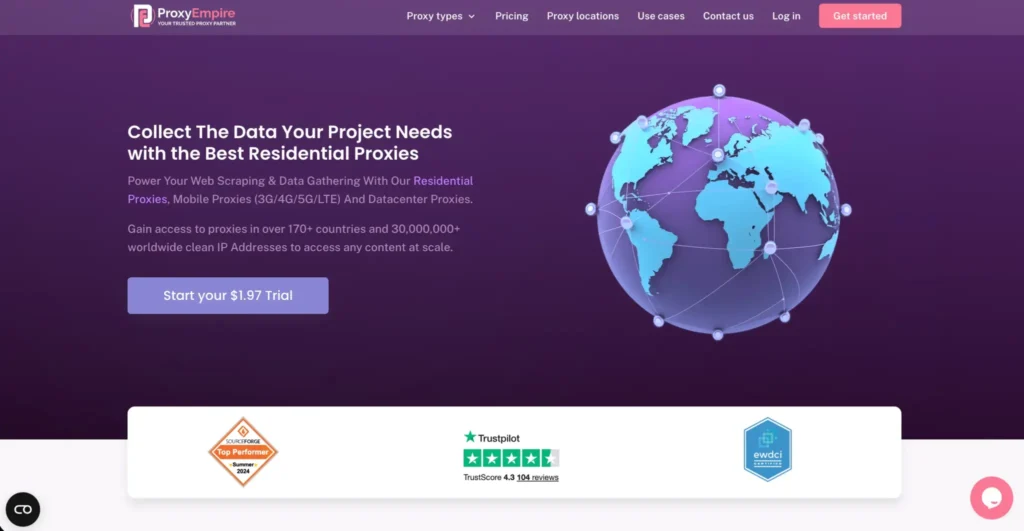
ProxyEmpire stands out because of its rollover model and broad targeting options. It offers rotating residential, static residential, rotating mobile, dedicated mobile, and rotating datacenter proxies.
ProxyEmpire says it provides 30M+ clean IPs, 170+ countries, 99.9% uptime, and 24/7 support. Its pricing table shows rotating residential plans starting with pay-as-you-go 1GB pricing and scaling down at higher volumes, with custom 5TB+ plans from $0.75/GB.
The most interesting feature is rollover. ProxyEmpire promotes unused bandwidth rollover, meaning unused data does not simply disappear at the end of the billing period. Its documentation and site copy repeatedly position rollover as a key advantage for cost control.
ProxyEmpire also supports HTTP, HTTPS, SOCKS5, and UDP for rotating residential and mobile proxies, while rotating datacenter, static residential, and dedicated mobile proxies support HTTP and SOCKS5.
This makes ProxyEmpire useful for users who need advanced targeting but do not want to waste unused bandwidth. It is a good fit for intermittent scraping, geo-specific research, and projects where usage spikes around campaigns or reporting cycles.
The main caution is that some claims on provider-owned content are promotional, so buyers should run real tests on their target websites before committing to large plans.
Best for: rollover bandwidth, geo-targeted scraping, intermittent projects, users who need residential and mobile options.
Pro Tip: ProxyEmpire is worth testing if you run campaign-based scraping. For example, if your usage spikes during product launches, Black Friday monitoring, or monthly reporting, rollover can protect your budget.
#9 — DataImpulse: Best Rotating Proxy for Pay-As-You-Go Economics
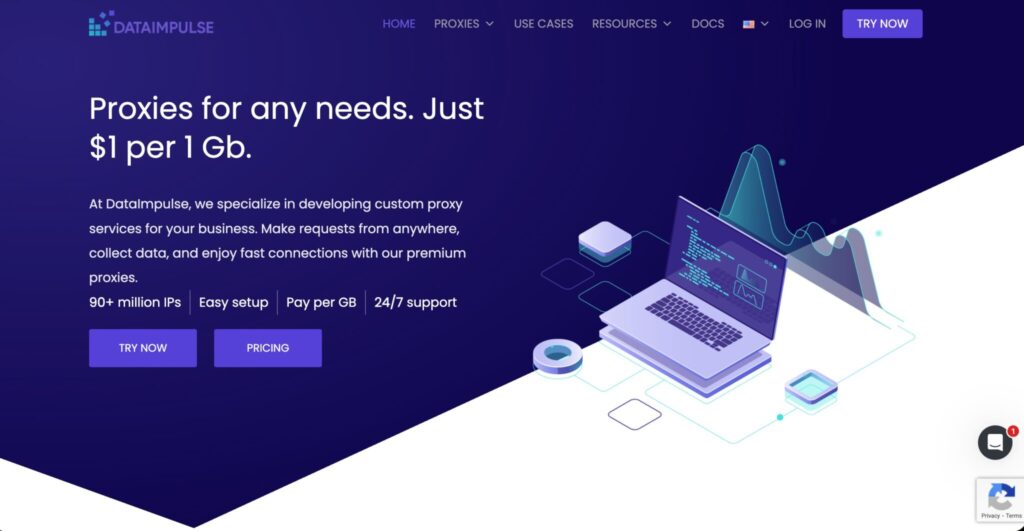
DataImpulse is one of the most attractive options for teams that want simple, low-cost pay-as-you-go residential proxies. Its official residential proxy page lists residential proxies starting at $1/GB, with 90M+ residential IPs, 195 countries, traffic that never expires, free country targeting, HTTP(S)/SOCKS5 support, rotating sessions, sticky sessions, API access, and 24/7 support.
That is a compelling package. Many providers advertise low pricing only at large commitments. DataImpulse keeps the offer simple: pay for bandwidth, use it when needed, and avoid monthly pressure. Its homepage also highlights “Just $1 per 1GB,” 90M+ IPs, easy setup, pay-per-GB pricing, and 24/7 support.
DataImpulse is not necessarily the most advanced provider for enterprise scraping, and it may not offer the same depth of tooling as Bright Data, Oxylabs, or Decodo. But for practical scraping economics, it is hard to ignore.
It is best for developers, small data teams, indie SaaS tools, SEO projects, and testing environments where predictable cost matters more than a premium enterprise wrapper.
Best for: pay-as-you-go residential proxies, low-cost testing, non-expiring traffic, small teams, flexible scraping.
Pro Tip: DataImpulse is ideal for building a low-cost fallback pool. Even if your main provider is Oxylabs, Decodo, or Bright Data, a secondary budget pool can help with testing, routing low-risk targets, or reducing cost on less protected sites.
Best Rotating Proxy Providers 2026: Quick Comparison Table
| Provider | Best For | Residential IP Pool | Starting Price | Rotation Options | Protocols | Key Strength | Main Limitation |
|---|---|---|---|---|---|---|---|
| Oxylabs | Enterprise and AI pipelines | 175M+ residential IPs | From $6/GB residential plan | Rotating and sticky options | HTTP, HTTPS, SOCKS5 on supported products | Scale, support, scraping tools | Premium pricing |
| Decodo | Growing teams and agencies | 115M+ to 125M+ IPs | From $3.75/GB on small plan | Rotating and sticky sessions | Common proxy integrations | Strong value and usability | Less enterprise-heavy than Oxylabs |
| Webshare | Free testing and low-cost entry | 80M+ residential IPs | From $1.40/GB residential | Rotating residential options | HTTP/SOCKS5 | Free tier and simple pricing | Fewer advanced scraping tools |
| Bright Data | AI agents and real-time data | 400M+ monthly residential IPs | From $5.88/GB, promos may vary | Sticky and rotating sessions | Broad proxy and data tooling | Advanced platform depth | Complex for beginners |
| SOAX | Clean pool and precise targeting | 155M+ residential IPs | From $3.60/GB | Per-request, sticky, custom sessions | Common proxy protocols | Clean targeting and flexible sessions | Minimum monthly plan may not suit tiny users |
| IPRoyal | Non-expiring bandwidth | Large global residential network | From around $1.75 custom packages | Rotating proxies and rollover/top-up options | HTTP/SOCKS5 on supported products | Non-expiring traffic | Less advanced data tooling |
| Proxy-Cheap | Budget residential usage | Large rotating pool | From $4.99/GB | Rotating residential | HTTP/SOCKS5 on supported products | Affordable and flexible | Needs careful benchmarking |
| ProxyEmpire | Rollover bandwidth and targeting | 30M+ clean IPs | From trial and scalable GB plans | Rotating, static, mobile, datacenter | HTTP, HTTPS, SOCKS5, UDP on rotating residential/mobile | Rollover data and targeting | Promotional claims need testing |
| DataImpulse | Pay-as-you-go economics | 90M+ residential IPs | From $1/GB | Rotating and sticky sessions | HTTP(S), SOCKS5 | Low price and non-expiring traffic | Not as feature-heavy as premium platforms |
How to Choose the Best Rotating Proxy Provider
Start with IP pool quality, not just pool size
A large IP pool looks impressive, but it does not guarantee better results. What matters is how many clean, usable IPs are available for your target websites, countries, and request patterns.
Ask these questions before buying:
- Does the provider own or directly source its network?
- Can you target country, state, city, ASN, or ZIP code?
- Are IPs shared heavily with other users?
- Does the provider refresh poor-performing IPs?
- Can you separate high-value targets from low-risk targets?
If you are scraping SERPs, marketplaces, or travel sites, geo accuracy matters. If you are collecting AI training data from broad public web pages, scale and throughput may matter more.
Match rotation logic to your workflow
Rotation is not one setting. It is a strategy.
Per-request rotation works well for simple page fetches, product listings, SERP checks, and public data collection.
Sticky sessions work better for workflows where the site expects one user to keep the same IP for several minutes.
Custom rotation intervals are useful when you need to mimic normal browsing behavior or reduce suspicion on stricter targets.
A common mistake is rotating too aggressively. If every step of a multi-page journey comes from a different IP, some websites see that as suspicious. For login flows, cart flows, localized browsing, or account testing, sticky sessions often perform better.
Check protocol support before you commit
Most teams need HTTP and HTTPS. Some tools and scraping frameworks work better with SOCKS5. Certain advanced workflows may require UDP or browser-level integration.
For basic scraping, HTTP(S) is usually enough. For more flexible networking, SOCKS5 is useful because it can handle more types of traffic. If your tool stack requires SOCKS5 and your provider only supports HTTP, you will waste time building workarounds.
Calculate real cost per successful request
Do not compare providers only by price per GB.
A $1/GB provider with a poor success rate can be more expensive than a $5/GB provider with cleaner IPs and fewer retries. The real metric is cost per successful page, cost per complete record, or cost per validated data point.
- Track these during testing:
- Success rate
- Average response time
- CAPTCHA frequency
- Ban rate
- Cost per 1,000 successful requests
- Retry volume
- Data completeness
- Support response time
This is where buyers often get surprised. The cheapest provider may win for easy targets. Premium providers often win when targets are protected or the data is business-critical.
Use multiple providers for serious data pipelines
- Professional teams rarely depend on one proxy provider forever. A smart stack may use:
- Oxylabs or Bright Data for difficult targets
- Decodo or SOAX for steady daily scraping
- Webshare, IPRoyal, or DataImpulse for lower-risk jobs
- ProxyEmpire for rollover-heavy campaigns
- Proxy-Cheap for budget tests
Multi-provider routing gives your team flexibility. If one pool struggles on a target, you can route traffic elsewhere instead of pausing the whole data pipeline.
FAQ: Best Rotating Proxy Providers 2026
What is the best rotating proxy provider in 2026?
Oxylabs is the best overall choice for enterprise teams, AI data pipelines, and production scraping where reliability matters most. Decodo is the best value option for growing teams. Webshare is the best free entry point. Bright Data is best for advanced AI agents and real-time data collection. DataImpulse is best for low-cost pay-as-you-go residential traffic.
How do rotating proxies work?
Rotating proxies route your requests through different IP addresses from a proxy pool. The IP can change with every request, after a fixed time, or after a session ends. This helps distribute traffic, reduce rate-limit issues, and collect localized data from different regions.
What’s the difference between rotating residential and rotating datacenter proxies?
Rotating residential proxies use real ISP-assigned IPs, so they look more like normal user traffic. They are better for difficult websites, geo-sensitive data, ad verification, and eCommerce scraping. Rotating datacenter proxies are server-based, faster, and cheaper, but easier for websites to detect and block.
Do rotating proxies work for web scraping?
Yes, rotating proxies are widely used for web scraping, especially when collecting public data at scale. They help reduce IP-based blocks and rate limits. Still, proxies are only one part of a scraping stack. Headers, browser fingerprints, request timing, retries, and legal compliance also matter.
How much do rotating proxies cost?
Rotating residential proxies can cost anywhere from around $1/GB to $8/GB depending on the provider, volume, traffic expiration rules, targeting, and support level. DataImpulse starts around $1/GB, Webshare lists residential pricing from $1.40/GB, Decodo starts from $3.75/GB on small plans, and Oxylabs starts from $6/GB on its residential Starter plan.
Can rotating proxies bypass CAPTCHAs?
Rotating proxies can reduce CAPTCHA frequency, but they do not magically bypass every CAPTCHA. CAPTCHAs are triggered by many signals, including IP reputation, request behavior, browser fingerprint, cookies, headers, and traffic patterns. For hard targets, you may need a full unblocker, browser automation, or scraping API in addition to proxies.
Are rotating proxies legal?
Rotating proxies are legal tools when used for lawful purposes, such as accessing public data, ad verification, brand protection, cybersecurity research, and testing. Problems arise when users violate website terms, collect restricted personal data, bypass authentication, commit fraud, or access systems without permission. Businesses should review laws, contracts, robots.txt expectations, and data privacy rules before scraping.
Should I use sticky sessions or rotate every request?
Use per-request rotation for simple page fetching, SERP checks, and large public datasets. Use sticky sessions when a workflow requires continuity, such as multi-page browsing, account testing, location-sensitive journeys, or cart flows. The best providers let you use both.
Conclusion: Best Rotating Proxy Providers 2026
The best rotating proxy provider depends on your workload.
Choose Oxylabs if your team needs enterprise-grade stability, large-scale scraping infrastructure, and strong support. Choose Decodo if you want the best mix of price, usability, and professional-grade residential proxies. Choose Webshare if you need a free or low-cost starting point. Choose Bright Data if your team is building advanced AI agents, real-time data systems, or complex extraction workflows.
SOAX is excellent for clean targeting and flexible sessions. IPRoyal is a smart pick for non-expiring bandwidth. Proxy-Cheap works for budget-sensitive teams that are willing to benchmark carefully. ProxyEmpire is useful when rollover matters. DataImpulse is hard to beat for simple pay-as-you-go residential proxy economics.
For serious SaaS and web data teams, the winning approach is often not one provider. It is a layered proxy strategy. Use premium networks for hard targets, value providers for daily scraping, and low-cost pay-as-you-go pools for lightweight jobs. That gives you better uptime, cleaner data, and a proxy bill that does not quietly eat your margins.