
IPRoyal Review.
IPRoyal sits in an interesting corner of the proxy market. It is not trying to look like the most expensive enterprise proxy provider. It is not overloaded with complex dashboards, contract-heavy pricing, or sales calls for every serious use case. Instead, it focuses on something many proxy buyers quietly care about more than fancy branding: affordable access to residential, ISP, datacenter, and mobile proxies without making the buying process painful.
That makes IPRoyal especially attractive for SEO teams, scraping teams, ecommerce operators, ad verification users, sneaker automation users, and smaller data teams that need real IP flexibility but do not want to jump straight into Bright Data or Oxylabs level pricing.
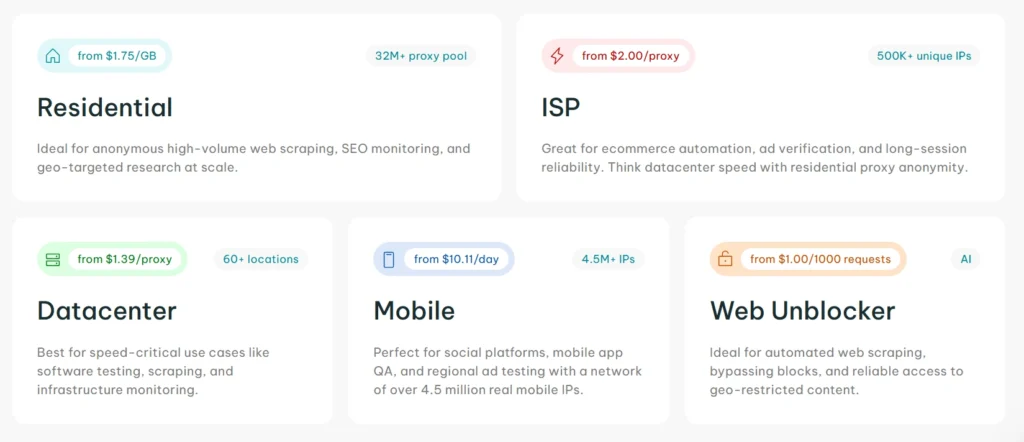
As of 2026, IPRoyal lists residential proxies from $1.75/GB, a 32M+ residential proxy pool, ISP proxies from around $2.40/proxy, datacenter proxies from $1.39/proxy, and mobile proxies from $10.11/day with a claimed 4.5M+ mobile IP pool. It also promotes non-expiring residential traffic, which is a major value point for users with irregular scraping or testing workloads.
What Is IPRoyal?
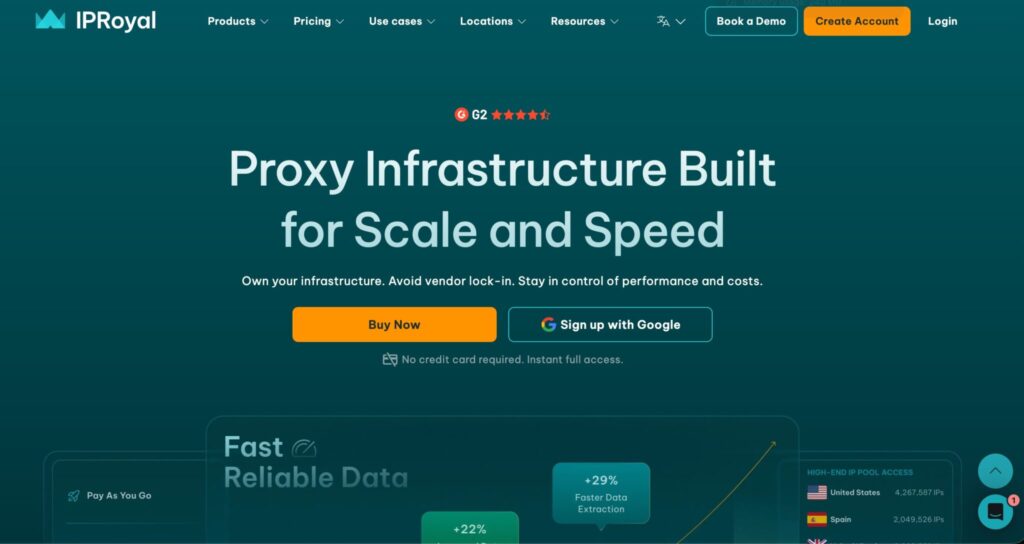
IPRoyal is a proxy service provider offering several proxy types under one dashboard:
| Proxy Type | Best For |
| Residential proxies | Web scraping, SEO monitoring, ad verification, price tracking |
| ISP proxies | Long sessions, ecommerce automation, account access, stable identity |
| Datacenter proxies | Fast scraping, testing, infrastructure monitoring |
| Mobile proxies | Social media testing, app QA, mobile ad verification |
| Sneaker proxies | Limited drops, retail checkout flows, bot-based purchasing setups |
The biggest appeal is not just the variety. Many providers offer multiple proxy categories now. The real appeal is that IPRoyal feels accessible. You can start small, test a use case, and scale only when you know the proxies work for your target websites.
That matters because proxy buying is not like buying hosting. You cannot judge a provider only from the pricing page. The real test is whether its IPs survive your target websites, whether rotation behaves predictably, whether sticky sessions hold long enough, and whether support can help when blocks rise.
IPRoyal Review: Quick Verdict
IPRoyal is best for buyers who want budget-friendly proxy access with flexible usage, especially for residential and ISP proxy workloads. It is a strong option for SEO monitoring, web scraping, ecommerce testing, market research, and ad verification.
It may not be the best fit for massive enterprise scraping teams that need advanced scraping APIs, managed unblockers, dedicated compliance workflows, or huge custom contracts. TechRadar also notes that IPRoyal is more cost-effective and accessible for smaller clients, while larger providers like Bright Data and Oxylabs offer broader enterprise tooling.
Best Fit
IPRoyal works well for:
| User Type | Fit |
| SEO agencies | Strong |
| Affiliate marketers | Strong |
| Small scraping teams | Strong |
| Ecommerce monitoring teams | Strong |
| Sneaker bot users | Good |
| Enterprise data extraction teams | Moderate |
| Teams needing scraping APIs | Limited |
IPRoyal Pros and Cons
Pros
| Pros | Why It Matters |
| Affordable residential pricing | Lower entry cost than many premium providers |
| Non-expiring traffic | Useful for irregular scraping and testing workloads |
| Multiple proxy types | Residential, ISP, datacenter, mobile, sneaker |
| Simple dashboard | Easier for beginners and small teams |
| Good use-case coverage | SEO, scraping, ecommerce, ads, automation |
| Flexible geo-targeting | Helpful for localized SERP checks and regional testing |
| Lower commitment | You can test without jumping into enterprise contracts |
Cons
| Cons | Why It Matters |
| Not the largest IP pool | Bigger providers may offer broader global depth |
| No full scraping API focus | You manage more of the scraping logic yourself |
| Performance varies by target site | Common with all residential proxy providers |
| Advanced enterprise support may be limited | Large teams may need more custom account management |
| Mobile pricing can get expensive | Mobile proxies are powerful but costly |
IPRoyal Pricing Breakdown
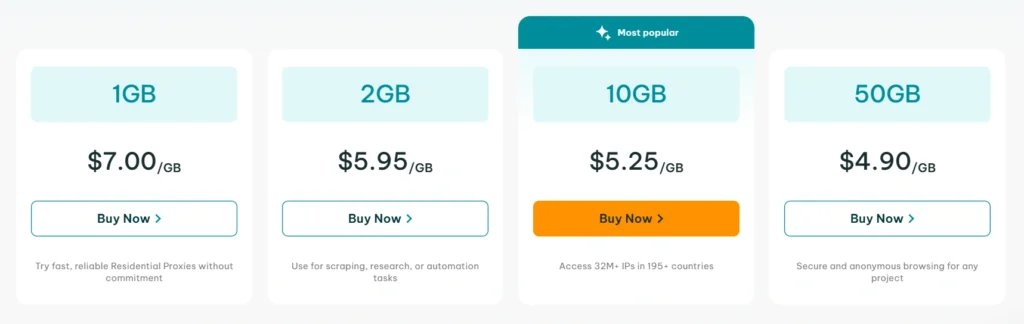
IPRoyal’s pricing is one of its strongest selling points. The company positions itself as a value-focused provider with flexible plans and no heavy contracts.
| Proxy Type | Starting Price | Pool Size or Coverage | Best Use Case |
| Residential proxies | From $1.75/GB | 32M+ proxy pool | Scraping, SEO, ads, market research |
| ISP proxies | From $2.40/proxy | 500K+ unique IPs | Stable sessions, ecommerce, account work |
| Datacenter proxies | From $1.39/proxy | 60+ locations | Speed-focused scraping and testing |
| Mobile proxies | From $10.11/day | 4.5M+ mobile IPs | Social media, mobile app QA, ad testing |
IPRoyal’s official pricing page highlights residential proxies with traffic that never expires, which is especially valuable if your usage is inconsistent. Many proxy providers make you buy monthly bandwidth that resets whether you use it or not. With non-expiring traffic, a small team can buy bandwidth once and consume it gradually.
Pro Tip
If your scraping workload is not daily, non-expiring residential bandwidth can reduce waste. For example, a small SEO team checking SERPs, competitor prices, and ad placements a few times per week may get better value from IPRoyal than from a monthly plan where unused GB disappears.
IPRoyal Feature Review
1. Residential Proxies
Residential proxies are IPRoyal’s main attraction. These IPs come from real residential networks, which makes them more trusted than datacenter IPs for websites that aggressively filter automation.
IPRoyal claims a 32M+ residential proxy pool, with use cases such as anonymous web scraping, SEO monitoring, geo-targeted research, and ad verification.
Residential proxies are best when you need:
| Use Case | Why Residential Helps |
| Google SERP tracking | More natural location-based search results |
| Price monitoring | Lower block rates on retail websites |
| Ad verification | View ads from different regions |
| Travel fare tracking | Check location-based price differences |
| Market research | Collect public data with lower detection risk |
The key advantage is trust. Websites often treat residential IPs as normal user traffic. That does not mean you can scrape recklessly. Bad headers, repeated patterns, fast request rates, and weak session management can still trigger blocks. But residential IPs give you a better starting point than raw datacenter IPs.
2. ISP Proxies
ISP proxies sit between datacenter and residential proxies. They usually offer the speed and stability of datacenter infrastructure while appearing closer to residential IPs.
IPRoyal lists ISP proxies with 500K+ unique IPs, positioned for ecommerce automation, ad verification, and long-session reliability.
These are useful when you need one IP to stay consistent for a longer session. For example, logging into an account, checking marketplace dashboards, testing checkout flows, or monitoring ecommerce sites where frequent IP changes look suspicious.
3. Datacenter Proxies
Datacenter proxies are fast, cheaper, and easier to scale, but they are also easier for websites to detect. IPRoyal offers datacenter proxies starting from $1.39/proxy with coverage across 60+ locations.
Use datacenter proxies when speed matters more than stealth.
Good use cases include:
| Use Case | Fit |
| Software testing | Excellent |
| Basic scraping | Good |
| Infrastructure monitoring | Excellent |
| Non-sensitive automation | Good |
| Heavy anti-bot websites | Weak |
For protected targets, residential or ISP proxies will usually perform better. For lightweight tasks, datacenter proxies can save money.
4. Mobile Proxies
Mobile proxies use carrier-grade mobile IPs. These are valuable because many platforms trust mobile network traffic more than datacenter traffic. IPRoyal promotes mobile proxies for social platforms, mobile app QA, and regional ad testing, with a claimed pool of 4.5M+ real mobile IPs.
Mobile proxies are best for:
| Use Case | Why Mobile Works |
| Social media testing | Platforms often treat mobile traffic as normal |
| Mobile app QA | Test regional mobile behavior |
| Ad verification | See mobile ads by location |
| App store research | Check country-specific visibility |
| Account warmup | Useful when stable and handled carefully |
The downside is cost. Mobile proxies are usually more expensive than residential and datacenter proxies. Use them only where mobile identity actually matters.
Massive IPRoyal Comparison Table
| Feature | IPRoyal | Bright Data | Oxylabs | Smartproxy/Decodo | SOAX |
| Best For | Budget-friendly flexible proxy use | Enterprise data teams | Enterprise scraping and data collection | Mid-market scraping and SEO | Geo-targeted residential and mobile |
| Residential Pool | 32M+ | Very large | Very large | Large | Large |
| ISP Proxies | Yes | Yes | Yes | Yes | Limited or plan-based |
| Datacenter Proxies | Yes | Yes | Yes | Yes | Limited |
| Mobile Proxies | Yes | Yes | Yes | Yes | Yes |
| Non-Expiring Traffic | Yes, on residential | Usually plan-based | Usually plan-based | Usually plan-based | Usually plan-based |
| Beginner Friendly | High | Medium | Medium | High | Medium |
| Enterprise Features | Moderate | Very strong | Very strong | Strong | Strong |
| Pricing Style | Flexible, budget-focused | Premium | Premium | Mid-range | Mid-range |
| Best Buyer | Small teams, SEO users, scrapers | Large companies | Large companies | Agencies and growth teams | Teams needing precise geo control |
IPRoyal wins on affordability and flexibility. Bright Data and Oxylabs win on enterprise tooling, massive infrastructure, and advanced data products. Smartproxy/Decodo is often stronger for teams that want a polished middle ground. SOAX is a good competitor when precise geo-targeting is the main priority.
How to Choose the Right IPRoyal Proxy Type
Choosing the wrong proxy type is the fastest way to waste money. The cheapest proxy is not always the best proxy. The best proxy is the one that matches your target website, traffic pattern, and session needs.
Choose Residential Proxies If You Need Better Trust
Residential proxies are best for public data collection, SERP tracking, price monitoring, and regional research. They offer a good balance between cost, trust, and flexibility.
Use residential proxies when:
| Need | Recommended |
| Rotating IPs | Yes |
| Geo-targeting | Yes |
| Lower block rates | Yes |
| Large public data scraping | Yes |
| Long account sessions | Not always |
Choose ISP Proxies If You Need Stable Sessions
ISP proxies are better when consistency matters. If your task breaks when the IP changes too often, ISP proxies are usually a better fit.
Use ISP proxies for:
| Need | Recommended |
| Account login sessions | Yes |
| Ecommerce checkout testing | Yes |
| Marketplace monitoring | Yes |
| Ad verification | Yes |
| High rotation scraping | Not ideal |
Choose Datacenter Proxies If You Need Speed
Datacenter proxies are fast and cheap. They are great for testing, monitoring, and simple automation. They are not ideal for heavily protected websites.
Use datacenter proxies for:
| Need | Recommended |
| Low-cost speed | Yes |
| Basic automation | Yes |
| Internal QA | Yes |
| Protected retail scraping | Not ideal |
| Social media automation | Not ideal |
Choose Mobile Proxies If You Need Carrier-Level Trust
Mobile proxies are powerful but expensive. Use them only when your workflow depends on mobile IP reputation.
Use mobile proxies for:
| Need | Recommended |
| Mobile ad testing | Yes |
| Social platform testing | Yes |
| App QA | Yes |
| Bulk scraping | Usually too expensive |
| Basic SEO checks | Not needed |
Understanding Rotation, Sessions, and IP Behavior (Where Most Buyers Get It Wrong)
A proxy is only as good as how you use it. This is where most people burn money. They buy “good proxies” and still get blocked because the rotation logic or session handling is wrong.
IPRoyal gives you enough flexibility here, but it does not babysit you with managed scraping APIs like enterprise providers. So you need to understand the basics.
Rotating vs Sticky Sessions
There are two core ways your proxy behaves:
| Mode | What Happens | When to Use |
| Rotating IPs | New IP on each request | Scraping large datasets, avoiding detection |
| Sticky Sessions | Same IP for a fixed duration | Logins, carts, checkout flows, account work |
IPRoyal supports both, especially on residential proxies. You can rotate per request or hold a session for a set time.
Real-world example:
- Scraping Google SERPs → rotating
- Logging into Amazon seller dashboard → sticky
- Checking product prices across regions → rotating
- Testing checkout flow → sticky
Pro Tip
If you mix rotating proxies with login workflows, you will trigger security systems fast. Always isolate workflows:
- One proxy strategy for scraping
- One proxy strategy for sessions
IP Pool Quality vs Size (The Hidden Factor Nobody Talks About)
Everyone loves to mention “millions of IPs.” It sounds impressive. But size alone does not guarantee success.
What actually matters:
1. IP Freshness
Fresh IPs have less usage history and fewer bans.
2. ASN Diversity
Different networks reduce pattern detection.
3. Geographic Depth
Not just country level. City-level targeting matters for:
- Local SEO tracking
- Ad verification
- Marketplace testing
IPRoyal’s pool is solid for most mid-scale use cases. It might not match enterprise providers in raw depth, but for 90% of SEO, affiliate, and scraping workflows, it holds up well.
Pro Tip
Instead of chasing the biggest pool, test:
- Success rate on your target website
- CAPTCHA frequency
- Request failure rate
That tells you more than any marketing page.
Performance Benchmarks That Actually Matter
You should not judge proxies on “speed” alone. The real metrics are:
| Metric | Why It Matters |
| Success rate | % of requests that return valid data |
| Block rate | How often you hit bans or CAPTCHAs |
| Latency | Important for automation workflows |
| Session stability | Critical for logins and checkouts |
| Geo accuracy | Important for SERP and ad testing |
IPRoyal generally performs well on:
- SEO tools
- Price scraping
- Marketplace monitoring
- Moderate-scale automation
It can struggle if:
- You push aggressive scraping rates
- You hit highly protected targets without proper headers and delays
That is not unique to IPRoyal. That is how residential proxies behave across the board.
Real Use Case Breakdown
Let’s cut the theory. Here is how IPRoyal actually fits into real workflows.
1. SEO Rank Tracking and SERP Scraping
IPRoyal is a strong fit here.
Why:
- Residential IPs mimic real users
- Geo targeting helps local SERPs
- Rotating IPs reduce bans
Setup:
- Rotate IP per query
- Add delays between requests
- Randomize user agents
2. Ecommerce Price Monitoring
Also a solid use case.
You can:
- Track competitor pricing
- Monitor stock levels
- Check regional pricing differences
Best setup:
- Residential proxies
- Moderate rotation
- Request throttling
3. Affiliate Ad Verification
Affiliate marketers often need to see:
- How ads appear in different regions
- Whether links redirect correctly
- Landing page variations
IPRoyal works well here because:
- Geo targeting is flexible
- You can simulate real user traffic
4. Sneaker and Retail Automation
IPRoyal even markets sneaker proxies, but let’s be honest.
It can work, but:
- Success depends more on your bot setup than proxies
- High competition drops require strong rotation + timing
Better suited for:
- Mid-tier drops
- Testing setups
- Backup proxy pool
5. Social Media and Account Management
This is where you need to be careful.
Use:
- ISP proxies for stability
- Mobile proxies for higher trust
Avoid:
- Aggressive automation
- Rapid switching between IPs
Advanced Buying Strategy (What Smart Buyers Do)
Instead of picking one proxy type and hoping it works, experienced users build a mix.
Hybrid Setup Strategy
| Task | Proxy Type |
| Bulk scraping | Residential |
| Account sessions | ISP |
| Testing & QA | Datacenter |
| Mobile validation | Mobile |
This reduces:
- Costs
- Block rates
- Dependency on a single proxy type
Pro Tip
Start small. Test with:
- 1–5 GB residential
- 2–5 ISP proxies
Scale only after:
- You confirm success rates
- Your workflow stabilizes
Common Mistakes to Avoid
1. Over-Rotating
Too much rotation can look unnatural.
Fix:
- Match rotation speed to real user behavior
2. Ignoring Headers
Even perfect proxies fail with bad headers.
Fix:
- Use realistic user agents
- Rotate browser fingerprints if needed
3. Sending Requests Too Fast
This is the fastest way to get blocked.
Fix:
- Add delays
- Randomize intervals
4. Using Datacenter Proxies Everywhere
Cheap, yes. Effective everywhere, no.
Fix:
- Use residential for protected targets
5. Not Testing Before Scaling
Buying 100 GB upfront without testing is risky.
Fix:
- Always run small tests first
IPRoyal vs Competitors: Real Talk
Let’s be direct.
- IPRoyal vs Bright Data
Bright Data wins in enterprise features, scraping APIs, and compliance tooling. IPRoyal wins in simplicity and cost. - IPRoyal vs Oxylabs
Oxylabs offers stronger enterprise infrastructure. IPRoyal is easier for smaller teams. - IPRoyal vs Smartproxy/Decodo
Smartproxy feels more polished. IPRoyal often wins on price flexibility. - IPRoyal vs SOAX
SOAX can offer tighter geo targeting. IPRoyal is simpler and often cheaper.
Who Should Pick IPRoyal?
Pick IPRoyal if:
- You are an SEO or affiliate marketer
- You run scraping tasks under mid-scale
- You want flexibility without contracts
- You are testing proxy-based workflows
Skip IPRoyal if:
- You need scraping APIs
- You run enterprise-level data extraction
- You need advanced compliance tooling
FAQs (Based on Real Buyer Queries)
1. Is IPRoyal good for web scraping?
Yes, especially for small to mid-scale scraping. Residential proxies perform well if you manage rotation and request timing properly.
2. Does IPRoyal offer unlimited bandwidth?
No. Residential proxies are bandwidth-based. However, unused traffic does not expire, which is a big advantage.
3. Are IPRoyal proxies safe?
Yes, when used for legitimate purposes like SEO, research, and testing. Always follow website terms and local laws.
4. Which IPRoyal proxy is best for SEO?
Residential proxies are the best choice for SERP tracking and competitor analysis.
5. Can I use IPRoyal for social media automation?
Yes, but use ISP or mobile proxies and avoid aggressive automation patterns.
6. How does IPRoyal compare to premium providers?
It is more affordable and easier to use but lacks enterprise-grade tools like scraping APIs and advanced automation layers.
7. Do IPRoyal proxies work for ecommerce bots?
They can, especially ISP and residential proxies. Success depends heavily on your bot setup and strategy.
8. What is the biggest advantage of IPRoyal?
Flexible pricing with non-expiring traffic. This alone makes it attractive for many users.
Final Verdict
IPRoyal does not try to dominate the enterprise space. It focuses on being practical, accessible, and cost-efficient.
That is exactly why it works.
If you are running SEO campaigns, affiliate funnels, scraping workflows, or ecommerce monitoring, IPRoyal gives you the tools without forcing you into expensive contracts or over-engineered systems.
It is not perfect. No proxy provider is. But for most real-world use cases, especially outside enterprise scale, it hits a sweet spot between cost, performance, and flexibility.
If you approach it correctly, use the right proxy type, and avoid common mistakes, IPRoyal can easily become a reliable part of your stack rather than just another tool you test and abandon.