
Decodo Review.
Smartproxy has changed its name to Decodo, but most users still search for it as Decodo. So for this review, I’ll refer to it as Smartproxy, now Decodo.
The short version: Decodo is no longer just a simple proxy provider. It now offers residential proxies, mobile proxies, ISP proxies, datacenter proxies, Site Unblocker, Web Scraping API, scraping templates, AI Parser, and browser extensions. Decodo currently promotes 125M+ IPs, 195+ locations, 99.99% uptime, and residential proxy pricing starting from $2/GB on higher-volume plans.
Decodo Review Snapshot
| Category | Smartproxy / Decodo Details |
| Best For | SEO scraping, eCommerce monitoring, SERP tracking, market research, AI data workflows |
| Proxy Types | Residential, mobile, ISP, datacenter |
| IP Pool | 125M+ IPs |
| Locations | 195+ locations |
| Residential Pricing | Starts from $2/GB on higher-volume plans |
| Trial | 3-day proxy trial, 7-day Web Scraping API trial with 1K requests |
| Support | 24/7 tech support |
| Skill Level | Beginner to intermediate |
| Main Strength | Strong value, clean dashboard, broad proxy stack |
| Main Weakness | Not as enterprise-heavy as Bright Data or Oxylabs |
What Is Decodo?
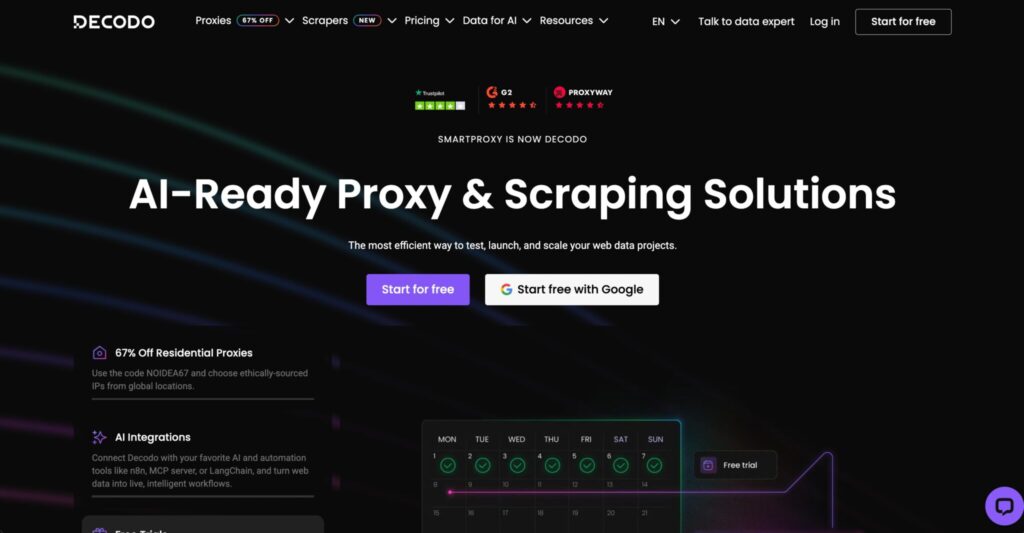
Smartproxy, now Decodo, is a proxy and web scraping platform built for users who need reliable IP infrastructure without the heavy enterprise feel of Bright Data or Oxylabs.
That is its sweet spot.
It is powerful enough for serious scraping teams, but still friendly enough for SEO agencies, affiliate marketers, eCommerce teams, and developers who do not want to spend two weeks just understanding the dashboard.
Decodo started as a value-first proxy provider. Over time, it expanded into a broader web data platform. Today, you get proxies, scraping APIs, browser tools, AI-friendly outputs, and automation integrations under one roof.
Decodo Pros and Cons
Pros
| Pros | Why It Matters |
| 125M+ IP pool | Large enough for most serious scraping and geo-targeting jobs |
| 195+ locations | Useful for SERP tracking, ad verification, and local testing |
| Beginner-friendly dashboard | Easier than many enterprise proxy tools |
| Residential proxies from $2/GB | Strong pricing for volume users |
| Multiple proxy types | Residential, ISP, mobile, and datacenter options |
| Web Scraping API | Helps bypass CAPTCHAs, blocks, and anti-bot systems |
| 24/7 support | Helpful for setup and troubleshooting |
| Browser extensions | Good for non-technical users |
Cons
| Cons | Why It Matters |
| Advanced users may want deeper controls | Bright Data still wins for highly complex enterprise workflows |
| Pricing depends on volume | Smaller plans cost more per GB |
| Scraping APIs add extra cost | Useful, but not always needed |
| Not every target needs premium proxies | Some basic tasks can be done cheaper with datacenter proxies |
Decodo Pricing Explained
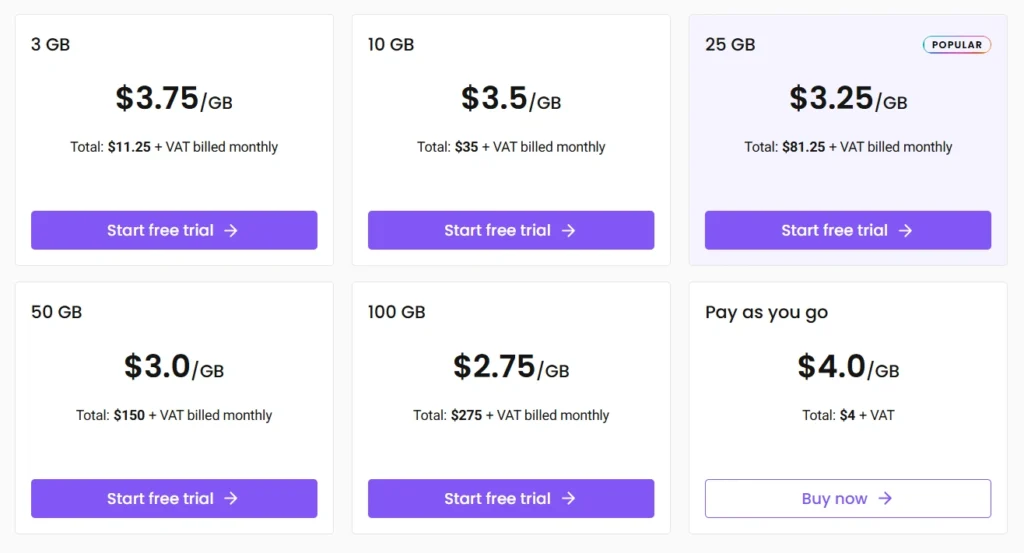
Decodo’s residential proxy pricing starts at $3.75/GB for the 3 GB monthly plan, then drops as you buy more traffic. Its pricing page also promotes residential proxies “starting at just $2/GB,” which applies to larger plans.
| Plan Size | Price Per GB | Total Monthly Cost |
| 3 GB | $3.75/GB | $11.25 + VAT |
| 10 GB | $3.50/GB | $35 + VAT |
| 25 GB | $3.25/GB | $81.25 + VAT |
| 50 GB | $3.00/GB | $150 + VAT |
Decodo also lists other starting prices across its scraping and proxy products, including mobile proxies from $2.25/GB, datacenter proxies from $0.02/IP, Site Unblocker from $0.95 per 1K requests, and Web Scraping API from $0.09 per 1K requests.
Pro Tip
Do not compare proxy providers only by price per GB. Compare the cost per successful request. A cheap proxy that fails 40% of the time can become more expensive than a slightly pricier proxy that works cleanly.
Decodo Proxy Types Reviewed
1. Residential Proxies
Residential proxies are Decodo’s strongest all-round option.
These IPs come from real residential networks, so they look more natural than datacenter IPs. That makes them useful for scraping websites that block obvious server traffic.
Best for:
| Use Case | Why Residential Proxies Work |
| SERP tracking | Better local search accuracy |
| Price monitoring | Looks like real user traffic |
| Travel scraping | Handles geo-based pricing better |
| Ad verification | Lets you check ads from different regions |
| Market research | Useful for collecting unbiased public data |
Residential proxies are the safest starting point if you do not know how strict the target website is.
2. ISP Proxies
ISP proxies are static residential-style proxies. They are usually faster and more stable than rotating residential proxies, while still appearing more trustworthy than regular datacenter IPs.
Best for:
| Use Case | Why ISP Proxies Help |
| Account management | Stable IP identity |
| Login-based workflows | Fewer sudden IP changes |
| Social tools | Better session consistency |
| Long scraping sessions | Lower interruption risk |
| B2B research | Stable and clean routing |
Use ISP proxies when the website expects the same user to keep the same IP.
3. Mobile Proxies
Mobile proxies route traffic through mobile networks. These are usually more expensive, but they can be extremely useful for mobile-first platforms.
Best for:
| Use Case | Why Mobile Proxies Work |
| App testing | Real mobile network behavior |
| Mobile SERP tracking | Better mobile result accuracy |
| Social media workflows | Mobile IPs look natural |
| Ad verification | Useful for mobile campaign checks |
| Geo testing | Helps simulate local mobile users |
Mobile proxies are not necessary for every project. But when a platform behaves differently on mobile networks, they are worth testing.
4. Datacenter Proxies
Datacenter proxies are fast, stable, and affordable. They are best for websites that do not aggressively block server traffic.
Best for:
| Use Case | Fit |
| Low-protection scraping | Good |
| Bulk checks | Good |
| Internal testing | Good |
| Simple automation | Good |
| Strict eCommerce scraping | Weak |
Use datacenter proxies when speed matters more than trust level.
Decodo Feature Breakdown
| Feature | Rating | Notes |
| Residential proxy pool | 9/10 | Large 125M+ IP network |
| Geo targeting | 9/10 | 195+ locations |
| Pricing | 8.8/10 | Strong value, especially for volume users |
| Ease of use | 9.2/10 | Cleaner than many enterprise dashboards |
| Scraping tools | 8.7/10 | Web Scraping API, Site Unblocker, templates, AI Parser |
| Developer support | 8.5/10 | Good docs, API options, integrations |
| Enterprise depth | 8/10 | Strong, but Bright Data and Oxylabs are deeper |
| Beginner friendliness | 9/10 | One of its biggest advantages |
Smartproxy(Decodo) vs Similar Proxy Providers
| Provider | Best For | Main Strength | Main Weakness |
| Smartproxy / Decodo | Value-focused scraping teams | Strong balance of price, ease, and features | Less advanced than Bright Data |
| Bright Data | Enterprise web data | Deep tooling and huge infrastructure | Expensive and complex |
| Oxylabs | Enterprise scraping | Premium support and large network | Higher pricing |
| SOAX | Clean UI and geo targeting | Easy to use | Can get costly |
| IPRoyal | Budget users | Affordable residential proxies | Smaller ecosystem |
| Webshare | Datacenter and static proxies | Very low-cost options | Limited scraping tools |
| NetNut | ISP-heavy use cases | Stable static residential network | Less beginner-friendly |
Early Verdict
Smartproxy, now Decodo, is one of the best proxy platforms for users who want serious performance without enterprise-level complexity.
It is not the cheapest provider in every category. It is also not the most advanced proxy system on the market. But it hits a very practical middle ground.
For SEO agencies, eCommerce scrapers, affiliate marketers, data teams, and developers, that middle ground is often exactly what you need.
How to Choose the Right Decodo Proxy Type

The easiest mistake is buying the wrong proxy for the job. A proxy can be “good” and still fail if it does not match the target site.
Use Residential Proxies When You Need Trust
Choose residential proxies when you are scraping websites that check traffic quality closely.
Best for:
| Task | Why It Works |
| Google SERP tracking | Better local result accuracy |
| Amazon or marketplace scraping | Looks closer to real-user traffic |
| Price monitoring | Helps avoid location-based blocks |
| Travel fare checks | Useful for geo-sensitive pricing |
| Ad verification | Shows what real users see in each region |
Use ISP Proxies When You Need Stability
ISP proxies are better when the same session needs to stay active.
Best for:
| Task | Why It Works |
| Account dashboards | Stable IP identity |
| Login flows | Less suspicious than constant IP changes |
| Long research sessions | Fewer interruptions |
| Social media monitoring | Consistent network behavior |
Use Mobile Proxies When the Platform Is Mobile-First
Mobile proxies are useful when the website or app behaves differently on mobile networks.
Best for:
| Task | Why It Works |
| App testing | Real mobile carrier behavior |
| Social platforms | Mobile IPs look natural |
| Mobile ads | Checks region and device-level delivery |
| Mobile SERPs | More accurate mobile rankings |
Use Datacenter Proxies When Speed Matters
Datacenter proxies are fast and affordable, but easier to detect.
Best for:
| Task | Why It Works |
| Low-protection websites | Cheap and fast |
| Bulk testing | Good for high-volume checks |
| Internal automation | Stable and simple |
| Public data from easy targets | Keeps cost low |
IP Pools, Rotation Protocols, and Session Control
This is where Decodo becomes more than a basic proxy seller.
IP Pool Quality
Decodo’s 125M+ IP pool gives enough coverage for most SEO, eCommerce, travel, and data collection workflows.
But pool size alone is not everything.
You should also check:
| Factor | Why It Matters |
| Country coverage | Needed for global scraping |
| City targeting | Useful for local SERPs and ads |
| ASN diversity | Helps avoid repeated network patterns |
| Rotation quality | Reduces blocks and duplicate fingerprints |
| Session control | Keeps behavior realistic |
Rotation Protocols Explained
Rotation decides how often your IP changes.
Per Request Rotation
This gives you a new IP for every request.
Use it for:
- Large-scale scraping
- Product page crawling
- SERP collection
- Public data extraction
This works well when you do not need to stay logged in.
Sticky Sessions
Sticky sessions keep the same IP for a set time.
Use them for:
- Login sessions
- Shopping cart flows
- Multi-page journeys
- Dashboard access
- Form testing
Sticky sessions make your activity look more like one real user instead of hundreds of random users.
Time-Based Rotation
This rotates IPs every few minutes.
Use it when you need balance.
It is useful for workflows where per-request rotation feels too aggressive, but static IPs are too risky.
Pro Tip
For eCommerce scraping, use rotating residential proxies for product pages and sticky sessions for carts, search filters, and checkout simulations. This gives you scale without making the user journey look broken.
Decodo Tools Worth Using
Decodo’s is useful because it does not stop at proxies. It also gives you tools that reduce scraping friction.
1. Site Unblocker
Site Unblocker helps handle blocked requests, CAPTCHAs, headers, and retries.
Use it when:
- Your scraper gets blocked often
- You do not want to manage browser fingerprints manually
- You need cleaner responses from protected pages
This is especially useful for teams that want output, not proxy engineering headaches.
2. Web Scraping API
The Web Scraping API is built for collecting structured public web data.
It is helpful when you want to scrape without building the full stack yourself.
Good for:
- Search results
- Product pages
- Reviews
- Pricing data
- Public listings
3. Browser Extension
The browser extension is useful for quick testing.
You can switch locations, test websites, and check how pages appear from different regions without writing code.
Best for:
- SEO checks
- Ad previewing
- Localized website testing
- Manual QA
4. AI Parser
AI Parser helps turn messy scraped content into cleaner structured output.
This can save time when you are pulling data from pages with inconsistent layouts.
Decodo Use Cases
SEO Rank Tracking
Decodo works well for agencies that need location-specific search results.
Use residential proxies or SERP-focused tools when checking Google results across cities and countries.
Ecommerce Price Monitoring
For eCommerce, residential proxies are usually the safest option.
You can monitor:
- Product prices
- Stock availability
- Shipping differences
- Regional discounts
- Marketplace competitors
Travel Data Scraping
Travel websites often change results based on location, session, and browsing behavior.
Residential proxies with sticky sessions can help collect cleaner fare and availability data.
Ad Verification
Decodo can help advertisers check whether campaigns appear correctly in different countries.
This is useful for:
- Affiliate ad checks
- Display ads
- Search ads
- Local landing page testing
Market Research
For agencies and SaaS teams, Decodo can collect public market data without needing to manage a huge scraping infrastructure.
Massive Decodo Comparison Table
| Feature | Smartproxy / Decodo | Bright Data | Oxylabs | SOAX | IPRoyal | Webshare | NetNut |
| Best For | Value-focused scraping | Enterprise web data | Enterprise scraping | Geo-targeting | Budget users | Cheap static proxies | ISP proxies |
| Residential Proxies | Yes | Yes | Yes | Yes | Yes | Limited | Yes |
| Mobile Proxies | Yes | Yes | Yes | Yes | Limited | No | Limited |
| ISP Proxies | Yes | Yes | Yes | Yes | Yes | Yes | Strong |
| Datacenter Proxies | Yes | Yes | Yes | Yes | Yes | Strong | Yes |
| IP Pool | 125M+ | 400M+ monthly | Large | Large | Medium | Smaller | Medium |
| Locations | 195+ | 195+ | Global | Global | Global | Limited | Global |
| Ease of Use | Very good | Moderate | Moderate | Good | Good | Very good | Moderate |
| Scraping API | Yes | Yes | Yes | Limited | No | No | Limited |
| Unblocker Tool | Yes | Yes | Yes | No | No | No | No |
| Pricing | Strong value | Premium | Premium | Mid-high | Budget | Budget | Mid-high |
| Best User Type | Agencies, SMBs, developers | Enterprises | Enterprises | Mid-market teams | Beginners | Budget users | Static session users |
Decodo Alternatives
Bright Data
Choose Bright Data if you need the deepest targeting, enterprise compliance, and the largest web data toolkit.
It is better for large teams, but more complex and expensive.
Oxylabs
Choose Oxylabs if you want enterprise-grade scraping with strong account support.
It is a strong Bright Data alternative, especially for bigger companies.
SOAX
Choose SOAX if you want a clean interface and strong geo-targeting.
It is easier to use than many enterprise tools, but pricing can climb.
Decodo FAQs
Is Decodo now called Decodo?
Yes. Decodo has rebranded as Decodo. Many users still call it Decodo because that name has been popular in the proxy market for years.
Is Decodo good for beginners?
Yes. It is easier to use than most enterprise proxy platforms. The dashboard, browser extension, and documentation make it beginner-friendly without making it too basic.
What is Decodo best for?
Decodo is best for SEO tracking, eCommerce scraping, ad verification, travel data collection, market research, and public web data extraction.
Are Decodo residential proxies good?
Yes. Residential proxies are one of Decodo’s strongest products. They are useful for websites that block datacenter IPs or show different results by location.
Does Decodo support sticky sessions?
Yes. Sticky sessions are available and useful for login flows, shopping carts, multi-page browsing, and session-sensitive tasks.
Is Decodo cheaper than Bright Data?
Usually, yes. Decodo is positioned as a more affordable and easier-to-use option, while Bright Data is more enterprise-heavy and advanced.
Can Decodo bypass CAPTCHAs?
Decodo proxies alone do not magically solve every CAPTCHA. For harder targets, tools like Site Unblocker and Web Scraping API are better because they handle more of the blocking logic.
Which Decodo proxy type should I choose?
Use residential proxies for general scraping, ISP proxies for stable sessions, mobile proxies for mobile-first platforms, and datacenter proxies for fast low-cost tasks.
Final Verdict
Smartproxy, now Decodo, is one of the strongest proxy platforms for users who want reliability without getting buried in enterprise complexity.
It gives you a large IP pool, broad location coverage, multiple proxy types, scraping tools, and a dashboard that does not feel like it was designed only for senior engineers.
Is it the most advanced proxy platform in the world? No. Bright Data and Oxylabs still have more enterprise depth.
Is it one of the best value picks for SEO agencies, affiliate marketers, eCommerce teams, and growing data teams? Absolutely.
Decodo is the provider I would shortlist when you want something stronger than budget proxies but easier and more affordable than full enterprise proxy infrastructure.