
Anonymous proxies sit in a strange middle ground. They are not basic free proxies that leak your real IP like a cracked pipe, but they are also not always the same as elite proxies that try to hide proxy usage completely. For businesses, marketers, SaaS teams, researchers, developers, and data teams, that difference matters.
A weak proxy setup can ruin an entire workflow. SERP tracking gets blocked. Ad verification becomes unreliable. Price monitoring returns incomplete pages. Social testing starts triggering security checks. Even worse, the wrong proxy provider can burn your budget by giving you recycled IPs that already carry a poor reputation.
The best anonymous proxy provider in 2026 is not just the one with the biggest IP pool. Size helps, sure. But anonymity depends on cleaner IP sourcing, smart rotation, session control, protocol support, country coverage, success rate, dashboard quality, and how well the provider handles abuse prevention. A 100 million IP pool means very little if the same IPs are overused, poorly rotated, or easy to fingerprint.
For this guide, I focused on providers that offer practical anonymity for real business use cases: web data collection, ad verification, brand monitoring, localized testing, market research, QA testing, cybersecurity research, and privacy-conscious browsing. I also considered whether each provider gives you enough control over rotation, sticky sessions, targeting, and proxy type selection.
Understanding Anonymity Levels in Proxies
Before choosing a provider, you need to understand what “anonymous proxy” actually means. Many people use the phrase loosely, but proxy anonymity usually falls into three levels.
A transparent proxy may pass your real IP address or proxy-related headers to the destination server. It is not a good choice when privacy or low-detection access matters.
An anonymous proxy hides your real IP address, but the target website may still know that a proxy is being used. Oxylabs describes anonymous proxies as mid-level anonymity because they conceal the user IP while still allowing the destination server to identify proxy usage through certain headers.
An elite proxy, also called a high-anonymity proxy, hides both your original IP address and the fact that a proxy is being used. Decodo explains the same hierarchy clearly: transparent proxies are easiest to detect, anonymous proxies hide the real IP but reveal proxy use, and elite proxies hide both.
For serious SaaS, SEO, scraping, or ad verification work, you usually want elite or high-anonymity behavior, even if the product page uses the broader term “anonymous proxies.” Residential and mobile proxies often perform better for anonymity because their IPs come from real user networks or mobile carriers, making them harder to flag than cheap shared datacenter IPs.
That said, anonymity is not a license for abuse. Use proxies for legal, ethical, and authorized workflows. Avoid credential attacks, platform manipulation, payment fraud, spam, or scraping private data. A strong provider should help you stay compliant, not help you hide bad behavior.
9 Best Anonymous Proxy Providers in 2026
#1 — Oxylabs: Best Anonymous Proxy for Enterprise-Grade Privacy
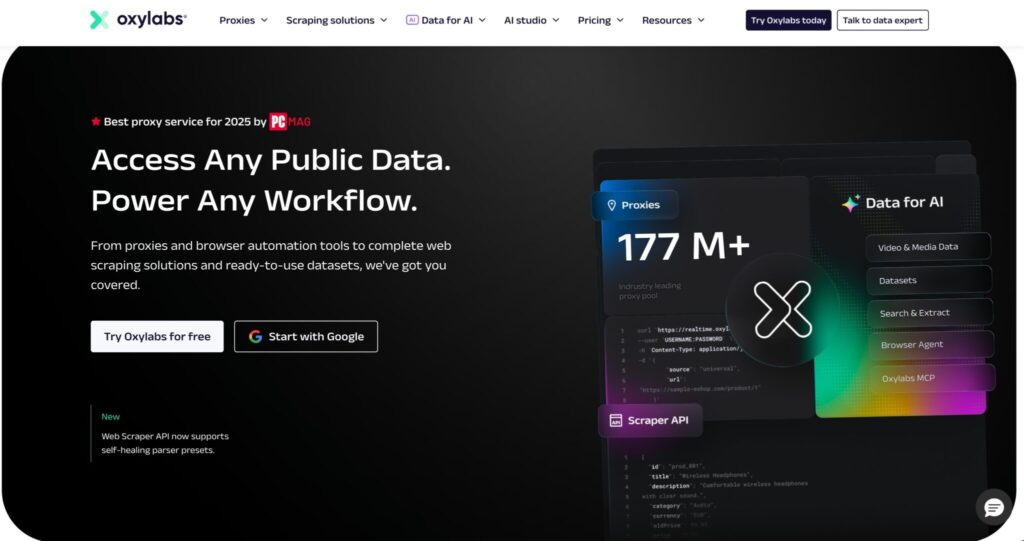
Oxylabs is the provider I would put first for companies that care about scale, reliability, and clean infrastructure. It is not the cheapest option in this list, but it is one of the most serious choices for enterprise proxy operations.
The company offers a large proxy ecosystem, including residential, mobile, datacenter, ISP-style options, scraping APIs, and unblocker products. Oxylabs lists 175M+ residential IPs and 2M datacenter IPs on its main proxy platform, which gives enterprise teams plenty of room to build complex workflows across markets, regions, and use cases.
For anonymous proxy use cases, Oxylabs is especially strong because it does not force you into one proxy type. If you need high trust, you can use residential or mobile proxies. If you need speed and predictable performance, you can use dedicated datacenter proxies. If you need sensitive scraping infrastructure, its anonymous proxy page also highlights advanced targeting and pricing starting from $8/GB for anonymous proxy products.
Where Oxylabs stands out is control. You can target by country, state, city, ZIP, and ASN on supported products. That matters because anonymity is not only about hiding your IP. It is about appearing consistent with the environment you are testing. A US ecommerce price monitoring workflow should not bounce between Brazil, Germany, and Singapore unless you specifically want that behavior.
Oxylabs also supports SOCKS5 on residential proxies, which is useful for tools that need broader protocol flexibility beyond standard HTTP or HTTPS. Its residential proxy page confirms SOCKS5 support for residential and dedicated datacenter proxies.
Best for: enterprise scraping, ad verification, cybersecurity research, brand protection, market intelligence, and teams that need strong geo-targeting.
Pro Tip: Use rotating residential proxies for large public web data jobs, but use sticky sessions when your workflow requires multi-step browsing, carts, forms, or logged-in test accounts. Rotation is powerful, but too much rotation can look unnatural.
#2 — Decodo: Best Anonymous Proxy Value with Anti-Detection Tools
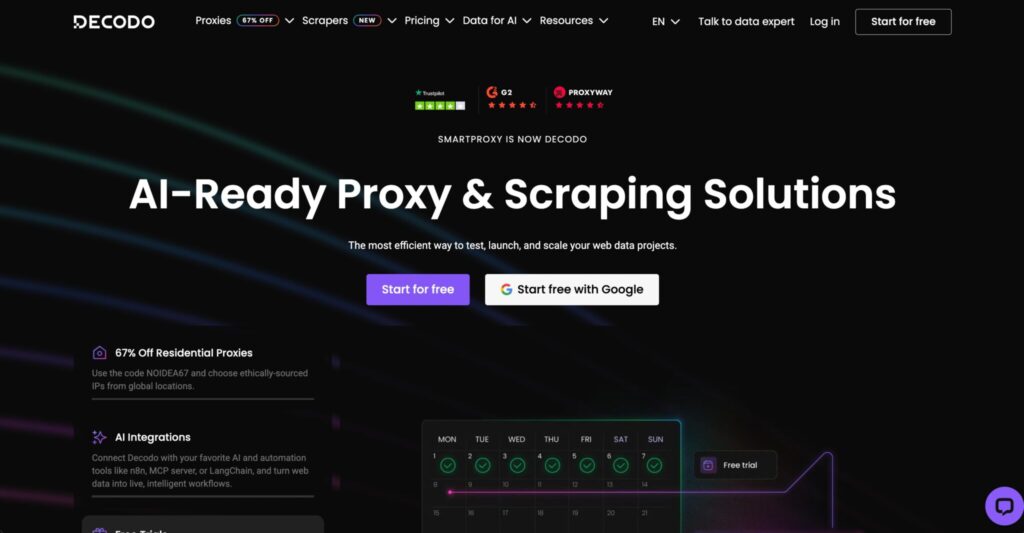
Decodo, formerly Smartproxy, has become one of the most balanced providers in the proxy market. It gives you strong IP coverage, simple onboarding, fair pricing options, and a dashboard that does not feel like it was designed by network engineers for other network engineers.
Decodo says it has 125M+ IPs, 195+ locations, 99.99% uptime, and very fast average speeds on its main site. Its residential proxy page lists 115M+ residential IPs from 195+ locations, rotating and sticky sessions, 99.86% success rate, and 24/7 support.
For anonymous proxy buyers, Decodo’s biggest advantage is usability. You get enough technical depth without drowning in configuration. You can rotate residential and mobile proxies with every request or keep the same IP for set periods such as 1, 10, 30, or 60 minutes, with custom session control up to 24 hours.
That level of session control is valuable. A product page scrape may need a new IP every request. A checkout flow test may need the same IP for 10 minutes. A localized SERP check may need the same city-level identity for a short session. Decodo makes these choices easier.
Pricing can vary by plan, but Decodo’s pricing page mentions Pay As You Go residential usage at $8.5 per GB when purchased through Wallet. Depending on your volume, prepaid plans may lower the effective rate.
Best for: SEO teams, growth teams, ad verification, localized QA, data scraping, and users who want strong performance without enterprise-level complexity.
Pro Tip: For SaaS testing, avoid rotating on every click. Use sticky sessions that match a normal user journey. A real user does not usually change IP addresses five times while opening one dashboard.
#3 — Webshare: Best Anonymous Proxy with a Free Starting Point
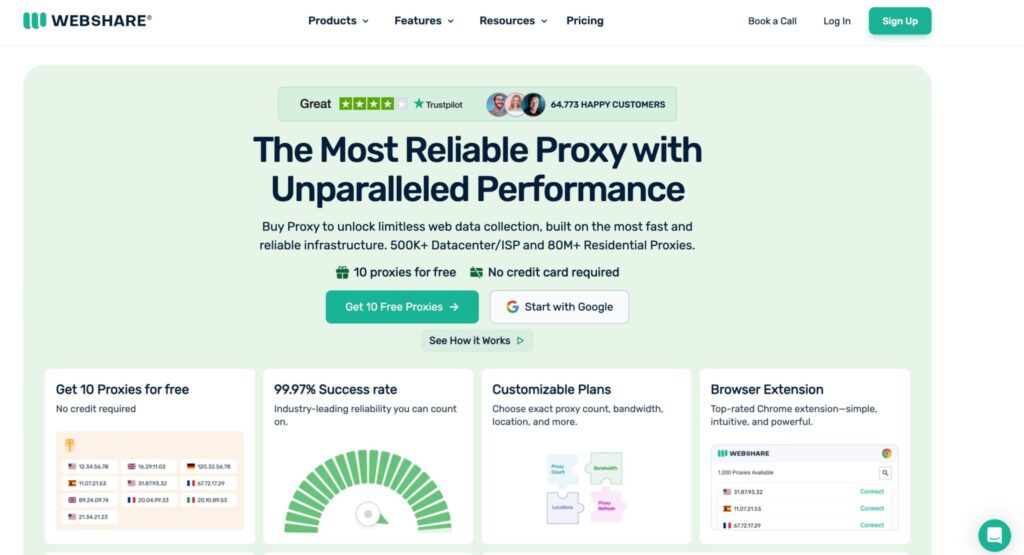
Webshare is one of the easiest proxy providers to recommend for beginners, small teams, and budget-conscious users. It is affordable, cleanly packaged, and refreshingly simple. Not every buyer needs a giant enterprise setup. Sometimes you just need reliable HTTP or SOCKS5 proxies that work without ten sales calls.
Webshare offers 10 free proxies, and its proxy server page lists HTTP/SOCKS5 support, a 100+ Gbps aggregate network, 50+ countries, and 99.97% uptime. Its free proxy page says users can get 10 premium proxies for free and notes support for SOCKS5 and HTTP-style usage.
This makes Webshare a practical first step for people testing anonymous proxy workflows. You can experiment with proxy authentication, browser setup, automation tools, and location routing before spending serious money.
That said, Webshare is not the most advanced provider on this list. It is not as feature-heavy as Oxylabs or Bright Data. It does not give you the same enterprise scraping layer or as many high-end workflow tools. But that is also part of the appeal. Webshare is lean, direct, and easy to understand.
For anonymity, Webshare is best when you need affordable private or dedicated proxies for basic browsing, testing, lightweight scraping, or simple geo-checking. For high-risk targets, large scraping jobs, or mobile-level trust, you may want residential or mobile proxies from a larger provider.
Best for: beginners, small teams, developers, testing environments, budget proxy users, and users who want a free starting point.
Pro Tip: Use Webshare’s free proxies for testing setup and tooling, not for judging final production performance. Free proxy performance rarely reflects what a properly configured paid pool can do.
#4 — Bright Data: Most Comprehensive Anonymous Proxy Infrastructure
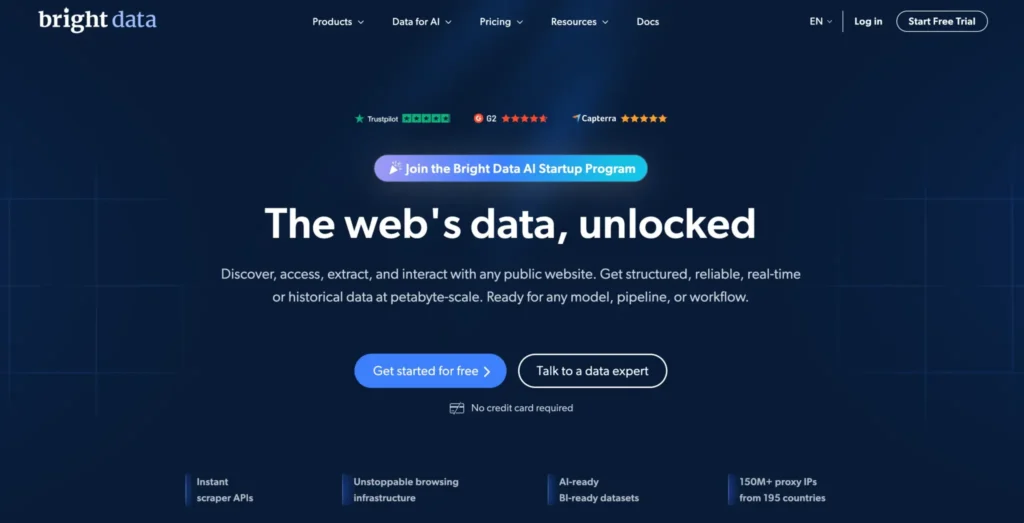
Bright Data is one of the most advanced proxy platforms available. It is not built only for people who need a few proxies. It is built for organizations that need proxy networks, scraping infrastructure, datasets, compliance controls, and serious targeting.
Bright Data’s residential proxy documentation lists access to 400M+ monthly residential IPs across 195+ countries. Its residential proxy page also highlights sticky and rotating sessions, about 0.7 second response time, 99.95% success rate, and free geo-location targeting.
For anonymous proxy use cases, Bright Data shines because of depth. You can choose residential, datacenter, ISP, and mobile networks. You can use rotation or sticky sessions. You can target countries, cities, carriers, and ASNs depending on the product. You can also layer proxy usage into scraping APIs and structured data workflows.
Bright Data’s rotation documentation explains that shared pool proxies, also called rotating proxies, are available across datacenter, ISP, residential, and mobile networks. It also notes that Bright Data assigns random proxies based on your zone configuration, such as country targeting.
That makes it suitable for advanced teams that want to build specific environments. For example, a fraud prevention team may test how a site behaves from different carriers. A pricing team may compare results by city. A brand team may verify localized ads across multiple countries.
The downside is complexity and cost. Bright Data is powerful, but smaller teams may find it more than they need.
Best for: enterprise data teams, market intelligence, ad verification, AI data collection, SERP monitoring, compliance-heavy proxy workflows, and teams needing granular targeting.
Pro Tip: Bright Data is best when you use its controls properly. Build separate zones for separate use cases instead of pushing every workflow through one generic rotating pool.
#5 — SOAX: Best Anonymous Proxy for Security-First Operations
SOAX has grown into a strong choice for teams that want ethically sourced proxies, good location coverage, and clean operational controls. It has a more security-conscious feel than many low-cost providers, and that matters when you are building long-term proxy workflows.
SOAX says its platform gives access to over 191M clean, whitelisted IPs, with success rates above 99.5% and geotargeting in 195+ countries. Its residential proxy page lists 155M+ residential IPs across 195+ locations, HTTP(S), SOCKS5, UDP/QUIC availability, unlimited concurrent sessions, ethical sourcing, and 99.9% uptime.
The biggest reason to choose SOAX for anonymous proxy work is precision. It works well when you need city-level or carrier-level logic, session consistency, and a cleaner source of IPs. Its documentation on geo-targeting says users can control proxy IP location by country, region, city, or ISP/carrier.
That targeting depth is useful for ad verification, localized testing, travel fare checks, ecommerce research, and app QA. If you only need random global IPs, SOAX may feel like overkill. But if you need a specific kind of identity, it becomes much more attractive.
SOAX also supports several proxy types, including residential, mobile, ISP, and datacenter options. That gives you flexibility when balancing cost, speed, and anonymity.
Best for: security-conscious teams, ad verification, app testing, regional data checks, ecommerce monitoring, and location-sensitive automation.
Pro Tip: Use ISP or sticky residential sessions for workflows that need identity stability. Use rotating residential or mobile proxies when the target is sensitive to repeated requests from the same IP.
#6 — IPRoyal: Best Anonymous Proxy with Static Identity Options
IPRoyal is a strong pick for buyers who want affordability, simplicity, and flexible proxy options without stepping into enterprise-level pricing. It offers residential, datacenter, ISP, and mobile proxies, which makes it useful across several anonymity levels.
IPRoyal’s residential proxy page lists 32M+ residential proxies in 195+ countries, rotating and sticky sessions, 99.4% success rate, about 0.5 second response time, HTTP(S) and SOCKS5 support, and country, state, and city-level targeting. Its documentation also confirms that IPRoyal offers over 32M residential proxies in more than 195 countries.
Where IPRoyal stands out is static identity. Many anonymous proxy use cases do not need constant rotation. In fact, rotation can be a problem when you need trust over time. ISP proxies or static residential-style options can help when you need a more stable identity for account testing, research, or long browsing sessions.
For example, if you are testing SaaS signup flows across regions, you may want a consistent IP for the entire journey. If you are monitoring localized SERPs, rotating every request may distort the results. IPRoyal’s mix of rotating and sticky controls gives smaller teams a practical way to manage that.
It is not as large as Bright Data or Oxylabs, but it offers a strong balance of cost and functionality. For many independent marketers, SEO teams, and smaller SaaS companies, that balance is exactly what they need.
Best for: small businesses, SEO teams, privacy-conscious browsing, account QA, SERP monitoring, and buyers who need stable proxy identities.
Pro Tip: If your target workflow involves logins, forms, carts, dashboards, or session-based testing, start with sticky or static proxies before trying high-frequency rotation.
#7 — Proxy-Cheap: Best Affordable Anonymous Proxy for Everyday Use

Proxy-Cheap is built around one clear promise: affordable proxy access without making the setup feel painful. It is not the most premium provider in the market, but it is useful for buyers who care about cost and basic anonymity more than enterprise data operations.
Proxy-Cheap offers static residential, rotating residential, datacenter IPv4, datacenter IPv6, static mobile, and other proxy products. Its pricing page shows examples such as static residential proxies starting around a few dollars per month, rotating residential pricing from $4.99/GB, datacenter IPv4 pricing per proxy, and static mobile options from 47+ locations.
The platform also highlights usage analytics, which is helpful for controlling spend. That may sound minor, but proxy costs can spiral quickly when scripts run badly. A simple dashboard that shows consumption helps teams catch waste before the invoice becomes ugly.
Proxy-Cheap is best for everyday anonymous browsing, light automation, basic research, testing, and smaller scraping workloads. It is less ideal for complex enterprise workflows where you need large-scale compliance documentation, advanced scraping tools, or deep API-based control.
Its wider proxy type mix makes it flexible. You can use datacenter proxies for speed, residential proxies for trust, or mobile proxies for higher anonymity use cases.
Best for: budget users, everyday anonymous browsing, light scraping, testing, social QA, and small automation workflows.
Pro Tip: Cheap proxies are useful, but do not choose purely by price. A low-cost proxy with a burned reputation can cost more in failed requests than a better proxy costs in bandwidth.
#8 — ProxyEmpire: Best Anonymous Proxy for Mobile-Level Anonymity
ProxyEmpire is a good fit when mobile anonymity and global targeting matter. It offers residential, mobile, and datacenter proxies, but its mobile and rotating products are the real attraction.
ProxyEmpire’s main site lists 30M+ clean IPs, 170+ countries, 99.9% uptime, 24/7 support, and residential, mobile, and datacenter proxy options. Its rotating mobile proxy page mentions 4G/5G proxies in over 170 countries, HTTP/HTTPS/SOCKS5 support, and mobile IPs suitable for carrier-grade workflows.
Mobile proxies can be powerful because mobile carrier IPs often carry higher trust than datacenter IPs. Many users share mobile carrier NAT ranges, so one mobile IP may represent normal mobile traffic patterns. That does not make mobile proxies magic, but it does make them useful for app testing, ad verification, mobile SERP checks, localized content testing, and mobile-first QA workflows.
ProxyEmpire also offers country, regional, and city targeting across residential and mobile locations. That makes it useful for campaigns that need market-level checks rather than generic country-level routing.
The main tradeoff is cost. Mobile proxies usually cost more than datacenter proxies and sometimes more than standard residential proxies. Use them where mobile identity actually matters.
Best for: mobile app testing, mobile ad verification, mobile SERP tracking, social media QA, localized mobile content checks, and high-trust browsing workflows.
Pro Tip: Do not waste mobile proxies on simple page fetches. Use cheaper residential or datacenter proxies for basic collection, then reserve mobile IPs for sensitive flows where device and carrier trust matter.
#9 — DataImpulse: Best Budget Anonymous Proxy
DataImpulse is one of the most interesting budget proxy providers in this list because it focuses heavily on low-cost bandwidth. If you need affordable residential proxies for scraping, testing, SERP checks, or market research, it deserves a look.
DataImpulse’s homepage advertises proxies from $1 per GB, 90M+ IPs, easy setup, pay-per-GB pricing, and 24/7 support. Its residential proxy page lists 90M+ ethical residential IPs, 195-country coverage, and typical pricing starting from $1 per GB. Another DataImpulse page notes that residential traffic starts at $1/GB, does not require a subscription, and traffic does not expire.
That pricing model is attractive for users who dislike monthly commitments. You can top up, test, and scale based on usage. For smaller SEO teams or affiliate marketers running periodic checks, that can be more practical than paying for a large monthly plan.
DataImpulse is not as polished as Bright Data or Oxylabs, and it does not have the same enterprise reputation. But for budget-friendly anonymous proxy use, it gives you a lot of reach for the money.
It is best suited for users who already understand proxy basics and want affordable bandwidth. If you need white-glove onboarding, enterprise SLAs, or advanced scraping APIs, look elsewhere. If you want low-cost residential traffic for routine work, DataImpulse is hard to ignore.
Best for: budget scraping, SERP checks, price comparison, ad checks, lightweight research, and pay-as-you-go proxy buyers.
Pro Tip: Start with smaller top-ups and test success rates against your real targets. Cheap residential bandwidth is useful only if it performs well on the sites you actually need.
Massive Comparison Table: Best Anonymous Proxy Providers in 2026
| Provider | Best For | Proxy Types | IP Pool / Coverage | Rotation & Sessions | Starting Price Signal | Main Strength | Main Limitation |
|---|---|---|---|---|---|---|---|
| Oxylabs | Enterprise privacy and public data collection | Residential, mobile, datacenter, dedicated, scraping tools | 175M+ residential IPs, 2M datacenter IPs | Rotating and sticky options depending on product | Anonymous proxies from $8/GB | Enterprise-grade quality and targeting | Higher cost for small users |
| Decodo | Best value with strong controls | Residential, mobile, ISP, datacenter | 115M+ residential IPs, 195+ locations | Per-request rotation, sticky sessions, custom durations | PAYG residential listed at $8.5/GB | Easy dashboard and great session control | PAYG can be costly for casual users |
| Webshare | Free starting point and simple setup | Datacenter, private, dedicated, static residential, rotating options | 50+ countries on proxy server plans | Simple proxy list and dashboard controls | 10 free proxies available | Affordable and beginner-friendly | Less advanced than enterprise platforms |
| Bright Data | Most complete proxy infrastructure | Residential, ISP, mobile, datacenter, scraping APIs | 400M+ monthly residential IPs, 195 countries | Rotating, sticky sessions, zones | Residential pricing from $5.88/GB | Deep targeting and enterprise tooling | Complex for beginners |
| SOAX | Security-first operations | Residential, mobile, ISP, datacenter | 191M+ total IPs, 155M+ residential, 195+ countries | Sticky and rotating options | Plan-based pricing | Clean sourcing and precise targeting | Can feel advanced for casual users |
| IPRoyal | Static identity and affordability | Residential, ISP, mobile, datacenter | 32M+ residential IPs, 195+ countries | Rotating and sticky sessions | Flexible PAYG and plans | Good price-to-control ratio | Smaller pool than top enterprise providers |
| Proxy-Cheap | Everyday affordable proxy use | Static residential, rotating residential, mobile, datacenter IPv4/IPv6 | Multiple proxy categories and 47+ static mobile locations | Product-dependent | Rotating residential from $4.99/GB | Low-cost access and simple plans | Not ideal for enterprise workflows |
| ProxyEmpire | Mobile-level anonymity | Residential, mobile, datacenter | 30M+ clean IPs, 170+ countries | Rotating and targeting controls | Trial and plan-based pricing | Strong mobile proxy angle | Mobile proxies can be expensive |
| DataImpulse | Budget residential bandwidth | Residential, mobile, datacenter, premium residential | 90M+ residential IPs, 195 countries | Rotating residential model | Residential from $1/GB | Very low entry cost | Less polished than premium providers |
How to Choose the Best Anonymous Proxy Provider
Choosing the right anonymous proxy is not about picking the biggest brand and hoping for the best. You need to match the provider to the job.
1. Start with the proxy type
For most anonymity-sensitive work, residential and mobile proxies are stronger than shared datacenter proxies. Residential IPs come from real ISP networks, while mobile proxies use carrier networks. Datacenter proxies are faster and cheaper, but they are often easier to detect.
Use this simple rule:
| Use Case | Best Proxy Type |
|---|---|
| Large-scale web scraping | Rotating residential |
| Mobile app testing | Mobile proxies |
| SERP tracking | Residential or ISP proxies |
| Login/session testing | Static residential or ISP |
| Fast bulk requests | Dedicated datacenter |
| Ad verification | Residential or mobile |
| Budget testing | Webshare, Proxy-Cheap, or DataImpulse |
2. Look beyond IP pool size
A huge IP pool sounds impressive, but quality matters more. Ask yourself:
- Does the provider refresh its pool often?
- Can you target by country, state, city, carrier, or ASN?
- Are the IPs ethically sourced?
- Can you control rotation timing?
- Does the provider support sticky sessions?
- Can you monitor bandwidth and failures?
A smaller clean pool can outperform a massive abused pool.
3. Match rotation to the workflow
Rotation is not always better. It is just different.
Use per-request rotation when you are collecting many public pages and do not need session continuity.
Use sticky sessions when you need to behave like one user for several minutes.
Use static proxies when you need a stable identity for a longer period.
Bad rotation logic is one of the biggest reasons proxy campaigns fail. If your IP changes every request during a multi-step form, you may look less like a human, not more.
4. Check protocol support
Most users need HTTP and HTTPS. Developers, automation tools, and certain apps may need SOCKS5. Some advanced systems may care about UDP/QUIC support, which providers like SOAX mention on residential proxy products.
Before buying, check whether your tools support the provider’s authentication method, IP allowlisting, browser profile setup, and endpoint format.
5. Test real targets before scaling
Never judge a proxy provider only by its homepage. Test it against your real websites, regions, and workflows. Measure:
- Success rate
- Average response time
- Block rate
- CAPTCHA frequency
- Session stability
- Bandwidth usage
- Cost per successful request
The cheapest provider is not always cheaper after failed requests. The most expensive provider is not always necessary either.
FAQs: Best Anonymous Proxy Providers 2026
What is the difference between anonymous and elite high-anonymity proxies?
Anonymous proxies hide your real IP address, but the target website may still detect that you are using a proxy. Elite or high-anonymity proxies hide both your real IP and the signs of proxy usage. For business workflows like scraping, ad verification, and localized testing, elite-style behavior is usually better.
Can anonymous proxies be traced?
Anonymous proxies can reduce exposure of your original IP, but they are not invisibility tools. Websites may still detect proxy patterns, browser fingerprints, request behavior, DNS leaks, cookies, account history, or device signals. Your provider may also keep logs depending on its policy and legal obligations.
Are anonymous proxies legal?
Anonymous proxies are legal in many countries when used for legitimate purposes such as privacy, testing, research, ad verification, security work, and public data collection. They become risky when used for fraud, spam, credential abuse, unauthorized access, or violation of laws. Always follow local laws and platform rules.
What is a high-anonymity proxy used for in SaaS?
SaaS teams use high-anonymity proxies for geo-testing, QA, pricing checks, competitor monitoring, uptime checks, ad verification, app testing, and security research. A SaaS company may need to see how its product behaves from different regions, networks, or mobile carriers without relying on internal office IPs.
Do anonymous proxies hide my location?
Yes, they can mask your visible IP location by routing traffic through another IP. However, location can still leak through browser settings, GPS permissions, cookies, account data, WebRTC, language settings, and payment profiles. For accurate geo-testing, combine proxies with clean browser profiles and proper environment settings.
Are residential proxies more anonymous than datacenter proxies?
Usually, yes. Residential proxies use IPs associated with real internet service providers, so they often look more natural than datacenter IPs. Datacenter proxies are faster and cheaper, but many websites can identify datacenter ranges more easily. For sensitive workflows, residential or mobile proxies are usually safer.
Should I use rotating or sticky anonymous proxies?
Use rotating proxies when you need to send many independent requests. Use sticky proxies when your task needs continuity, such as login testing, form flows, checkout testing, or multi-page browsing. For most professional workflows, the best setup uses both depending on the task.
Are free anonymous proxies safe?
Free proxies are risky unless they come from a reputable provider. Random free proxy lists may log traffic, inject ads, expose credentials, or disappear without warning. Webshare is safer than random public lists because it offers a controlled free tier, but free proxies should still be used mainly for testing, not sensitive production work.
Which anonymous proxy provider is best overall?
For enterprise use, Oxylabs and Bright Data are the strongest choices. For value and usability, Decodo is excellent. For budget users, DataImpulse and Webshare are attractive. For mobile-level anonymity, ProxyEmpire is a strong option. The best provider depends on your target websites, volume, proxy type, and session needs.
Conclusion: Best Anonymous Proxy Providers in 2026
The best anonymous proxy provider is the one that matches your actual workflow, not the one with the loudest homepage claim.
If you want enterprise-grade reliability and deep targeting, Oxylabs is the strongest overall pick. If you want a polished balance of price, performance, and usability, Decodo is one of the easiest recommendations. If you need a free or low-cost starting point, Webshare is hard to beat. For large-scale infrastructure and advanced controls, Bright Data is the most complete platform. For clean sourcing and security-minded operations, SOAX is a strong contender. For affordable static and rotating options, IPRoyal deserves serious attention. For low-cost everyday use, Proxy-Cheap works well. For mobile anonymity, ProxyEmpire stands out. For budget residential bandwidth, DataImpulse gives you a lot of room to test without heavy commitments.
My practical advice: do not buy proxies based on pool size alone. Test the provider against your actual targets. Check rotation behavior. Watch success rates. Compare cost per successful request, not just cost per GB. That is where the real winner becomes obvious.