
Web scraping looks simple from the outside. Send a request, collect the HTML, parse the data, repeat.
Then reality hits.
Your scraper works for 300 pages and suddenly every request gets blocked. Your IP gets rate-limited. Product pages start returning fake prices. SERP results change by location. JavaScript-heavy pages refuse to load. The website knows you are not a normal visitor.
That is where proxies become a serious part of the stack.
A good proxy setup does not magically make bad scraping ethical, legal, or reliable. What it does is help legitimate data teams collect public web data at scale without hammering one IP address, ruining accuracy, or triggering avoidable rate limits. The right proxy provider can mean the difference between a clean, repeatable data pipeline and a messy script that breaks every Monday morning.
For web scraping in 2026, the best proxy provider is not always the one with the biggest IP pool. You need clean IP reputation, strong rotation controls, geo-targeting, session management, fast response times, reliable uptime, transparent pricing, and support that understands scraping workloads.
Let’s break down the best proxies for web scraping in 2026, starting with what actually matters before you spend money.
What Makes a Proxy Great for Web Scraping?
The best proxy for web scraping depends on the target website, request volume, location needs, and how much anti-bot friction you are facing. A small price-monitoring script does not need the same infrastructure as a company scraping millions of pages daily.
The first factor is IP quality. Residential IPs usually work better for tougher targets because they come from real consumer networks. Datacenter proxies are faster and cheaper, but they are easier to detect when used aggressively. ISP proxies sit between the two: they are hosted like datacenter proxies but registered with internet service providers, which often gives them better trust signals.
The second factor is rotation control. Web scraping rarely works well with random rotation alone. You need to choose between rotating every request, holding sticky sessions for a few minutes, or keeping one IP attached to a workflow long enough to preserve session consistency. For example, scraping public product listings may work with per-request rotation, while account-based dashboards or localized pages often need sticky sessions.
The third factor is geo-targeting. If your scraper collects search results, travel prices, ecommerce prices, marketplace listings, or ad placements, location accuracy matters. Country targeting is useful. City, ZIP, ASN, and carrier targeting are better when your use case demands precision.
The fourth factor is cost predictability. Some providers charge by bandwidth, some by proxy count, and some by requests. Bandwidth pricing can get expensive when scraping heavy pages with images, scripts, and bloated HTML. Request-based scraping APIs may look costly at first, but they can save money when they handle retries, browser rendering, and blocks for you.
The fifth factor is compliance. Web scraping public data is not automatically illegal, but it is not automatically risk-free either. U.S. case law around public data scraping has supported the idea that scraping publicly accessible data may not violate the CFAA, but contract terms, privacy laws, login walls, copyright, and personal data rules still matter. The safer path is to collect public, non-sensitive data, respect robots.txt where appropriate, avoid logged-in scraping unless you have permission, and never overload a target site.
9 Best Proxies For Web Scraping in 2026
#1 — Oxylabs: Best Overall Proxy for Web Scraping
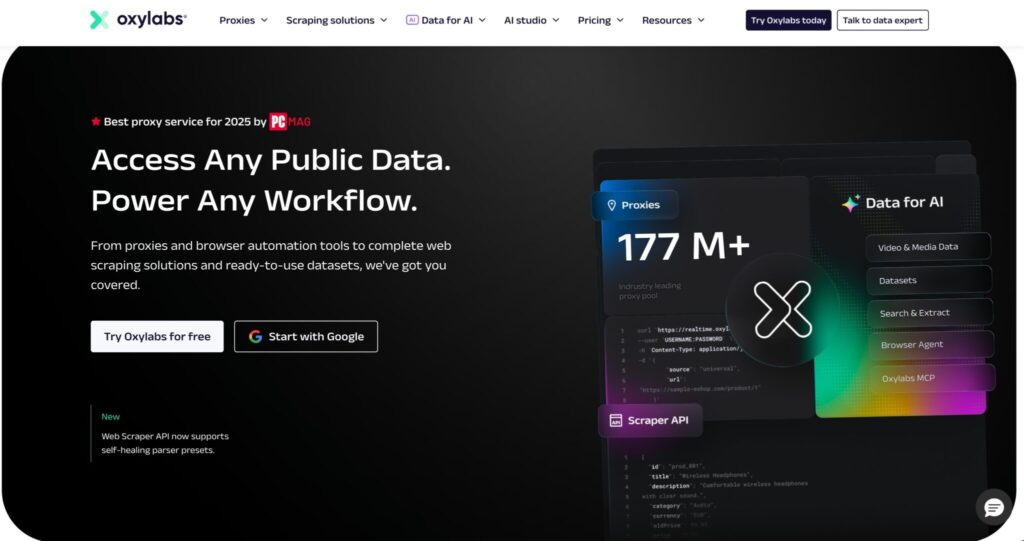
Oxylabs is the provider I would put at the top for serious web scraping teams that care about reliability more than getting the lowest possible per-GB rate. It offers a large proxy network, scraping APIs, and enterprise-grade infrastructure built for public web data collection.
Oxylabs states that its platform includes 175M+ residential IPs and 2M datacenter IPs, which makes it one of the biggest proxy networks in the market. It also offers Web Unblocker, Web Scraper API, datasets, and AI-focused data tools for teams that want more than raw proxies.
For scraping, Oxylabs works best when you are dealing with tougher targets: ecommerce sites, search engines, travel aggregators, public marketplaces, and competitive intelligence workflows. The biggest advantage is not just the proxy pool. It is the surrounding infrastructure. If your team does not want to build every retry, header, session, and blocking workaround manually, Oxylabs gives you managed options.
The downside is price. Oxylabs is not the cheapest provider here, and smaller teams may find it overbuilt for basic scraping. If you only need 5GB of residential proxy traffic per month, you can find cheaper options. But if scraping failure costs you money, the higher price can make sense.
Best for: Enterprise scraping, ecommerce intelligence, SERP data, travel pricing, large-scale public data collection.
Pro Tip: Use Oxylabs raw residential proxies when you already have a mature scraper. Use Web Unblocker or Scraper API when anti-bot handling is eating too much engineering time.
#2 — Decodo: Best Value Web Scraping Proxy
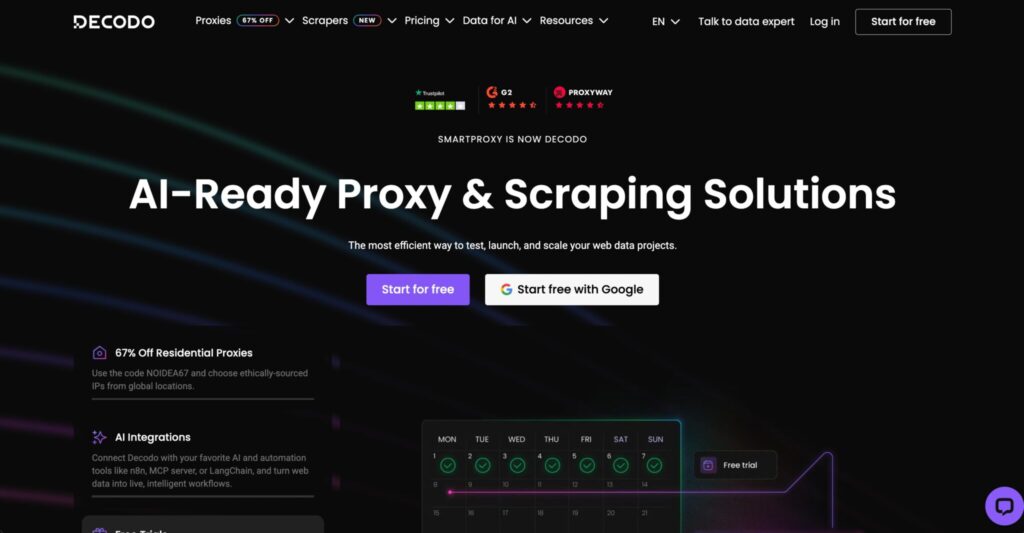
Decodo, formerly Smartproxy, is one of the strongest choices for buyers who want a balance between price, ease of use, and proxy pool size. It is not as enterprise-heavy as Oxylabs or Bright Data, but that is part of its appeal.
Decodo says its residential plans include access to a 115M+ IP pool, advanced geo-targeting at country, continent, state, city, and ZIP level, plus unlimited concurrent sessions. Its residential proxy pricing page currently lists plans starting from around $2/GB, with smaller self-serve plans priced higher per GB.
For web scraping, Decodo is especially useful for developers, SEO teams, affiliate marketers, ecommerce researchers, and mid-size data teams. The dashboard is easier to work with than many enterprise-first platforms. You can launch quickly without talking to sales, which matters when you are testing a new scraping workflow.
The provider also offers different proxy types, including residential, static residential, mobile, and scraping tools. That gives you room to start simple and upgrade later.
The main limitation is that Decodo may not offer the same level of custom enterprise support or deep data-product ecosystem as Bright Data or Oxylabs. Still, for most teams, it hits a very practical sweet spot.
Best for: Mid-size scraping projects, SEO scraping, ecommerce monitoring, agencies, developers who want strong value.
Pro Tip: Start with residential proxies for tougher targets, but test datacenter or ISP proxies first for low-protection websites. You may cut costs without hurting success rates.
#3 — Webshare: Best Free Web Scraping Proxy Tier
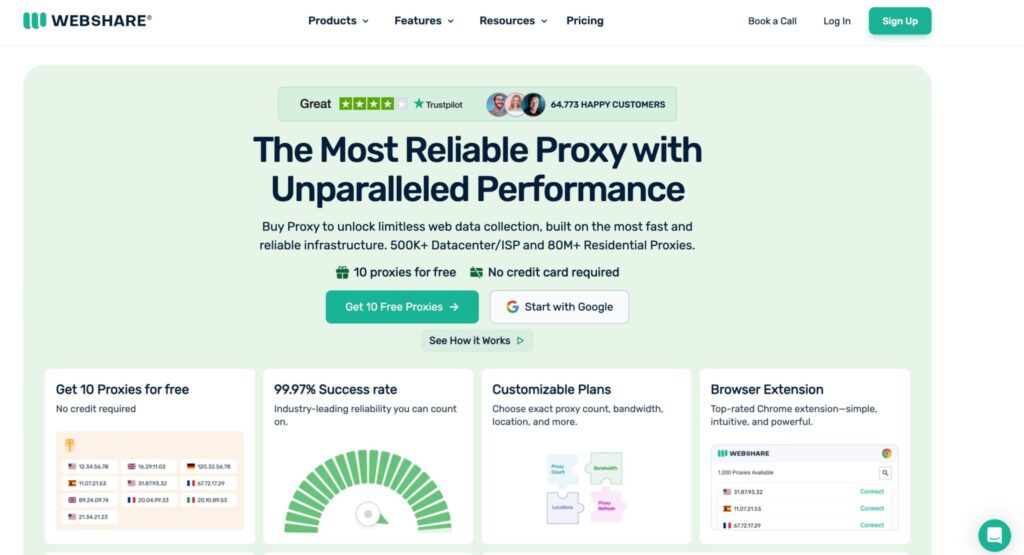
Webshare is a smart pick for beginners, small scrapers, QA testing, and teams that want affordable proxies without a big upfront commitment.
Its biggest hook is the free tier. Webshare says it offers 10 proxies with up to 1GB/month free, with no credit card and no trial period. That makes it useful for testing scripts, building proof-of-concept scrapers, or learning how proxy authentication works before paying for traffic.
Webshare offers proxy servers, static residential proxies, and rotating residential proxies. It is not as feature-rich as Bright Data, Oxylabs, or Decodo when it comes to managed scraping tools, but its dashboard is simple and its pricing is approachable.
For scraping, Webshare works best when your targets are not extremely hostile. Public directories, simple ecommerce pages, lightweight sites, and QA tasks are good fits. If you are scraping sites with heavy anti-bot protection, you may need a more advanced provider or a scraping API.
The free tier is useful, but do not treat it as production infrastructure. Free proxies are best for testing, not serious scraping operations. For business workflows, use paid private, residential, or ISP proxies depending on the target.
Best for: Beginners, small teams, testing, low-cost scraping, lightweight data collection.
Pro Tip: Use Webshare’s free tier to test your scraper logic, then move to paid private or residential proxies before scaling.
#4 — Bright Data: Best Web Scraping Proxy for AI and Data Pipelines
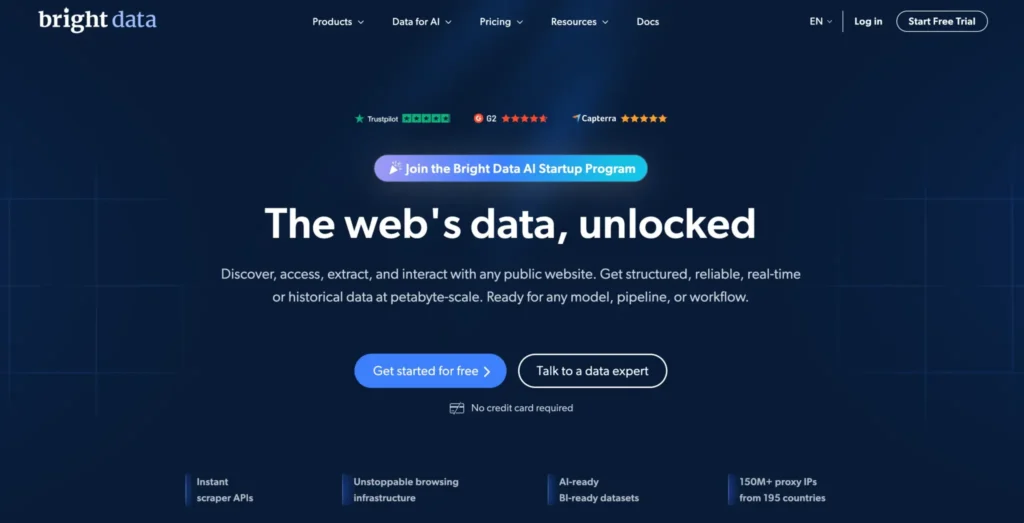
Bright Data is one of the most advanced names in the proxy and web data market. It is not only a proxy seller. It is a full data collection platform with proxies, scraping APIs, datasets, SERP tools, browser infrastructure, and compliance systems.
Bright Data says its residential proxy network includes 400M+ monthly residential IPs across 195 countries, with sticky and rotating sessions, free geo-location targeting, and a stated 99.95% success rate on its residential proxy page.
For AI and data pipeline teams, Bright Data is especially strong. If you are building training datasets, market intelligence systems, competitive pricing databases, product catalogs, or search monitoring tools, Bright Data gives you several ways to collect public web data. You can use raw proxies, Web Unlocker, SERP API, Scraping Browser, or ready-made datasets.
The trade-off is complexity and cost. Bright Data can feel heavy for small users. Its platform is powerful, but newer users may need time to understand zones, pricing models, compliance requirements, and product options.
Bright Data is best when data is core to your business, not just a side task. If your company depends on consistent public data feeds, the tooling can justify the premium.
Best for: AI data pipelines, enterprise scraping, SERP APIs, public datasets, large-scale data operations.
Pro Tip: If you are scraping for AI workflows, compare the cost of raw proxies versus ready-made datasets. Buying cleaned data can be cheaper than building and maintaining the entire pipeline yourself.
#5 — SOAX: Best Web Scraping Proxy for Clean IP Quality
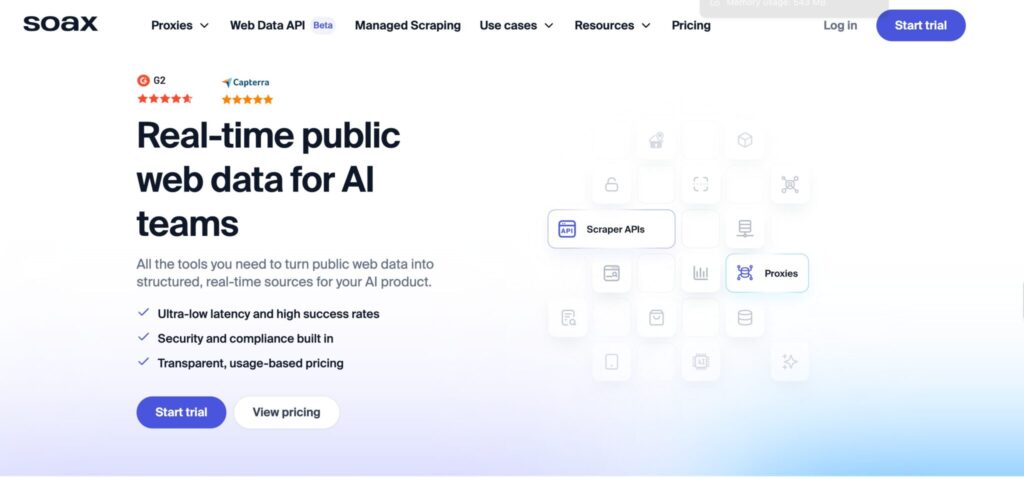
SOAX has become a strong mid-to-premium option for teams that care about clean IPs, flexible targeting, and a simpler buying experience than some enterprise-heavy providers.
SOAX lists bundled plans that include access to proxies and its Web Data API, with residential proxy plans starting around $3.60/GB on a 25GB Starter plan. Its residential proxy page also mentions 155M+ IPs in 195+ locations.
The provider is particularly appealing for users who need precise targeting and a clean interface. For web scraping, SOAX is a good fit for ecommerce tracking, market research, SEO monitoring, ad verification, and localized data collection.
SOAX also tends to position itself around ethically sourced proxies and controlled access, which matters more in 2026 than it did a few years ago. Proxy quality is no longer just about “how many IPs do you have?” Buyers now care about consent, abuse prevention, and long-term sustainability.
The pricing is not the cheapest on this list, but it is reasonable for the quality tier. If you want a more premium feel without jumping straight into Bright Data or Oxylabs-level complexity, SOAX deserves a look.
Best for: Clean residential IPs, location-sensitive scraping, ecommerce research, SEO monitoring, mid-market teams.
Pro Tip: Use SOAX when location precision matters. For broad, non-localized scraping, cheaper providers may be enough.
#6 — IPRoyal: Best Web Scraping Proxy for Non-Expiring Bandwidth
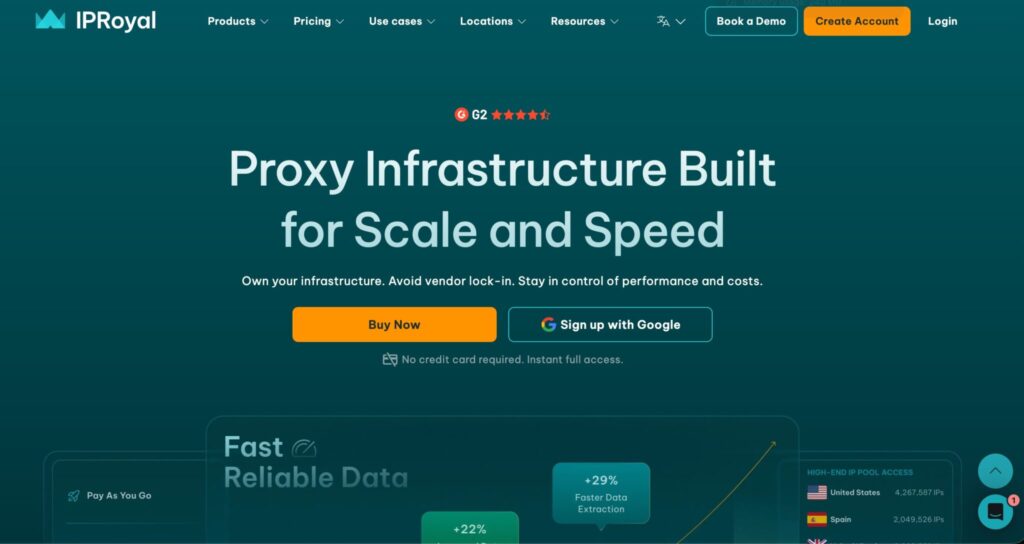
IPRoyal is attractive for one reason many scraping teams care about: residential traffic that does not expire.
IPRoyal says its residential proxy traffic is available until you use it, with pricing starting at $7/GB and dropping as low as $1.75/GB when bought in bulk. That non-expiring bandwidth model is useful if your scraping volume changes month to month.
For example, maybe you scrape heavily during product launches, seasonal pricing changes, SEO audits, or competitor research sprints. With monthly bandwidth plans, unused traffic can feel wasted. IPRoyal’s rollover-style approach gives occasional scrapers more breathing room.
IPRoyal is not always the first pick for huge enterprise scraping operations, but it is practical for SMBs, freelancers, affiliate teams, SEO tools, and developers who want cost control. It also offers datacenter, ISP, mobile, and sneaker proxies, giving users flexibility beyond residential IPs.
The main thing to test is consistency against your target websites. IPRoyal can be very cost-effective, but as with any budget-friendly provider, success rates depend heavily on the target, rotation settings, and request behavior.
Best for: Irregular scraping workloads, SEO projects, budget-conscious teams, users who hate expiring bandwidth.
Pro Tip: Buy a small amount first and benchmark success rate, response time, and block rate on your actual targets before purchasing bulk traffic.
#7 — Proxy-Cheap: Best Budget Web Scraping Proxy
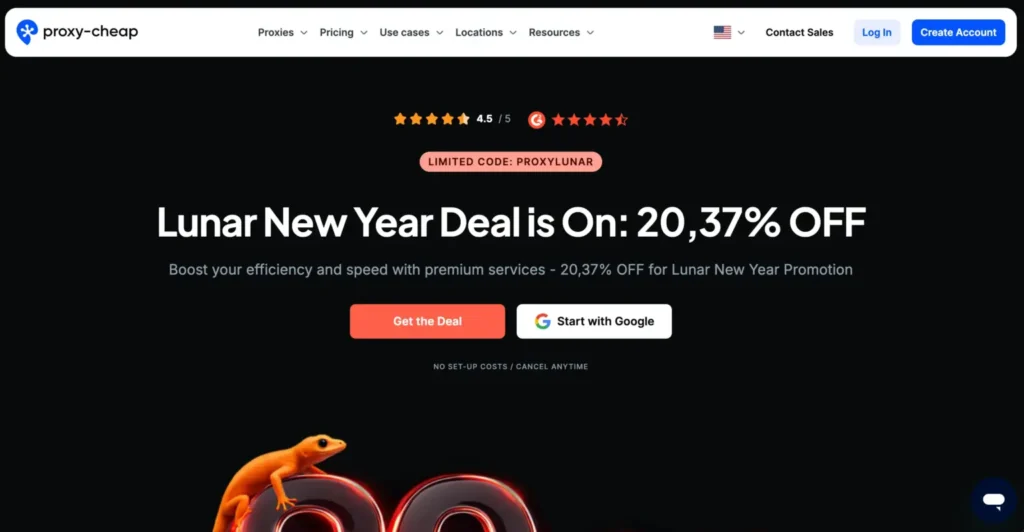
Proxy-Cheap is exactly what the name suggests: a budget-friendly proxy provider built for users who want lower pricing across different proxy types.
Its homepage lists multiple proxy categories, including static residential, rotating residential, datacenter IPv4, datacenter IPv6, and static mobile proxies. It currently advertises rotating residential proxies starting around $4.99/GB, datacenter IPv4 from around $1.49/month, and datacenter IPv6 from around $0.15/month, depending on plan and promotion.
For web scraping, Proxy-Cheap is best suited for cost-sensitive projects where you can tolerate some testing and tuning. It may not be the first provider I would choose for mission-critical enterprise pipelines, but it can work well for lightweight scraping, SEO checks, basic market research, and low-cost experiments.
The key advantage is flexibility. You can test datacenter proxies for simple targets, rotating residential for higher-trust scraping, or static residential for session-based workflows.
The main caution is that cheaper proxies often require more hands-on optimization. You may need to adjust concurrency, timeout settings, session lengths, and retry logic to get stable results.
Best for: Budget scraping, experiments, simple targets, users who want low-cost datacenter and residential options.
Pro Tip: Do not judge Proxy-Cheap on raw price alone. Track cost per successful page, not cost per GB or proxy.
#8 — ProxyEmpire: Best Web Scraping Proxy for Variable-Volume Operations
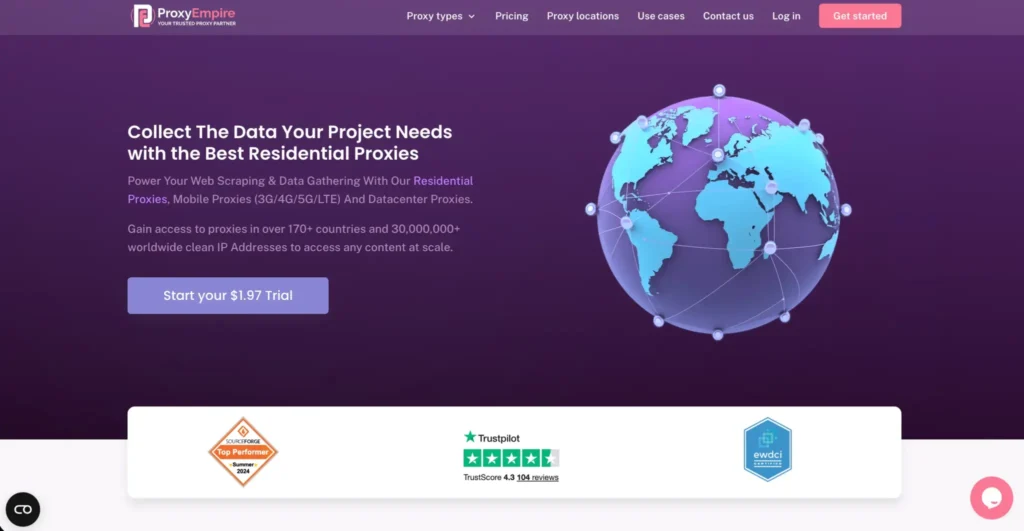
ProxyEmpire is a good fit for users who want flexible proxy access, rollover-style usage, and multiple proxy types under one provider.
ProxyEmpire says it offers 30M+ clean IPs, 99.9% uptime, 24/7 support, datacenter proxies from around $0.35, and unlimited residential proxy plans starting from around $200.
For web scraping, ProxyEmpire is useful when your volume is uneven. Some businesses scrape lightly most of the month, then collect large datasets during campaigns, audits, or price changes. Flexible plans can be helpful in that situation.
It supports residential, static residential, mobile, and datacenter proxy use cases. That makes it suitable for ecommerce intelligence, SEO tracking, ad verification, travel pricing, and localized public data collection.
ProxyEmpire may not have the same developer ecosystem as Bright Data or Oxylabs, but it is strong for buyers who care about flexible usage and practical proxy access without a giant enterprise contract.
Best for: Variable scraping volume, rollover-style usage, multi-country scraping, ecommerce and SEO teams.
Pro Tip: For variable workloads, compare monthly plans against pay-as-you-go pricing over a 90-day period. A plan that looks cheap monthly may cost more if your usage spikes.
#9 — DataImpulse: Best Budget Web Scraping Proxy
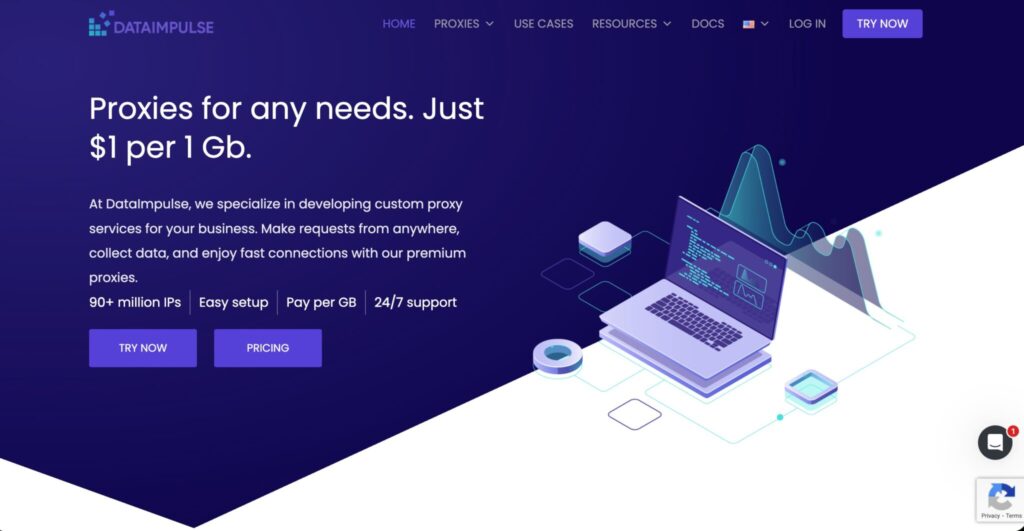
DataImpulse is one of the most interesting budget proxy providers in 2026 because it combines low pricing with a simple pay-per-GB model.
DataImpulse advertises residential proxies at $1 per GB, 90M+ IPs, easy setup, pay-per-GB pricing, and 24/7 support. Its use-case pages also mention that residential proxy traffic starts at $1/GB, requires no subscription, and does not expire.
That makes DataImpulse appealing for scrapers who want a low-cost residential option without committing to larger monthly contracts. If you are scraping public listings, price data, search pages, or regional content at moderate scale, it can be a strong value pick.
The main question is performance consistency. Budget residential networks can be excellent for some targets and less reliable for others. That is not unique to DataImpulse. It is true across the category. The right move is to benchmark before scaling.
DataImpulse is especially useful for buyers who care about cost per successful request and do not need a heavy enterprise dashboard.
Best for: Budget residential scraping, price comparison, testing, moderate-volume public data collection.
Pro Tip: DataImpulse is a strong test candidate when residential proxy costs are eating your margins. Run it side-by-side with a premium provider and compare success rate, not just price.
Best Proxies for Web Scraping in 2026: Quick Comparison
| Provider | Best For | Proxy Types | Notable Strength | Starting/Advertised Pricing Snapshot | Best Fit |
|---|---|---|---|---|---|
| Oxylabs | Best overall | Residential, datacenter, mobile, ISP, scraping APIs | Large network and enterprise scraping tools | Residential and scraping plans vary by product | Enterprise scraping and high-success workflows |
| Decodo | Best value | Residential, static residential, mobile, datacenter | 115M+ residential IP pool and self-serve pricing | Residential from around $2/GB on larger plans | Agencies, developers, SEO and ecommerce teams |
| Webshare | Best free tier | Proxy servers, static residential, rotating residential | 10 free proxies with 1GB/month | Free tier available | Beginners and lightweight scraping |
| Bright Data | Best for AI/data pipelines | Residential, datacenter, ISP, mobile, APIs, datasets | 400M+ monthly residential IPs and data products | Residential pricing starts from $5.88/GB on current page | AI datasets, SERP scraping, enterprise data feeds |
| SOAX | Best clean IP quality | Residential, mobile, US datacenter, Web Data API | 155M+ IPs and strong geo-targeting | Starter around $3.60/GB with 25GB included | Location-sensitive scraping |
| IPRoyal | Best non-expiring bandwidth | Residential, datacenter, ISP, mobile | Residential traffic does not expire | From $7/GB, lower with bulk | Irregular scraping workloads |
| Proxy-Cheap | Best budget flexibility | Static residential, rotating residential, datacenter, mobile | Low-cost proxy categories | Rotating residential from around $4.99/GB | Budget testing and simple scraping |
| ProxyEmpire | Best variable-volume operations | Residential, mobile, datacenter, static residential | 30M+ IPs and flexible plans | Unlimited residential from around $200 | Variable-volume teams |
| DataImpulse | Best low-cost residential | Residential, mobile, datacenter | $1/GB and no subscription model | Residential from $1/GB | Cost-sensitive scraping |
How to Choose the Best Proxy for Web Scraping
Choosing a proxy provider is not about picking the biggest brand. It is about matching the proxy type to the scraping job.
For simple public websites, start with datacenter proxies. They are fast, cheap, and easy to scale. If the target has weak bot protection, residential proxies may be unnecessary.
For ecommerce scraping, residential or ISP proxies are usually safer. Ecommerce platforms often track IP reputation, session behavior, location, and request patterns. Sticky sessions can help when collecting multiple pages from the same store or region.
For SERP scraping, use residential proxies or a dedicated SERP API. Search engines are sensitive to unusual request patterns, so raw proxies often require careful rotation, headers, delays, and CAPTCHA handling.
For travel data, geo-targeting is critical. Prices can change by city, country, currency, and device type. A cheap proxy with weak location accuracy can ruin the dataset.
For AI training data pipelines, look beyond proxies. You may need scraping browsers, unblockers, APIs, datasets, scheduling, parsing, and compliance workflows. Bright Data and Oxylabs are stronger here because they provide more than IP access.
For budget scraping, calculate cost per successful page. A $1/GB proxy that fails 40% of requests may cost more than a $4/GB proxy with cleaner success rates.
FAQs: Best Proxies For Web Scraping 2026
What type of proxy is best for web scraping?
Residential proxies are usually the best all-around choice for web scraping because they use real consumer IP addresses and tend to face fewer reputation-based blocks than datacenter proxies. That said, datacenter proxies are better for simple, high-speed, low-cost scraping when the target website has light protection.
Do I need a scraping API or just proxies for web scraping?
You need proxies if you already have a working scraper and only need IP rotation, geo-targeting, or session control. You need a scraping API if you want the provider to handle rendering, retries, headers, CAPTCHAs, and anti-bot friction. For hard targets, a scraping API can save engineering time.
How many proxies do I need for web scraping?
It depends on request volume, target rate limits, session length, and how strict the website is. A small scraper may work with a few dozen IPs. Large-scale scraping may need thousands or millions of rotating residential IPs. The safer way is to calculate requests per minute per IP and keep that rate human-like.
Can web scraping proxies bypass Cloudflare?
Proxies alone should not be treated as a tool to defeat Cloudflare or any access control system. For legitimate public data collection, proxies can help distribute requests and improve location accuracy, but strong bot protection may also inspect browser behavior, TLS fingerprints, JavaScript execution, cookies, and request patterns. If a website blocks automated access, review its terms and your legal basis before continuing.
Is web scraping with proxies legal?
Web scraping can be legal when collecting publicly available, non-sensitive data in a responsible way. It can become risky when you scrape personal data, copyrighted material, content behind logins, or websites where you agreed to terms that prohibit scraping. The hiQ v. LinkedIn litigation supported the idea that scraping public web data may not violate the CFAA, but contract, privacy, and copyright issues still matter.
Are residential proxies better than datacenter proxies?
Residential proxies are better for trust and block resistance. Datacenter proxies are better for speed and cost. The best scraping teams usually test both. If datacenter proxies work, use them. If they get blocked or return inaccurate data, move to residential, ISP, or a scraping API.
Which proxy provider is best for beginners?
Webshare is the easiest starting point because of its free tier and simple dashboard. Decodo is a better next step when you want more serious residential scraping without jumping into enterprise-level complexity.
Which proxy provider is best for enterprise scraping?
Oxylabs and Bright Data are the strongest enterprise choices. Oxylabs is excellent for high-success scraping workflows and managed public data collection. Bright Data is better when you also need datasets, SERP APIs, scraping browsers, and AI-ready data infrastructure.
Which is the cheapest proxy for web scraping?
DataImpulse is one of the cheapest residential proxy options on this list with its advertised $1/GB pricing. Webshare is also attractive because it has a free tier. The cheapest option is not always the best, though. Always compare cost per successful request.
Conclusion: Best Proxies For Web Scraping 2026
The best proxy for web scraping in 2026 depends on your workload.
If you want the best overall provider for serious scraping, Oxylabs is the strongest pick. If you want the best value, Decodo is hard to ignore. If you are just starting, Webshare gives you a clean free tier. For AI and data pipelines, Bright Data offers the deepest platform. For clean IP quality and targeting, SOAX is a strong mid-market choice. If unused bandwidth frustrates you, IPRoyal is practical. For lower-cost testing, Proxy-Cheap and DataImpulse are worth benchmarking. For variable-volume teams, ProxyEmpire offers useful flexibility.
The real answer is simple: do not buy based on IP pool size alone.
Test each provider against your actual target websites. Measure success rate, response time, block rate, cost per successful page, location accuracy, and support quality. A proxy that looks expensive on paper can be cheaper in production if it reduces failed requests. A cheap proxy can be a bargain if your targets are easy.
For professional scraping, proxies are not just a cost. They are infrastructure. Pick them like you would pick hosting, analytics, or payment processing: based on reliability, fit, and long-term performance.