
Best Proxies for Travel Fare Aggregation.
Travel pricing is not static. A flight fare you see from New York can look different from the one shown in London, Mumbai, Singapore, or Dubai. Hotel prices shift by device type, user location, currency, demand window, loyalty status, browsing behavior, and sometimes even the route used to reach the booking page.
That is why travel fare aggregation is one of the tougher scraping jobs in the data industry.
You are not just collecting numbers from a simple HTML table. You are dealing with airlines, OTAs, hotel chains, metasearch engines, car rental platforms, cruise booking sites, and dynamic pricing systems that update constantly. A weak proxy setup can give you incomplete data, repeated blocks, wrong regional pricing, or a false view of the market.
The right proxy network helps you collect public travel fare data from different locations with better consistency. It gives your crawler access to region-specific pricing, localized availability, currency variations, and route-level fare changes without relying on one fixed IP source.
For 2026, the best proxies for travel fare aggregation are not always the cheapest ones. The real value comes from IP pool quality, geographic depth, session control, rotation flexibility, uptime, and clean sourcing. Here are the seven providers worth considering.
The Unique Challenges of Travel Fare Scraping
Travel fare scraping is harder than normal eCommerce scraping because travel prices are deeply time-sensitive. A hotel room rate can change after a few searches. A flight price can move after seat inventory changes. A rental car quote may shift based on pickup location, user country, currency, date range, and demand signals.
The first challenge is geo-sensitive pricing. Airlines and travel platforms often localize prices based on the user’s IP location, language, currency, and market. A fare from Delhi to Bangkok may show differently when searched from India, Thailand, the United States, or the UAE. If your proxy pool does not support accurate country, state, or city-level targeting, your data can become shallow very quickly.
The second challenge is session continuity. Travel search flows often involve multiple steps: route search, date selection, passenger count, fare class, add-ons, taxes, baggage fees, and final quote validation. If your proxy rotates too aggressively during that flow, the site may treat the session as inconsistent. If it does not rotate enough, your crawler may hit limits.
The third challenge is inventory volatility. Travel data ages fast. A fare snapshot from 9:00 AM may be outdated by 9:20 AM. This means your proxy setup must support concurrent requests, stable throughput, and fast retries without creating noisy traffic patterns.
The fourth challenge is localized SERP and OTA behavior. Travel aggregators may display different OTA partners, taxes, booking fees, or hotel availability based on the visitor’s market. For fare comparison engines, that location layer is not optional. It is the whole point.
The fifth challenge is compliance and data quality. A professional travel data operation should prioritize public data, follow applicable terms, respect rate limits where required, and avoid collecting personal or account-protected information. The proxy provider you choose should support ethical sourcing, clean documentation, and predictable controls.
7 Best Proxies For Travel Fare Aggregation 2026
| Provider | Best For | Proxy Strength | Location Coverage | Rotation Control | Pricing Style | Travel Fare Fit |
|---|---|---|---|---|---|---|
| Oxylabs | Enterprise travel data teams | 175M+ residential IPs, city-level targeting, SOCKS5 support | Global | Sticky sessions up to 24 hours | Premium plans | Best for serious fare aggregation at scale |
| Decodo | Best value for growing teams | 115M+ residential IPs, ZIP/city targeting, unlimited concurrent sessions | Global | Rotating and sticky sessions | Subscription and PAYG | Strong balance of cost, scale, and usability |
| Webshare | Developer testing and prototypes | 80M+ residential IPs, low starting prices | Global | Easy rotation setup | Low-cost plans | Good for building and testing fare crawlers |
| Bright Data | Global fare coverage | 400M+ monthly residential IPs from 195 countries | Very broad | Sticky and rotating sessions | Premium usage-based | Best for complex global pricing intelligence |
| SOAX | Carrier-sensitive and geo-specific scraping | 155M+ IPs, 195+ locations, sticky sessions | Global | Automatic rotation and sticky sessions | Mid-market | Strong for controlled market-by-market monitoring |
| IPRoyal | Long-term fare trend tracking | 32M+ residential IPs, 195+ countries, non-expiring traffic | Global | Session TTL controls | PAYG and bulk pricing | Useful for periodic fare checks and trend analysis |
| Proxy-Cheap | Budget monitoring | Rotating residential and static options | Broad | Basic rotation options | Budget-friendly | Best for narrow routes and smaller datasets |
#1 — Oxylabs: Best Travel Fare Aggregation Proxy
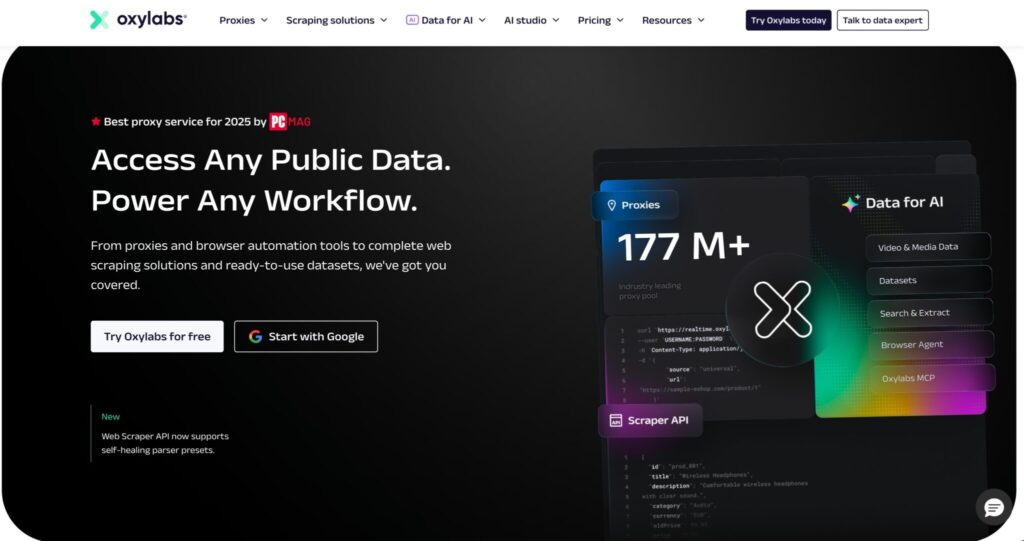
Oxylabs is the strongest pick for serious travel fare aggregation teams that care about scale, uptime, and data consistency. It is not the cheapest provider on this list, but it is built for companies that cannot afford unreliable collection.
The biggest advantage is its large residential proxy pool. Oxylabs lists 175M+ residential IPs, city-level targeting, SOCKS5 support, and sticky sessions that can hold the same IP for up to 24 hours. That combination matters in travel scraping because you often need both quick rotation for search result pages and stable sessions for multi-step quote validation.
For example, if you are tracking airfare between London and New York across 20 country markets, you need more than a random residential proxy. You need the ability to choose locations precisely, maintain session behavior, and collect clean snapshots without burning through retry cycles.
Oxylabs also fits teams collecting data from airlines, hotels, booking engines, and travel aggregators at the same time. Its network depth gives you enough room to separate workloads by country, route, site, and frequency. That makes it easier to build a cleaner data pipeline.
The best use case is enterprise fare intelligence. Think airfare monitoring, OTA benchmarking, hotel price comparison, cruise availability checks, rental car rate tracking, and market-by-market pricing analysis.
What makes Oxylabs strong for travel fare aggregation?
- Large residential IP pool for global collection
- City-level targeting for localized fare checks
- Sticky sessions for multi-step booking paths
- SOCKS5 support for more flexible technical setups
- Better fit for high-volume, production-grade pipelines
Where it may not fit
Oxylabs may be too much for small projects. If you are only tracking a handful of routes or testing an MVP, you may not need an enterprise-grade provider. The cost makes more sense when data quality and uptime directly affect revenue.
Pro-Tip: Use Oxylabs when you need structured fare collection across many countries, airports, and OTAs. For early testing, start with a smaller sample set, validate block rates, then scale by route clusters instead of scraping every destination at once.
#2 — Decodo: Best Value Travel Proxy
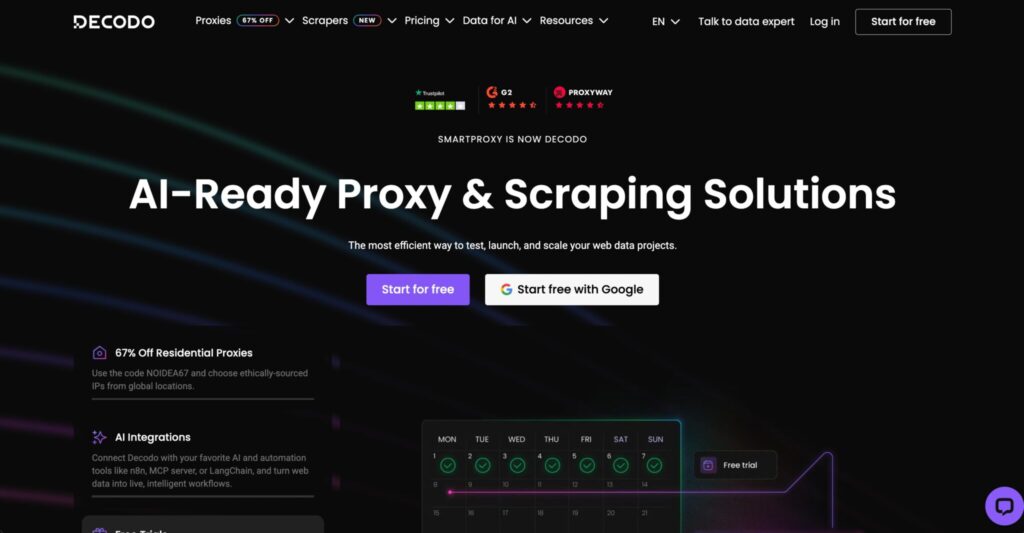
Decodo, formerly Smartproxy, is one of the most practical choices for travel fare aggregation teams that want strong residential coverage without jumping straight into enterprise pricing.
Its residential proxy product lists 115M+ IPs, advanced geo-targeting at country, continent, state, city, and ZIP code level, and unlimited concurrent sessions. Decodo also offers flexible subscription and pay-as-you-go options, which makes it easier for smaller teams to control costs while testing travel data workflows.
For travel fare scraping, Decodo’s real strength is usability. You can set up location-specific collection jobs without dealing with a painfully complex dashboard. That matters when your team needs to run different fare checks by market, route, device profile, or currency.
Decodo also has a travel price comparison use case page that specifically positions its residential proxies for flight and hotel price scraping, real-time fares, and travel data workflows.
This makes Decodo a strong option for agencies, affiliate travel sites, fare comparison startups, and data teams that need reliable proxy infrastructure without oversized contracts.
What makes Decodo strong for travel fare aggregation?
- 115M+ residential IPs
- City and ZIP-level geo-targeting
- Unlimited concurrent sessions
- Good balance between price and performance
- Easier setup for non-enterprise teams
- Suitable for flight and hotel price comparison workflows
Where it may not fit
Decodo is excellent for value, but large enterprise teams may still prefer providers with deeper compliance tooling, custom SLAs, or heavier account management. For most mid-sized travel data teams, though, it gives a strong balance.
Pro-Tip: Decodo works well when you need to compare localized fares across many markets, but do not want to overpay during testing. Use it to validate your route coverage, fare freshness, and market differences before building a larger collection stack.
#3 — Webshare: Best Travel Proxy for Developer Prototyping
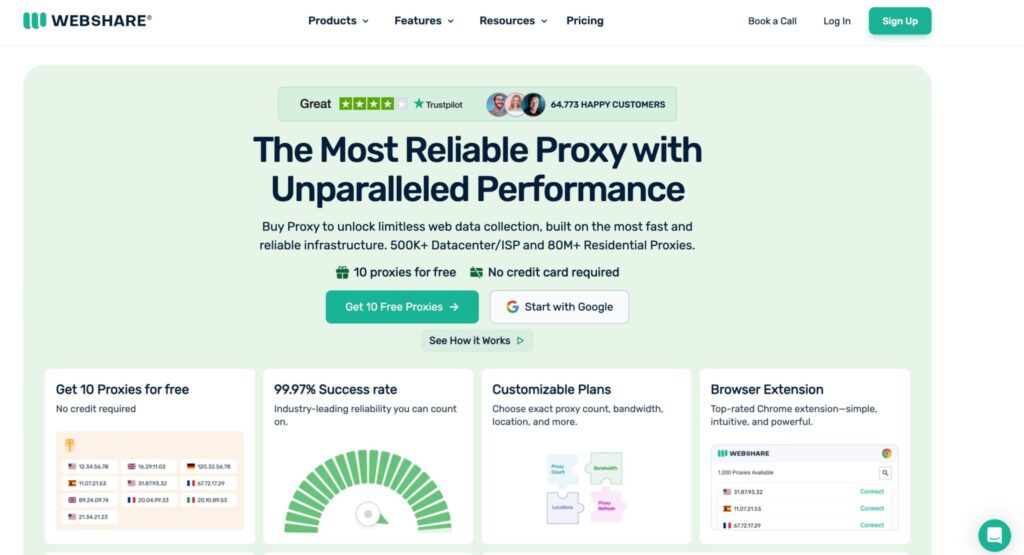
Webshare is a strong pick for developers building and testing travel fare crawlers. It is affordable, simple, and flexible enough for early-stage workflows.
Webshare lists rotating residential proxies with 80M+ residential IPs, residential pricing starting from $1.4/GB, and datacenter proxy pricing starting at $0.05/IP. It also highlights easy rotating proxy setup, global coverage, and 99.97% uptime on its feature page.
That pricing structure makes Webshare useful for prototyping. If you are building a fare scraper, testing route pages, checking how OTAs display localized pricing, or validating parsing logic, you do not always need a premium residential network on day one. You need affordable access, a clean dashboard, and enough coverage to test properly.
Webshare is also useful for developers who want to separate proxy types by task. You may use datacenter proxies for low-risk testing, static residential proxies for stable sessions, and rotating residential proxies for broader fare checks.
For production-grade fare aggregation, Webshare may not be the first choice for the most complex targets. But for building crawlers, running smaller jobs, or testing data collection logic, it offers excellent practical value.
What makes Webshare strong for travel fare aggregation?
- Low-cost entry point
- 80M+ residential IPs
- Simple setup for developers
- Rotating residential and datacenter options
- Good for testing and route-level monitoring
- Useful API-driven workflow for technical teams
Where it may not fit
Webshare is not as feature-heavy as Bright Data or Oxylabs. If you need advanced tooling, managed support, or large-scale global fare intelligence, it may feel limited. But that is not its main role. Its real strength is affordable proxy access for builders.
Pro-Tip: Use Webshare for crawler development, parser testing, small route monitoring, and proof-of-concept projects. Once you know which markets and OTAs matter, move the hardest targets to a premium residential provider.
#4 — Bright Data: Best Travel Proxy for Global Fare Coverage
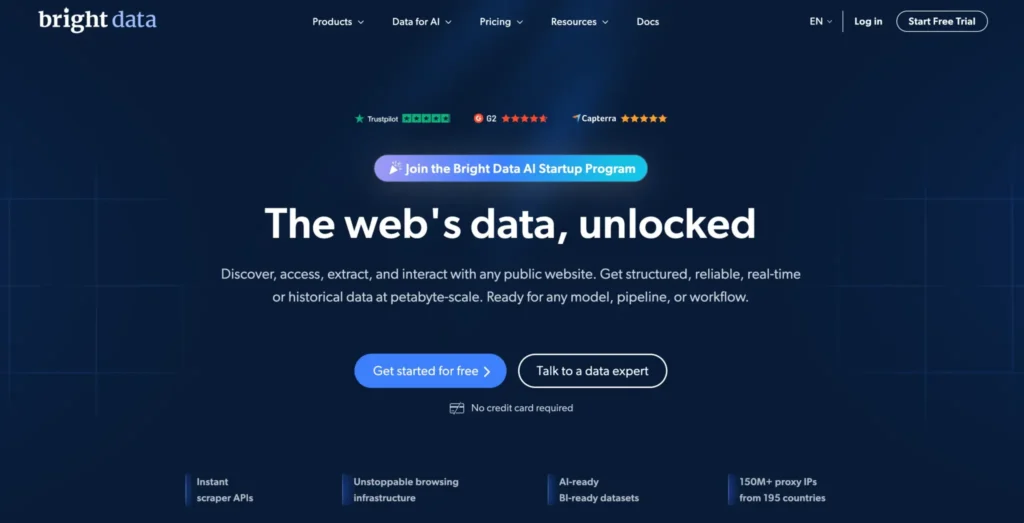
Bright Data is one of the most powerful options for global travel fare aggregation. It is especially strong when your project requires wide location coverage, precise geo-targeting, and enterprise-level controls.
Bright Data lists 400M+ monthly ethical residential IPs from 195 countries, with sticky and rotating sessions, geo-location targeting, and published performance claims on its residential proxy page. Its location page also mentions city, state, and ZIP code level targeting.
For travel fare aggregation, this is valuable because pricing differences often appear at the country, region, and city level. If your business compares airfare and hotel rates across global markets, broader coverage gives you more accurate market visibility.
Bright Data also makes sense for companies that need more than proxies. It has scraping infrastructure, datasets, and data collection tools, which may reduce engineering burden if your internal team does not want to build everything from scratch.
The tradeoff is cost and complexity. Bright Data is a premium provider. It gives you serious capability, but you need a clear plan to use it well. If your team is only scraping a few routes per day, you may not need this much infrastructure.
What makes Bright Data strong for travel fare aggregation?
- Very large residential proxy network
- 195-country coverage
- City, state, and ZIP-level targeting
- Sticky and rotating sessions
- Strong fit for international fare comparison
- Additional data collection tooling available
Where it may not fit
Bright Data can feel heavy for beginners. Smaller teams may need time to configure it properly and control costs. It is best used when fare data is a core business asset, not a side experiment.
Pro-Tip: Bright Data is best for global fare intelligence where every market matters. Use it when you need to compare pricing by country, city, currency, OTA, and route at scale.
#5 — SOAX: Best Travel Proxy for Carrier-Sensitive Fare Detection
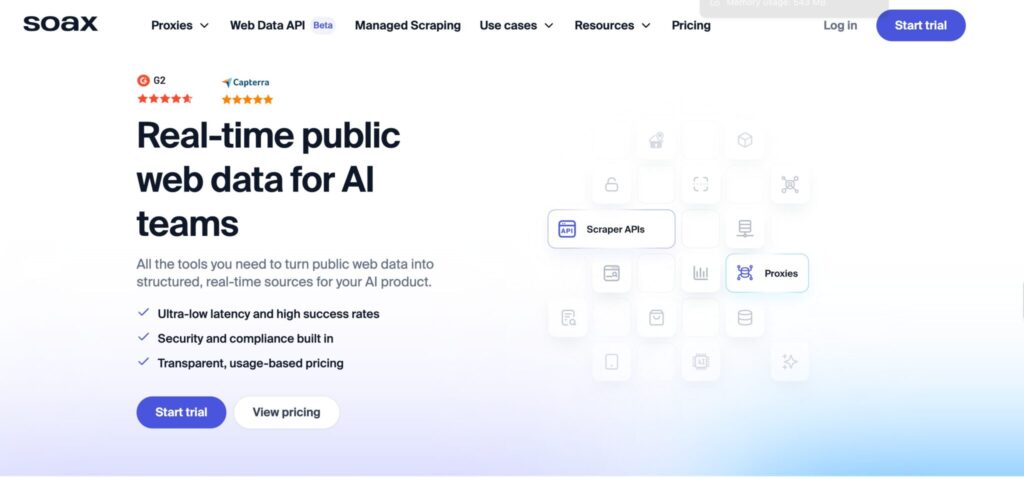
SOAX is a strong mid-market choice for travel data teams that need controlled residential coverage, sticky sessions, and flexible rotation.
SOAX lists 155M+ residential IPs in 195+ locations, unlimited concurrent sessions, ethically sourced proxies, 99.9% uptime, automatic IP rotation, and sticky sessions.
That combination makes SOAX useful for carrier-sensitive fare detection. Some travel platforms respond differently depending on the user’s location, network type, or session behavior. SOAX gives you enough control to test markets carefully without jumping into the highest-cost enterprise tier.
It is especially useful for route monitoring where you need repeatable collection patterns. For example, you may want to check the same flight routes every few hours from selected countries and compare fare movement over time. SOAX’s sticky session support helps when you need a more stable identity during multi-step flows.
SOAX is also a good fit for hotel and OTA monitoring. If your site compares hotel rates across countries, you can use SOAX to check localized prices from different regions and detect market-level differences.
What makes SOAX strong for travel fare aggregation?
- 155M+ residential IPs
- 195+ locations
- Sticky sessions and automatic rotation
- Unlimited concurrent sessions
- Strong balance between control and cost
- Good for recurring market checks
Where it may not fit
SOAX is powerful, but you still need proper crawler design. If your request timing, retry logic, and session handling are messy, even a good proxy network will not fix bad data collection architecture.
Pro-Tip: Use SOAX when you want controlled market-by-market monitoring. Build separate proxy pools for flight routes, hotel destinations, and car rental locations so your data stays clean and easier to audit.
#6 — IPRoyal: Best Travel Proxy for Long-Term Fare Trend Analysis
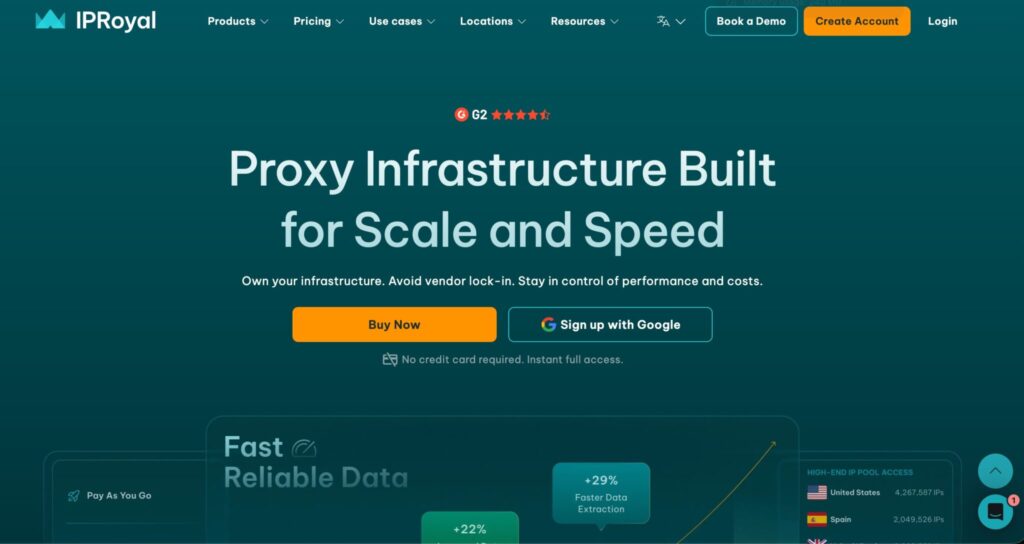
IPRoyal is a smart option for teams that do not scrape nonstop but need reliable proxy access for recurring fare checks. Its biggest advantage is simple, flexible pricing.
IPRoyal lists 32M+ residential IPs, coverage in 195+ countries, pay-as-you-go pricing, and non-expiring residential traffic. Its documentation also mentions session TTL controls, location selection, and high-end pool options.
That non-expiring traffic model is useful for travel fare trend analysis. Many travel projects do not need to burn bandwidth every day. You may collect airfare snapshots twice per day, monitor seasonal routes, track hotel prices ahead of peak demand, or compare fares before holiday periods. With non-expiring traffic, unused bandwidth does not vanish at the end of the month.
IPRoyal is also appealing for smaller teams because it avoids heavy commitments. You can buy traffic, run targeted collection jobs, and keep the remaining balance for future monitoring.
It is not the largest pool on this list, but it is practical. For long-term trend tracking, that practicality matters.
What makes IPRoyal strong for travel fare aggregation?
- 32M+ residential IPs
- 195+ country coverage
- Non-expiring traffic
- Pay-as-you-go model
- Session TTL controls
- Good for periodic fare tracking
Where it may not fit
IPRoyal may not be the best fit for extremely large, high-concurrency travel scraping operations. If you are collecting millions of fare checks per day, Oxylabs or Bright Data may be more suitable.
Pro-Tip: Use IPRoyal for route-level trend monitoring. It works well when you need to compare fare movement over weeks or months instead of running massive real-time scraping jobs every hour.
#7 — Proxy-Cheap: Best Budget Travel Proxy for Focused Monitoring
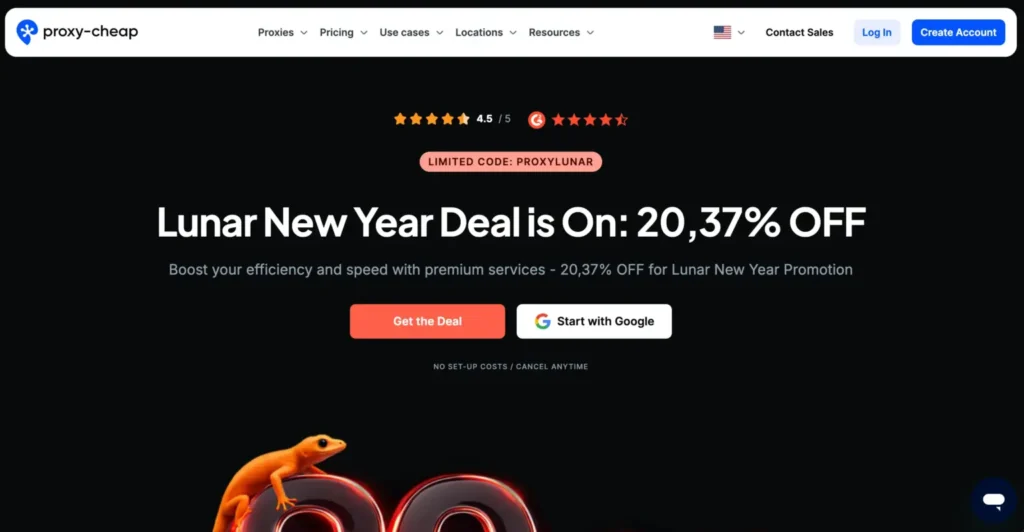
Proxy-Cheap is the budget-friendly option on this list. It is not built to replace enterprise proxy infrastructure, but it can be useful for small travel monitoring projects, narrow route tracking, and early-stage testing.
Proxy-Cheap offers rotating residential proxies, static residential proxies, mobile proxies, datacenter proxies, and usage analytics. Its rotating residential proxy page lists pay-as-you-go options and pricing starting around $4.99/GB for a 1 GB monthly plan.
This makes it a reasonable choice if you only need to monitor a limited set of destinations. For example, a travel affiliate site may want to track hotel prices in Bali, flight fares from New York to Paris, or rental car prices in Orlando. You do not need a giant proxy contract for that kind of narrow tracking.
Proxy-Cheap also works for testing localized pricing differences before deciding whether a bigger provider is worth it.
What makes Proxy-Cheap strong for travel fare aggregation?
- Budget-friendly plans
- Rotating residential proxy options
- Static residential and mobile options available
- Usage analytics dashboard
- Good for small route sets
- Useful for low-volume monitoring
Where it may not fit
Proxy-Cheap is not ideal for large-scale fare aggregation across hundreds of markets. If accuracy, uptime, and global coverage are mission-critical, use it for focused tasks rather than your entire data pipeline.
Pro-Tip: Use Proxy-Cheap for narrow tracking projects. Pick a few routes, run consistent checks, and compare data quality before expanding.
How to Choose the Best Proxy for Travel Fare Aggregation
Choosing a proxy for travel fare aggregation is not only about IP count. A large pool looks good on paper, but the real question is whether the provider can support accurate, repeatable, and location-specific fare collection.
1. Prioritize Residential Proxies for Real Travel Pricing
Residential proxies are usually the best starting point for travel fare scraping because they use IPs associated with real internet service providers. Travel platforms often treat residential IPs as more natural than datacenter IPs.
Datacenter proxies are faster and cheaper, but they are also easier to identify in high-friction scraping environments. They can still work for low-risk sources, internal testing, or partner-approved endpoints, but they should not be your only option for serious travel data.
2. Check Geo-Targeting Depth
Country-level targeting is useful, but travel fare aggregation often needs more detail. City, state, ZIP, and ASN targeting can help when platforms show different fares or partners by region.
For example, hotel prices in the United States may vary depending on whether the request appears from New York, Miami, Los Angeles, or Dallas. Flight fares may also shift based on market localization and currency settings.
3. Use Rotation Based on Workflow Type
Do not rotate blindly. Match rotation to the scraping task.
For search result pages, per-request or short-session rotation may work well. For checkout-style fare validation, sticky sessions are better because the flow needs continuity. For trend monitoring, you may want consistent location settings and controlled rotation windows so your data remains comparable.
A simple rule:
- Search result scraping: faster rotation
- Multi-step fare validation: sticky sessions
- Long-term trend analysis: stable geo-targeting with controlled rotation
- App or mobile-specific pricing checks: mobile proxies may help
- Low-risk testing: datacenter proxies may be enough
4. Look at Concurrent Session Support
Travel data gets stale quickly. If your proxy provider limits concurrent sessions too tightly, your crawler may collect prices too slowly. By the time your job finishes, part of the dataset may already be outdated.
Concurrent sessions matter most when you monitor multiple routes, dates, airlines, OTAs, or hotel markets at once.
5. Watch Bandwidth Pricing Carefully
Travel pages can be heavy. They often include scripts, images, trackers, maps, calendars, and dynamic content. If your crawler loads too much unnecessary content, bandwidth costs can rise quickly.
A good setup blocks non-essential assets where appropriate, uses efficient parsing, and avoids repeated full-page loads when structured data is available legally and reliably.
6. Test Before Scaling
Never judge a proxy provider only by marketing claims. Run a small test first.
Track:
- Success rate by site
- Average response time
- Block rate
- CAPTCHA frequency
- Cost per successful fare record
- Accuracy of localized pricing
- Session failure during multi-step flows
- Data freshness after collection
The best provider is not always the one with the largest pool. It is the one that gives you the lowest cost per clean, usable fare record.
FAQs: Best Proxies for Travel Fare Aggregation 2026
Why is travel fare scraping harder than other web scraping?
Travel fare scraping is harder because prices change quickly and depend on many variables, including user location, route, booking date, currency, demand, device type, and availability. Unlike a normal product page, a travel quote may involve several steps before the final price appears.
Can proxies see location-specific flight prices?
Yes, proxies can help you view location-specific flight prices by routing requests through IPs from different countries or cities. This is useful when airlines or OTAs display different fares, currencies, fees, or partner offers based on market location.
How fast do travel fares change?
Travel fares can change within minutes, especially for popular routes, peak seasons, limited inventory, or dynamic airline pricing systems. Hotel and car rental prices may also move frequently based on demand, cancellation patterns, and local availability.
Do I need mobile proxies for travel scraping?
You do not always need mobile proxies. Residential proxies are enough for most fare aggregation tasks. Mobile proxies become useful when you need to test app-specific prices, mobile-only offers, carrier-sensitive behavior, or mobile booking flows.
Are datacenter proxies good for travel fare aggregation?
Datacenter proxies can work for low-risk sources, development, and internal testing. For real-world fare aggregation across airlines, hotels, and OTAs, residential proxies usually perform better because they look closer to normal consumer traffic.
What is the best proxy type for hotel price scraping?
Rotating residential proxies are usually the best choice for hotel price scraping. They help you compare localized prices across countries and cities. Sticky sessions may be needed when the booking flow requires date selection, room selection, taxes, and final price validation.
Which proxy provider is best for small travel data projects?
For smaller projects, Decodo, Webshare, IPRoyal, and Proxy-Cheap are practical choices. Decodo gives the best balance, Webshare is good for developers, IPRoyal is useful for non-expiring traffic, and Proxy-Cheap works for budget-focused monitoring.
Which proxy provider is best for enterprise travel fare aggregation?
Oxylabs and Bright Data are the strongest enterprise options. Oxylabs is excellent for production-grade scraping pipelines, while Bright Data is powerful for global fare coverage, precise targeting, and broader data collection infrastructure.
Conclusion: Best Proxies for Travel Fare Aggregation in 2026
The best proxy for travel fare aggregation depends on your scale.
If you are building a serious fare intelligence system, Oxylabs is the strongest overall choice. It has the scale, targeting, and session controls needed for production travel data operations.
If you want the best balance of price, usability, and residential coverage, Decodo is the most practical value pick.
If your team is still building and testing crawlers, Webshare is the best developer-friendly option.
If global market coverage is your top priority, Bright Data is hard to ignore.
If you need controlled geo-targeting and sticky sessions without jumping straight into enterprise pricing, SOAX is a strong mid-market choice.
If you care about long-term route monitoring and non-expiring traffic, IPRoyal is a smart pick.
If your budget is tight and your monitoring scope is narrow, Proxy-Cheap can get the job done.
For travel fare aggregation, do not buy proxies only by IP pool size. Look at location accuracy, rotation behavior, session stability, bandwidth cost, and clean data output. The real winner is the provider that helps you collect fresh, accurate, market-specific fare data with fewer failures and less wasted bandwidth.