
Best Proxies for ChatGPT & AI Tools
AI teams are not using proxies just because they want to “hide an IP.” That is the cheap explanation. The real reason is more practical.
A developer may need stable access while testing AI workflows across different regions. A SaaS team may need clean routing for QA, uptime checks, browser agents, web data collection, or AI-assisted research pipelines. A growth team may run AI tools inside cloud browsers, automation dashboards, or account environments where shared datacenter IPs trigger friction too quickly.
That said, proxies are not a free pass to break platform rules. OpenAI’s Terms of Use apply to ChatGPT, DALL·E, and other OpenAI services, and OpenAI’s usage policies stress safe and responsible use. So the smart approach is simple: use proxies for lawful testing, privacy, routing, geo-QA, and compliant automation, not for spam, abuse, account farming, or bypassing restrictions.
For ChatGPT and AI tools, the best proxy is not always the biggest one. You need the right IP type, the right session control, clean geography, and a provider that will not fall apart once your workflow moves from “small test” to “daily production.”
Below is a practical, buyer-focused breakdown of the 6 best proxies for ChatGPT and AI tools in 2026.
What developers and SaaS teams are dealing with:
AI workflows create a strange traffic profile. They are repetitive, structured, and often browser-based. That can look suspicious if everything comes from the same cloud IP block, especially when you are testing multiple tools, multiple regions, or multiple customer environments.
Here is where proxies usually enter the picture:
1. Geo-based testing for AI tools
Some AI tools show different pricing, language, availability, latency, or features depending on region. A proxy lets you test how your product, landing page, chatbot, or AI integration behaves from a specific country or city.
2. Browser automation and AI agents
AI agents that browse, collect public data, compare search results, monitor pages, or run QA checks need stable routing. Cheap shared datacenter proxies often work for simple checks, but they can fail quickly on stricter websites.
3. Account environment separation
Teams managing different client workspaces may want clean IP separation between environments. This is not about creating fake accounts. It is about avoiding messy overlap when legitimate teams, contractors, VAs, and QA systems all work from cloud servers.
4. API reliability and fallback routing
For OpenAI API access, the cleanest route is usually direct API access from a supported region. OpenAI maintains separate supported-country pages for ChatGPT and API access, and users outside supported countries may see unsupported-country errors.
5. Reduced friction for AI research stacks
Many AI research workflows combine proxies with browsers, scraping APIs, data pipelines, and LLMs. The proxy is only one layer. The real value comes from combining clean IPs, proper rate limits, retries, session logic, and respect for target-site rules.
6 Best Proxies for ChatGPT & AI Tools in 2026
#1 — Oxylabs: Best Overall Proxy for AI Tools
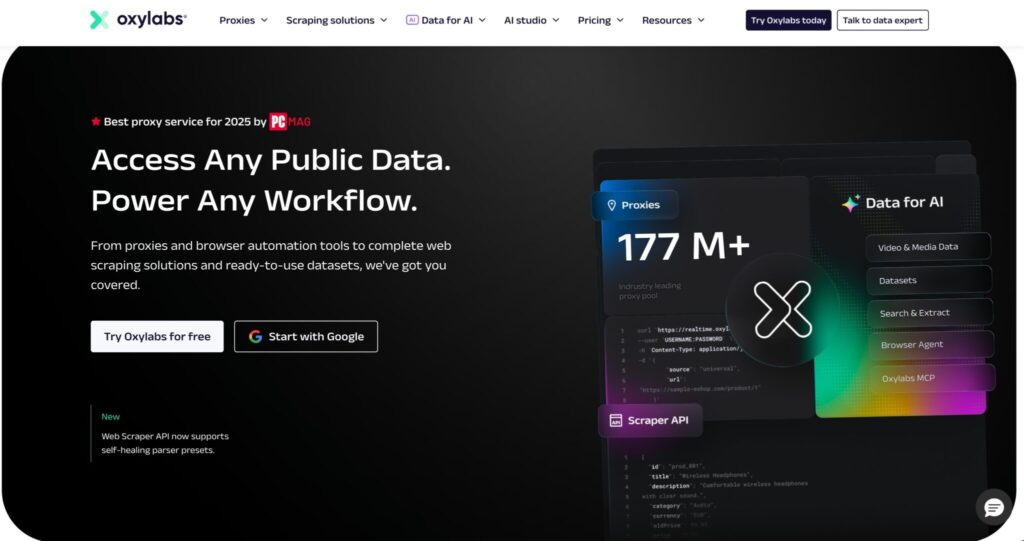
Oxylabs is the strongest pick for serious AI teams, especially if your use case goes beyond simple browser access. It is built more like enterprise infrastructure than a cheap proxy dashboard. That matters when you are running AI agents, web data workflows, SERP monitoring, QA automation, or multi-region testing.
Oxylabs offers residential proxies, mobile proxies, datacenter proxies, dedicated datacenter proxies, ISP proxies, Web Unblocker, Headless Browser, Web Scraper API, and other data collection tools. Its homepage highlights AI-focused products such as Web Unblocker, Headless Browser for AI agents, Fast Search API for AI workflows, and AI Studio.
The main reason Oxylabs ranks first is reliability under pressure. If you are building an AI product that depends on live web access, public data retrieval, or global testing, you need more than “some proxies that work today.” You need success-rate stability, enterprise support, clean documentation, and flexible routing.
For ChatGPT-related workflows, Oxylabs is best used for:
- AI browser agents that need stable browsing environments
- Public web research pipelines
- Search result collection for AI apps
- Testing AI products across different markets
- Large-scale QA where residential, ISP, and datacenter IPs may all be needed
Pro-Tip: Use Oxylabs residential proxies for region-sensitive browser testing and its datacenter or dedicated datacenter proxies for high-volume, lower-risk internal tasks. Do not waste premium residential bandwidth on basic uptime checks.
The drawback is price. Oxylabs is not the cheapest option here. Smaller teams may find it overbuilt if they only need a few proxies for light AI tool access. But for production-grade AI automation, it is the safest overall bet.
Best for: Enterprise AI teams, serious SaaS workflows, AI agents, data collection, global QA
Avoid if: You only need a small budget proxy for occasional use.
#2 — Decodo: Best Value Proxy for AI Tools
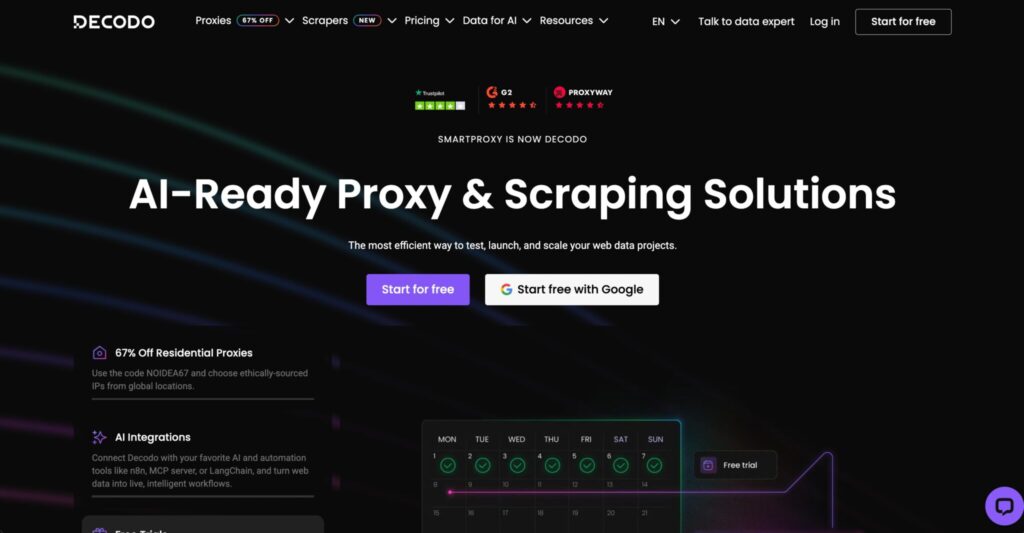
Decodo, formerly known as Smartproxy, is one of the best middle-ground providers for AI teams that want strong infrastructure without enterprise-heavy complexity. It has a clean dashboard, solid documentation, and pricing that makes more sense for startups, agencies, and SaaS teams that are scaling but not yet at Oxylabs-level volume.
Decodo’s residential proxy page currently lists 115M+ IPs, advanced geo-targeting by country, continent, state, city, and ZIP code, unlimited concurrent sessions, and a 3-day free trial. Its residential pricing starts at $3.75/GB for the 3GB plan, with lower per-GB rates on larger plans.
For ChatGPT and AI tools, Decodo is attractive because it balances coverage, usability, and cost. You get a large residential pool, strong location targeting, and session flexibility without needing to talk to sales for every small move.
It works especially well for:
- Testing AI SaaS dashboards across regions
- AI-assisted market research
- Browser automation with rotating residential IPs
- AI workflow QA for agencies and product teams
- Lightweight public data collection
The rotation setup is important. For AI tools, you usually do not want aggressive rotation on every single request if you are maintaining a logged-in browser session. You want sticky sessions for browser-based work and rotating sessions for public data collection. Decodo gives you enough flexibility to manage both.
Pro-Tip: For browser-based AI tasks, start with longer sticky sessions. Rotating too often can create more problems than it solves, especially with login-based tools.
Decodo is not as enterprise-heavy as Oxylabs, but that is also part of its appeal. It feels easier to deploy, easier to explain to a team, and easier to keep within a monthly budget.
Best for: Startups, agencies, AI SaaS teams, value-focused residential proxy use
Avoid if: You need deep enterprise SLAs or highly customized procurement
#3 — Webshare: Best Free Proxy for AI Tools
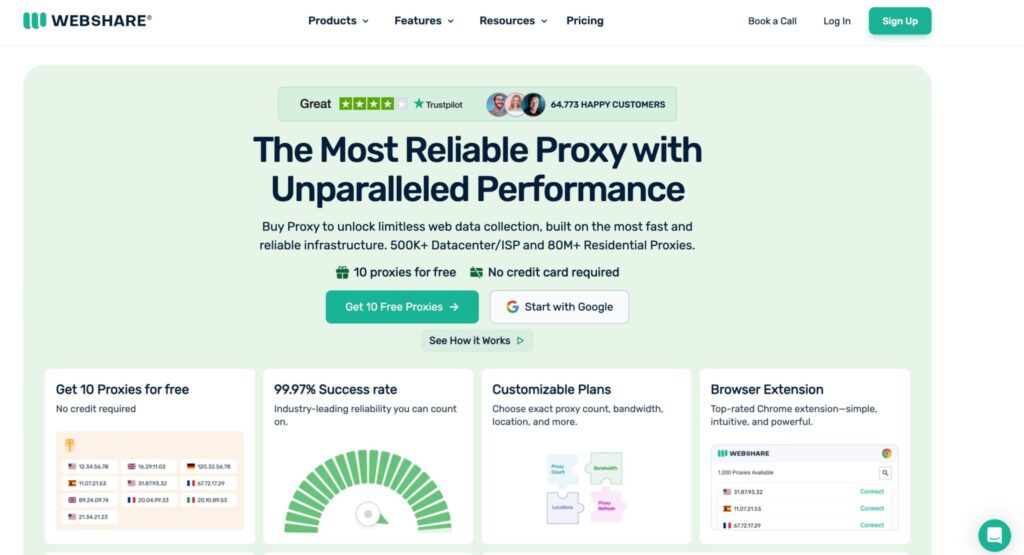
Webshare is the best option for users who want to test proxy workflows without spending money upfront. It is not the most advanced provider on this list, but it wins on simplicity and entry-level access.
Webshare says its proxy server infrastructure supports HTTP and SOCKS5 for web scraping, data collection, ad verification, and global access at scale. It also promotes a free start, pricing as low as $0.0179 per proxy, and 99.97% uptime on its proxy server page.
The biggest advantage is that Webshare makes proxy testing easy. If you are building a small AI automation workflow, testing browser routing, or checking whether a proxy helps with a specific AI tool environment, Webshare is a low-risk starting point.
It is useful for:
- Small AI tool tests
- Entry-level browser routing
- Internal QA experiments
- Datacenter proxy testing
- Lightweight automation where cost matters most
Webshare is also a good training ground for teams new to proxies. You can learn authentication, IP whitelisting, proxy lists, rotation basics, and bandwidth planning before moving into larger residential networks.
The tradeoff is that Webshare may not be enough for stricter workflows. Free or very cheap proxies can be heavily used, and shared IP reputation can vary. For casual tests, that is fine. For production AI agents or sensitive account environments, you may want a stronger residential or ISP option.
Pro-Tip: Use Webshare to validate your setup, not to judge the full performance of premium residential proxies. A failed free proxy test does not always mean proxies will not work. It may only mean that the IP type is wrong for the job.
Best for: Beginners, small tests, budget-conscious developers, proxy learning
Avoid if: You need premium residential quality, deep geo-targeting, or account-sensitive stability
#4 — IPRoyal: Best Budget Proxy for AI Automation
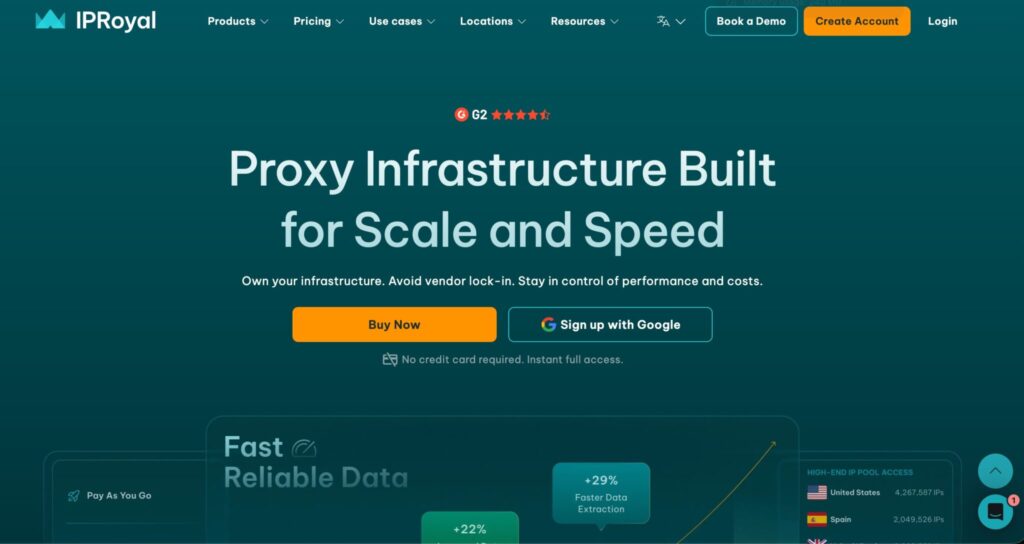
IPRoyal is a strong pick for budget-focused AI automation because it gives you a mix of residential, ISP, mobile, and datacenter proxies without making the buying process feel complicated. It is not the biggest provider, but it is practical, affordable, and flexible.
IPRoyal’s residential proxy page lists 32M+ residential IPs in 195+ countries, HTTP(S) and SOCKS5 support, rotating and sticky sessions, country/state/city targeting, and a listed 99.4% success rate. Its residential pricing starts at $7/GB for 1GB, with lower rates at higher volumes, and it highlights non-expiring traffic.
For AI automation, IPRoyal is useful when you need more quality than a cheap datacenter proxy but do not want to jump straight into enterprise pricing. It is also helpful for workflows where traffic is uneven. Non-expiring traffic is a nice fit for teams that run tests in bursts rather than pushing daily volume.
Use IPRoyal for:
- Small to mid-size AI automation
- AI tool testing from specific locations
- Browser sessions that need sticky IPs
- Budget residential proxy use
- Teams that want pay-as-you-go flexibility
IPRoyal’s static residential options are worth looking at for long-running sessions. The company describes static residential proxies as long-term IPs with no bandwidth limitation for the plan duration, while rotating residential proxies change at intervals or per request.
Pro-Tip: For logged-in AI tool dashboards, do not start with rotating residential IPs. Test static residential or ISP proxies first, then use rotating residential only for public, non-login tasks.
The main limitation is scale. IPRoyal can handle plenty of use cases, but large AI data teams may eventually want the deeper tooling of Oxylabs or Decodo.
Best for: Budget AI automation, sticky sessions, pay-as-you-go users
Avoid if: You need the largest possible IP pool or enterprise-grade web scraping tools
#5 — SOAX: Best Proxy for AI Tool Account Management
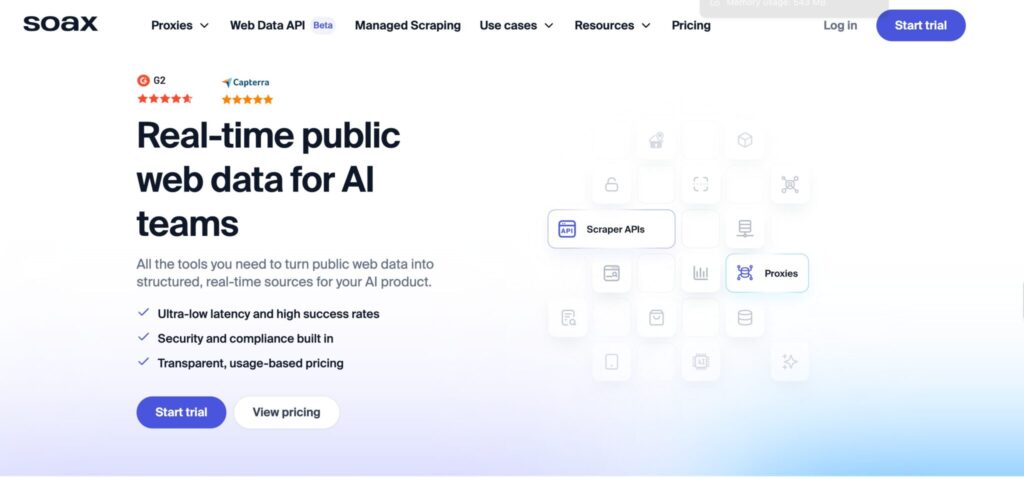
SOAX is a strong choice when precision matters. It gives you a large residential network, flexible session control, and very granular targeting. That makes it useful for legitimate AI tool account management, multi-region QA, and browser environments where random IP behavior can create unnecessary friction.
SOAX lists 155+ million residential proxies worldwide, more than 195 geos, city-level targeting, sticky and rotating sessions, HTTP(S) and SOCKS5 support, and customizable session behavior. Its residential plans currently show $3.60/GB on Starter, $3.40/GB on Advanced, $2.46/GB on Professional, and $2.00/GB on Business, with enterprise pricing starting lower by custom arrangement.
For AI tools, SOAX works best when you need clean control rather than raw volume. You can rotate IPs on every request, keep the same IP for longer, set custom session lengths, and target locations with strong detail.
That makes SOAX useful for:
- AI SaaS account QA
- Testing dashboards across cities or regions
- Browser profiles used by distributed teams
- AI product localization testing
- Research workflows where session behavior matters
Pro-Tip: Match session length to task type. Use sticky sessions for dashboards and accounts. Use short rotation for public data checks. Do not mix both inside the same browser profile unless you know exactly why you are doing it.
SOAX is not the cheapest starting point because the Starter plan includes 25GB and bills monthly. But if you actually use the bandwidth, the quality-to-control ratio is strong.
Best for: Account-safe environments, session control, geo-targeted AI QA
Avoid if: You only need 1GB or 2GB for casual testing
#6 — Proxy-Cheap: Best Entry-Level Proxy for AI Tools

Proxy-Cheap is the entry-level pick for users who want affordable static residential, rotating residential, datacenter, mobile, and SOCKS5 options in one place. It is not the most polished enterprise provider, but it gives beginners and small operators a low-cost way to test different proxy types.
Proxy-Cheap lists HTTP/SOCKS5 support, dedicated IP addresses, country and ISP-level targeting, usage analytics, browser proxy manager tools, 24/7 customer support, and several product categories including static residential, rotating residential, datacenter IPv4, datacenter IPv6, static mobile, and rotating mobile proxies. Its site currently shows rotating residential from $4.99/GB, datacenter IPv4 from $1.49/month, and static residential monthly pricing on its homepage.
For ChatGPT and AI tools, Proxy-Cheap is useful for:
- Beginners testing AI tool proxy setups
- Low-cost browser routing
- Small account environments
- SOCKS5-based apps
- Testing whether static residential or datacenter IPs fit your workflow
The provider is especially appealing if you want to experiment with different proxy categories without committing to a premium platform. For example, you might test datacenter IPv4 for speed, static residential for session stability, and rotating residential for public data tasks.
Pro-Tip: Start with the cheapest proxy type that fits the risk level. For internal testing, datacenter may be enough. For logged-in AI dashboards, static residential is usually safer. For public research, rotating residential may make more sense.
The downside is that entry-level providers can vary more in IP quality, support depth, and consistency. Test before committing to a long plan.
Best for: Beginners, small budgets, proxy experimentation, low-cost AI workflows
Avoid if: You need enterprise-grade support, advanced APIs, or very high reliability
Best Proxies for ChatGPT & AI Tools 2026: Quick Comparison Table
| Provider | Best For | Proxy Types | IP Pool / Coverage | Rotation & Session Control | Protocols | Starting Price Signal | Best AI Tool Use Case | Main Watch-Out |
|---|---|---|---|---|---|---|---|---|
| Oxylabs | Best overall | Residential, mobile, datacenter, dedicated datacenter, ISP, Web Unblocker, Headless Browser | 2M+ datacenter IPs, 188+ countries listed on homepage, plus AI-focused scraping tools | Strong enterprise controls, sticky and rotating options across products | HTTP(S), SOCKS5 depending on product | Premium, sales-led for many products | AI agents, large SaaS QA, public data workflows | Overkill for tiny projects |
| Decodo | Best value | Residential, datacenter, ISP, mobile, scraping tools | 115M+ residential IP pool with country/state/city/ZIP targeting | Unlimited concurrent sessions, sticky and rotating sessions | HTTP(S), SOCKS5 depending on product | Residential from $3.75/GB on 3GB plan | Startups, agencies, AI SaaS teams | Not as enterprise-heavy as Oxylabs |
| Webshare | Best free/cheap start | Datacenter, static residential, rotating residential | Broad proxy infrastructure, free start available | Simple dashboard controls | HTTP, SOCKS5 | Free start, proxy server pricing as low as $0.0179/proxy | Testing, learning, small workflows | Free/cheap IP reputation may vary |
| IPRoyal | Best budget automation | Residential, static residential, mobile, datacenter | 32M+ residential IPs in 195+ countries | Rotating and sticky sessions, static residential for long sessions | HTTP(S), SOCKS5 | Residential from $7/GB, bulk discounts lower | Budget AI automation, sticky sessions | Smaller pool than top enterprise options |
| SOAX | Best for account-safe QA | Residential, mobile, US datacenter, Web Data API | 155M+ residential proxies, 195+ geos | Rotate every request or keep same IP, custom session lengths | HTTP(S), SOCKS5, UDP, QUIC listed in plan details | Starter at $3.60/GB with 25GB included | AI account QA, geo testing, controlled sessions | Monthly minimum may be high for casual users |
| Proxy-Cheap | Best entry-level | Static residential, rotating residential, datacenter IPv4/IPv6, mobile, SOCKS5 | Multiple global locations with country and ISP targeting | Browser proxy manager, usage analytics, static and rotating options | HTTP, HTTPS, SOCKS5 | Rotating residential from $4.99/GB, datacenter from low monthly pricing | Beginner AI workflows and testing | Quality can vary by proxy type |
How to Choose the Best Proxy for ChatGPT & AI Tools
1. Choose the proxy type based on the task
Do not buy residential proxies just because they sound premium. Match the proxy to the job.
Datacenter proxies are fast and cheap. Use them for internal testing, simple automation, uptime checks, and low-risk tasks.
Residential proxies use IPs associated with real residential networks. Use them for geo-sensitive testing, stricter websites, and AI browser workflows where IP reputation matters.
Static residential or ISP proxies are best for logged-in sessions because they keep the same identity longer.
Mobile proxies are useful for testing mobile-first AI apps, app flows, and mobile carrier behavior, but they are usually more expensive.
2. Do not rotate IPs blindly
Bad rotation causes problems. A human does not log into an AI dashboard from New York, switch to Berlin two seconds later, then appear in Singapore after another click.
For account-based AI tools, use sticky sessions. For public data collection, use rotating sessions. For long browser automation, use static residential or ISP proxies.
3. Look at IP pool quality, not just size
A huge IP pool sounds impressive, but pool quality matters more. You want clean sourcing, stable sessions, accurate geo-targeting, and low failure rates. A smaller clean pool can beat a massive abused pool.
4. Check protocol support
Most browser-based AI workflows work fine with HTTP(S). Some apps, desktop tools, or automation environments may need SOCKS5. SOAX lists HTTP(S), SOCKS5, UDP, and QUIC in its plan details, while Webshare and Proxy-Cheap also highlight SOCKS5 support.
5. Respect AI platform rules
OpenAI supports ChatGPT and API access only in supported countries and regions. For unsupported-country errors, OpenAI points users to its supported country list rather than offering a workaround.
That means your proxy strategy should support legitimate routing and testing, not policy avoidance. For API use, direct compliant API access is usually better than forcing traffic through a proxy layer.
6. Test before scaling
Run a small test with your real workflow. Do not judge a provider only by homepage claims. Test:
- Login stability
- Session persistence
- Latency
- CAPTCHA frequency
- Failure rate
- Geo accuracy
- Support response
- Bandwidth usage
- Cost per successful task
A cheap proxy can become expensive if half the requests fail.
FAQs: Best Proxies for ChatGPT & AI Tools 2026
Why do I need a proxy for ChatGPT?
You may need a proxy for legitimate routing, privacy, regional QA, browser testing, or separating client environments. You should not use proxies to violate OpenAI’s terms, bypass unsupported-region restrictions, create fake accounts, or automate abusive activity. For API work, using OpenAI’s official API from a supported country is usually the cleaner route.
Which countries is ChatGPT blocked in?
OpenAI does not maintain a simple public page titled “blocked countries.” It publishes supported countries and regions for ChatGPT and API access. If a country or territory is not supported, users may see an unsupported-country message when signing up or creating API keys.
Country-level status can change because of local laws, sanctions, business rules, or platform restrictions. Mainland China has also seen OpenAI API access restrictions reported by Reuters, with OpenAI notifying Chinese users about additional API traffic blocks in 2024.
What proxy type works best for AI tool API access?
For official API access, a proxy is usually not the first thing you need. You need a compliant account, supported billing region, stable server infrastructure, and proper rate-limit handling. If you still need routing control, use high-quality datacenter or ISP proxies with stable sessions. Avoid aggressive residential rotation for API calls unless you have a specific, compliant reason.
Can OpenAI detect proxy usage?
Large AI platforms can evaluate many signals, including IP reputation, region consistency, login behavior, device signals, request patterns, payment region, and account history. A proxy alone does not make traffic “safe” or “undetectable.” The better approach is compliant usage, stable sessions, realistic rate limits, and avoiding behavior that looks abusive.
Do I need a different proxy for each AI tool?
Not always. One high-quality proxy setup can support several tools if the use case is simple. But for logged-in browser environments, client dashboards, or region-specific QA, it is better to separate environments. Do not use one rotating pool for everything. Keep stable accounts on stable IPs.
Are free proxies safe for ChatGPT and AI tools?
Free proxies are fine for learning and simple testing, but they are risky for accounts, passwords, paid tools, and production workflows. Many free proxies are slow, crowded, unstable, or poorly maintained. Webshare is a better free-start option because it is a known provider with a structured dashboard, but sensitive workflows should still use paid, private, or residential options.
Are residential proxies better than datacenter proxies for AI tools?
Residential proxies are better for region-sensitive browsing, account-based workflows, and stricter websites. Datacenter proxies are better for speed, cost, and simple backend tasks. For many AI teams, the best setup is mixed: datacenter for internal automation, static residential for logged-in sessions, and rotating residential for public research.
How many proxies do I need for AI automation?
Start smaller than you think. For one browser profile, one stable static residential or ISP proxy may be enough. For public data collection, calculate based on request volume, target sensitivity, rotation rules, and failure rate. A 10GB residential plan can be plenty for testing, while production AI data workflows may need hundreds of GB.
Which proxy provider is best for beginners?
Webshare is the easiest starting point if you want to learn proxy basics. Proxy-Cheap is also beginner-friendly if you want to test multiple proxy types at low cost. For a more serious but still manageable setup, Decodo is the best upgrade path.
Conclusion | Best Proxies for ChatGPT & AI Tools 2026
The best proxy for ChatGPT and AI tools depends on what you are actually building.
Choose Oxylabs if you need enterprise-grade infrastructure for AI agents, public data workflows, and serious SaaS automation.
Choose Decodo if you want the best balance of price, usability, residential IP scale, and startup-friendly flexibility.
Choose Webshare if you want to test proxy workflows without spending much.
Choose IPRoyal if you need budget-friendly residential proxies with pay-as-you-go flexibility and sticky session options.
Choose SOAX if your AI workflow depends on precise geo-targeting, account-safe sessions, and strong control over rotation.
Choose Proxy-Cheap if you are starting out and want affordable access to several proxy types from one provider.
For most AI teams, the smartest setup is not one proxy provider for everything. Use datacenter proxies for speed, static residential or ISP proxies for logged-in sessions, and rotating residential proxies for public research tasks. Keep your routing stable, respect platform rules, and test the exact workflow before scaling.
That is how you avoid wasting money, burning accounts, or building an automation stack that works for two days and then collapses when real traffic starts.