
Best Proxies for Android
Android proxy buying looks simple until you actually try to run a serious workflow.
You buy a proxy plan, copy the host and port, add it to your phone, and expect everything to route cleanly. Then one app ignores the proxy. Another keeps asking for authentication. Your browser works, but your testing app does not. Your IP rotates too often. Or worse, it does not rotate when you need it to.
That is where most proxy guides fail. They list providers, throw in a few prices, and call it a day. But Android is different from a desktop browser. You need to think about how Android handles Wi-Fi proxy settings, how apps behave, whether you need mobile carrier IPs, and whether your provider supports sticky sessions, SOCKS5, country targeting, city targeting, ASN targeting, or API-based rotation.
For Android, the “best proxy” depends on the job.
If you are testing app localization, mobile proxies are usually the cleanest fit. If you are checking ads, SERPs, or ecommerce layouts, residential proxies often make more financial sense. If you only need simple browsing or low-risk automation, static residential or ISP proxies can be easier to manage. And if you are doing large-scale public data collection, you need a provider that can handle rotation, bandwidth, and session control without turning your workflow into a debugging project.
Android lets you configure a proxy at the Wi-Fi network level through manual proxy settings, although some apps may not respect the system proxy the same way a browser does. For full-device routing, users often need a VPN-style proxy client, a dedicated proxy app, or app-level proxy support. Proxy setup guides from providers such as Oxylabs and Proxyway show the standard Wi-Fi path using host, port, and manual proxy configuration.
Quick Verdict: Best Android Proxy Providers
If I had to shortlist the market quickly, I would group the providers like this:
- Best overall for Android proxy workflows: Decodo
- Best enterprise-grade mobile proxy network: Oxylabs
- Best for granular geo-targeting: SOAX
- Best budget mobile proxy option: IPRoyal
- Best for business-scale mobile traffic: NetNut
- Best for high-volume mobile bandwidth: Rayobyte
- Best for country and city targeting: ProxyEmpire
- Best low-cost residential option: DataImpulse
- Best for simple Android browser proxy use: Webshare
- Best flexible mobile and residential mix: Infatica
One important caveat: Bright Data is still a major proxy company, but its own documentation says Mobile Proxies are no longer available to new signups as of April 2026. That makes it less suitable as a fresh Android mobile proxy recommendation, unless you are using its other proxy networks or already have access.
Massive Comparison Table: Best Proxies for Android
| Provider | Best For | Proxy Types Useful for Android | Starting Price Snapshot | Rotation Control | Geo Targeting | Protocol Support | Best Use Case | Main Limitation |
|---|---|---|---|---|---|---|---|---|
| Decodo | Best overall | Mobile, residential, ISP, datacenter | Mobile pricing page shows plans from $2.25 per GB under current listed pricing | Strong | Country and location options | HTTP, HTTPS, SOCKS5 support varies by product | Android app testing, scraping, ad checks | Can get expensive at scale |
| Oxylabs | Enterprise mobile proxy work | Mobile, residential, ISP, datacenter | Mobile plans include 4 GB at $7.50 per GB and larger tiers down to $3.50 per GB | Strong | Country, state, city, coordinates, ASN | HTTP, HTTPS, SOCKS5 | Large teams, public data, QA | Higher entry cost |
| SOAX | Granular control | Mobile, residential, ISP, datacenter | Pricing page lists bundled plans from $3.60 per GB, with larger mobile tiers lower | Strong | Detailed geo filters | HTTP, HTTPS, SOCKS5 | Geo-sensitive Android checks | Smaller users may find plans too large |
| IPRoyal | Affordable mobile proxies | Dedicated mobile, rotating mobile, residential | Dedicated mobile from $10.11 for 24 hours, rotating mobile from $5.20 per GB | Good | Carrier and location options | HTTP, HTTPS, SOCKS5 | Small teams, social testing, Android browser use | Not as enterprise-heavy as Oxylabs |
| NetNut | Business mobile traffic | Mobile, residential, ISP | Starter mobile plan listed at $7.60 per GB with 13 GB plan | Good | Country-level and business targeting | HTTP, HTTPS, SOCKS5 | Data collection, brand checks | Minimum plans may feel high |
| Rayobyte | High-volume mobile bandwidth | Mobile, residential, datacenter, ISP | Mobile plans list a $250 trial for 500 GB and professional plans from $1.25 per GB | Good | Location targeting | HTTP, HTTPS, SOCKS | Heavy data workflows | Not ideal for tiny one-off users |
| ProxyEmpire | Country, city, carrier targeting | Rotating mobile, residential, datacenter | Mobile page lists pay-as-you-go 1 GB at $4.50 per GB under promo pricing | Good | 170+ countries, city, carrier | HTTP, SOCKS5 depending setup | Android geo-testing | Pricing can vary with promos |
| DataImpulse | Budget residential traffic | Residential, mobile, datacenter | Site lists proxy traffic from $1 per GB | Basic to moderate | Country and targeting options | HTTP, HTTPS, SOCKS5 | Budget Android browsing and testing | Less premium polish |
| Webshare | Simple, cheap proxy use | Residential, static residential, datacenter | Residential proxy page lists 1 GB from $3.50 per month and 80M+ residential IPs | Moderate | Country targeting | SOCKS5 available on plans | Browser-level Android proxy use | No strong mobile proxy positioning |
| Infatica | Flexible mixed proxy use | Mobile, residential, ISP, datacenter | Pricing page lists pay-as-you-go from $4 per GB, mobile page has trial options | Good | Country and flexible filters | HTTP, SOCKS | SEO, data, Android workflows | Interface may suit technical users more |
What Makes a Proxy Good for Android?
A proxy for Android should not be judged only by price per GB. That is the beginner mistake.
Android workflows usually need four things: clean IPs, stable authentication, predictable rotation, and a setup method that works with your app or browser.
A cheap proxy that works in Chrome but fails inside the app you are testing is not cheap. It is wasted time. A mobile proxy with carrier IPs but no session control can break login-based workflows. A residential proxy with a huge pool but weak country targeting can ruin location testing. A datacenter proxy might be fast, but it can look less natural for mobile-first checks.
Mobile Proxies vs Residential Proxies on Android
Mobile proxies use IPs associated with mobile carriers. These are often best for Android because the IP pattern looks closer to real smartphone traffic. They are useful for app testing, mobile ad verification, social platform QA, and location-sensitive workflows.
Residential proxies use IPs from household networks. They are usually cheaper than premium mobile proxies and work well for browsing, SERP checks, ecommerce research, and public web data collection.
ISP proxies sit somewhere between residential and datacenter proxies. They are stable and fast, which makes them useful when you need the same IP for longer sessions.
Datacenter proxies are fast and affordable, but they are easier to classify as proxy traffic. Use them for low-risk tasks, backend testing, or situations where speed matters more than residential trust.
Pro Tip
For Android, do not buy purely on “largest IP pool.” Ask this instead: can I control country, city, carrier, session duration, protocol, and rotation frequency from one dashboard? That answer matters more than a huge number on the homepage.
1. Decodo: Best Overall Proxy Provider for Android
Decodo, formerly Smartproxy, is one of the safest all-round choices for Android proxy work because it balances usability, pricing, coverage, and proxy variety. It is not always the cheapest provider, and it is not always the most enterprise-heavy, but it hits the middle ground well.
For Android users, Decodo’s mobile proxies are useful when you need 3G, 4G, or 5G-style browsing patterns. You can use them for app QA, local search checks, ad verification, marketplace research, and mobile-first scraping where standard datacenter proxies get blocked too quickly.
The pricing page currently lists mobile proxy plans starting at $2.25 per GB, with public plan examples such as 2 GB, 8 GB, and 25 GB tiers under active promotional pricing. That makes it more approachable than some enterprise-only providers.
Decodo is also beginner-friendly. You do not need to be a network engineer to get started. The dashboard is clear, the setup flow is simple, and the provider has enough scale for serious projects.
Best for: Android app testing, SEO checks, ad verification, data collection, and marketers who want a reliable all-round provider.
Watch out for: Pricing can climb fast if you run heavy scraping or always-on Android traffic.
Pro Tip
Use Decodo mobile proxies when your Android task depends on looking like a real mobile user. Use residential proxies when you need more affordable bandwidth for browser-based checks.
2. Oxylabs: Best Enterprise Proxy Provider for Android Workflows
Oxylabs is built for companies that need scale, reliability, and strong compliance. It is a premium provider, and that shows in both features and pricing.
Its mobile proxy plans currently show a 4 GB starter plan at $7.50 per GB, a 15 GB basic plan at $6.67 per GB, a 100 GB advanced plan at $5 per GB, and a 715 GB corporate plan at $3.50 per GB. Oxylabs also highlights mobile IPs from real devices, HTTP, HTTPS, and SOCKS5 support, unlimited concurrent sessions, static 24-hour sessions, and targeting across 140+ countries.
For Android testing, Oxylabs makes sense when failure is expensive. Think mobile app localization testing, public data collection, competitive monitoring, fraud-prevention research, brand protection, or ad verification across markets.
The big advantage is control. Oxylabs supports advanced targeting options such as continent, country, state, city, coordinates, and ASN. That level of filtering matters if you are checking how an Android app, mobile website, or ad funnel behaves in specific regions.
Best for: Enterprise teams, agencies, data companies, and high-volume Android proxy users.
Watch out for: Overkill for small users who only need occasional Android proxy browsing.
Pro Tip
For login-based Android testing, use longer sticky sessions instead of rotating on every request. Fast rotation sounds powerful, but it can break sessions and trigger extra verification.
3. SOAX: Best Android Proxy Provider for Geo-Targeting
SOAX is a strong pick when location accuracy matters. If your Android workflow depends on testing how a page, app, ad, or offer appears in a specific country or city, SOAX deserves a close look.
SOAX lists bundled proxy plans starting at $3.60 per GB for 25 GB, with larger tiers such as $3.40 per GB for 50 GB and $2.00 per GB for 800 GB. Its mobile proxy page also mentions enterprise rates that can go lower for high-volume users.
For Android, SOAX is useful because it gives you control without feeling too clunky. You can build proxy lists, set locations, rotate IPs, and manage usage from a dashboard that works well for technical and semi-technical users.
It is especially useful for mobile ad verification, SERP checks, local ecommerce research, market research, and app localization QA.
Best for: Location-sensitive Android testing and teams that care about clean targeting.
Watch out for: Entry plans may be more than a casual user needs.
Pro Tip
Before buying a large plan, test the exact country and city you need. A provider can be excellent globally but still weaker in one specific market.
4. IPRoyal: Best Budget Mobile Proxies for Android
IPRoyal is a good fit for users who want mobile proxies without enterprise-level pricing or complexity. It offers both dedicated mobile proxies and rotating mobile proxies, which gives Android users two different paths.
Its pricing page lists dedicated mobile proxies from $10.11 for 24 hours, while its mobile proxy page says rotating mobile options start at $5.20 per GB. IPRoyal also notes longer-duration discounts for dedicated mobile plans.
For Android, this is useful if you want to test one device, one region, or one app without committing to a large bandwidth plan. Dedicated mobile proxies can be helpful when you need a stable IP for a longer session. Rotating mobile proxies are better when you need broader coverage or repeated requests.
The dashboard is straightforward, and the pricing feels more approachable for solo marketers, small agencies, and QA testers.
Best for: Budget-conscious Android users, small teams, and light mobile proxy workflows.
Watch out for: It is not as deep on enterprise tooling as Oxylabs or Bright Data-style platforms.
Pro Tip
Use dedicated mobile proxies for account-based testing. Use rotating mobile proxies for research, browsing checks, or location sampling.
5. NetNut: Best for Business-Scale Android Proxy Traffic
NetNut is a business-focused provider with mobile, residential, and ISP proxy options. It is not the cheapest choice for casual users, but it makes sense for teams that need predictable bandwidth and support.
Its mobile proxy pricing currently lists a Starter plan at $7.60 per GB with 13 GB included for $99 per month, plus larger plans such as $250 per month for 34 GB and $499 per month for 72 GB.
For Android, NetNut is best suited to structured workflows. Think recurring mobile checks, brand monitoring, ad verification, and public data collection where you need a stable vendor rather than a cheap throwaway proxy list.
The main strength is that it feels like a provider for ongoing operations, not random one-time use.
Best for: Agencies, ecommerce researchers, brand teams, and data teams with recurring Android proxy needs.
Watch out for: Entry pricing may be too high for occasional users.
Pro Tip
NetNut makes more sense when you already know your monthly traffic needs. If you are still experimenting, start with a smaller or pay-as-you-go provider first.
6. Rayobyte: Best for High-Volume Android Mobile Proxy Bandwidth
Rayobyte is interesting because its mobile proxy pricing is built around larger bandwidth commitments. Its mobile proxy page lists a $250 trial with 500 GB at $0.50 per GB for the first 500 GB, then professional plans such as $250 per month for 200 GB at $1.25 per GB and $1,000 per month for 909 GB at $1.10 per GB.
That pricing structure is not for everyone. If you only need 2 GB to test an Android app, Rayobyte may feel too large. But if you run serious mobile data operations, the economics can become attractive.
Rayobyte works well for teams that care about volume, bandwidth, and predictable cost. It is better for planned workflows than quick one-off Android browsing.
Best for: High-volume data teams, scraping teams, and companies that need a lot of mobile traffic.
Watch out for: Not ideal for tiny projects or casual proxy users.
Pro Tip
Do not judge Rayobyte only by the monthly minimum. Calculate cost per successful request. For heavy workloads, cheaper per-GB pricing can beat smaller “starter” plans very quickly.
7. ProxyEmpire: Best for Android Country, City, and Carrier Targeting
ProxyEmpire is a strong option for users who need location flexibility. It offers residential, static residential, mobile, and datacenter proxies, with rotating mobile proxies available across many regions.
Its site lists proxies across 170+ countries and mobile proxy pricing examples such as 1 GB pay-as-you-go at $4.50 per GB under current promo pricing, along with larger mobile plans. ProxyEmpire also highlights city and mobile carrier targeting on its mobile proxy pages.
For Android, this is useful when you are testing region-specific mobile content. For example, you may want to see how a mobile landing page behaves in a certain country, how ads appear in a metro area, or how localized pricing changes by market.
ProxyEmpire also has an Android proxy manager app listing on Google Play that says it can route apps through HTTP or SOCKS5 proxy servers without root, which is useful for users who do not want to rely only on Wi-Fi proxy settings.
Best for: Geo-targeted Android testing, local mobile research, and carrier-sensitive workflows.
Watch out for: Pricing pages may show promotional discounts, so check the final billing price before buying.
Pro Tip
For Android app testing, carrier targeting can be more useful than city targeting. Some mobile experiences change based on carrier-grade network behavior, not just location.
8. DataImpulse: Best Low-Cost Proxy Option for Android Browsing and Testing
DataImpulse is a practical choice if your main goal is affordable residential proxy traffic. Its homepage lists proxy traffic from $1 per GB and mentions 90+ million IPs, pay-per-GB usage, and 24/7 support.
For Android, DataImpulse works well for browser-based proxy use, mobile SERP checks, light scraping, and market research. It also has an Android setup tutorial specifically for residential proxies, which makes it easier for beginners to configure host and port details on an Android device.
This is not the most premium-feeling provider in the list, but that is not always a problem. If your workflow is cost-sensitive, DataImpulse gives you a low entry point.
Best for: Budget Android proxy users, lightweight research, and pay-as-you-go traffic.
Watch out for: For highly sensitive app testing, premium mobile proxies may still perform better.
Pro Tip
Use DataImpulse for early testing before scaling. Once you know your traffic pattern, you can decide whether you really need premium mobile IPs.
9. Webshare: Best for Simple Android Proxy Use on a Budget
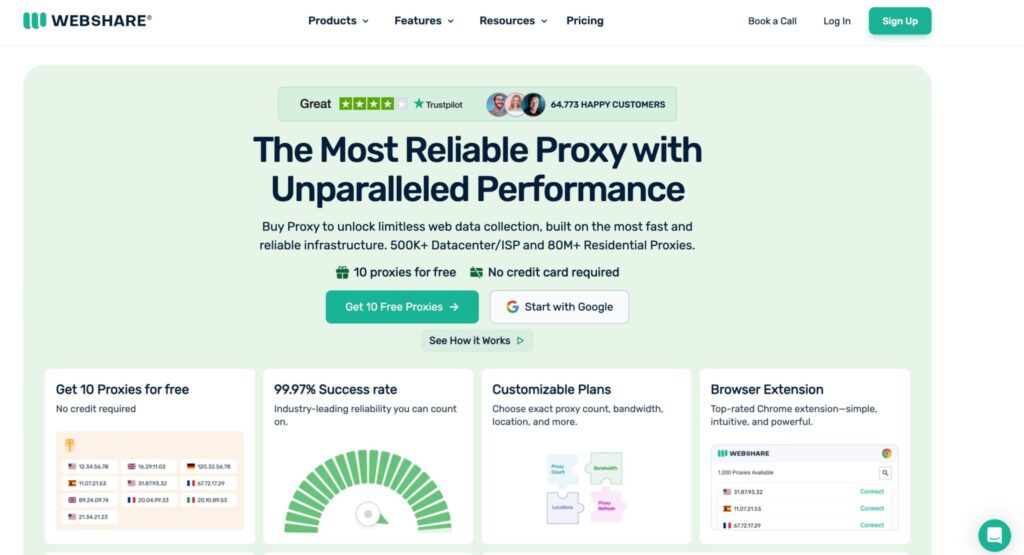
Webshare is not my first pick for serious Android mobile proxy testing, but it is excellent for simple, affordable proxy workflows. If you need proxies for Android browser testing, basic privacy separation, or light web checks, it can be a smart pick.
Its residential proxy page lists 80M+ residential IPs, pricing from $3.50 per month for 1 GB, and static residential options. Webshare also offers SOCKS5 support with datacenter and residential subscriptions, and its free proxy option is useful for testing the dashboard before paying.
Webshare is especially good when you do not need mobile carrier IPs. For example, if you only want to route Chrome on Android through a proxy for basic checks, it can be enough.
Best for: Beginners, low-cost Android browser proxy use, and simple testing.
Watch out for: Not the best choice if you specifically need real 4G or 5G mobile proxy behavior.
Pro Tip
Use Webshare for low-risk browser checks. Do not use it as your main provider for serious Android app localization or carrier-level testing.
10. Infatica: Best Flexible Proxy Mix for Android Users
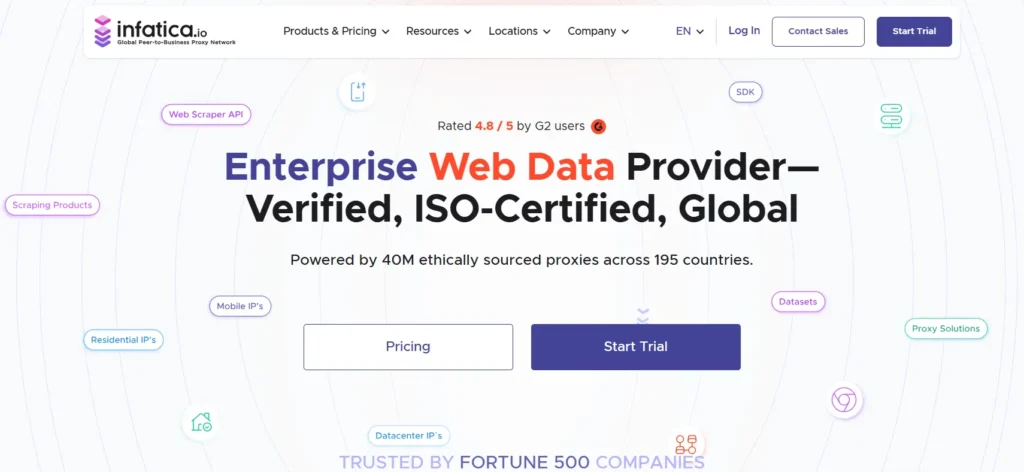
Infatica gives Android users access to mobile, residential, ISP, shared datacenter, and dedicated datacenter options. Its pricing page lists pay-as-you-go traffic from $4 per GB, with larger bandwidth plans reducing the per-GB cost. Its mobile proxy page also mentions trial options and flexible plan structures.
For Android, Infatica works best when you want flexibility. You may use mobile proxies for app testing, residential proxies for web checks, and datacenter proxies for speed-focused tasks. That mix can be useful for agencies handling multiple client workflows.
It may not be the simplest option for total beginners, but technical users will appreciate the range.
Best for: Mixed Android proxy workflows, SEO teams, and data users.
Watch out for: Beginners may need time to understand the best proxy type for each task.
Pro Tip
Build separate proxy profiles by use case. Do not use the same proxy type for app testing, scraping, local search checks, and browser privacy.
How to Choose the Best Android Proxy Provider
The best Android proxy provider is the one that fits your actual workflow. Here is how I would choose.
1. Start With the Use Case
For Android app QA, choose mobile proxies.
For mobile SERP checks, choose residential or mobile proxies.
For ecommerce research, choose residential proxies.
For high-speed backend checks, choose datacenter or ISP proxies.
For long login sessions, choose sticky residential, ISP, or dedicated mobile proxies.
2. Check IP Pool Quality, Not Just IP Pool Size
A provider can advertise millions of IPs, but your target country may only have weak availability. Always test the country, city, and carrier you care about.
Look for:
- Real mobile carrier IPs for mobile workflows
- Clean residential IPs for web checks
- Low failure rate
- Clear replacement policy
- Ethical sourcing
- Transparent usage dashboard
3. Understand Rotation Protocols
Rotation is where Android proxy buying gets technical.
Rotating on every request is good for scraping public pages, but it can break sessions.
Sticky sessions are better for logins, carts, forms, app testing, and ad funnel checks.
Time-based rotation works well when you need the same IP for 5, 10, 30, or 60 minutes.
Manual rotation is useful for debugging because you control when the IP changes.
For Android, sticky sessions are often safer than aggressive rotation.
4. Confirm Protocol Support
Most Android browser proxy setups work with HTTP or HTTPS proxies. Some tools and proxy manager apps support SOCKS5 as well.
SOCKS5 is useful when you need broader traffic handling, but not every Android app will route through your system proxy automatically. That is why a VPN-style proxy app or app-level proxy field can matter.
5. Test Authentication Before Buying Large Plans
Most paid proxies use one of two authentication methods:
- Username and password
- IP whitelisting
On Android, username and password authentication is usually easier if you switch networks. IP whitelisting can be annoying because your mobile or Wi-Fi IP may change.
6. Watch Bandwidth Burn
Android apps can use background data. If you route all traffic through a paid per-GB proxy, updates, syncs, analytics calls, and media previews can burn bandwidth quickly.
Before running a long test:
- Turn off auto-updates
- Disable background data for unnecessary apps
- Use a clean browser profile
- Avoid video-heavy pages
- Track usage from the proxy dashboard
7. Avoid Free Proxies for Serious Android Work
Free proxies are fine for curiosity, not for business workflows. They can be slow, unstable, recycled, blocked, or unsafe. For Android testing, you want accountability. A paid provider gives you a dashboard, support, replacement options, and cleaner IP sourcing.
Best Android Proxy Setup Method
The simplest method is Android’s Wi-Fi proxy setting.
Go to your connected Wi-Fi network, edit the network, open advanced options, choose manual proxy, then enter the proxy hostname and port. Some providers also require username and password authentication after the first browser request. Provider setup guides show this general path, although the exact menu names can change by Android version and phone brand.
For browser-only testing, that may be enough.
For full-device or app-level routing, use one of these:
- A proxy manager app
- A VPN-style proxy client
- An app that supports custom proxy settings
- A rooted device for advanced testing
- An Android emulator with proxy configuration
For most marketers and QA users, a proxy manager app or emulator is cleaner than modifying a personal phone.
Final Verdict: Which Android Proxy Should You Buy?
For most users, Decodo is the best starting point because it balances pricing, usability, and proxy variety. If you need enterprise-grade mobile proxies, Oxylabs is the stronger technical choice. If location accuracy is your main concern, SOAX and ProxyEmpire deserve attention. If budget matters, IPRoyal, DataImpulse, and Webshare are easier to start with. For heavy mobile bandwidth, Rayobyte can become cost-effective. For mixed workflows, Infatica gives you room to experiment.
The real answer is this: do not buy the biggest proxy plan first. Buy the smallest plan that lets you test your exact Android use case. Check app compatibility, session stability, location accuracy, speed, and bandwidth usage. Then scale.
That approach saves money, prevents frustration, and gives you a proxy stack that works in the real world.
FAQs About Android Proxies
1. What is the best proxy type for Android?
Mobile proxies are usually the best fit when you need real smartphone-like traffic. Residential proxies are better when you want cheaper bandwidth for browsing, SEO checks, or public web research. ISP proxies are useful when you need stable sessions.
2. Can I use proxies on Android without root?
Yes, you can configure a proxy for a Wi-Fi network without root. For full-device routing or apps that ignore Android’s Wi-Fi proxy settings, you may need a proxy manager app, VPN-style proxy client, emulator, or app-level proxy support.
3. Do Android proxy settings work for all apps?
Not always. Many browsers respect Wi-Fi proxy settings, but some apps may ignore them or use their own networking logic. That is why app testing often requires a proxy client, emulator, or dedicated testing setup.
4. Are mobile proxies better than residential proxies for Android?
For Android-specific workflows, yes, mobile proxies usually look more natural because they use carrier-associated IPs. But they also cost more. Residential proxies are often enough for basic browsing, SERP checks, and market research.
5. Which proxy provider is best for Android app testing?
Oxylabs is strong for enterprise app testing, Decodo is the best all-round option, and SOAX is excellent for geo-targeted app checks. ProxyEmpire is also useful if you need city or carrier-level targeting.
6. Can I use SOCKS5 proxies on Android?
Yes, but Android’s basic Wi-Fi proxy setting is mainly used for HTTP or HTTPS proxy configuration. For SOCKS5, you may need a proxy app, VPN-style client, browser that supports SOCKS5, or a testing tool with proxy fields.
7. Are free Android proxies safe?
Free proxies are risky for serious work. They may be slow, unstable, shared by too many users, or poorly managed. For business use, paid proxies from a reputable provider are safer and more predictable.
8. Which Android proxy is best for SEO checks?
For mobile SERP checks, use residential or mobile proxies with country and city targeting. SOAX, Decodo, Oxylabs, ProxyEmpire, and IPRoyal are all good options depending on budget and scale.
9. Which Android proxy is best for beginners?
Webshare and IPRoyal are easy starting points for basic use. Decodo is better if you want a more complete provider that can support mobile, residential, and more advanced workflows as you grow.