
Best Proxies for Amazon Scraping: A Practical Buyer’s Guide for Reliable E-Commerce Data Collection;
Amazon data is valuable because it changes constantly. Prices move. Sponsored placements shift. Product availability depends on location. Reviews grow, vanish, and change sentiment. For sellers, agencies, price intelligence teams, and e-commerce researchers, that data can shape real business decisions.
But Amazon is not a simple website to collect data from. It has marketplace-specific pages, localized pricing, dynamic layouts, request limits, and strict rules around automated access. Amazon’s own Conditions of Use restrict the use of robots, data mining, and similar extraction tools, so the safest starting point is always permission-based, API-first, and public-data-only collection. Amazon also provides official developer routes such as Selling Partner API for seller-side business data and documentation for catalog-related access.
That said, many businesses still use proxy infrastructure and scraper APIs for public market research, competitor price monitoring, Buy Box visibility checks, search result tracking, review monitoring, and regional product availability analysis. The right proxy setup does not magically make a bad scraper good. It simply gives your compliant data pipeline better location coverage, session control, and request stability.
This guide compares the best proxy and scraper API providers for Amazon-related public data collection, with a practical focus on IP pools, rotation behavior, marketplace targeting, session quality, pricing style, and when each provider actually makes sense.
Quick Verdict: Best Amazon Scraping Proxy Providers
| Provider | Best For | Proxy Types | Key Strength | Best Fit |
|---|---|---|---|---|
| Bright Data | Enterprise Amazon datasets and large-scale collection | Residential, ISP, datacenter, mobile, scraper APIs | Huge infrastructure, ready Amazon datasets, compliance controls | Large brands, data teams, agencies |
| Oxylabs | Enterprise scraping API and managed extraction | Residential, datacenter, scraper API | Strong Amazon Scraper API with structured outputs | Teams that want results, not proxy management |
| Decodo | Balanced pricing, strong residential pool | Residential, ISP, mobile, datacenter | 125M+ IPs, flexible plans, user-friendly dashboard | Mid-size scraping teams |
| SOAX | Location targeting and sticky session control | Residential, mobile, ISP, datacenter | Fine-grained geo targeting and sticky sessions | Price and availability monitoring |
| NetNut | Scalable residential and rotating residential proxies | Residential, rotating residential, mobile, datacenter | 85M+ IP pool and global coverage | Larger scraping workloads |
| Webshare | Budget-friendly ISP and datacenter options | Datacenter, ISP, rotating residential | Low-cost entry and fast static residential proxies | Small teams and testing |
| IPRoyal | Affordable residential proxies | Residential, datacenter, ISP, mobile | Sticky and random rotation options | Smaller research projects |
| ScraperAPI | Amazon scraping without managing proxies directly | Scraper API | Amazon endpoint with JSON outputs | Developers who want a simple API |
| ZenRows | Scraping API with residential proxies | Scraper API, residential proxies | 55M+ residential IPs and JS rendering support | Dynamic product pages |
| Apify | Ready-made Amazon scraping workflows | Cloud scrapers, actors, automation | Marketplace of scraping tools and workflows | No-code and semi-technical teams |
What Makes a Proxy Good for Amazon Scraping?
A normal proxy list is not enough for Amazon. You need infrastructure that can handle three things well: location, rotation, and session stability.
Location matters because Amazon pricing, stock status, delivery estimates, sellers, and search results can vary by country, city, postal code, and marketplace. A product page on Amazon.com may not behave the same as Amazon.co.uk, Amazon.de, Amazon.in, or Amazon.ca.
Rotation matters because public data collection usually involves repeated requests across product pages, category pages, reviews, search results, and offer listings. Rotating residential proxies are commonly used for this because they distribute traffic across a larger pool of IP addresses. Bright Data explains the basic difference clearly: static proxies keep one IP for requests, while rotating proxies change IPs automatically.
Session control matters because not every request should rotate instantly. For search result pages, frequent rotation can work. For localized pricing checks, cart-adjacent flows, or region-specific pages, a short sticky session can help keep the browsing context consistent. SOAX, for example, highlights automatic IP rotation and sticky sessions on its residential proxy product page.
The safest technical approach is simple: collect only public data you are allowed to use, respect robots and marketplace terms, throttle requests, avoid login-protected areas, avoid personal data collection, and use official APIs wherever available.
1. Bright Data: Best Overall for Enterprise Amazon Data Collection
Bright Data is one of the most mature proxy and web data platforms in the market. It is not the cheapest option, but for Amazon scraping at serious scale, it gives you a broad toolkit: residential proxies, ISP proxies, datacenter proxies, mobile proxies, Web Scraper tools, ready-made datasets, and Amazon-specific data products.
Bright Data states that it has over 400M residential proxy IPs and supports targeting by country, city, carrier, and ASN. It also puts heavy emphasis on ethical sourcing, opt-in peer networks, KYC, and compliance processes.
For Amazon work, Bright Data is best when you do not want to build everything from scratch. Its Amazon-related scraper and dataset pages cover product search, price data, seller information, reviews, product details, and category-level data.
Why Bright Data Works Well for Amazon
Bright Data is strong because it gives you options. You can use raw proxies if you already have an in-house scraping stack, or you can move toward managed scraping APIs and datasets if your team wants cleaner outputs and fewer infrastructure headaches.
Its residential and ISP proxies are useful for localized marketplace checks. Its datasets are useful for teams that need recurring Amazon data but do not want to maintain scrapers. For agencies and enterprise data teams, this flexibility matters.
Where It Falls Short
Bright Data can feel heavy for beginners. The platform has many products, pricing layers, compliance checks, and configuration choices. If you only need to monitor 500 ASINs once a week, it may be more power than you need.
Pro Tip
Use Bright Data when the data quality matters more than the lowest possible bandwidth cost. For Amazon price intelligence, seller tracking, and category monitoring, failed requests can cost more than premium infrastructure.
2. Oxylabs: Best Managed Amazon Scraper API for Enterprises
Oxylabs is another heavyweight in the proxy and public web data space. Its website highlights 175M+ residential proxies and 2M datacenter IPs, along with Web Unblocker, Headless Browser, Web Scraper API, and other data collection tools.
For Amazon specifically, Oxylabs offers an Amazon Scraper API as part of its Web Scraper API. The product page mentions real-time Amazon product data, listings, prices, ASINs, seller details, Q&A, bestseller data, localized content from different Amazon marketplaces, and pay-per-successful-result style positioning.
Why Oxylabs Works Well for Amazon
Oxylabs is excellent for teams that want Amazon data without babysitting proxy pools. Instead of manually handling proxy rotation, parsing, retries, and page rendering, you can use its Amazon Scraper API to retrieve structured outputs.
This is valuable for enterprise teams because Amazon pages are not static. Product pages, pricing blocks, review snippets, sponsored placements, and offer details can change layout. A managed API reduces maintenance time.
Where It Falls Short
Oxylabs is built for serious users. Smaller affiliates, solo developers, and early-stage projects may find the pricing and enterprise positioning more than they need.
Pro Tip
Choose Oxylabs when your internal team cares about business data, not proxy engineering. If your goal is to feed dashboards with product prices, seller data, or Amazon search results, a managed API can be more practical than raw residential proxies.
3. Decodo: Best Balanced Choice for Price, Pool Size, and Usability
Decodo is the new brand name for Smartproxy. The company states that Smartproxy rebranded to Decodo and references 125M+ IPs.
Decodo is a strong fit for teams that want capable residential proxies without jumping straight into enterprise-only pricing. Its residential proxy pricing page lists plans starting from smaller bandwidth packages, with pricing shown from $2 per GB depending on plan type and volume.
Why Decodo Works Well for Amazon
Decodo works well for Amazon scraping because it balances scale and simplicity. You get a large residential pool, location targeting, and session options without the platform feeling too intimidating.
For Amazon use cases like price monitoring, search page tracking, review monitoring, and marketplace comparison, Decodo gives enough control for developers while still keeping the dashboard friendly.
Where It Falls Short
For very large enterprise data operations, Bright Data or Oxylabs may offer deeper managed data products and compliance tooling. Decodo is excellent, but it is usually better positioned as a practical, flexible choice rather than the most advanced enterprise data platform.
Pro Tip
Decodo is a smart middle-ground provider. Use it when Webshare feels too basic, but Bright Data or Oxylabs feels too expensive or complex for your current workload.
4. SOAX: Best for Geo Targeting and Sticky Sessions
SOAX is a strong residential proxy provider for teams that need granular targeting and session control. Its residential proxy page mentions 155M+ IPs in 195+ locations, unlimited concurrent sessions, ethically sourced proxies, 99.9% network uptime, automatic IP rotation, and sticky sessions.
SOAX is especially relevant for Amazon because location can change what you see. A pricing analyst checking product availability across regions may need controlled marketplace and location signals rather than random global rotation.
Why SOAX Works Well for Amazon
SOAX gives you the kind of control that helps with localized product research. Sticky sessions can be useful when you want to keep an IP stable for a short period, while rotation helps distribute larger page collection jobs.
Its location targeting also helps when you need to compare Amazon marketplaces, regional availability, or localized search results.
Where It Falls Short
SOAX may require more hands-on configuration than a fully managed Amazon Scraper API. If your team does not want to manage scraping logic, parsing, or job scheduling, Oxylabs, Bright Data, ScraperAPI, or ZenRows may feel easier.
Pro Tip
Use SOAX for regional Amazon intelligence. For example, if you are tracking product availability across multiple countries, choose location-specific sessions rather than throwing random global residential IPs at the task.
5. NetNut: Best for Scalable Residential Proxy Workloads
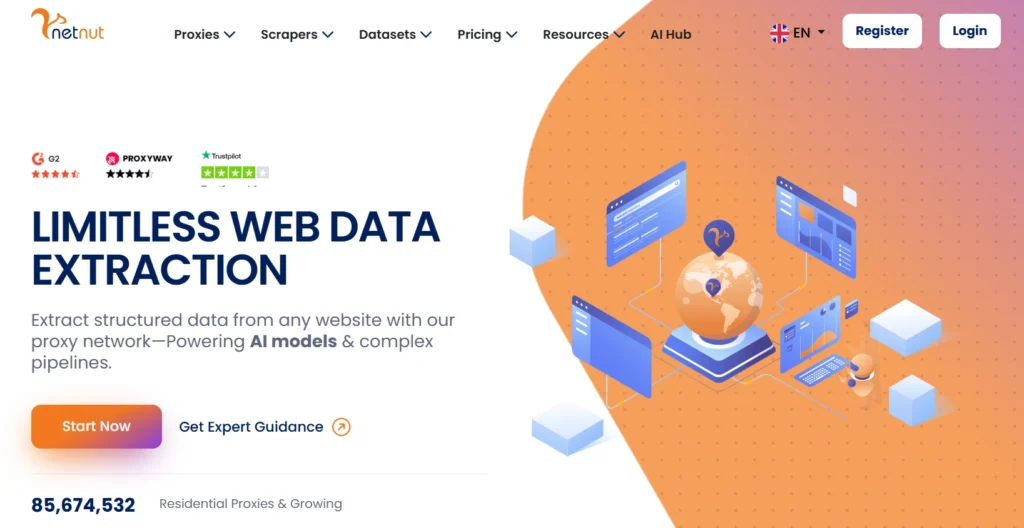
NetNut offers residential, rotating residential, mobile, and datacenter proxies. Its website mentions over 85 million IPs worldwide and coverage across 195+ countries for rotating residential proxies.
NetNut is built for web data collection, ad verification, market research, and similar use cases. For Amazon scraping, it can support product monitoring, pricing analysis, availability checks, and regional marketplace research.
Why NetNut Works Well for Amazon
NetNut is a good choice when you need a scalable residential network but still want a provider that is not as complex as some enterprise-first platforms. Its rotating residential proxies fit large public data collection jobs, while its broader proxy lineup gives teams flexibility.
Where It Falls Short
NetNut’s Amazon-specific tooling may not feel as polished as a dedicated Amazon Scraper API from Oxylabs or ScraperAPI. If you want structured JSON from Amazon pages with minimal engineering, a scraper API may be easier.
Pro Tip
NetNut makes sense when your team already has a working scraper and mainly needs better IP infrastructure. It is less ideal if you want a plug-and-play Amazon data endpoint.
6. Webshare: Best Budget Option for Small Teams and Testing
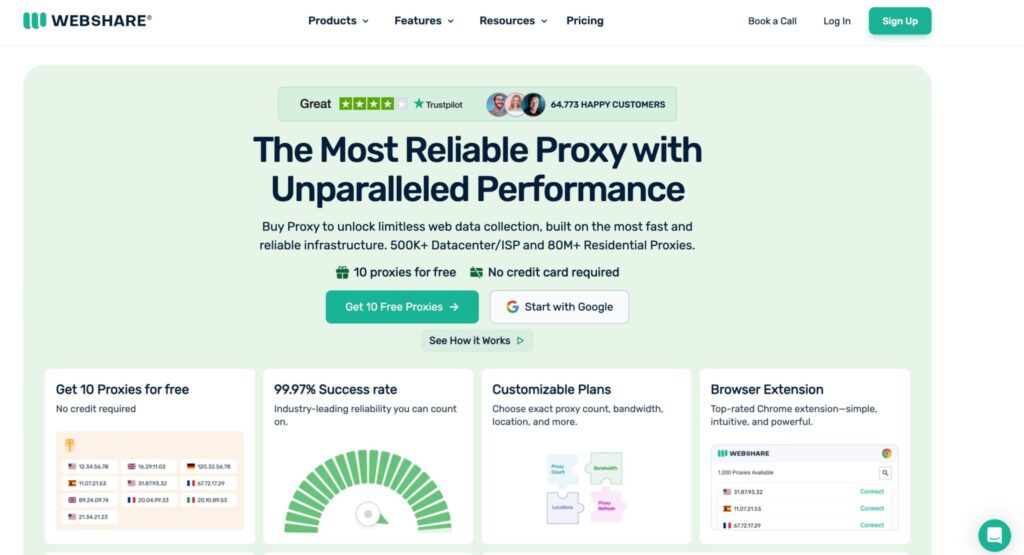
Webshare is popular because it is affordable and easy to start with. Its static residential proxy page mentions ISP-issued static IPs, HTTP/SOCKS5 support, and use cases such as scraping, ad verification, and long-running sessions.
Its ISP proxy page also highlights low-cost plans starting at $6 per month for 20 IPs with 250GB bandwidth, along with fast static residential proxies.
Why Webshare Works Well for Amazon
Webshare is a good starting point if you are testing a small Amazon data project. Its ISP and datacenter proxies can be useful for lightweight tasks, QA checks, and low-volume monitoring.
It is also attractive for developers who want predictable pricing instead of paying high residential bandwidth rates from day one.
Where It Falls Short
Amazon is a demanding target. Basic datacenter proxies often struggle more than residential or ISP networks, especially when requests scale. Webshare is useful, but it is not the strongest choice for complex, high-volume Amazon scraping.
Pro Tip
Start with Webshare for proof-of-concept work. Once your scraper logic, data fields, and compliance process are stable, move heavier workloads to residential, ISP, or managed scraping APIs.
7. IPRoyal: Best Affordable Residential Proxy Choice
IPRoyal is a budget-friendly proxy provider with residential, datacenter, ISP, and mobile proxy options. Its documentation explains two residential proxy rotation types: Sticky and Randomize. Sticky keeps a session more stable, while Randomize rotates IP behavior for broader request distribution.
IPRoyal’s residential proxy guide also shows controls for selecting location, choosing rotation type, and setting session TTL.
Why IPRoyal Works Well for Amazon
IPRoyal is useful for smaller teams that need residential proxies without high monthly commitments. For Amazon research projects, it can handle basic price monitoring, product page checks, and search result tracking when configured responsibly.
Its sticky session control helps when you need short-term consistency. Its random rotation helps when you are collecting broader public product data.
Where It Falls Short
IPRoyal may not offer the same enterprise-level tooling, managed data products, or advanced scraping APIs as Bright Data or Oxylabs. It is better for cost-conscious users than large-scale enterprise pipelines.
Pro Tip
IPRoyal is best when your scraping volume is moderate and your budget is tight. Keep your request rates conservative and track success rates by marketplace before scaling.
8. ScraperAPI: Best Simple Amazon Scraper API
ScraperAPI is not just a proxy provider. It is a scraping API that handles proxy infrastructure behind the scenes. Its Amazon Scraper API page says it can retrieve product details, reviews, offers, searches, and product pricing in JSON format.
This makes it appealing for developers who do not want to manage proxy pools, sessions, retries, and parsing logic manually.
Why ScraperAPI Works Well for Amazon
ScraperAPI is attractive because it simplifies the workflow. Instead of building proxy rotation and parser maintenance from scratch, you send requests to an Amazon-focused endpoint and receive structured data.
For lean teams, affiliate site operators, small SaaS products, and e-commerce analysts, this can save a lot of time.
Where It Falls Short
A scraper API gives you less low-level control than raw proxies. If you need custom browser behavior, very specific session logic, or unusual collection workflows, a raw proxy provider may be more flexible.
Pro Tip
Use ScraperAPI when speed of implementation matters. If your main goal is to monitor prices, offers, reviews, and search pages quickly, an Amazon endpoint is often cleaner than building everything yourself.
9. ZenRows: Best for Dynamic Pages and Developer-Friendly Scraping
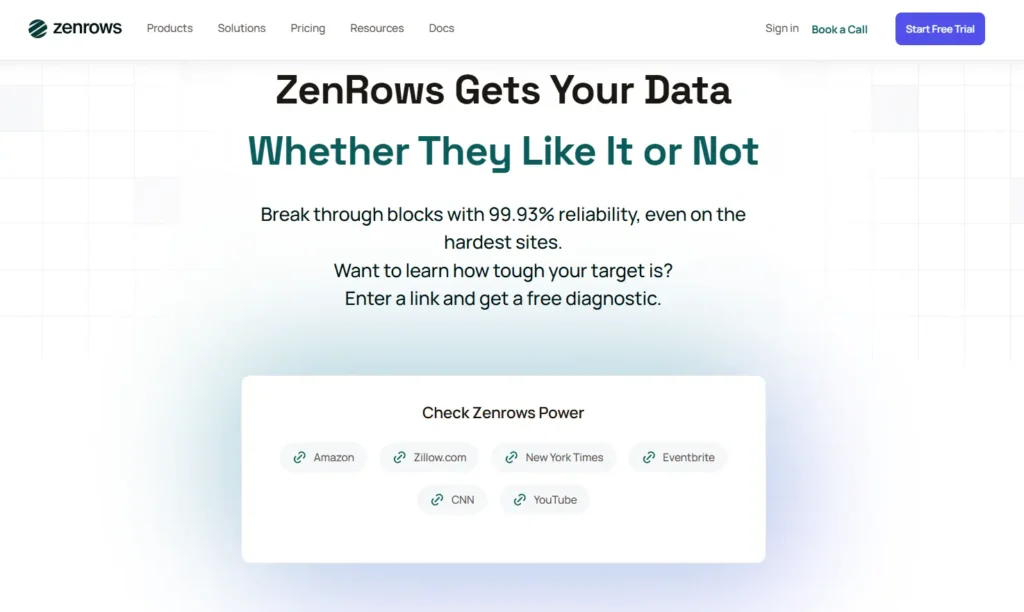
ZenRows provides a web scraping toolkit that includes Universal Scraper API, Scraping Browser, and residential proxies. Its site mentions residential proxies with 55M+ IPs across 185+ countries, geotargeting, smart rotation, and support for dynamic scraping needs.
Why ZenRows Works Well for Amazon
ZenRows is helpful when your Amazon data collection involves dynamic pages, rendered content, screenshots, or browser-style workflows. It also gives developers a more convenient API layer instead of forcing them to manage every proxy detail.
For teams already using Puppeteer, Playwright, or browser automation, ZenRows can fit into existing workflows more naturally than a basic proxy pool.
Where It Falls Short
ZenRows is stronger as a scraping API toolkit than as a pure raw proxy bargain. If you only need low-cost proxies and want to handle everything yourself, Webshare or IPRoyal may be cheaper.
Pro Tip
Choose ZenRows when Amazon page rendering and structured scraping matter more than raw bandwidth cost.
10. Apify: Best for Ready-Made Amazon Scraping Workflows
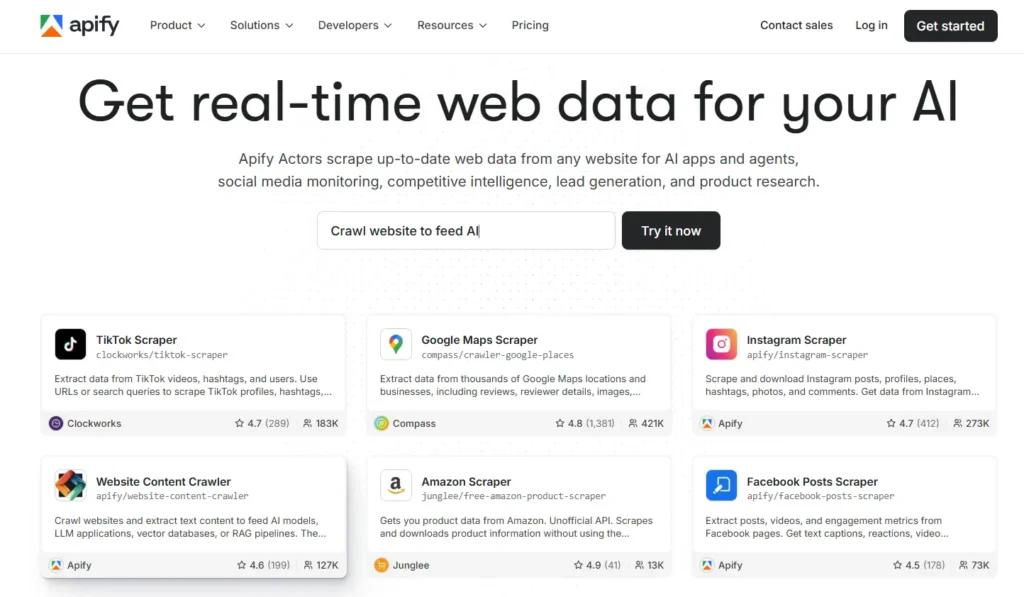
Apify is a cloud platform for web scraping, browser automation, AI agents, and data extraction. Its homepage mentions 31,000+ ready-made tools and templates, along with the ability to build, run, and monetize scrapers.
Apify is different from proxy-first providers. It is more of a scraping operations platform. You can use ready-made Actors, build your own crawlers, schedule jobs, store outputs, and integrate with APIs.
Why Apify Works Well for Amazon
Apify is useful if you want workflows, not just proxies. For example, a team may want to schedule Amazon product monitoring, export results, connect data to Google Sheets, or run recurring crawlers without building a full backend.
Where It Falls Short
Ready-made scrapers can break when target layouts change, and scraping platform costs can increase as volume grows. If your team needs complete infrastructure control, raw proxy providers may be a better fit.
Pro Tip
Apify is excellent for semi-technical teams. Use it when you want recurring Amazon data jobs but do not want to engineer the entire scraping system from scratch.
Amazon Scraping Proxy Comparison Table
| Provider | IP Pool / Scale | Rotation Control | Geo Targeting | Amazon-Specific Tools | Pricing Style | Best Use Case | Main Limitation |
|---|---|---|---|---|---|---|---|
| Bright Data | 400M+ residential IPs stated | Advanced rotation and session tools | Country, city, carrier, ASN | Amazon scrapers and datasets | Premium, usage-based | Enterprise market intelligence | Cost and complexity |
| Oxylabs | 175M+ residential proxies stated | Managed through API and proxy tools | Global marketplace coverage | Amazon Scraper API | Enterprise / pay per results options | Structured Amazon data | Less beginner-friendly |
| Decodo | 125M+ IPs stated | Rotating and sticky options | Wide global targeting | Scraping tools available | Flexible bandwidth plans | Mid-market scraping teams | Fewer enterprise dataset products |
| SOAX | 155M+ IPs stated | Automatic rotation and sticky sessions | 195+ locations | Proxy-first setup | Bandwidth-based | Localized Amazon checks | Requires scraper setup |
| NetNut | 85M+ IPs stated | Rotating residential options | 195+ countries | Proxy-first setup | Plan-based | Large residential workloads | Less plug-and-play for Amazon |
| Webshare | Broad ISP, residential, datacenter options | Static and rotating options | Global coverage varies by plan | No major Amazon API focus | Low-cost plans | Testing and small jobs | Not ideal for heavy Amazon scraping |
| IPRoyal | Residential pool with sticky/random rotation | Sticky and random sessions | Location selection | Proxy-first setup | Budget-friendly | Small to mid-size projects | Less advanced tooling |
| ScraperAPI | Managed infrastructure | Handled by API | Amazon endpoint support | Amazon Scraper API | API/request-based | Quick Amazon data extraction | Less low-level control |
| ZenRows | 55M+ residential IPs stated | Smart rotation | 185+ countries | Universal Scraper API | API and proxy pricing | JS-heavy pages | Can cost more than raw proxies |
| Apify | Platform-based | Depends on actor/workflow | Depends on configuration | Ready-made scraping workflows | Usage/platform-based | Scheduled workflows | Actor quality varies |
How to Choose the Best Proxy for Amazon Scraping
1. Start With the Data Type
Not all Amazon data needs the same setup.
For product prices, you need stable marketplace targeting and consistent parsing.
For search result tracking, you need reliable rotation, keyword coverage, and location control.
For reviews, you need pagination handling, duplicate detection, and careful request pacing.
For seller or offer data, you need structured extraction because the layout can vary by product and marketplace.
For Buy Box monitoring, you need consistency because small changes in location, delivery settings, or page state can change what you see.
If you need structured data quickly, pick Oxylabs, ScraperAPI, Bright Data, ZenRows, or DataForSEO-style APIs. If you already have crawlers and only need IP infrastructure, use Bright Data, Decodo, SOAX, NetNut, Webshare, or IPRoyal.
2. Match Proxy Type to Workload
| Proxy Type | Best For Amazon Use | When to Avoid |
|---|---|---|
| Residential proxies | Large public data collection, localized checks | When budget is very tight |
| ISP proxies | Stable sessions, price checks, longer monitoring windows | When you need massive rotation |
| Datacenter proxies | Testing, lightweight scraping, non-sensitive pages | Heavy Amazon collection |
| Mobile proxies | Niche mobile marketplace testing | Most normal price scraping projects |
| Scraper APIs | Structured product data without proxy management | Highly custom workflows |
For Amazon, residential and ISP proxies usually perform better than basic datacenter proxies. Datacenter proxies are fast and cheap, but they are easier to classify as automated infrastructure. Webshare itself notes that datacenter proxies are more easily detected compared to residential proxies.
3. Look Closely at IP Pool Quality, Not Just Pool Size
A large IP pool looks impressive, but quality matters more than the number printed on the homepage.
Check for:
- Ethically sourced residential IPs
- Real geo coverage in your target marketplaces
- Low failure rates during your own test runs
- Session controls that match your scraper logic
- Clean documentation and API examples
- Support response speed
- Clear acceptable use policies
A 10M IP pool with stable performance in your target country can beat a 100M IP pool that performs poorly in the marketplace you care about.
4. Understand Rotation Protocols Before Scaling
Rotation should match the page type.
For search result pages, rotating per request can work because each page is independent.
For product detail pages, moderate rotation is better because you still want consistent marketplace behavior.
For localized price checks, sticky sessions are often better because sudden IP changes can alter the region signal.
For large catalog monitoring, use controlled batches. Rotate across batches, not chaotically across every single request.
The goal is not aggressive scraping. The goal is clean, repeatable data collection that does not overload systems or produce junk results.
5. Do a Small Proof of Concept Before Buying Big Plans
Before you commit to a large proxy plan, test:
- 100 to 500 ASINs
- 3 to 5 target marketplaces
- Product pages, search pages, and review pages separately
- Peak and off-peak request timing
- Output accuracy against manual checks
- Cost per successful result
- Duplicate and missing data rates
The best proxy is not always the one with the lowest per-GB price. The real metric is cost per accurate, usable, compliant result.
Pro Tips for Better Amazon Data Collection
Pro Tip 1: Track success rate by page type.
Product pages, search pages, review pages, and offer pages behave differently. Do not average everything together or you will miss the real bottleneck.
Pro Tip 2: Use official APIs where possible.
If you are a seller, Selling Partner API may be the right path for your own listings, orders, payments, and reports. If you are working with affiliate/product data, check Amazon’s current Product Advertising or Creators API documentation before scraping.
Pro Tip 3: Do not over-rotate sticky tasks.
If your goal is to check localized price or availability, changing IPs too frequently can create inconsistent results.
Pro Tip 4: Watch data quality, not just blocks.
Bad Amazon scraping does not always fail loudly. Sometimes it returns incomplete pages, wrong locations, missing offers, or inconsistent prices.
Pro Tip 5: Separate parsing from collection.
Store raw HTML or API responses when allowed, then parse separately. This helps debug layout changes without rerunning every request.
Pro Tip 6: Avoid login-protected or personal data.
Keep your workflow focused on public product, price, search, review, and availability data. Do not collect customer personal data or private account areas.
Pro Tip 7: Budget using cost per successful row.
Residential proxies may look expensive per GB, but if they produce more accurate rows with fewer retries, they can be cheaper in practice.
Best Provider by Use Case
| Use Case | Best Pick | Why |
|---|---|---|
| Enterprise Amazon datasets | Bright Data | Strong scraper and dataset ecosystem |
| Structured Amazon product API | Oxylabs | Amazon Scraper API with parsed outputs |
| Mid-budget residential proxies | Decodo | Strong balance of pool size and pricing |
| Localized Amazon price checks | SOAX | Strong geo targeting and sticky sessions |
| High-volume residential scraping | NetNut | Scalable rotating residential network |
| Cheap testing setup | Webshare | Low entry cost and ISP proxy options |
| Small team residential proxies | IPRoyal | Affordable sticky/random rotation |
| Simple Amazon endpoint | ScraperAPI | Developer-friendly Amazon API |
| Dynamic page workflows | ZenRows | Scraping API, rendering, residential proxies |
| Workflow automation | Apify | Ready-made tools and scheduled jobs |
Final Recommendation
For most professional Amazon scraping projects, I would shortlist Bright Data, Oxylabs, Decodo, SOAX, and ScraperAPI first.
Pick Bright Data if you need enterprise-grade infrastructure, Amazon datasets, and deep control.
Pick Oxylabs if you want structured Amazon data from a managed scraper API.
Pick Decodo if you want a strong residential proxy provider with better cost balance.
Pick SOAX if localized price and availability monitoring is your main use case.
Pick ScraperAPI if you want a simple Amazon-focused API without managing proxies manually.
For smaller projects, Webshare and IPRoyal are practical starting points. For workflow-driven teams, Apify can save time. For dynamic pages and browser-style scraping, ZenRows deserves a look.
The winning setup depends on your workload. Amazon scraping is not just about getting a proxy. It is about building a clean data collection system that respects rules, controls request volume, targets the right marketplace, and gives you accurate results.
FAQs About Amazon Scraping Proxies
1. What type of proxy is best for Amazon scraping?
Residential proxies and ISP proxies are usually the best choices for Amazon public data collection. Residential proxies offer broad rotation and location coverage, while ISP proxies provide more stable sessions. Datacenter proxies are cheaper and faster, but they are usually less reliable for demanding Amazon scraping tasks.
2. Are rotating proxies better than sticky proxies for Amazon?
It depends on the data. Rotating proxies are better for large product or search result collection. Sticky proxies are better when you need short-term consistency, such as localized pricing, availability checks, or repeated requests within the same marketplace context.
3. Is Amazon scraping legal?
It depends on what data you collect, how you collect it, your jurisdiction, and Amazon’s terms. Amazon’s Conditions of Use restrict data mining, robots, and similar extraction tools, so you should get legal guidance, use official APIs when available, collect only permitted public data, and avoid login-protected or personal data.
4. Can I scrape Amazon without proxies?
For very small manual checks or API-based workflows, you may not need proxies. For larger public data collection, proxies are often used for location coverage, request distribution, and session control. A scraper API may be easier than managing raw proxies yourself.
5. Which is better for Amazon: proxy provider or scraper API?
Use a proxy provider if you already have developers, parsers, schedulers, and QA systems. Use a scraper API if you want structured data faster and do not want to manage retries, rendering, and parsing. For business users, scraper APIs are often more practical.
6. What data can businesses monitor on Amazon?
Common public-data use cases include product pricing, product titles, ratings, review counts, search rankings, seller offers, stock availability, category trends, and marketplace differences. Always avoid private account data, customer personal data, and restricted areas.
7. How much do Amazon scraping proxies cost?
Costs vary widely. Budget providers may start with small monthly plans, while residential proxy plans often charge by bandwidth. Managed scraper APIs may charge by request or successful result. The better metric is not price per GB. It is cost per accurate data row.
8. Do I need country-specific proxies for Amazon scraping?
Yes, if your project depends on localized results. Amazon content can vary by marketplace and location. Country or city targeting helps when tracking regional prices, delivery availability, marketplace search results, or seller visibility.
9. What is the safest way to collect Amazon data?
Start with official APIs where possible, collect only permitted public data, respect applicable terms and robots instructions, throttle requests, avoid login-protected areas, avoid personal data, and document your data purpose clearly. For commercial projects, get legal review before scaling.