
Mobile proxies are not cheap, and SOCKS5 support is not something you should assume every provider handles properly. That is where many buyers make the wrong call.
They see “mobile proxies,” buy a plan, plug it into a scraping tool, automation browser, SEO tracker, social workflow, or app testing setup, then realize the product only supports HTTP(S), has weak session control, limited carrier targeting, or no clean SOCKS5 configuration.
A proper mobile SOCKS5 proxy setup gives you two advantages at once. First, your traffic routes through real mobile carrier IPs, often 3G, 4G, LTE, or 5G. Second, SOCKS5 gives broader compatibility than standard HTTP proxies, especially for tools that need lower-level proxy handling, custom clients, desktop apps, browser profiles, and technical workflows.
Decodo describes SOCKS5 as a Layer 5 proxy that routes traffic between your client and the destination without inspecting or changing the payload, while Infatica explains mobile proxies as internet-connected mobile devices, such as smartphones or tablets, that mask your original IP with a mobile-network IP.
This guide cuts through the noise and focuses on providers that are worth testing for mobile SOCKS5 use cases. The main things I looked at are mobile IP pool quality, protocol support, rotation control, sticky sessions, geo-targeting, setup complexity, and whether the provider is better for small users, developers, or enterprise teams.
Quick Picks: Best Mobile SOCKS5 Proxy Providers
| Provider | Best For | Mobile SOCKS5 Support | Mobile Pool / Coverage | Rotation Style | Best Strength |
|---|---|---|---|---|---|
| Bright Data | Enterprise mobile proxy infrastructure | Yes | 7M+ mobile IPs worldwide | Rotating and session control | Strong compliance, scale, targeting |
| Oxylabs | Premium mobile data collection | Yes | 20M+ mobile IPs, 140+ countries | Per-request and 24-hour sticky sessions | Very strong mobile scraping setup |
| Decodo | Best overall balance | Yes | 10M+ mobile IPs, 160+ locations, 700+ carriers | Rotating and sticky | Easy setup, strong performance |
| SOAX | Precise geo-targeting | Yes | 33M+ mobile IPs, 195 locations | Rotating and sticky | Carrier and location control |
| IPRoyal | Affordable mobile SOCKS5 | Yes | Real mobile carrier IPs worldwide | Custom rotation | Budget-friendly and flexible |
| NetNut | High-scale teams | Yes | 5M+ mobile IPs, 100+ countries | Rotating mobile proxies | Strong scale and enterprise workflow |
| Infatica | Developers and API users | Yes | Mobile proxy product with HTTP and SOCKS5 | Port/session based setup | Developer-friendly docs |
| MarsProxies | Budget mobile proxy testing | Yes | 5G/4G/3G/LTE mobile proxies | Rotation and proxy management | Simple pricing and SOCKS5 support |
| Proxy-Seller | Dedicated/shared mobile proxy setups | Yes | Real 4G/5G carrier proxies | Timer and on-demand rotation | Manual control over rotation |
| Proxyrack | Protocol flexibility | Yes | Mobile/residential style proxy products | Rotating options | HTTP, HTTPS, SOCKS4, SOCKS5, UDP |
What Are Mobile SOCKS5 Proxies?
A mobile proxy routes your traffic through a mobile network IP address. These IPs usually come from mobile carriers and are tied to cellular networks rather than fixed home broadband or data center infrastructure.
A SOCKS5 proxy is a more flexible proxy protocol than HTTP. HTTP proxies are mainly built for web traffic. SOCKS5 can handle a wider set of traffic types, depending on how the provider configures it. Proxy-Seller describes SOCKS5 as a versatile protocol that can handle more than HTTP/HTTPS traffic and may support TCP and UDP-style use cases.
When you combine mobile IPs with SOCKS5, you get a proxy type that works well for:
- Mobile app testing
- Localized mobile web checks
- Ad verification
- SEO rank tracking from mobile networks
- Price monitoring
- Public web data collection
- Browser profile tools
- QA testing across regions
- Tools that specifically require SOCKS5
The main benefit is not “magic invisibility.” The real benefit is compatibility plus a more natural mobile-network footprint.
Mobile SOCKS5 vs Residential SOCKS5 Proxies
Residential SOCKS5 proxies use IPs linked to home internet connections. Mobile SOCKS5 proxies use IPs linked to mobile carriers.
Mobile proxies usually have a stronger trust profile on mobile-first platforms because many users share carrier-grade NAT IP ranges. That makes mobile IP behavior different from a single household broadband IP. Rayobyte explains that mobile proxies can be harder to ban because mobile IPs are often shared by many users through carrier-grade NAT, although they also tend to be slower and more expensive than other proxy types.
Use mobile SOCKS5 when your workflow needs:
- Mobile carrier IPs
- 3G/4G/LTE/5G network appearance
- Mobile-first testing
- Better compatibility with apps and automation tools
- Sticky mobile sessions
- Carrier or city targeting
Use residential SOCKS5 when you need:
- Larger pools
- Lower cost per GB
- More general web scraping
- Home broadband style IPs
- Wider availability across countries
1. Bright Data: Best Enterprise Mobile SOCKS5 Proxy Network
Bright Data is one of the strongest options if you need enterprise-grade mobile proxy infrastructure. Its documentation states that SOCKS5 proxy connections are supported across Bright Data’s datacenter, ISP, residential, and mobile networks. Bright Data also documents a mobile proxy network with 7 million mobile IPs worldwide.
Bright Data is not the cheapest provider, but it is built for teams that care about scale, compliance, targeting depth, and infrastructure reliability. If you are running ad verification, business intelligence, competitor monitoring, or serious public data collection, this is one of the first providers worth testing.
Why Bright Data Stands Out
Bright Data gives you strong targeting controls, large infrastructure, a mature dashboard, and documentation that explains important SOCKS5 restrictions clearly. That matters because SOCKS5 support is not always plug-and-play. Some providers hide protocol limits until after purchase. Bright Data at least makes the technical setup clear.
Best Use Cases
Bright Data works best for enterprise scraping, mobile ad verification, app QA, market intelligence, and regulated data workflows where you need a serious provider with compliance processes.
Where It Falls Short
The setup can feel technical for beginners. Also, Bright Data’s SOCKS5 documentation includes specific usage rules, so you should test your exact target, protocol, and port requirements before buying a larger plan.
Pro Tip
Use Bright Data when infrastructure reliability matters more than saving a few dollars per GB. It is overkill for tiny projects, but strong for serious workflows.
2. Oxylabs: Best Premium Mobile SOCKS5 Provider for Data Collection
Oxylabs is another premium provider with strong mobile proxy infrastructure. Its mobile proxy page lists 20M+ mobile IPs across 140+ countries, 99.9% uptime, automatic rotation, 24-hour sticky sessions, and support for HTTP, HTTPS, and SOCKS5 protocols.
This makes Oxylabs one of the cleanest choices for teams that need mobile SOCKS5 proxies for scraping, monitoring, testing, and data collection at scale.
Why Oxylabs Stands Out
Oxylabs does a good job combining mobile IP quality, protocol support, targeting, and enterprise-grade support. Its 24-hour sticky session option is especially useful because many mobile proxy users do not want an IP that changes too aggressively during multi-step workflows.
Best Use Cases
Oxylabs is strong for mobile SERP tracking, ecommerce monitoring, price intelligence, mobile ad verification, public data scraping, and app testing.
Where It Falls Short
Oxylabs is premium-priced. Smaller users may find IPRoyal, MarsProxies, or Proxy-Seller more affordable for testing.
Pro Tip
Oxylabs is worth testing if your workflow fails with cheaper mobile proxies. You may pay more upfront, but better success rates can lower your real cost per successful request.
3. Decodo: Best Overall Balance for Mobile SOCKS5 Proxies
Decodo, formerly Smartproxy, is one of the best overall choices for users who want mobile SOCKS5 proxies without a painful setup process. Its mobile proxy page says users can choose between HTTP(S) and SOCKS5, and its pricing page lists 10M+ mobile proxies from 700+ carriers with HTTP(S) and SOCKS5 protocol support.
Decodo’s documentation also explains an important detail: SOCKS5 mobile proxies must use the gate.decodo.com endpoint and port 7000, while country endpoints do not work for SOCKS5.
Why Decodo Stands Out
Decodo is practical. The dashboard is easier than many enterprise providers, the documentation is clear, and the product gives enough technical control for serious users without feeling too heavy.
It is a strong pick for affiliate marketers, SEO teams, web data teams, app testers, and developers who want a reliable mobile proxy stack.
Best Use Cases
Decodo works well for mobile rank tracking, localized mobile testing, social platform QA, ecommerce scraping, browser automation, and mobile app testing.
Where It Falls Short
SOCKS5 setup has endpoint-specific rules. If you try to use country endpoints directly with SOCKS5, your setup may fail.
Pro Tip
With Decodo, configure geo-targeting through username parameters when using SOCKS5. Do not assume HTTP endpoint logic works the same way for SOCKS5.
4. SOAX: Best for Geo-Targeted Mobile SOCKS5 Workflows
SOAX is a strong mobile proxy provider for users who care about targeting. Its mobile proxy page lists 33M+ mobile proxies, 195 locations, and support for HTTP, HTTPS, SOCKS5, UDP, and QUIC. (Soax)
SOAX is especially useful when location accuracy matters. If your workflow depends on country, city, carrier, or regional targeting, SOAX belongs on your shortlist.
Why SOAX Stands Out
The big advantage is control. SOAX is known for a clean dashboard and strong targeting filters. It also supports a wider protocol set than many providers, including SOCKS5, UDP, and QUIC on the mobile proxy page.
Best Use Cases
SOAX is best for local SEO checks, mobile ad verification, regional price checks, app localization testing, and market research.
Where It Falls Short
SOAX is not always the cheapest option. If your main goal is low-cost scraping at high volume, compare it against Decodo, IPRoyal, MarsProxies, and Proxy-Seller.
Pro Tip
Choose SOAX when bad geo-targeting would ruin the project. For example, checking how ads appear in a city is different from simply needing “a US mobile IP.”
5. IPRoyal: Best Budget-Friendly Mobile SOCKS5 Provider
IPRoyal is a strong option for users who want mobile SOCKS5 proxies without jumping straight into enterprise pricing. Its mobile proxy quick-start guide says IPRoyal mobile proxies are sourced from premium mobile carriers worldwide, support HTTP/HTTPS and SOCKS5, offer country, state, and city-level geo-targeting, and include custom rotation options.
IPRoyal documentation also says it offers dedicated and rotating mobile proxies using real mobile IPs from physical mobile devices with 3G/4G/5G SIM cards.
Why IPRoyal Stands Out
IPRoyal is easy to recommend for smaller teams and solo users because it combines affordability, mobile IPs, SOCKS5 support, and flexible rotation controls.
It is not always as enterprise-polished as Bright Data or Oxylabs, but it gives you enough technical control for many real-world projects.
Best Use Cases
IPRoyal is useful for small scraping projects, mobile testing, browser profiles, social media management workflows, QA checks, and budget-sensitive proxy testing.
Where It Falls Short
The platform may not offer the same depth of enterprise tooling, compliance workflows, or advanced infrastructure as Bright Data or Oxylabs.
Pro Tip
Start with IPRoyal if you are testing mobile SOCKS5 for the first time. Track success rate carefully. If performance is strong, you may not need a more expensive provider.
6. NetNut: Best for High-Scale Mobile Proxy Teams
NetNut offers a large mobile proxy network, with its mobile proxy page listing 5M+ mobile IP addresses across 100+ countries and 3G, 4G, 5G, and LTE mobile proxy servers. Its mobile proxy documentation says NetNut proxies support HTTP, HTTPS, and SOCKS5 protocols.
NetNut is better suited for users who already understand proxy workflows and need scale, not beginners looking for the cheapest test plan.
Why NetNut Stands Out
NetNut’s strength is scale. If you are running serious data collection, monitoring, or automation workflows, you want mobile IP volume, stable gateways, and account-level support. NetNut fits that profile.
Best Use Cases
NetNut is a good fit for enterprise scraping, mobile SERP intelligence, ad verification, price monitoring, and high-volume public data collection.
Where It Falls Short
Pricing and setup may feel less beginner-friendly. Smaller users may prefer Decodo, IPRoyal, or MarsProxies.
Pro Tip
Use NetNut when concurrency and coverage matter. Run a real benchmark against your target websites before committing to a larger plan.
7. Infatica: Best Developer-Friendly Mobile SOCKS5 Provider
Infatica is a good option for developers who want documentation and direct proxy configuration. Its mobile proxy documentation recommends HTTP and SOCKS5 for optimal performance and says HTTPS is available but not recommended for performance-sensitive tasks. It also mentions using different ports in the 10000–10999 range for simultaneous requests.
This is useful because mobile SOCKS5 setups often fail due to poor documentation, not because the proxy pool itself is bad.
Why Infatica Stands Out
Infatica’s documentation is practical for technical users. If you are integrating proxies into scripts, browser tools, or internal systems, clear port and protocol guidance matters.
Best Use Cases
Infatica works well for developer-led scraping, app testing, automation systems, market research, and public data collection workflows.
Where It Falls Short
Infatica does not have the same market visibility as Bright Data, Oxylabs, or Decodo. That does not make it weak, but it means testing is important before scaling.
Pro Tip
Infatica is worth testing when you want SOCKS5 configuration details and developer control rather than only a pretty dashboard.
8. MarsProxies: Best Budget Mobile SOCKS5 Option for Testing
MarsProxies offers mobile proxies with 5G/4G/3G/LTE support, and its mobile proxy page clearly mentions HTTPS and SOCKS5 support.
This makes it a practical option for users who want to test mobile SOCKS5 without starting with a top-tier enterprise provider.
Why MarsProxies Stands Out
MarsProxies keeps the offer simple. You get mobile proxies, SOCKS5 support, and accessible pricing compared with many premium providers. For testing, small automation tasks, and basic mobile workflows, that simplicity is useful.
Best Use Cases
MarsProxies fits small web scraping tests, mobile QA, account management workflows, basic automation, and users comparing proxy performance across several providers.
Where It Falls Short
It may not match the enterprise-grade targeting, pool depth, or compliance support of Bright Data, Oxylabs, or SOAX.
Pro Tip
Use MarsProxies as a benchmark provider. Compare its real success rate against a premium option before deciding whether the higher-cost provider is worth it.
9. Proxy-Seller: Best for Manual Rotation Control
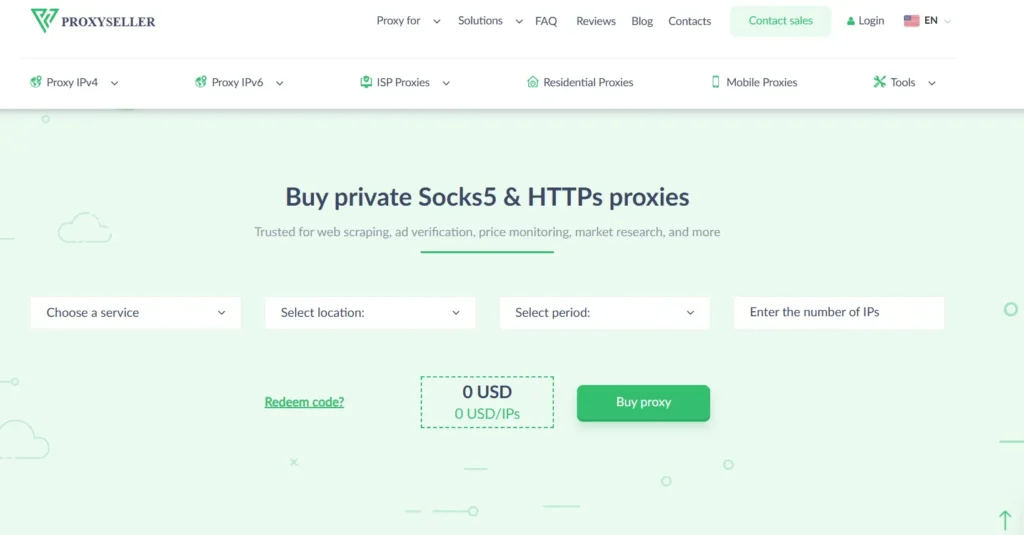
Proxy-Seller offers rotating 4G/5G/LTE mobile proxies from real carriers, with dedicated and shared pools and control over IP rotation by timer or on demand.
Proxy-Seller also states that its broader proxy catalog includes mobile proxies supporting SOCKS5 and HTTP(S), and its main site highlights HTTPS and SOCKS5 support for network applications.
Why Proxy-Seller Stands Out
The key value here is rotation control. Some projects need predictable IP changes. Others need manual switching through a control panel or rotation link. Proxy-Seller gives users more direct control than many simple rotating pools.
Best Use Cases
Proxy-Seller is good for account workflows, testing, scraping, QA, and projects where manual or timer-based rotation matters.
Where It Falls Short
You should confirm SOCKS5 support for the exact mobile plan and location before buying. Proxy-Seller has multiple proxy categories, and protocol support can vary by product.
Pro Tip
Before checkout, ask support to confirm the exact SOCKS5 hostname, port, authentication type, location availability, and rotation method for your selected mobile plan.
10. Proxyrack: Best for Protocol Flexibility
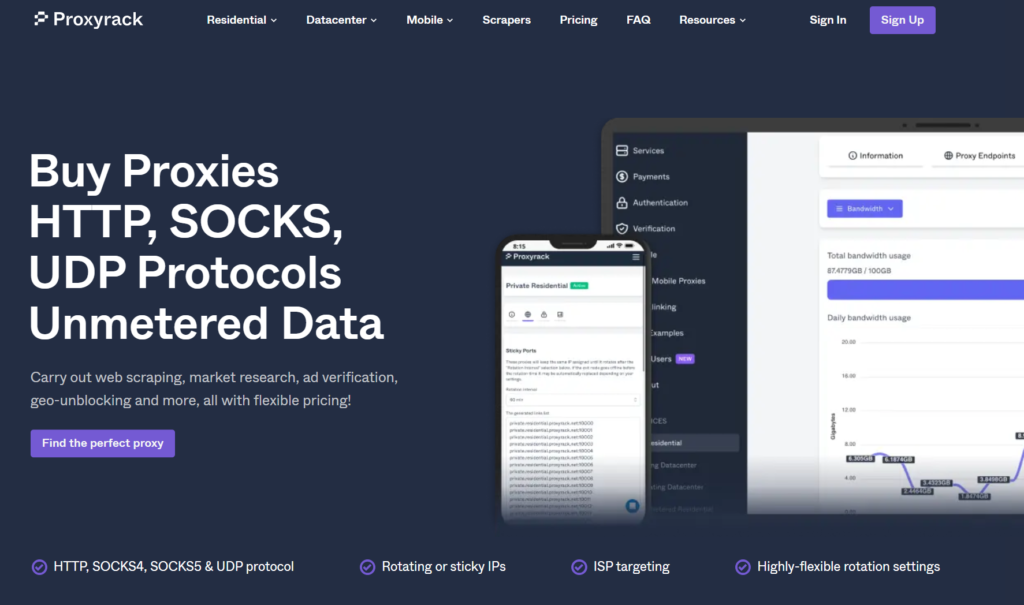
Proxyrack is useful for technical users because it promotes broad protocol support, including HTTP, HTTPS, SOCKS4, SOCKS5, and UDP.
It is not always the most polished-looking provider, but the protocol flexibility can be valuable if your workflow uses mixed tools or non-standard clients.
Why Proxyrack Stands Out
Some proxy users do not need the prettiest dashboard. They need protocol flexibility and a provider that can support different connection types. Proxyrack fits that profile.
Best Use Cases
Proxyrack is suitable for technical proxy users, app testing, mixed traffic workflows, scraping setups, and users who need more than basic HTTP proxying.
Where It Falls Short
The experience may not feel as smooth as Decodo or SOAX. If you want a modern dashboard and beginner-friendly onboarding, test before committing.
Pro Tip
Use Proxyrack when protocol compatibility matters more than interface polish.
How to Choose the Best Mobile SOCKS5 Proxy Provider
1. Confirm Mobile SOCKS5 Support Before Paying
Never assume every mobile proxy plan supports SOCKS5. Some providers support SOCKS5 on residential or datacenter plans but not mobile. Others support it only through specific gateways.
Ask these questions before buying:
- Does the mobile proxy plan support SOCKS5?
- Is SOCKS5 available in all countries?
- Does SOCKS5 use a separate endpoint or port?
- Does geo-targeting work with SOCKS5?
- Are sticky sessions supported with SOCKS5?
- Are there target-port limits?
- Does the provider support remote DNS with SOCKS5?
Decodo, for example, requires the gate.decodo.com endpoint and port 7000 for SOCKS5 residential or mobile proxies.
2. Understand the IP Pool, Not Just the Number
A large mobile IP pool looks great in marketing copy, but raw size does not tell the full story.
You need to check:
- How many mobile IPs are available in your target country?
- Are they real carrier IPs?
- Are 4G, LTE, and 5G options available?
- Can you target by city or carrier?
- Are IPs shared or dedicated?
- How often do IPs repeat?
For example, Oxylabs lists 20M+ mobile IPs in 140+ countries, SOAX lists 33M+ mobile proxies across 195 locations, and Decodo lists 10M+ mobile proxies from 700+ carriers. Those numbers are useful, but your real test should focus on the locations and targets you actually need.
3. Choose the Right Rotation Protocol
Mobile SOCKS5 proxies usually offer one or more rotation styles.
Per-request rotation gives you a new IP frequently. This is useful for broad scraping and large-scale data collection.
Time-based rotation changes the IP after a fixed period, such as every few minutes.
Manual rotation lets you change IPs through a link, dashboard, or API.
Sticky sessions keep the same IP for a longer workflow. Oxylabs, for example, mentions 24-hour sticky sessions for its mobile proxies.
For scraping, fast rotation can help. For login flows, cart testing, app testing, or multi-step browser sessions, sticky sessions are usually safer.
4. Check Location and Carrier Targeting
Mobile proxies are often bought for location-sensitive tasks. That means targeting depth matters.
At minimum, look for country targeting. For serious use, check city, state, ASN, carrier, or coordinate-level targeting. Oxylabs mentions filtering by continent, country, state, city, coordinate, and ASN. IPRoyal mentions country, state, and city-level targeting in its mobile quick-start guide.
5. Measure Cost Per Successful Request
Do not judge only by price per GB or price per IP. Mobile proxies can be expensive, so you need to calculate real output.
Track:
- Success rate
- CAPTCHA rate
- Timeout rate
- Median response time
- Retry rate
- Cost per successful page
- IP repeat rate
- Ban or block rate
A cheap provider that needs five retries per page can cost more than a premium provider that works on the first request.
6. Test With Your Real Tools
Mobile SOCKS5 performance depends heavily on your exact stack.
Test with your:
- Browser profile tool
- Scraper
- SEO tracker
- App testing setup
- Automation framework
- Target websites
- Target countries
- Session pattern
Do not rely only on generic speed tests. A provider can perform well in one country and poorly in another.
Best Mobile SOCKS5 Provider by Use Case
| Use Case | Best Provider |
|---|---|
| Enterprise mobile proxy infrastructure | Bright Data |
| Premium scraping and monitoring | Oxylabs |
| Best overall balance | Decodo |
| Geo-targeted mobile testing | SOAX |
| Budget mobile SOCKS5 | IPRoyal |
| High-scale business workflows | NetNut |
| Developer integrations | Infatica |
| Low-cost testing | MarsProxies |
| Manual rotation control | Proxy-Seller |
| Mixed protocol workflows | Proxyrack |
Common Mistakes to Avoid
Choosing Mobile Proxies When Residential Would Work
Mobile proxies are expensive. If your target does not require mobile carrier IPs, residential SOCKS5 proxies may give you better value.
Ignoring SOCKS5 Setup Rules
SOCKS5 often uses different endpoints, ports, or username parameters than HTTP proxies. Read the docs before blaming the provider.
Rotating Too Aggressively
Too much rotation can break sessions. Use sticky sessions for multi-step workflows.
Buying Based Only on Pool Size
Pool size matters, but usable IPs in your chosen country matter more.
Skipping Compliance
Use proxies for lawful purposes, respect website terms, and avoid workflows that involve unauthorized access, spam, credential abuse, or platform manipulation.
FAQs About Mobile SOCKS5 Proxies
1. What is the best mobile SOCKS5 proxy provider?
For enterprise users, Bright Data and Oxylabs are the strongest picks. For most users, Decodo offers the best balance of usability, mobile coverage, and SOCKS5 support. For budget users, IPRoyal and MarsProxies are good starting points.
2. Are mobile SOCKS5 proxies better than residential proxies?
They are better for mobile-specific workflows, but not always better overall. Mobile proxies are stronger for app testing, mobile ad verification, and mobile-first platforms. Residential proxies are usually cheaper and better for general scraping.
3. Do mobile SOCKS5 proxies support sticky sessions?
Many providers support sticky sessions, but the limits vary. Oxylabs mentions 24-hour sticky sessions, while other providers offer custom rotation, timed rotation, or manual refresh options.
4. Are mobile SOCKS5 proxies good for scraping?
Yes, they can be useful for scraping public data, especially when the target behaves differently for mobile users. Still, success depends on request patterns, headers, fingerprints, rate limits, and whether your use follows applicable rules.
5. Is SOCKS5 faster than HTTP proxies?
Not always. SOCKS5 can be efficient because it does not modify traffic in the same way HTTP proxies may, but speed depends on the provider, routing, target site, network load, and location.
6. Do SOCKS5 proxies encrypt traffic?
SOCKS5 does not automatically encrypt all traffic by itself. You still need HTTPS, TLS, SSH tunneling, or another secure layer when privacy matters. Proxy-Seller notes that SOCKS5 is flexible and can handle different traffic types, but encryption depends on how the connection is secured.
7. Can I use mobile SOCKS5 proxies for app testing?
Yes. Mobile SOCKS5 proxies are useful for testing how apps, landing pages, ads, and mobile web experiences behave in different countries, cities, carriers, and network environments.
8. Which mobile SOCKS5 proxy is cheapest?
IPRoyal, MarsProxies, and Proxy-Seller are usually more budget-friendly starting points than Bright Data or Oxylabs. The cheapest real option depends on success rate, not only the listed price.
9. Should I use rotating or sticky mobile SOCKS5 proxies?
Use rotating proxies for large-scale scraping and public data collection. Use sticky sessions for logins, app flows, checkout testing, account workflows, and multi-step tasks where the same IP must remain active.
10. Are free mobile SOCKS5 proxies safe?
Free mobile SOCKS5 proxies are not recommended for serious work. They are often unstable, abused, slow, and risky from a privacy perspective. For business use, paid providers with clear sourcing, support, and documentation are safer.
Final Verdict
The best mobile SOCKS5 proxy provider depends on what you are doing.
Choose Bright Data if you need enterprise-grade mobile proxy infrastructure and compliance controls. Choose Oxylabs if you want premium mobile proxy performance for scraping and monitoring. Choose Decodo if you want the best all-around mix of usability, SOCKS5 support, mobile coverage, and documentation.
For precise geo-targeting, SOAX is one of the strongest choices. For budget testing, start with IPRoyal, MarsProxies, or Proxy-Seller. For developer workflows, Infatica deserves a closer look. For protocol flexibility, Proxyrack is worth testing.
The smartest move is not to buy the largest plan first. Pick two or three providers, run the same test on your real target sites, compare success rate, speed, block rate, and cost per successful request, then scale the one that performs best in your exact workflow.