
Best Residential Proxy APIs.
Residential proxy APIs sit in that awkward but important space between “just give me a proxy endpoint” and “please handle the whole anti-blocking mess for me.”
If you run basic scraping jobs, a cheap rotating proxy pool may be enough. But once you start dealing with search engines, ecommerce pages, ad verification, travel pricing, review monitoring, app testing, or geo-sensitive pages, proxy quality starts affecting everything: success rate, speed, data accuracy, account stability, and cost per successful request.
That is where residential proxy APIs become valuable.
A good residential proxy API gives you access to real ISP-assigned residential IPs, rotation controls, geo-targeting, sticky sessions, protocol support, usage reporting, and sometimes managed unblocking features like CAPTCHA handling, browser rendering, or automatic retry logic. The better platforms do not just sell bandwidth. They help you route requests like real users from real locations without wasting half your budget on failed attempts.
Below is a detailed breakdown of the best residential proxy APIs worth considering, how they compare, and what to check before paying for one.
What Is a Residential Proxy API?
A residential proxy API is a programmatic way to route requests through residential IP addresses. These IPs usually come from real internet service providers rather than cloud data centers, which makes them appear closer to normal consumer traffic.
For developers, this usually means one of two things:
You connect to a proxy endpoint using HTTP, HTTPS, or SOCKS5 and control things like country, city, session, and rotation through credentials or parameters.
Or you use a managed scraping API where the provider handles residential proxy selection, retry logic, browser rendering, and anti-bot work behind one API call.
Both models can work. The better choice depends on how much control you need.
If you already have a crawler, queue system, retry layer, and parser, a raw residential proxy API gives you flexibility. If you want fewer headaches and faster deployment, a managed residential scraping API may be better.
Quick Verdict: Best Residential Proxy APIs by Use Case
| Use Case | Best Pick | Why It Fits |
|---|---|---|
| Enterprise-scale scraping | Bright Data | Huge network, advanced targeting, strong tooling |
| High-volume public data collection | Oxylabs | Large residential pool, strong performance, mature integrations |
| Best value for teams | Decodo | Strong balance of price, IP pool, usability, and scraping tools |
| Precise geo-targeting | SOAX | City, region, ASN targeting, flexible session controls |
| Stable enterprise routing | NetNut | Strong infrastructure, sticky IP sessions, stats API |
| Budget-friendly API access | IPRoyal | Good session control, SOCKS5 support, non-enterprise-friendly pricing |
| Affordable rotating residential proxies | Webshare | Low entry cost, simple endpoints, solid for lean projects |
| Managed web scraping API | Zyte API | Automated proxy management and residential use when needed |
| Simple API-first scraping | ScraperAPI | Easy single-call setup with residential proxy support |
Massive Comparison Table: Best Residential Proxy APIs
| Provider | Best For | Residential IP Pool | Locations | Rotation Control | Sticky Sessions | Protocols | API Style | Key Strength | Main Limitation |
|---|---|---|---|---|---|---|---|---|---|
| Bright Data | Enterprise data teams | 400M+ monthly residential IPs | 195 countries | Per request, session-based, zone rules | Yes | HTTP, HTTPS, SOCKS5 | Proxy API, Web Unlocker, Scraper APIs | Scale, targeting, compliance tooling | Can feel complex for beginners |
| Oxylabs | Large-scale scraping | 175M+ IPs | Global, city-level targeting | Rotating and sticky | Up to 24 hours | HTTP, HTTPS, SOCKS5 | Proxy endpoints, Web Unblocker, Web Scraper API | Reliability and enterprise support | Higher minimum commitment than budget tools |
| Decodo | Value plus usability | 115M+ residential IPs | 195+ locations | Per request or timed rotation | Minutes to days | HTTP(S), SOCKS5 | Proxy API, scraping API | Strong price-performance balance | Some advanced needs may require higher plans |
| SOAX | Geo-sensitive scraping | 155M+ residential proxies | 195+ geos | Every request or custom session | Custom session length | HTTP(S), SOCKS5 | Proxy credentials, endpoint generator | Fine targeting by city, region, ASN | Pricing and setup can vary by workload |
| NetNut | Stable enterprise routing | 85M+ IPs | 195+ countries | Session-based rotation | Yes | HTTP(S), SOCKS5 | Proxy network, stats API | One-hop style architecture and analytics | Less beginner-focused than simpler dashboards |
| IPRoyal | Affordable API control | 32M+ IPs | 195+ countries | New IP per request | Up to 7 days | HTTP(S), SOCKS5 | Proxy API, dashboard, sub-user management | Long sticky sessions and flexible access | Smaller pool than premium giants |
| Webshare | Low-cost residential access | 80M+ IPs | 195 countries | Rotating endpoints | Limited compared with premium tools | HTTP, SOCKS5 | Proxy endpoints, dashboard/API | Low cost and easy setup | Fewer managed scraping features |
| Zyte API | Managed unblocking | Not positioned mainly by pool size | Geo options available | Automated | Managed by Zyte logic | API/proxy mode | Fully managed scraping API | Uses residential proxies only when needed | Less raw proxy control |
| ScraperAPI | Simple scraping workflows | 4M+ residential proxies | Geo-targeting available | Automatic rotation | API-managed | API request model | Single API call | Very easy for developers | Less granular than raw proxy providers |
1. Bright Data: Best Residential Proxy API for Enterprise Control
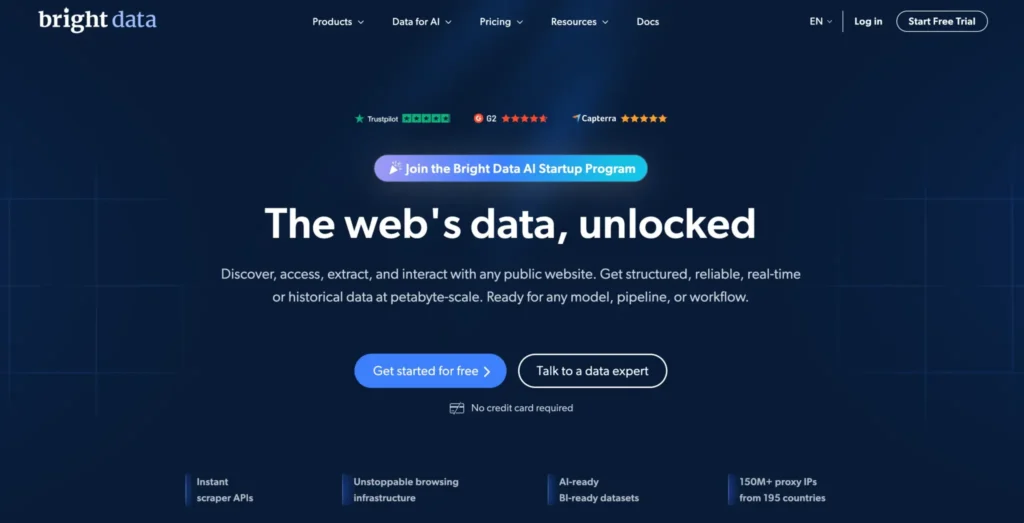
Bright Data is one of the most advanced names in the residential proxy market. Its residential proxy product advertises 400M+ monthly ethical residential IPs across 195 countries, plus targeting options such as city, state, country, ZIP code, and ASN. It also promotes sticky and rotating sessions, response time claims, and a 99.95% success rate on its residential proxy page.
What makes Bright Data stand out is not just the size of the network. It is the depth of control. You can build zones, apply targeting rules, manage access, rotate IPs, use proxy manager tools, or move up into managed products like Web Unlocker and scraping APIs.
This is ideal for teams that need proxy infrastructure as part of a larger data operation.
Bright Data is especially strong for:
- Large SERP scraping
- Retail price intelligence
- Travel fare monitoring
- Ad verification
- Market research
- Large-scale public web data pipelines
For developers, the main benefit is flexibility. You can run simple proxy endpoints or use more managed layers when targets become difficult. That means you do not have to switch vendors when your scraping stack grows.
Pro-Tip: Bright Data is best when you have a clear technical setup. Define zones by use case, such as ecommerce, SERP, social listening, or travel data. Mixing every workload into one setup makes debugging much harder.
The downside is complexity. New users may find the dashboard, pricing, and compliance workflows heavier than simpler platforms. But for serious data teams, that structure is part of the value.
2. Oxylabs: Best for High-Volume Web Scraping and Enterprise Reliability
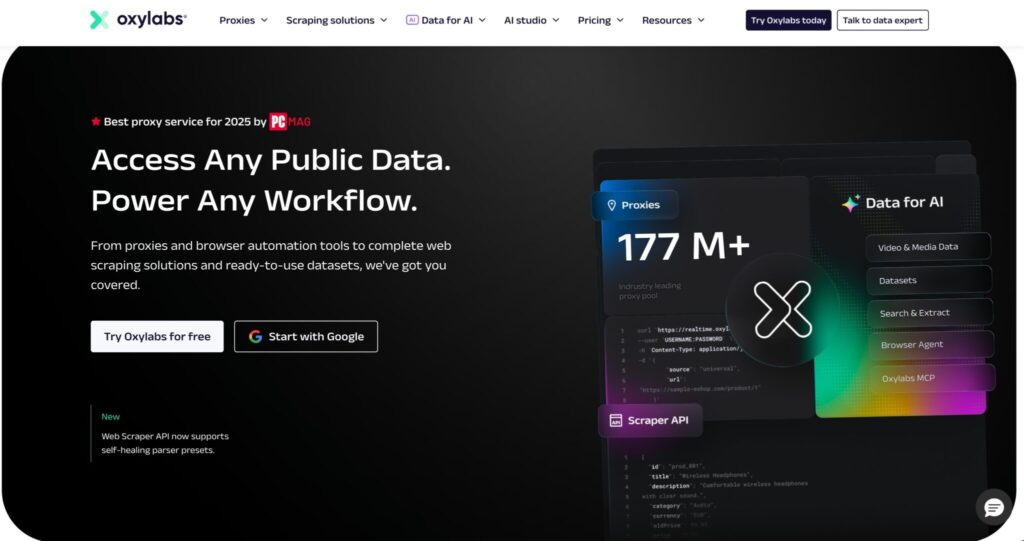
Oxylabs is a strong pick for teams that need reliability, scale, and enterprise support. Its residential proxy page lists 175M+ residential IPs, integrations with tools like Selenium, Puppeteer, Playwright, and Scrapy, plus session type options including sticky and rotating. Oxylabs also states that residential proxies support SOCKS5 and that sticky sessions can keep the same IP for up to 24 hours.
That makes Oxylabs a good fit for workloads where consistency matters. For example, if you are scraping ecommerce pages with regional pricing, you may need city-level targeting and predictable routing. If you are testing checkout flows or multi-step pages, sticky sessions are useful because you do not want your IP changing halfway through a flow.
Oxylabs also offers related products like Web Unblocker and Web Scraper API, so it can support both raw proxy users and teams that want managed scraping.
Best use cases include:
- Enterprise web scraping
- Price monitoring
- SERP tracking
- Travel aggregation
- Fraud prevention research
- Brand protection
Pro-Tip: Oxylabs works well when you separate target types. Use rotating sessions for simple list pages, and sticky sessions for login-like flows, filters, pagination chains, and anything that behaves like a user journey.
The main drawback is that it is not the cheapest option for small projects. Its plans are better suited for teams that care more about success rate and support than squeezing every GB to the lowest possible price.
3. Decodo: Best Value Residential Proxy API for Growing Teams
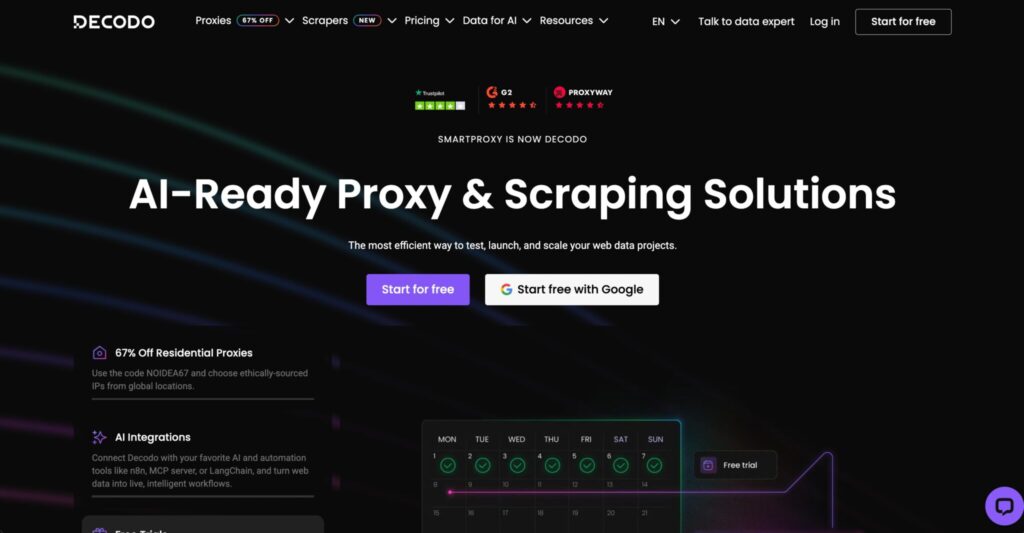
Decodo, formerly Smartproxy, has become one of the more practical choices for users who want strong performance without enterprise-level friction. Its residential proxy page explains that requests are routed through a 115M+ residential IP pool and that users can choose rotating IPs or sticky sessions depending on the task. It also notes that setup includes location selection, session type, and HTTP(S) or SOCKS5 protocol configuration.
The appeal is simple: Decodo gives you enough scale, enough targeting, and enough tooling for most professional scraping workflows without feeling too heavy.
It is especially useful for:
- SEO rank tracking
- Ecommerce monitoring
- Social media research
- Ad verification
- Small to mid-sized data teams
- Developers who want quick integration
Decodo also offers scraping APIs, which can be helpful if you want to move some workloads away from raw proxy management. For example, a simple HTML pull may work through rotating residential proxies, while a heavy JavaScript target may need a managed scraping API.
Pro-Tip: Start with Decodo when your team needs a serious residential proxy API but does not want to build around a very complex enterprise platform. It is often a good middle ground between raw budget proxies and premium data infrastructure.
The limitation is that very complex, high-risk targets may still need more advanced anti-bot handling or custom enterprise support. But for many commercial scraping and monitoring use cases, Decodo is one of the easiest platforms to justify.
4. SOAX: Best for Precise Geo-Targeting and Session Customization
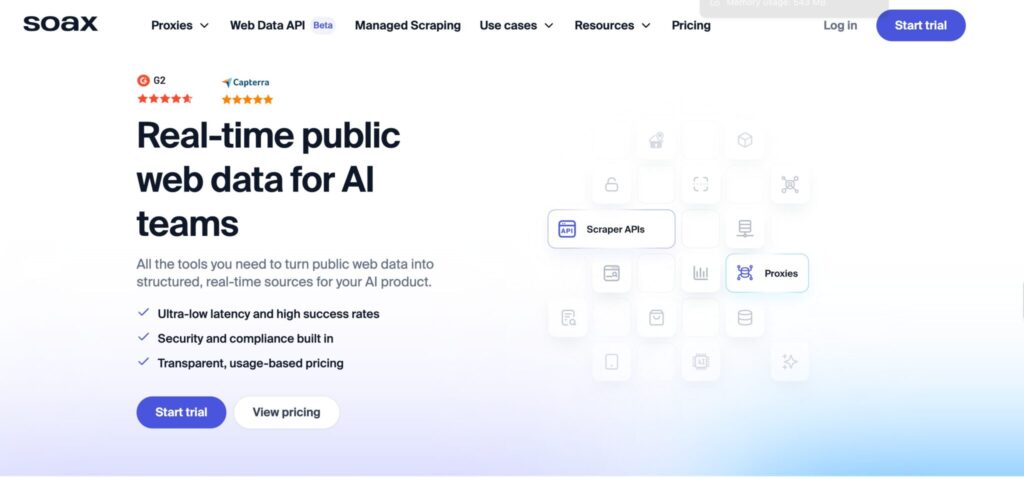
SOAX is a strong option when location accuracy matters. Its residential proxy product lists 155M+ residential proxies, 195+ geo locations, HTTP(S) and SOCKS5 support, sticky and rotating sessions, and targeting by region, city, or ASN. SOAX also lets users rotate IPs on every request or keep the same IP for a longer period with custom session lengths.
That makes SOAX useful for tasks where “United States” is not specific enough. Sometimes you need New York, Dallas, Berlin, Mumbai, or a specific ISP-like footprint. If the target website changes pricing, content, availability, rankings, or ads based on city or ISP, SOAX’s granular targeting can be very helpful.
Best use cases include:
- Localized SEO tracking
- Ad verification
- Geo-restricted content checks
- Retail availability monitoring
- Travel and ticket pricing
- Localized app testing
SOAX also has a clean output workflow. You can generate credentials as URL format, cURL request, username/password, or proxy list. That saves time when handing endpoints to developers, QA teams, or scraping tools.
Pro-Tip: Use SOAX when your scraping result depends on geography. Do not pay for detailed targeting if your project only needs random global rotation. But when city or ASN targeting changes the data, SOAX becomes much more valuable.
The possible drawback is that advanced filtering can increase complexity. Teams should test performance in their exact target regions before scaling.
5. NetNut: Best for Stable Enterprise Proxy Routing
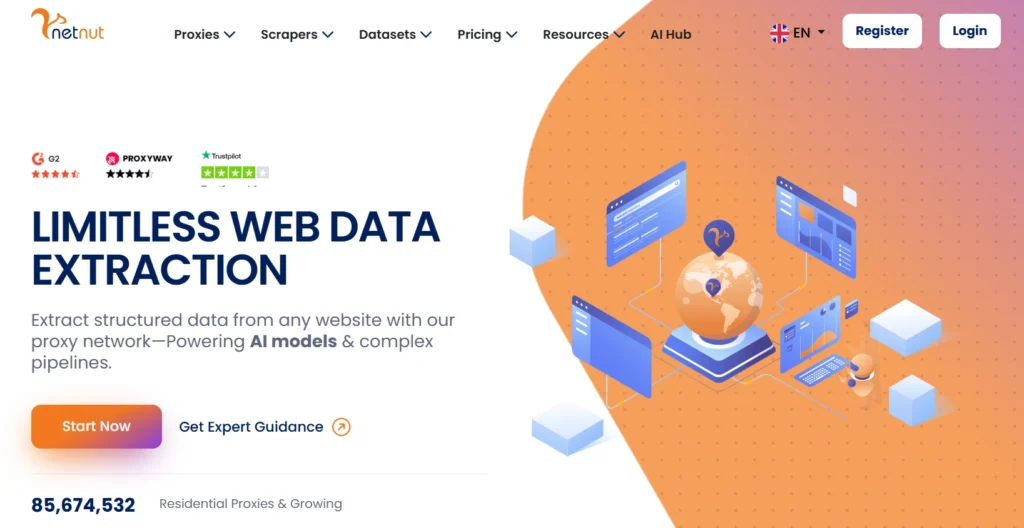
NetNut focuses heavily on stable routing and enterprise-grade proxy infrastructure. Its rotating residential proxy page lists 85M IPs across 195 countries, sticky IP sessions, dedicated private pools, and a stats API for near real-time usage retrieval. NetNut also describes its architecture as one-hop connectivity, designed to reduce bottlenecks in traffic flow.
That stability-first positioning makes NetNut attractive for teams that need predictable throughput. If your crawler is running large scheduled jobs, unstable proxy routes can cause timeout spikes, partial data, and messy retry queues. NetNut’s approach is built for users who care about cleaner traffic flow.
Best use cases include:
- High-volume data collection
- Enterprise analytics
- Market intelligence
- SEO monitoring
- Review monitoring
- Large recurring crawl jobs
The API for stats is also useful. When scraping gets expensive, visibility matters. You need to know where bandwidth is going, which jobs consume the most traffic, and whether failed requests are quietly increasing your cost.
Pro-Tip: With NetNut, monitor success per GB, not just cost per GB. A cheaper provider can become expensive if you burn bandwidth on retries, timeouts, and blocked responses.
NetNut may not be the most beginner-friendly choice, but for companies that want stability and monitoring, it deserves a place on the shortlist.
6. IPRoyal: Best Affordable Residential Proxy API With Long Sticky Sessions
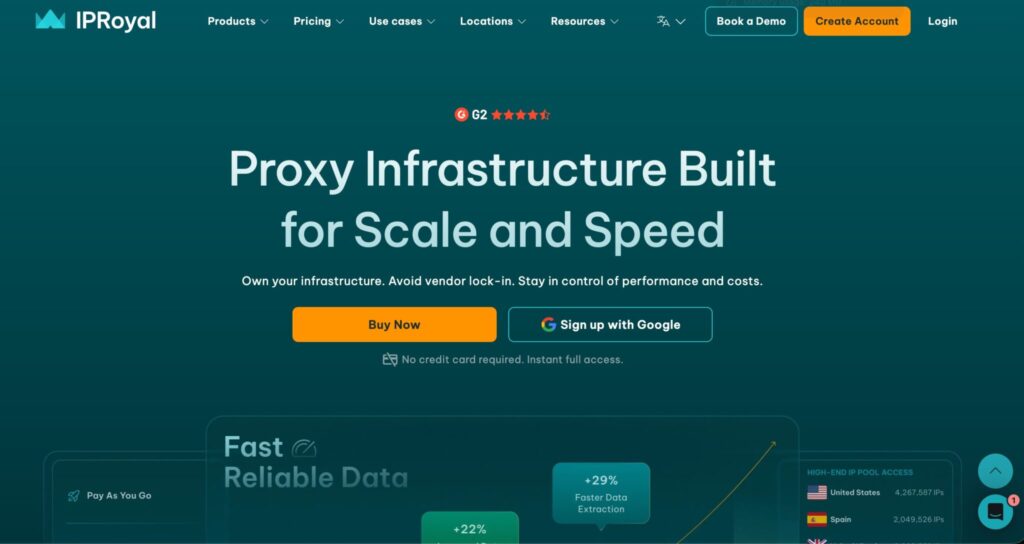
IPRoyal is a good fit for users who want more affordability without giving up core technical controls. Its documentation lists advanced session control, new IP per request, sticky sessions up to 7 days, unlimited simultaneous sessions, username/password and IP whitelist authentication, HTTP(S) and SOCKS5 support, and API access for infrastructure integration and sub-user management.
The standout feature is sticky session duration. Many residential proxy providers offer sticky sessions for minutes or hours. IPRoyal’s longer session support can be useful for workflows that need a persistent identity.
Use cases include:
- Account-based workflows
- Social media testing
- Localized browsing tasks
- Small business scraping
- Research automation
- Lower-budget proxy testing
IPRoyal also appeals to users who do not want to enter a heavy enterprise sales process. Its pricing is usually easier for smaller teams to approach, and the dashboard is not too difficult to understand.
Pro-Tip: Long sticky sessions are powerful, but do not abuse them. If one IP is used too aggressively for repetitive actions, it can still get flagged. Sticky sessions should feel like stable browsing, not one IP doing machine-speed work.
The main tradeoff is pool size. IPRoyal is useful and affordable, but it does not match the huge residential networks of Bright Data, Oxylabs, or SOAX.
7. Webshare: Best Budget-Friendly Rotating Residential Proxy API
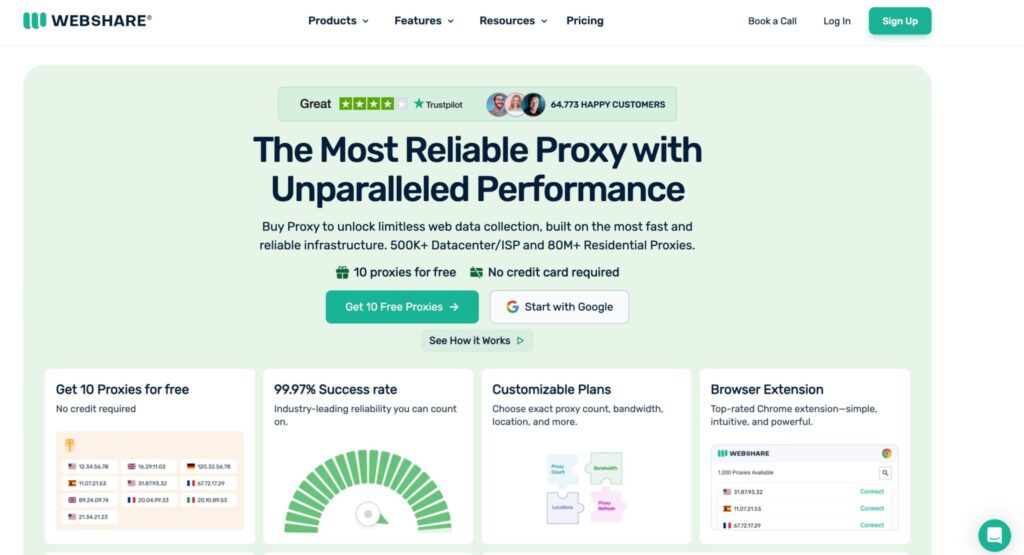
Webshare is popular with users who want simple, affordable proxy access. Its residential proxy page lists 80M+ ethically sourced residential IPs, HTTP/SOCKS5 proxy endpoints, 195 countries, 99.97% uptime, and pricing advertised as low as $1.40/GB.
Webshare is not trying to be the most advanced managed data platform. Its value is simplicity. You can get proxies, configure endpoints, and start routing traffic without a long setup process.
Best use cases include:
- Small scraping projects
- Testing proxy workflows
- Basic SEO checks
- Geo-browsing
- Low-budget automation
- Developer experiments
For many users, Webshare is a good starting point because it keeps the barrier low. If your project does not require advanced CAPTCHA solving, browser rendering, or enterprise controls, it can be enough.
Pro-Tip: Use Webshare for low to moderate difficulty targets first. If you are scraping heavily protected websites, compare success rates against premium providers before choosing purely on price.
The limitation is that Webshare does not offer the same depth of managed scraping features as platforms like Bright Data, Oxylabs, Decodo, or Zyte. It is best when you already know how to manage retries, headers, pacing, and parsing yourself.
8. Zyte API: Best Managed Residential Proxy API for Scraping Teams
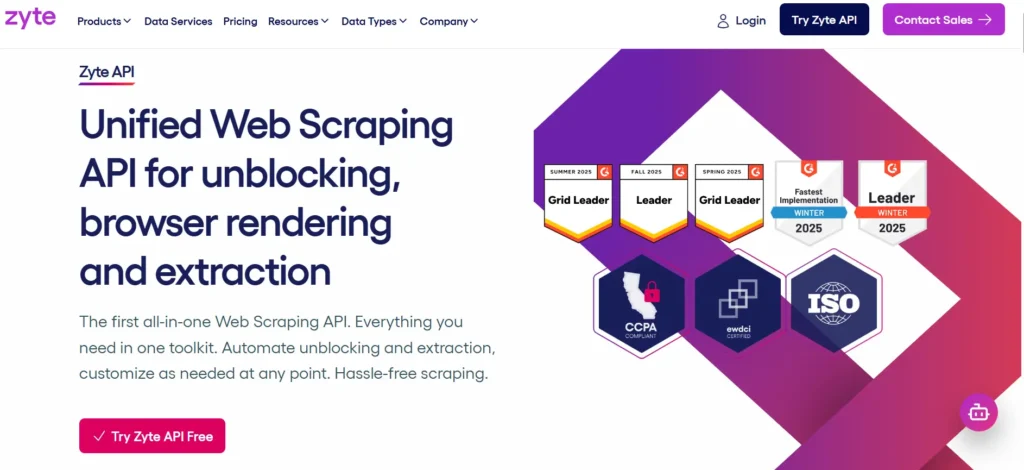
Zyte is different from a raw residential proxy provider. Its Zyte API focuses on managed scraping, automated proxy rotation, browser rendering, and residential proxies when needed. Zyte says its API automatically uses ethically sourced residential proxies to unblock complex and geo-restricted sites, but only when needed. Its Zyte API page also highlights automated proxy rotation, headless browser rendering, geolocation, and residential proxies.
That model is useful when you do not want to manually tune proxy pools. Instead of deciding which IP type to use on every request, you send the request through Zyte API and let the system apply the needed unblocking approach.
Best use cases include:
Complex web scraping
JavaScript-heavy websites
Crawlers with frequent blocks
Teams that prefer API results over proxy tuning
Data extraction workflows
Zyte also has proxy mode, which allows users to connect through an API endpoint in a proxy-like setup.
Pro-Tip: Use Zyte when engineering time is more expensive than request cost. If your developers are spending days tuning proxies, headers, browser sessions, and retries, a managed API may be cheaper overall.
The tradeoff is control. If you want to manually choose every proxy behavior, a raw residential provider may suit you better.
9. ScraperAPI: Best Simple API-First Residential Proxy Option
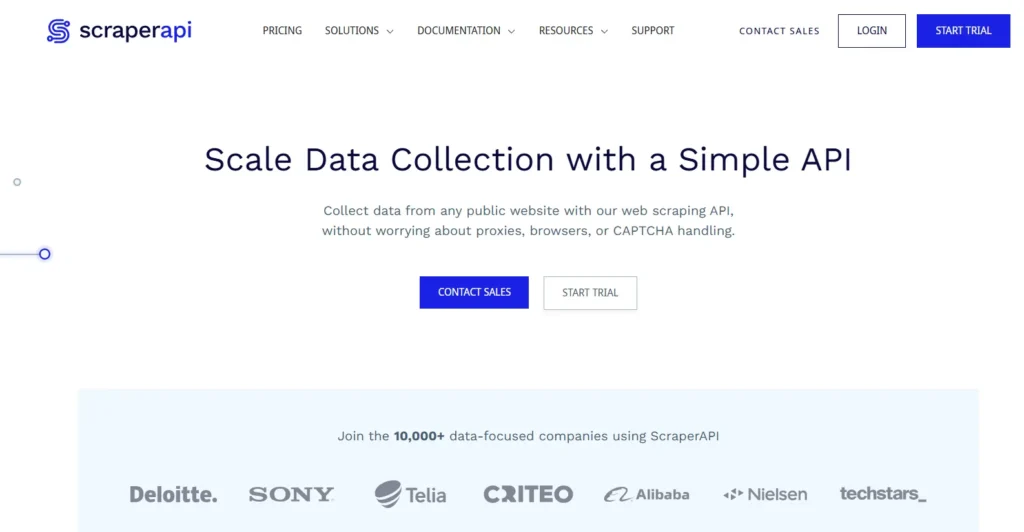
ScraperAPI is built for developers who want a simple scraping API rather than a full proxy control panel. Its residential proxy page says it handles proxy rotation, geotargeting, and CAPTCHAs through a single API call, with access to over 4 million residential proxies.
This is not the biggest residential pool in the list. But the value is ease of use.
Instead of building a complete proxy layer, you can call the API with your target URL and let ScraperAPI handle much of the routing. Its documentation also explains geotargeting by routing requests through proxies from the required country.
Best use cases include:
- Developers who want fast setup
- Simple web scraping jobs
- Startup data projects
- SERP and ecommerce scraping tests
- Teams without proxy infrastructure
Pro-Tip: ScraperAPI is useful when speed of deployment matters. For deep proxy customization, choose a raw provider. For fast HTML retrieval through one API, it keeps things simple.
The limitation is granularity. You get convenience, but you may not get the same level of control over IP pools, session behavior, ASN targeting, or custom rotation logic.
How to Choose the Best Residential Proxy API
Choosing a residential proxy API is not only about pool size. A huge IP pool with weak routing can still perform badly. A smaller provider with better session logic may outperform it on your exact target.
Here is the practical checklist.
1. Check IP Pool Quality, Not Just IP Pool Size
Large pool numbers look good in marketing, but quality matters more.
Ask these questions:
- Are the IPs ethically sourced?
- Are they real residential ISP IPs?
- Are they shared too heavily?
- Can you target country, state, city, ZIP, or ASN?
- How often do IPs fail or disappear mid-session?
- Does the provider recycle burned IPs too aggressively?
For scraping, you need diversity. For account-based workflows, you need stability. For local testing, you need accurate geo-targeting.
Pro-Tip: Test at least three target sites before buying a large plan. A provider can perform well on one site and poorly on another.
2. Understand Rotation Protocols
Rotation controls decide how your IP changes.
The three main patterns are:
Per-request rotation: Every request gets a new IP. Best for large-scale crawling where each request is independent.
Timed rotation: IP changes after a set interval. Useful when you want some stability without keeping the same IP too long.
Sticky sessions: Same IP stays active for a session. Best for login flows, carts, pagination chains, forms, dashboards, or multi-step journeys.
Do not use one rotation strategy for everything. It wastes money and increases block risk.
3. Match Sessions to the Task
A product listing page can often use rotating IPs. A checkout flow needs sticky sessions. Local SERP tracking may need city-level targeting. Social platform testing may need longer identity consistency.
Bad session design is one of the fastest ways to burn residential bandwidth.
A good setup may look like this:
- Rotating sessions for category pages
- Sticky sessions for detail page sequences
- City targeting for localized results
- ASN targeting only when the target reacts to ISP-level differences
- Separate credentials for each project or team
4. Check Protocol Support
Most serious providers support HTTP and HTTPS. SOCKS5 matters when you need more flexible traffic handling or support for tools that do not work cleanly through HTTP proxies.
If you are using browsers, automation frameworks, mobile testing tools, or custom networking software, confirm compatibility before you buy.
5. Measure Cost Per Successful Request
Do not choose based on per-GB price alone.
The real metric is:
Successful requests ÷ total cost
A provider at $8/GB may be cheaper than a $2/GB provider if it gives fewer blocks, fewer retries, lower timeout rates, and cleaner results.
Track:
- Success rate
- Timeout rate
- Average response time
- Bandwidth per successful page
- CAPTCHA rate
- Retry count
- Cost per 1,000 successful pages
6. Look for Usage APIs and Reporting
If you run scraping at scale, reporting matters.
You need to know:
- Which job used bandwidth
- Which geo-target consumed the most data
- Which targets caused retries
- Which credentials are overused
- Whether costs are rising silently
NetNut’s stats API is a good example of why this matters for enterprise users. Usage visibility can save more money than a small discount on bandwidth.
7. Review Compliance and Acceptable Use Rules
Residential proxy providers are more sensitive than datacenter proxy providers because they rely on consumer-like IP networks. Reputable vendors usually have stricter onboarding, KYC, and acceptable use policies.
This is not a bad thing. It often means the network is less abused and more stable.
Avoid providers that feel too cheap, too anonymous, or too vague about sourcing. Cheap residential proxies with unclear sourcing can create legal, ethical, and operational risks.
Best Residential Proxy API for Different Buyers
Best Overall: Bright Data
Choose Bright Data if you need scale, advanced targeting, multiple scraping products, and enterprise-grade control.
Best for Enterprise Scraping: Oxylabs
Choose Oxylabs if you want large-scale reliability, strong integrations, sticky sessions, SOCKS5, and managed scraping options.
Best Value: Decodo
Choose Decodo if you want a strong residential pool, user-friendly setup, and fair pricing for professional use.
Best Geo-Targeting: SOAX
Choose SOAX if city, region, or ASN-level targeting affects the accuracy of your data.
Best for Stable Routing: NetNut
Choose NetNut if you care about enterprise routing, sticky sessions, private pools, and usage visibility.
Best Budget Control: IPRoyal
Choose IPRoyal if you want affordable access, API support, SOCKS5, and long sticky sessions.
Best Low-Cost Option: Webshare
Choose Webshare if you need simple rotating residential proxy access at a lower cost.
Best Managed API: Zyte API
Choose Zyte if you want automated proxy selection, browser rendering, and less manual anti-blocking work.
Best Simple API Setup: ScraperAPI
Choose ScraperAPI if you want a quick API-based way to scrape pages without building proxy logic from scratch.
Common Mistakes to Avoid When Buying Residential Proxy APIs
Choosing the Cheapest Per-GB Plan
Low bandwidth price looks attractive, but failed requests waste money. Always test success rate.
Ignoring Session Logic
Many users rotate too aggressively. If your target expects the same user to stay consistent, use sticky sessions.
Using Residential Proxies for Everything
Residential proxies are expensive. Use datacenter or ISP proxies for easier targets when possible.
Not Separating Projects
Use different credentials, zones, or sub-users for different projects. It makes debugging and cost tracking much easier.
Forgetting About Headers and Browser Fingerprints
A residential IP alone does not make bot traffic look human. Headers, TLS behavior, browser fingerprints, timing, and request patterns still matter.
Running Too Fast Too Soon
Start slow. Increase concurrency gradually. Sudden spikes can trigger blocks even with good proxies.
FAQs About Residential Proxy APIs
1. What is the best residential proxy API overall?
Bright Data is the strongest overall choice for enterprise users because of its large residential network, advanced targeting, proxy controls, and scraping tools. Oxylabs is another excellent premium choice for large-scale scraping. Decodo is often the better value option for growing teams.
2. Are residential proxy APIs better than datacenter proxies?
Residential proxy APIs are better for targets that block datacenter IPs, show location-sensitive content, or use anti-bot systems. Datacenter proxies are cheaper and faster for easier targets. The best setup often uses both.
3. What is the difference between rotating and sticky residential proxies?
Rotating proxies change IPs per request or at intervals. Sticky proxies keep the same IP for a session. Use rotating proxies for large-scale crawling and sticky sessions for multi-step tasks like logins, carts, filters, or account-based workflows.
4. Which residential proxy API is best for beginners?
Webshare, IPRoyal, ScraperAPI, and Decodo are beginner-friendly options. Webshare is simple and affordable. ScraperAPI is easy if you want a single API call. Decodo gives more professional controls without overwhelming new users.
5. Which provider has the largest residential proxy pool?
Bright Data advertises 400M+ monthly residential IPs, while Oxylabs lists 175M+ residential IPs. SOAX lists 155M+ residential proxies, Decodo lists 115M+, and Webshare lists 80M+. Pool size should be tested against success rate, not judged alone.
6. Do residential proxy APIs support SOCKS5?
Many leading providers support SOCKS5, including Oxylabs, Decodo, SOAX, IPRoyal, and Webshare. SOCKS5 can be useful for tools and workflows that need more flexible traffic handling than standard HTTP proxies.
7. Are residential proxy APIs legal?
Residential proxies can be legal when used for legitimate tasks such as public data collection, SEO monitoring, ad verification, QA testing, and market research. Legality depends on your use case, local law, target website terms, and data type. Avoid scraping private, restricted, copyrighted, or personal data without proper rights.
8. How much do residential proxy APIs cost?
Pricing varies widely. Budget providers may start around a few dollars per GB, while premium providers can cost more but may deliver higher success rates and better targeting. Always calculate cost per successful request instead of only looking at cost per GB.
9. Should I use a raw proxy API or a managed scraping API?
Use a raw residential proxy API if you want full control over requests, headers, sessions, retries, and parsing. Use a managed scraping API if you want the provider to handle proxy rotation, browser rendering, CAPTCHA handling, and retries.
Final Verdict: Which Residential Proxy API Should You Choose?
The best residential proxy API depends on your workload.
For enterprise-grade scraping, start with Bright Data or Oxylabs. For the best balance of usability, price, and performance, shortlist Decodo. For location-sensitive projects, test SOAX. For stable enterprise routing and analytics, consider NetNut. For affordable residential access with strong session control, IPRoyal is worth testing. For lower-budget rotating residential proxies, Webshare is practical. For managed scraping where you want fewer proxy headaches, compare Zyte API and ScraperAPI.
The smart move is not to buy the biggest plan first. Pick two or three providers, test them on your real target sites, track success rate, response time, block rate, and cost per successful page, then scale the one that performs best.
That is how serious teams buy residential proxy APIs. Not by pool size alone, but by clean data delivered at a cost that makes sense.