
Best Proxies For AI Data Scraping.
AI data scraping has become much more demanding than normal web scraping. A basic scraper might collect prices from a few ecommerce pages. An AI data pipeline may need millions of pages, fresh search results, review snippets, product metadata, forum discussions, news pages, job listings, public datasets, and niche web content that changes every hour.
That is where proxy quality starts to matter.
A cheap proxy can look attractive at first, especially when the dashboard shows a huge IP pool and low per GB pricing. But once you start feeding a real AI workflow, the weak spots show up quickly. Failed requests increase. Session drops become common. Geo targeting feels inconsistent. The data comes back messy. Your crawler wastes more time retrying requests than collecting useful content.
For AI data scraping, the best proxy is not just the cheapest one. You need clean IPs, good rotation controls, stable sessions, proper location targeting, API friendly setup, clear usage rules, and enough scale to support your collection volume without burning through budget.
Quick Verdict: Best Proxies For AI Data Scraping
If you want the strongest all round choice for serious AI data scraping, Bright Data and Oxylabs are the top enterprise picks. They offer large proxy pools, advanced scraping tools, strong documentation, and infrastructure built for large data teams.
If you want a balance of quality, ease of use, and pricing, Decodo and SOAX are excellent mid market choices. They are easier to start with and still strong enough for serious scraping workflows.
If budget matters more than enterprise tooling, Webshare, IPRoyal, and DataImpulse are worth considering. They can work well for smaller AI scraping projects, testing pipelines, and volume conscious teams.
Massive Comparison Table: Best AI Data Scraping Proxy Providers
| Provider | Best For | Main Proxy Types | Approx Pool Size | Rotation Control | Geo Targeting | Pricing Style | Best AI Use Case |
|---|---|---|---|---|---|---|---|
| Bright Data | Enterprise scale AI data collection | Residential, ISP, datacenter, mobile | 400M+ residential IPs | Very advanced | Country, city, state, ZIP, ASN | Premium bandwidth pricing | RAG pipelines, public web data collection, SERP, ecommerce |
| Oxylabs | Large scale scraping and AI workflows | Residential, datacenter, ISP, mobile | 175M+ residential IPs | Advanced | Country, city, ASN, coordinates in some products | Tiered GB pricing | AI training datasets, market intelligence, web scraping APIs |
| Decodo | Best mid market balance | Residential, ISP, datacenter, mobile | 125M+ IPs | Flexible sessions | 195+ locations | GB based plans | AI agents, ecommerce scraping, SERP data |
| SOAX | Granular targeting and clean rotation | Residential, mobile, ISP, datacenter | 155M+ residential IPs | Per request and sticky sessions | Country, city, ISP, ASN | Bundled GB pricing | Localized AI data collection, market research |
| NetNut | Stable business scraping | Residential, static residential, mobile, datacenter | 85M+ residential IPs | Good rotation options | 195+ countries | Custom and business plans | Enterprise monitoring, product data, long running scrapers |
| Webshare | Affordable self service scraping | Residential, static residential, datacenter | 80M+ residential IPs | Basic to moderate | Country and city targeting | Low cost GB pricing | Budget AI data collection and testing |
| IPRoyal | Smaller teams and flexible budgets | Residential, ISP, datacenter, mobile | 32M+ residential IPs | Session TTL and rotation options | 195+ countries | Pay as you go and plans | Small AI scraping projects, testing, geo research |
| DataImpulse | Low cost high volume collection | Residential, mobile, datacenter | 90M+ IPs | Request level options | 195+ countries | Pay as you go | Cost sensitive AI data pipelines |
| Rayobyte | US focused and mixed proxy setups | Residential, ISP, datacenter | Varies by product | Standard rotation options | Country and region options | GB and IP based pricing | Datacenter heavy scraping, US data collection |
| ProxyEmpire | Flexible rotating residential access | Residential, mobile, static residential | Large multi country pool | Rotating and sticky | Country, region, city, ISP in some plans | Tiered GB pricing | Geo specific scraping and niche datasets |
What Makes A Proxy Good For AI Data Scraping?
AI scraping is different because it often involves three pressures at the same time: volume, freshness, and structure.
You may need to collect a large number of public pages. You may need to revisit those pages often. You may also need the output to be clean enough for a vector database, data warehouse, training set, or internal AI search system.
That means your proxy setup should support:
Reliable IP rotation: You need to rotate IPs without breaking sessions or sending strange traffic patterns.
Sticky sessions: Some targets need a stable session for pagination, location based results, or multi step browsing.
Large IP pools: Bigger pools reduce repeated IP use and improve coverage across regions.
Good targeting: Country level targeting is not enough for many AI projects. City, state, ISP, ASN, and mobile carrier targeting may matter.
Protocol support: HTTP, HTTPS, and SOCKS5 support gives developers more room to connect proxies with scraping frameworks.
Clear compliance rules: For AI data, this matters more than people think. You should work with providers that explain acceptable use, data sourcing, and restrictions clearly.
API friendly setup: Your team should be able to integrate proxies into Python, Node.js, scraping APIs, headless browsers, and workflow tools without fighting the dashboard.
1. Bright Data: Best Overall For Enterprise AI Data Scraping
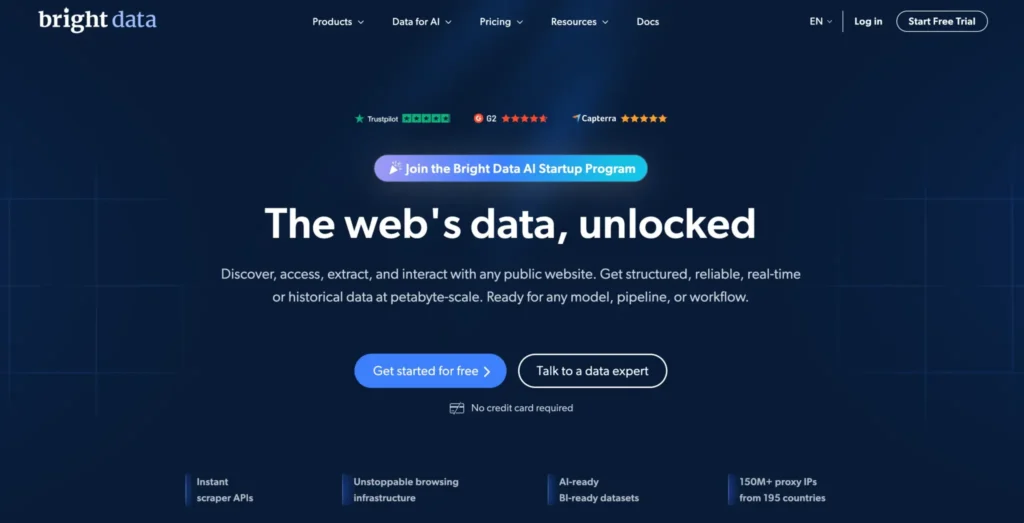
Bright Data is one of the strongest names in proxy infrastructure, especially for teams that need scale, compliance controls, and advanced data collection tools under one roof.
The biggest advantage is depth. Bright Data is not only a proxy provider. It also offers scraping APIs, SERP tools, web unlocker style products, datasets, browser automation support, and very granular targeting. For an AI data scraping team, that matters because raw proxies are only one part of the pipeline.
If your use case involves collecting public data for RAG, product intelligence, ad monitoring, review analysis, or search result tracking, Bright Data gives you a strong technical base. You can use residential proxies when you need realistic user like routing, ISP proxies when you need more stable sessions, and datacenter proxies when speed and cost matter more than IP reputation.
Why Bright Data Works Well For AI Data Scraping
Bright Data is strong when the scraping operation is mission critical. Think large public data collection, multi country monitoring, complex SERP extraction, price intelligence, and AI data feeds that need consistency.
Its large IP pool, targeting depth, and developer tooling make it easier to build workflows that can scale. You can also use its scraping tools instead of building every piece from scratch.
Where Bright Data Falls Short
The main drawback is pricing. Bright Data is not the cheapest option, and smaller teams may feel the cost quickly if they are collecting a lot of bandwidth heavy pages.
Also, the platform has more moving parts than a simple proxy dashboard. That is good for advanced teams, but not always ideal for someone testing a small scraper for the first time.
Pro Tip
Use Bright Data when failure cost is higher than proxy cost. If your AI pipeline depends on clean, fresh, large scale public web data, paying more for reliability can be cheaper than wasting engineering hours on broken scrapers.
2. Oxylabs: Best For Large Scale AI Scraping Teams
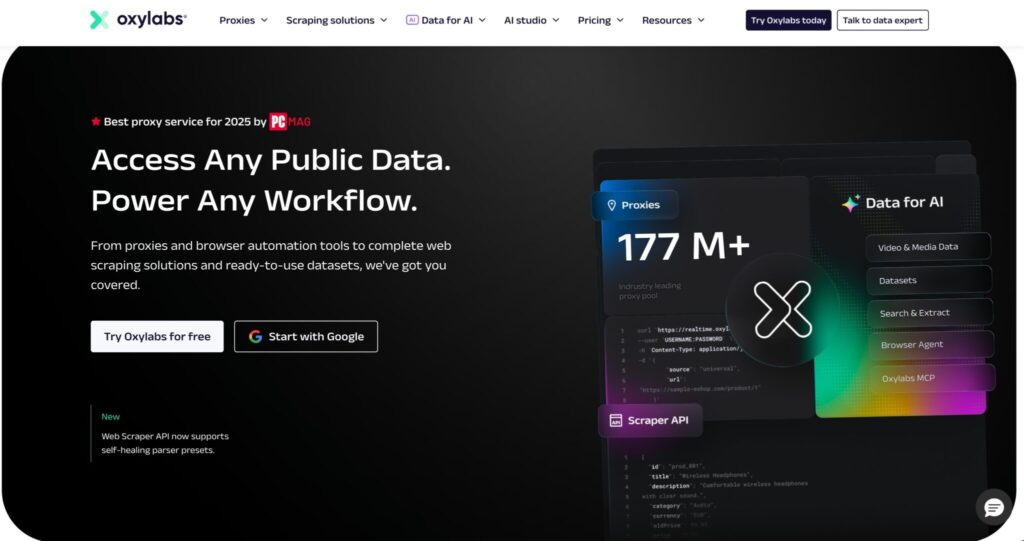
Oxylabs is another premium proxy provider built for serious data collection. It has a strong reputation among teams doing public web scraping, competitive intelligence, market research, cybersecurity research, and AI data workflows.
For AI scraping, Oxylabs stands out because it combines a large proxy network with scraping focused products. You can use standard residential proxies, datacenter proxies, ISP proxies, or its higher level scraping solutions depending on how much control you want.
A technical team can plug Oxylabs into custom crawlers, while a data team can use its scraping APIs to reduce scraper maintenance. That flexibility is useful when your AI project moves from testing into production.
Why Oxylabs Works Well For AI Data Scraping
Oxylabs is a good fit for teams that collect data at scale and need strong documentation, responsive support, and predictable infrastructure. Its residential network is large, and its product lineup covers common AI data needs like SERP extraction, ecommerce monitoring, and web data feeds.
The provider also supports common protocols and has developer friendly guides, which makes onboarding easier for engineering teams.
Where Oxylabs Falls Short
Oxylabs can be expensive for smaller teams. The entry plan is accessible compared with some enterprise tools, but serious volume still adds up. Also, some advanced products may be more than a small scraping setup needs.
Pro Tip
Use Oxylabs when your scraping project has moved beyond “let’s test this idea” and into “this data supports our product, model, dashboard, or revenue workflow.”
3. Decodo: Best Mid Market Proxy For AI Data Collection
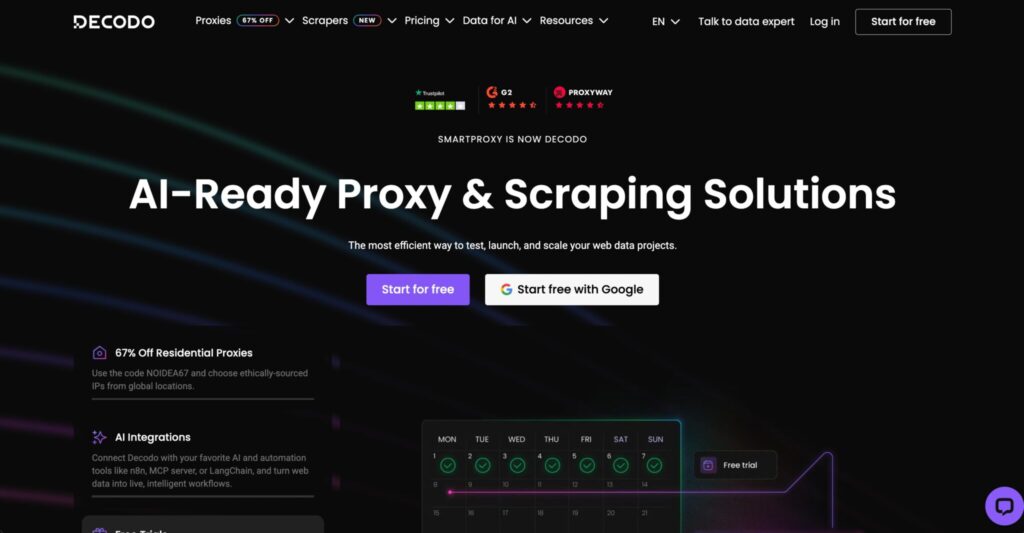
Decodo, formerly known as Smartproxy, is one of the best choices for users who want strong proxy infrastructure without the complexity of a heavy enterprise platform.
It has a large IP pool, good location coverage, easy onboarding, and a dashboard that feels more approachable than some premium enterprise systems. For AI data scraping, this makes Decodo a practical middle ground.
You can use Decodo for ecommerce scraping, SERP collection, market research, social listening, app testing, and public data collection for AI powered tools. The platform also supports scraping APIs and site unblocker style tools, which can help teams that do not want to maintain every scraper manually.
Why Decodo Works Well For AI Data Scraping
Decodo is easy to recommend for growing teams. It is not the cheapest provider, but it offers a strong mix of scale, usability, and pricing.
Its session controls are useful for AI workflows where some requests need rotation and others need persistence. For example, you might rotate IPs for broad page discovery, then use sticky sessions when collecting paginated results from a region specific website.
Where Decodo Falls Short
Power users may still prefer Bright Data or Oxylabs for the most complex enterprise workflows. Decodo is strong, but some large teams may want deeper compliance tooling, bigger custom contracts, or more advanced data products.
Pro Tip
Decodo is a smart first serious proxy provider for teams moving from cheap proxies into real production scraping.
4. SOAX: Best For Granular Geo Targeting
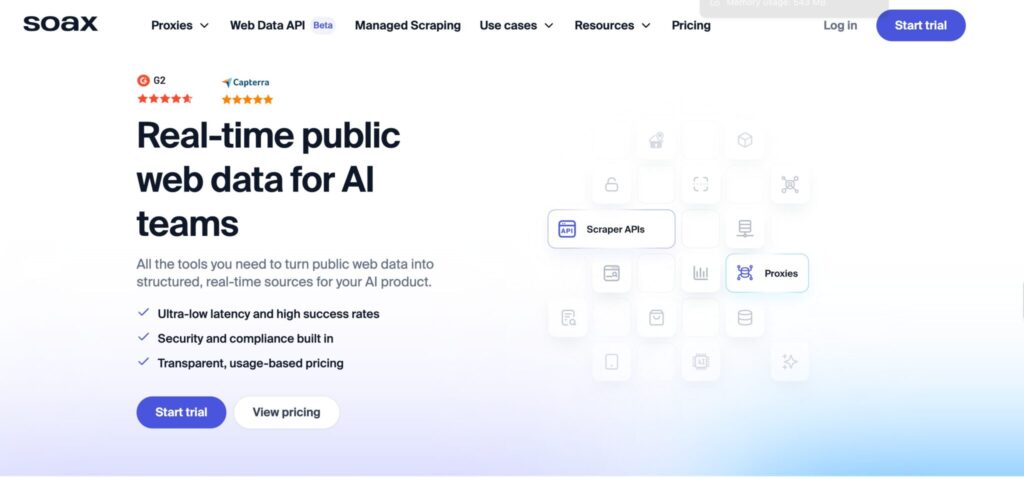
SOAX is a strong option when location accuracy matters. For AI data scraping, geo targeting is not just a nice extra. It can shape the entire dataset.
Search results change by location. Prices change by country and city. Travel listings, local business results, ads, shipping availability, and marketplace inventory all vary depending on where the request appears to come from.
SOAX gives users flexible control over proxy types, rotation, and targeting. Its residential proxies support rotating and sticky sessions, which makes it suitable for both broad crawling and more controlled browsing flows.
Why SOAX Works Well For AI Data Scraping
SOAX is especially useful for AI projects that need local data. If you are building a pricing model, local SEO dataset, travel comparison engine, regional market monitor, or location aware AI assistant, targeting quality matters a lot.
The platform is also friendly to teams that want to test different proxy types under one plan. You can compare residential, mobile, ISP, and datacenter options depending on the target and data quality needs.
Where SOAX Falls Short
SOAX is not always the lowest cost provider for small users, and some teams may find the bundled pricing model less simple than pure pay as you go tools.
Pro Tip
Use SOAX when your dataset needs location accuracy. A smaller but better targeted dataset often beats a larger dataset full of location noise.
5. NetNut: Best For Stable Business Scraping
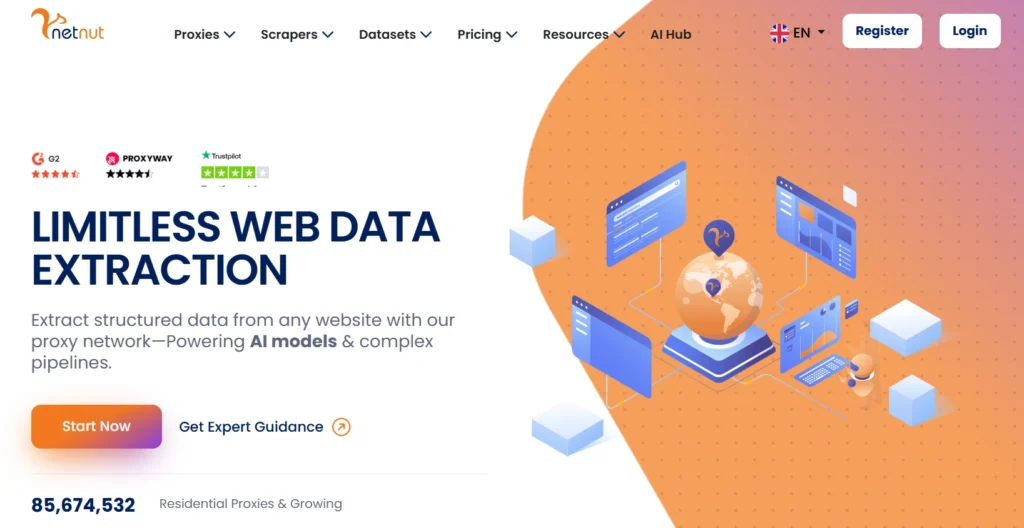
NetNut positions itself around business grade proxy infrastructure, with residential, static residential, mobile, and datacenter options.
Its biggest strength is stability. For AI scraping projects that need ongoing data feeds, stability can matter more than having the flashiest dashboard. NetNut is a good fit for companies that collect public data regularly and want a provider that can handle long running scraping jobs.
Static residential and ISP style proxies are useful when a session needs to remain steady. That can help with accounts you own, internal QA, location testing, or multi page flows where constant IP rotation would create problems.
Why NetNut Works Well For AI Data Scraping
NetNut works well for structured business use cases: ecommerce monitoring, brand protection, public market data collection, travel pricing, ad verification, and product catalog tracking.
Its residential pool is large enough for serious work, and the platform supports standard integration patterns for developers.
Where NetNut Falls Short
Pricing can be less beginner friendly, and some users may prefer the simpler self serve experience of Webshare, IPRoyal, or DataImpulse.
Pro Tip
NetNut is worth testing when you need stable data collection over time, not just quick experiments.
6. Webshare: Best Affordable Proxy For Self Service Scraping
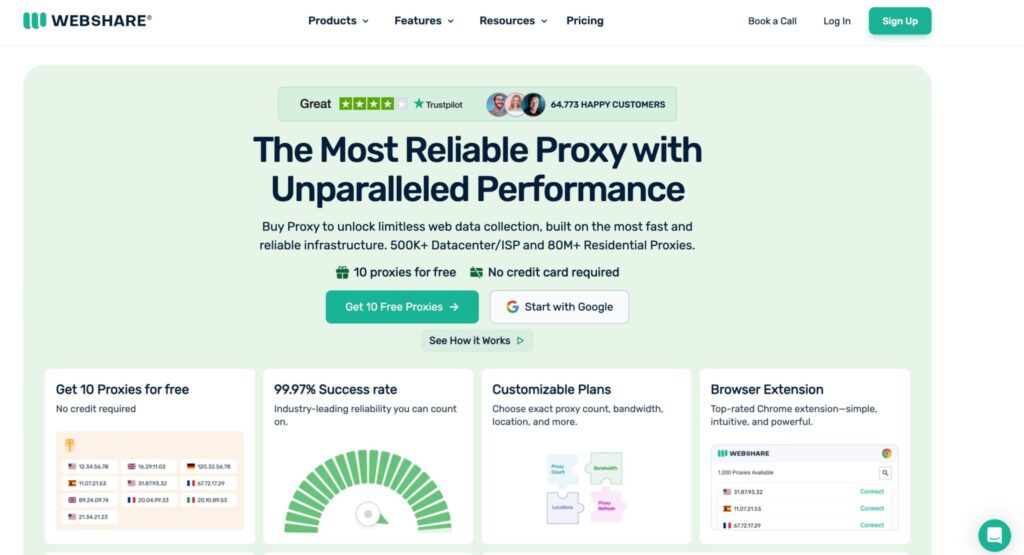
Webshare is one of the most attractive options for budget conscious users. It offers residential, static residential, and datacenter proxies with a simple dashboard and low entry pricing.
For AI data scraping, Webshare works best when you need affordable testing, smaller scale collection, or datacenter heavy workloads. It may not have the advanced scraping products of Bright Data or Oxylabs, but that is not always a problem.
If your team already has good scraping logic and only needs proxy infrastructure, Webshare can be a practical choice.
Why Webshare Works Well For AI Data Scraping
The pricing is friendly, the setup is simple, and the product is easy to test. That makes it useful for startups, solo developers, SEO teams, affiliate researchers, and AI builders who need to validate a dataset idea before committing to a premium provider.
Webshare’s static residential proxies can also be useful when session consistency matters more than constant rotation.
Where Webshare Falls Short
Webshare is not the best choice if you need hands on enterprise support, advanced scraping APIs, or very complex routing controls. It is more of a clean, practical proxy platform than a full data collection suite.
Pro Tip
Use Webshare for testing crawler logic, measuring bandwidth needs, and building early AI datasets before moving to a bigger provider.
7. IPRoyal: Best Budget Friendly Residential Proxy Option
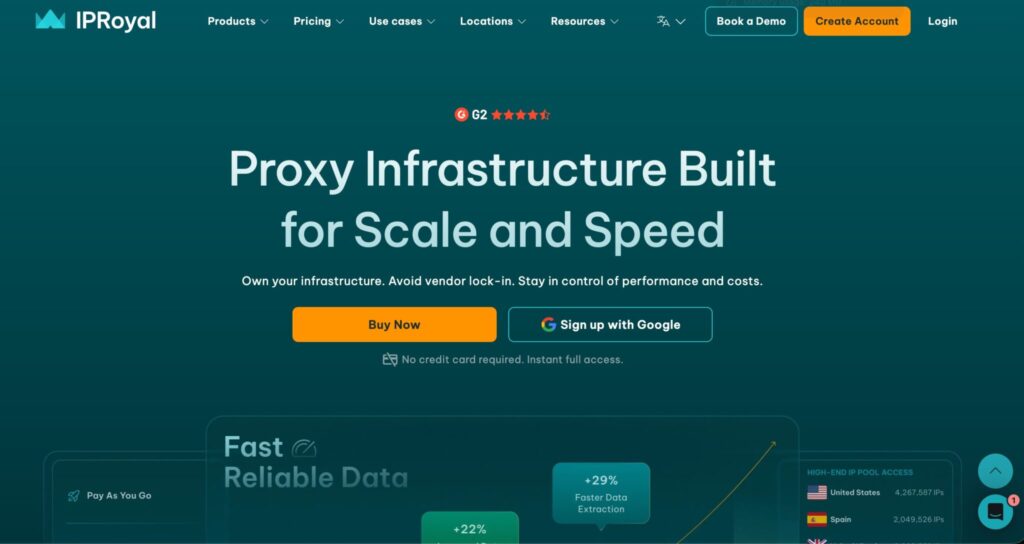
IPRoyal is a popular choice for users who want flexible residential proxies without enterprise pricing. It offers residential, ISP, datacenter, and mobile proxies, with pay as you go options and non expiring traffic in some plans.
For AI data scraping, IPRoyal is useful when you need residential IPs for smaller projects, location testing, or moderate public data collection.
The dashboard gives users control over location and session behavior, including session TTL. This helps when you want to decide whether an IP should rotate quickly or stay active longer.
Why IPRoyal Works Well For AI Data Scraping
IPRoyal is simple, affordable, and flexible. It is not trying to be an enterprise data platform, which can actually be an advantage for smaller teams.
You can use it for scraping tests, SERP checks, public review collection, ecommerce research, and location based monitoring without dealing with heavy contracts.
Where IPRoyal Falls Short
The IP pool is smaller than Bright Data, Oxylabs, Decodo, and SOAX. For very large workloads, that can matter. It also lacks the same level of advanced scraping APIs that premium providers offer.
Pro Tip
IPRoyal is a good starter option if you want residential proxies but do not want to commit to high monthly minimums.
8. DataImpulse: Best Low Cost Pick For High Volume Testing
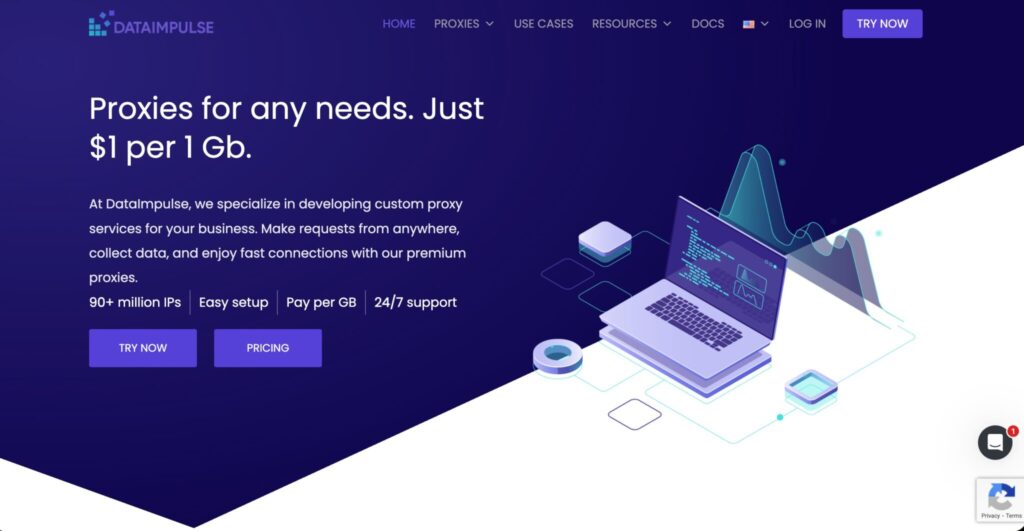
DataImpulse has become interesting because of its low per GB pricing and large residential pool. It is aimed at users who want affordable access to residential, mobile, and datacenter proxies without a complicated buying process.
For AI teams, this can be useful during early data experiments. If you are testing whether a source is useful for a model, RAG pipeline, or analytics product, you may not want to spend premium rates immediately.
Why DataImpulse Works Well For AI Data Scraping
The biggest advantage is price. Low cost bandwidth gives teams more room to test data collection ideas, run experiments, and estimate real scraping costs.
It also supports common use cases like web scraping, SERP tracking, ad verification, and price intelligence.
Where DataImpulse Falls Short
Budget providers usually require more testing before production use. You should measure success rate, latency, blocked request rate, geo accuracy, and data quality before relying on it for a critical AI pipeline.
Pro Tip
Use DataImpulse for discovery and cost testing. Once you know which sources matter most, you can decide whether to keep it or move important targets to a premium provider.
9. Rayobyte: Best For Mixed Proxy Strategies
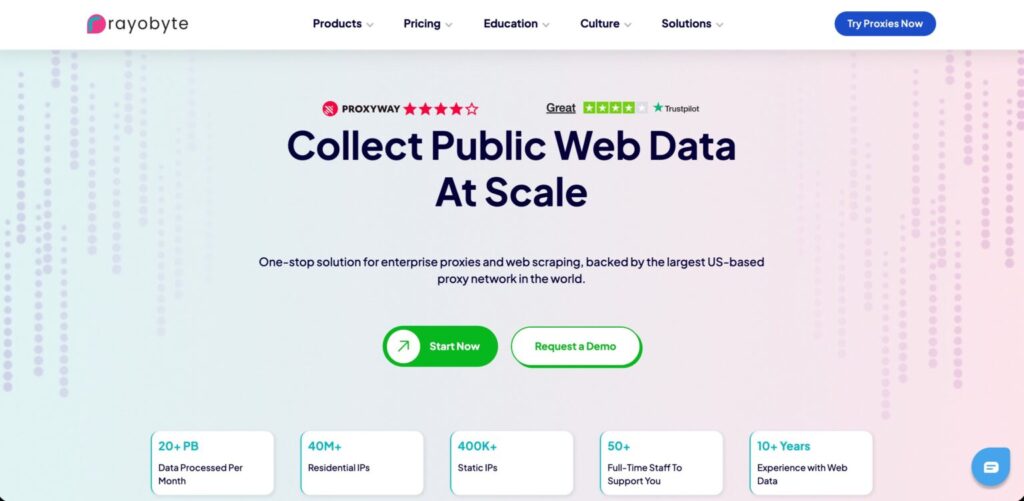
Rayobyte is a good choice for teams that want to mix proxy types, especially datacenter, ISP, and residential proxies. It has been around for a long time and is often considered by users who care about predictable proxy infrastructure.
For AI data scraping, Rayobyte can be useful when not every target needs residential proxies. This is important because many teams overspend by using residential IPs for everything.
Some public sources work fine with datacenter proxies. Others need residential or ISP proxies. A mixed strategy can reduce costs while keeping success rates healthy.
Why Rayobyte Works Well For AI Data Scraping
Rayobyte is useful for teams that want to build a cost aware proxy stack. You can route easy targets through datacenter proxies and reserve residential traffic for sources that need higher trust.
This approach is often better than choosing one proxy type for all requests.
Where Rayobyte Falls Short
It may not be the first choice for teams that need the largest residential pool or the most advanced AI scraping tools. It is better as part of a thoughtful proxy mix.
Pro Tip
Do not use premium residential proxies for every page. Segment your targets by difficulty and assign proxy types based on actual failure rates.
How To Choose The Best Proxy For AI Data Scraping
Choosing a proxy provider is not about picking the biggest number on a landing page. You need to match the provider to your data pipeline.
1. Start With Your Data Source Type
Different websites behave differently. A public ecommerce page, a search result page, a government directory, a review site, and a social platform all have different traffic patterns and rules.
For easier public pages, datacenter proxies may be enough. For localized results, residential or mobile proxies may work better. For long sessions, ISP proxies can be more stable.
2. Check IP Pool Quality, Not Just IP Pool Size
A provider may advertise millions of IPs, but you need to know how many are useful for your target countries, cities, and traffic volume.
Ask these questions:
How many IPs are available in your target countries?
Does the provider support city or ASN targeting?
Can you test the pool before scaling?
A smaller clean pool can outperform a huge noisy pool.
3. Understand Rotation Protocols
Rotation is one of the most important parts of AI scraping.
Per request rotation changes the IP on each request. It works well for broad crawling, discovery, and pages that do not require session continuity.
Sticky sessions keep the same IP for a set period. This is better for pagination, localized browsing, and multi step flows.
Time based rotation changes IPs after a chosen period, such as 1 minute, 10 minutes, or 30 minutes.
Manual rotation gives the developer more control but requires better engineering.
For AI data scraping, the best setup usually combines rotation methods. Use fast rotation for discovery. Use sticky sessions for detail pages, multi page browsing, or region specific results.
4. Match Proxy Type To Workload
Residential proxies are good for realism and geo specific data. ISP proxies are good for stable sessions with better speed. Datacenter proxies are good for speed and cost. Mobile proxies are useful for mobile first data, app testing, and carrier specific checks.
A smart AI scraping stack uses all of them where needed.
5. Measure Real Success Rate
Do not trust marketing numbers alone. Test providers with your real targets.
Track:
- Successful response rate
- Average response time
- CAPTCHA or challenge rate
- Cost per successful page
- Duplicate content rate
- Geo accuracy
- Session stability
- Data completeness
- Retry count per 1,000 requests
The most important metric is not cost per GB. It is cost per clean, usable page.
6. Review Compliance And Data Rules
AI data scraping is under more scrutiny now. You should collect only public data, respect website terms, avoid private or sensitive data, and follow data protection laws that apply to your region and users.
A serious provider should have acceptable use rules, abuse controls, and clear sourcing policies.
7. Think About Engineering Time
A cheaper provider can become expensive if your developer spends days fixing failed requests.
For early experiments, budget proxies are fine. For production AI data pipelines, support quality, documentation, logs, and API reliability matter.
Pro Tips For AI Data Scraping Teams
Pro Tip 1: Build a proxy waterfall. Start with datacenter proxies for easy targets, move to ISP proxies for stable sessions, and use residential proxies for sources that need stronger geo realism.
Pro Tip 2: Track cost per usable document. AI teams often track bandwidth cost, but that hides the real number. A provider at $6/GB can be cheaper than one at $1/GB if it produces cleaner pages with fewer retries.
Pro Tip 3: Keep raw HTML and parsed output separate. AI pipelines improve when you can reprocess raw pages later without scraping again.
Pro Tip 4: Rotate user agents responsibly. Proxy rotation alone is not enough. Your request headers, browser behavior, timeouts, and crawl pacing should look technically consistent.
Pro Tip 5: Avoid scraping everything. Collect what your model actually needs. More data is not always better data.
Final Verdict: Which Proxy Should You Pick?
For enterprise AI data scraping, Bright Data is the strongest all round platform if you need scale, targeting depth, and advanced data collection tools. Oxylabs is close behind and may be the better fit for teams that want strong scraping APIs and structured enterprise support.
For growing teams, Decodo offers one of the best balances of usability, scale, and price. SOAX is the better choice when geo targeting and session control are the main priorities.
For budget conscious teams, Webshare, IPRoyal, and DataImpulse are practical options. They are especially useful for testing, early data collection, and smaller AI workflows.
For mixed proxy strategies, Rayobyte and NetNut are worth testing, especially when you need stable sessions or want to combine residential, ISP, and datacenter proxies.
The best proxy for AI data scraping is the one that gives you the lowest cost per usable page, not the lowest cost per GB.
FAQs About Proxies For AI Data Scraping
1. What type of proxy is best for AI data scraping?
Residential proxies are usually the safest choice for public web data collection that needs location accuracy and realistic traffic routing. However, datacenter proxies can work well for easier targets, and ISP proxies are better for stable long sessions.
2. Are residential proxies better than datacenter proxies for AI scraping?
Residential proxies are better for harder targets and location specific data. Datacenter proxies are faster and cheaper, but they are easier to identify in some environments. The best setup often uses both.
3. How much do AI scraping proxies cost?
Pricing varies widely. Budget residential proxies may start around $1 to $2 per GB, while premium providers often charge more. Enterprise pricing can become cheaper at high volume, but minimum commitments may apply.
4. Do I need rotating proxies for AI data scraping?
Yes, in most cases. Rotating proxies help distribute requests across different IPs. But rotation should be controlled. Use per request rotation for broad crawling and sticky sessions for multi page flows.
5. What is the difference between rotating and sticky proxies?
Rotating proxies change IPs frequently, often on every request. Sticky proxies keep the same IP for a set time. Sticky sessions are useful when a website expects continuity across several pages.