
Email scraping sounds simple until the first campaign breaks.
You build a scraper, point it at public business directories, company pages, event listings, author bios, or vendor databases, and then the ugly stuff starts. Timeouts. Blocks. Duplicate results. Half-loaded pages. IP bans. Cloud security checks. A dataset that looked clean at 500 rows becomes a mess at 50,000.
That is where proxies matter.
For email scraping, I am not talking about scraping private inboxes, bypassing logins, or collecting personal data for spam. This guide is about compliant public web data collection, such as gathering publicly listed business emails, verifying lead records, enriching B2B databases, or monitoring company contact pages. You still need to respect privacy laws, opt-out rules, site terms, and sensible request limits.
A good proxy setup gives your scraper stability. A bad one gives you noisy data and wasted bandwidth.
Below are the best proxy providers for email scraping, based on pool size, rotation control, geographic reach, protocol support, dashboard quality, and how well they fit professional scraping workflows.
Quick Comparison Table: Best Email Scraping Proxy Providers
| Provider | Best For | Proxy Types | IP Pool | Rotation Control | Protocols | Best Fit |
|---|---|---|---|---|---|---|
| Bright Data | Enterprise scraping teams | Residential, ISP, datacenter, mobile | 400M+ monthly IPs | Advanced session and zone control | HTTP, HTTPS, SOCKS5 | Large-scale compliant scraping |
| Oxylabs | High-volume B2B data teams | Residential, mobile, ISP, datacenter | 175M+ residential IPs | Sticky sessions and rotation controls | HTTP, HTTPS, SOCKS5 | Serious data extraction workflows |
| Decodo | Balanced price and usability | Residential, mobile, ISP, datacenter | 125M+ IPs | Flexible rotation and sessions | HTTP, HTTPS, SOCKS5 | Agencies and mid-sized teams |
| SOAX | Clean geo-targeting | Residential, mobile, ISP, datacenter | 155M+ residential IPs | Custom rotation windows | HTTP(S), SOCKS5, UDP/QUIC | Geo-specific contact scraping |
| NetNut | Stable residential scraping | Residential, mobile, datacenter | 85M+ residential IPs | Rotating and sticky options | HTTP, HTTPS, SOCKS5 | Scalable business data projects |
| IPRoyal | Budget-conscious teams | Residential, datacenter, ISP, mobile | Smaller than enterprise pools | Sticky sessions available | HTTP, HTTPS, SOCKS5 | Small scrapers and testing |
| Webshare | Low-cost proxy testing | Residential, static residential, datacenter | 80M+ residential IPs | Rotating endpoint | HTTP, SOCKS5 | Starter scraping stacks |
| Infatica | Mid-market rotating proxies | Residential, mobile, datacenter | 35M+ rotating proxies | Dashboard-based rotation | HTTP, HTTPS, SOCKS5 | Controlled scraping projects |
| Rayobyte | Ethical residential and ISP mix | Residential, ISP, datacenter | 36M+ residential IPs | Rotating options | HTTP, HTTPS | Teams needing simple pricing |
1. Bright Data: Best For Enterprise Email Scraping
Bright Data is the provider I would look at first if email scraping is part of a larger data operation. It has a huge residential footprint, strong location targeting, detailed proxy management, and more compliance infrastructure than most cheaper providers.
For email scraping, the biggest advantage is control. You can create different zones for different scraping jobs, manage rotation rules, use sticky sessions where needed, and separate experimental scraping from production scraping. That matters when your pipeline is collecting emails from different sources, such as local business directories, SaaS partner pages, conference speaker pages, and company websites.
Bright Data is not the cheapest option. It also has more setup complexity than plug-and-play providers. But for a team that cares about clean logs, repeatable workflows, and serious scale, it is one of the strongest choices.
Pro Tip: Use residential proxies for fragile websites and ISP proxies for sources where session stability matters more than constant rotation.
2. Oxylabs: Best For High-Volume B2B Data Collection
Oxylabs sits in the same premium category as Bright Data, but it feels more streamlined for enterprise scraping teams that want a polished platform without too much dashboard noise.
Its residential proxy pool is large, the network supports SOCKS5, and the platform is built around data gathering at scale. For email scraping, Oxylabs works well when you are collecting public contact details across many domains and need strong uptime, high concurrency, and dependable session handling.
Where Oxylabs stands out is reliability. If your scraper runs daily or weekly and feeds a CRM, sales intelligence dashboard, or lead validation tool, you do not want proxy chaos. Oxylabs is built for that more mature use case.
It may be overkill for a solo SEO or a small affiliate team scraping only a few thousand public business records per month. But if your workflow has real revenue tied to data quality, it is worth shortlisting.
Pro Tip: Use sticky sessions when scraping paginated business profiles so your crawler does not look like a new visitor on every page load.
3. Decodo: Best Balance Of Price, Pool Size, And Ease Of Use
Decodo, formerly Smartproxy, is a strong middle-ground pick. It has a large IP pool, clean documentation, a friendly dashboard, and enough proxy types to handle most scraping jobs without forcing you into enterprise pricing from day one.
For email scraping, Decodo works well for agencies, growth teams, affiliate researchers, and data operators who need residential proxies but do not want a heavy enterprise sales process. It is also easier to set up than some premium platforms.
The rotation controls are practical. You can rotate IPs for broader crawling or keep sessions sticky when a site requires continuity. That makes it useful for mixed email scraping tasks where some sources are simple HTML pages and others are dynamic directories with filters.
It is not always the deepest platform for custom compliance workflows, but for the price-to-performance ratio, Decodo is one of the safest recommendations.
Pro Tip: Start with country-level targeting only. Add city-level targeting later if the site actually serves different contact results by location.
4. SOAX: Best For Geo-Targeted Email Scraping
SOAX is a good fit when geography matters. If you are scraping public emails from local business directories, regional service providers, country-specific marketplaces, or location-based company listings, SOAX gives you useful control over proxy location.
Its residential network is large, and it supports modern protocol options, including SOCKS5 and UDP/QUIC. The platform also puts a lot of emphasis on clean, ethically sourced proxies, which is important in a niche where shady proxy networks can create legal and operational risk.
For email scraping, SOAX is especially useful when your scraper needs to test what a website shows in different countries or cities. Some directories hide contact details, change layouts, or show different listings based on location. A strong geo-targeting setup helps reduce those inconsistencies.
SOAX can feel more expensive than budget providers, but the targeting quality often justifies the cost.
Pro Tip: For local scraping, test three locations first: target city, target country, and a neutral location. Compare output before scaling.
5. NetNut: Best For Stable Residential Sessions
NetNut is a solid choice for teams that want residential proxies with stable routing and high concurrency. It is built for web data collection, and its large residential pool gives scrapers enough coverage for most professional use cases.
For email scraping, NetNut makes sense when you are collecting data from sources that punish unstable sessions. Some business directories do not like rapid IP switching during filtered searches. Others will load results but fail when you open profile pages from a different session. NetNut’s rotating and sticky options help reduce those issues.
The platform may not feel as beginner-friendly as Webshare or IPRoyal, but it is stronger for repeatable scraping. If you are past the testing stage and now need consistent data delivery, NetNut belongs on the list.
Pro Tip: Do not rotate too aggressively on directory-style sites. A 5 to 15 minute sticky session often produces cleaner results than per-request rotation.
6. IPRoyal: Best Budget Residential Proxy Option
IPRoyal is one of the more accessible proxy providers for smaller email scraping projects. It offers residential proxies with traffic-based pricing and supports common protocols like HTTP, HTTPS, and SOCKS5.
The key appeal is budget control. If you are testing a scraper, validating a niche, or building a small public lead list, you may not want to commit to a large monthly plan. IPRoyal gives you a lower-friction way to get started.
The tradeoff is scale. Its pool is not as large as Bright Data, Oxylabs, Decodo, or SOAX. For heavy scraping, you may run into quality variation sooner. Still, for small and mid-sized jobs, it can be a practical option.
Pro Tip: Use IPRoyal for testing your extraction logic before moving the same scraper to a larger provider.
7. Webshare: Best For Low-Cost Proxy Experiments
Webshare is popular because it is simple, affordable, and easy to test. Its residential proxy pool is large enough for many scraping use cases, and the dashboard is beginner-friendly.
For email scraping, Webshare is a good option when your target sources are not extremely protected. Think basic company pages, simple directories, public profile pages, and smaller niche databases. It is less ideal for complex scraping environments that require browser rendering, advanced unblocking, or account-level workflow support.
The rotating endpoint is useful, and pricing is attractive for budget-conscious teams. Just remember that lower-cost proxies often require more testing. You may need to tune retries, timeouts, and concurrency more carefully.
Pro Tip: Keep concurrency conservative at first. Cheaper bandwidth does not help if failed requests eat half your budget.
8. Infatica: Best Mid-Market Rotating Proxy Pick
Infatica offers rotating residential proxies with useful dashboard controls for IP whitelisting, authorization, geo-targeting, and rotation. It is a good option for teams that want more control than a basic proxy seller but do not need the full enterprise stack.
For email scraping, Infatica works best when your scraper needs steady rotation across public web pages and directories. Its pool is smaller than the biggest providers, but still large enough for many focused scraping projects.
The platform is also fairly approachable. You can configure proxy lists, manage access, and track usage without needing a full infrastructure team. That makes it a decent fit for SEO teams, lead researchers, and smaller data businesses.
Pro Tip: Create separate proxy lists for different target categories. It makes debugging much easier when one source starts failing.
9. Rayobyte: Best For Ethical Residential And ISP Proxy Mix
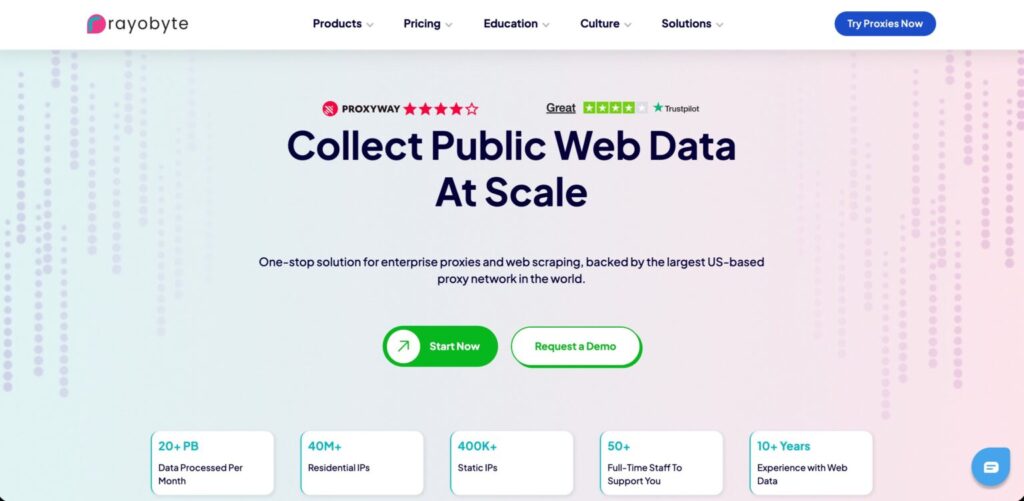
Rayobyte is worth considering if you want a mix of residential, ISP, and datacenter proxies with a focus on ethically sourced infrastructure. Its residential pool is not the largest, but it has clear pricing and useful options for teams that want to keep scraping costs controlled.
For email scraping, Rayobyte is useful when you do not need the biggest pool on the market but still want reliable proxy types. Residential proxies can handle harder public sources, while ISP proxies can help with stable sessions on sites where consistency matters.
It is especially appealing for teams that prefer straightforward buying over complex enterprise contracts.
Pro Tip: Try ISP proxies for stable public directories and residential proxies for sources that block datacenter traffic quickly.
How To Choose Proxies For Email Scraping
Start With The Target Type
Not every email scraping job needs residential proxies. If you are scraping simple public websites, datacenter proxies may work. If you are scraping business directories, local listings, or profile-heavy platforms, residential proxies usually perform better. If the site requires session stability, ISP proxies may be the cleaner choice.
Check Real IP Diversity, Not Just Pool Size
A provider may advertise millions of IPs, but what matters is usable diversity. You want different subnets, countries, cities, ISPs, and ASN spread. If many IPs behave the same way, blocks can spread quickly.
For email scraping, usable IP diversity helps reduce failed requests across repeated crawls. It also helps when scraping regional sources where one country or ISP range gets throttled.
Use Rotation Carefully
Per-request rotation sounds powerful, but it is not always the best choice. For search result pages, broad crawling, and simple HTML collection, frequent rotation can work well. For paginated profiles, filtered searches, or multi-step workflows, sticky sessions are usually better.
A good proxy provider should offer both. Avoid providers that only rotate randomly with no session control.
Match Protocols To Your Scraper
Most email scraping tools work fine with HTTP or HTTPS proxies. SOCKS5 is useful when you need broader traffic support or custom networking behavior. Browser-based scrapers may also benefit from providers that support stable sessions and clean authentication.
Watch Bandwidth Waste
Email scraping can burn bandwidth fast when pages include images, JavaScript, tracking scripts, and heavy layouts. Block images, avoid unnecessary assets, cache pages where allowed, and extract only what you need.
The cheapest proxy is not always cheapest if the failure rate is high.
Final Recommendation
For enterprise email scraping, choose Bright Data or Oxylabs. For the best balance of price, scale, and usability, choose Decodo. For geo-targeted scraping, SOAX is a strong pick. For stable residential sessions, NetNut deserves attention. For budget testing, start with IPRoyal or Webshare. For mid-market rotation control, Infatica works well. For ethical residential and ISP mixing, Rayobyte is a practical option.
The best proxy provider is not the one with the biggest number on the homepage. It is the one that gives you clean sessions, predictable rotation, usable locations, fair bandwidth costs, and enough control to keep your email scraping workflow compliant and stable.
FAQs About Email Scraping Proxies
Are proxies required for email scraping?
Not always. Small public scraping jobs may work without proxies. But once you scrape many pages, run recurring jobs, or collect data across many domains, proxies help reduce throttling, failed requests, and IP-based limits.
Are residential proxies better than datacenter proxies for email scraping?
Residential proxies usually perform better on protected directories and location-sensitive sites. Datacenter proxies are faster and cheaper, but they are easier to detect and block.
What is the best rotation setting for email scraping?
Use per-request rotation for simple crawling. Use sticky sessions for paginated directories, filtered searches, or multi-step profile scraping. A 5 to 15 minute sticky window is often a good starting point.
Can I scrape emails from any website?
No. You should only collect publicly available data where you have a lawful reason, respect site terms, and follow privacy and anti-spam rules. Never scrape private accounts, gated areas, or sensitive personal data.
Which proxy type is best for B2B lead scraping?
Residential proxies are usually the safest default. ISP proxies are useful when session stability matters. Datacenter proxies can work for simple, low-risk sources.
How do I reduce proxy bandwidth costs?
Disable images, videos, fonts, and unnecessary scripts. Use HEAD requests where appropriate, avoid duplicate crawling, cache pages when allowed, and keep retry logic tight.
Should I use free proxies for email scraping?
No. Free proxies are slow, unstable, risky, and often abused by many users. For business data collection, paid proxies are safer and more predictable.
What matters more: IP pool size or proxy quality?
Quality matters more. A smaller clean pool with good rotation, healthy IPs, and strong location coverage can beat a huge pool with poor reliability.
Is SOCKS5 necessary for email scraping?
Not always. HTTP and HTTPS are enough for most web scraping. SOCKS5 is useful for more flexible network handling or tools that require it.