
Retail intelligence is not just about checking a competitor’s price once a week. Real teams track product availability, regional pricing, discount patterns, marketplace listings, reviews, shipping visibility, seller movement, MAP violations, and search placement across dozens of retail sites.
That means your proxy setup has to do more than “hide your IP.”
It must collect data consistently without breaking workflows every time a retailer changes its anti-bot rules.
A weak proxy stack creates dirty data. You get missing prices, blocked pages, duplicate sessions, wrong geos, and false out-of-stock signals. That is painful when your pricing team is making decisions from that feed.
The best proxies for retail intelligence usually combine large residential pools, sticky sessions, precise geo-targeting, smart rotation, clean IP sourcing, and strong dashboard controls. Some providers also add scraping APIs, browser automation, CAPTCHA handling, or ready-made retail datasets.
Those extras matter when your team does not want to maintain every scraper, parser, and retry rule internally.
Below is a practical buyer’s guide built for retail teams, ecommerce analysts, pricing intelligence companies, data vendors, and growth teams that need reliable public web data at scale.
Quick Comparison Table: Best Retail Intelligence Proxy Providers
| Provider | Best For | Proxy Strength | Retail Intelligence Fit | Main Watch-Out |
|---|---|---|---|---|
| Bright Data | Enterprise retail data operations | Huge residential pool, APIs, datasets | Excellent for pricing, MAP, product, and marketplace tracking | Premium pricing and more setup depth |
| Oxylabs | Large-scale ecommerce scraping | Residential, datacenter, ISP, Web Unblocker | Strong for complex targets and structured data pipelines | Better suited for serious budgets |
| Decodo | Balanced price and scale | 115M+ residential IPs, scraping API | Great for mid-market teams needing flexible rotation | Advanced use cases may need tuning |
| SOAX | Geo-specific retail monitoring | Residential, mobile, ISP, datacenter | Strong city and ISP targeting for regional retail checks | Smaller tool layer than top enterprise platforms |
| NetNut | Stable rotating residential access | 85M+ residential IPs, unlimited concurrency | Good for high-volume monitoring workflows | Pricing may feel heavy for smaller teams |
| IPRoyal | Affordable retail research | Residential proxies in 195+ locations | Useful for startups, testing, and moderate scraping | Not as advanced for managed scraping |
| Webshare | Budget-friendly proxy infrastructure | Rotating residential and static residential | Good for cost-conscious product data projects | Less enterprise scraping support |
| Rayobyte | US-focused data collection | Residential, ISP, datacenter proxies | Good for US retail monitoring and scalable scraping | Pool size is smaller than mega providers |
| Infatica | Compliance-focused proxy operations | 40M+ proxies, scraping APIs | Strong for teams wanting ethical sourcing and stability | May need comparison testing for tough targets |
1. Bright Data
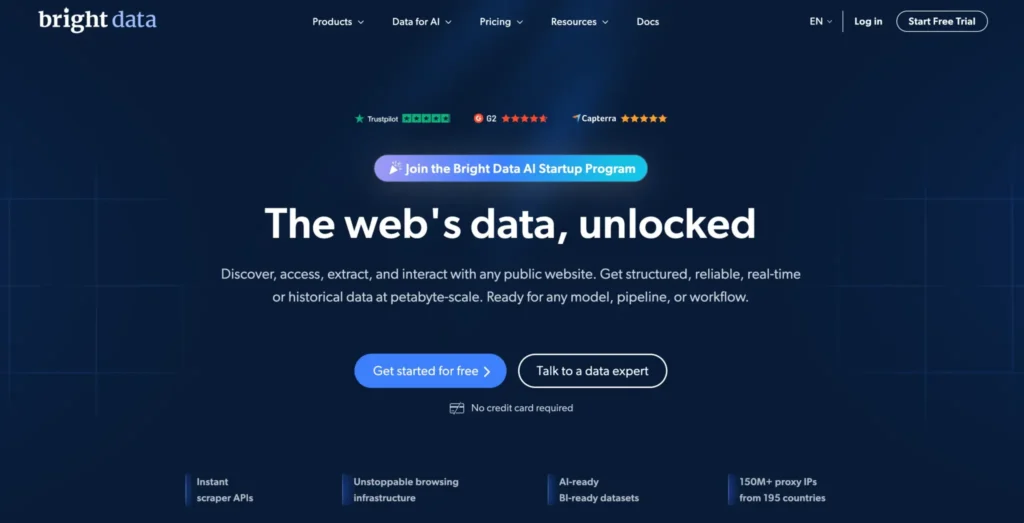
Bright Data is the heavy-duty option for teams that treat retail intelligence as a business-critical system. Its network is built for large-scale data collection, and the platform goes beyond raw proxies with Web Scraper API, SERP API, datasets, and retail-focused intelligence tools.
For retail teams, the biggest advantage is coverage. You can target by country, city, carrier, ASN, and other location-level signals. That helps when pricing changes by region, delivery ZIP code, or marketplace storefront.
Bright Data makes the most sense when you need reliable collection across Amazon-style marketplaces, regional retailer sites, category pages, product pages, and search result pages. It is not the cheapest route, but it is one of the strongest choices when failed requests cost more than proxy traffic.
Pro Tip: Use residential proxies for dynamic retail pages, ISP proxies for stable account-like sessions, and scraping APIs when your team wants structured output instead of maintaining parsing logic.
2. Oxylabs
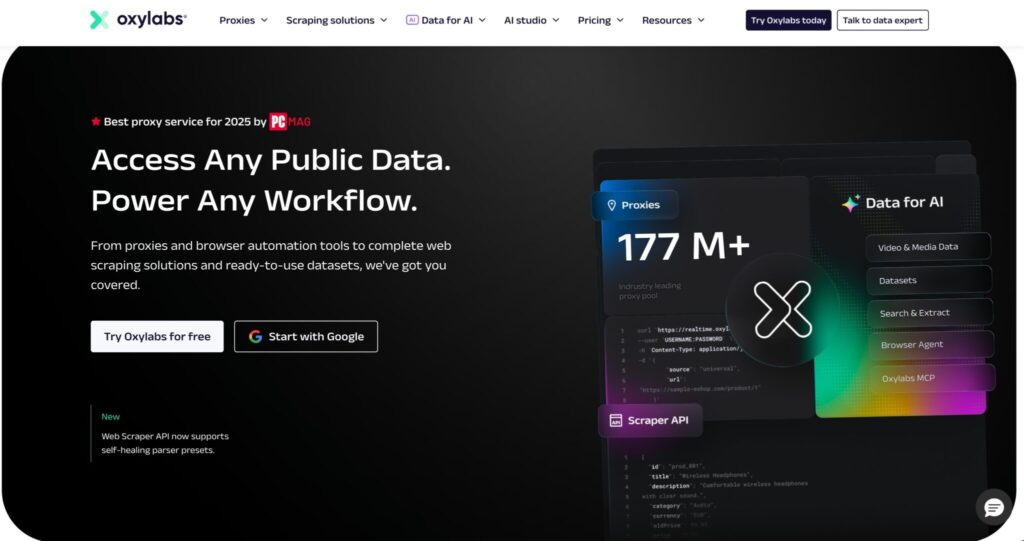
Oxylabs is another enterprise-grade pick, especially for companies running serious ecommerce scraping, product monitoring, and competitive pricing pipelines. It offers residential proxies, datacenter proxies, ISP proxies, mobile proxies, Web Unblocker, and Web Scraper API.
The platform fits retail intelligence projects where scale and consistency matter. If you are collecting prices from thousands of product pages across multiple countries, Oxylabs gives you the building blocks to manage high request volume without constantly fighting blocks.
Its Web Unblocker is valuable for tougher websites where simple rotation is not enough. Retail sites often use device fingerprinting, browser checks, rate limits, and behavioral signals. A proxy alone does not always solve that. Oxylabs is useful when you need proxy infrastructure plus unblocking logic.
Pro Tip: For large catalogs, separate your crawling into discovery, refresh, and high-priority SKU monitoring. Use faster proxy types for discovery and residential or unblocker-based flows for protected product pages.
3. Decodo
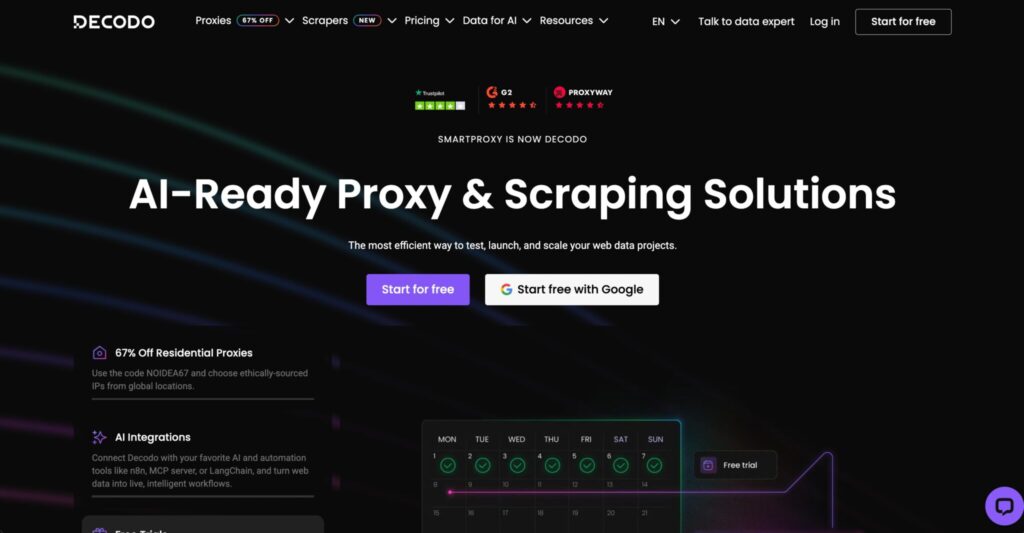
Decodo, formerly Smartproxy, is a strong middle-ground provider for retail intelligence teams that want scale without an overly complex enterprise setup. Its residential proxy pool is large, pricing is more approachable than some premium players, and the dashboard is generally easier to work with.
For retail use cases, Decodo works well for price tracking, product availability monitoring, review collection, competitor catalog checks, and regional marketplace research. The rotating proxy setup is friendly for teams that need steady access but do not want to spend weeks configuring everything.
The Web Scraping API is also useful if your team wants to reduce engineering work. Instead of building the full stack around browser rendering, retries, proxies, and output handling, you can push more of that work to the provider.
Pro Tip: Use sticky sessions when checking checkout-adjacent flows, shipping estimates, or localized pricing. Use rotating sessions for broad category discovery and large SKU refreshes.
4. SOAX
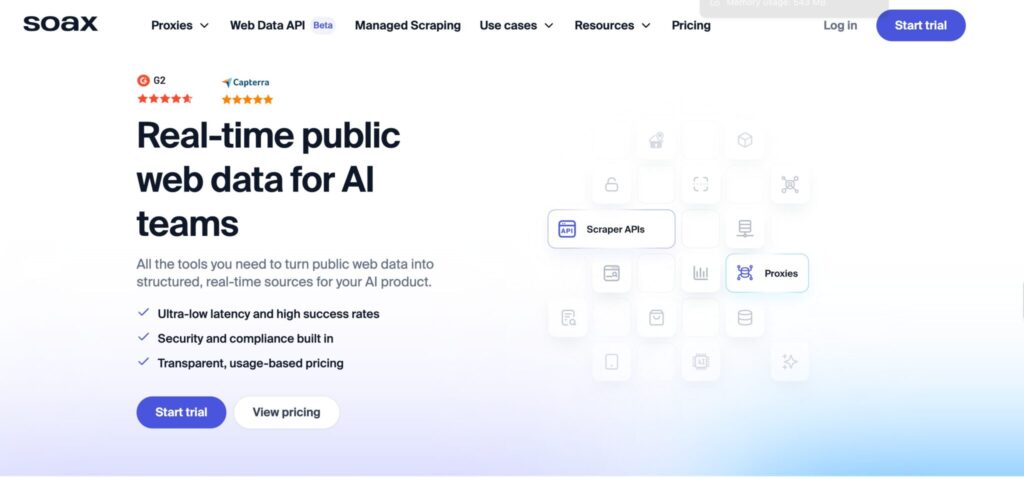
SOAX is a strong option when geo-targeting is a key part of your retail intelligence workflow. It offers residential, mobile, ISP, and datacenter proxies, with coverage across many locations. That matters for retailers that show different prices, availability, tax estimates, delivery windows, or promotions depending on the visitor’s region.
Retail teams can use SOAX for localized price checks, product feed validation, ad verification, seller monitoring, and marketplace research. Its clean interface and targeting controls make it easier to run location-specific data collection without overcomplicating the stack.
SOAX is especially useful when your team cares about regional accuracy. For example, a beauty retailer, grocery delivery platform, or electronics marketplace may show different stock data in Mumbai, London, New York, and Toronto. Geo-targeted proxies help you catch those differences.
Pro Tip: Always log proxy location, target URL, timestamp, currency, and delivery region with each scrape. Retail intelligence data is weak if you cannot explain where the result came from.
5. NetNut
NetNut is built for teams that care about stable, high-volume residential proxy access. Its rotating residential network, country coverage, and unlimited concurrency positioning make it useful for continuous retail monitoring jobs.
The key appeal is scale. If you are refreshing a large product database several times per day, you need a proxy provider that can handle many parallel requests without creating unstable results. NetNut fits pricing intelligence, product matching, review scraping, catalog monitoring, and search placement tracking.
It may not be the first choice for a small test project, but it makes sense when you already know your data targets and need reliable throughput.
Pro Tip: Do not rotate too aggressively on every request. For retail pages with session-based localization, hold the same IP long enough to preserve region, currency, and delivery context.
6. IPRoyal
IPRoyal is a practical choice for smaller teams, affiliate researchers, ecommerce operators, and startups that need residential proxies without jumping straight into enterprise contracts. It offers residential proxies across many countries, with flexible pricing that can work well for testing and moderate retail intelligence tasks.
It is useful for price checks, product research, marketplace monitoring, competitor research, and light scraping. If you are building your first retail data workflow, IPRoyal gives you room to test assumptions before committing to a larger platform.
The trade-off is that you may need more in-house scraping logic. IPRoyal is more proxy-first than full retail data platform. That is fine if your team already has scrapers, parsers, queues, and retry logic.
Pro Tip: Start with a small traffic package and test success rate by target type. Category pages, product pages, search pages, and review pages often behave very differently.
7. Webshare
Webshare is attractive for cost-sensitive teams that want a simple proxy setup for retail data projects. It offers rotating residential proxies, static residential proxies, and datacenter proxies, which gives you a useful mix for different task types.
For retail intelligence, Webshare works well for lighter product scraping, stock checks, page testing, SEO-style marketplace monitoring, and data validation. Its static residential proxies can be useful when you need a more stable identity, while rotating residential proxies are better for wider crawling.
It is not as feature-rich as Bright Data or Oxylabs, but that may be a benefit for teams that want clean proxy access without paying for a large platform layer.
Pro Tip: Use Webshare datacenter proxies only on easier targets. For major ecommerce sites with strict bot controls, residential or static residential proxies will usually produce cleaner results.
8. Rayobyte
Rayobyte is a strong fit for teams focused on US retail data and public web data collection. It offers residential proxies, datacenter proxies, ISP proxies, and scraping support, with a clear emphasis on ethical data collection.
Retail teams can use Rayobyte for price tracking, product listing monitoring, market research, and SKU-level data checks. Its ISP proxies can be helpful when you need stable sessions with residential-like trust signals.
Rayobyte is not always the largest pool option, but it can be a good fit for teams that want a provider with strong US infrastructure and support.
Pro Tip: Use ISP proxies for recurring checks on the same retailers. They can reduce session noise compared with fully rotating residential pools.
9. Infatica
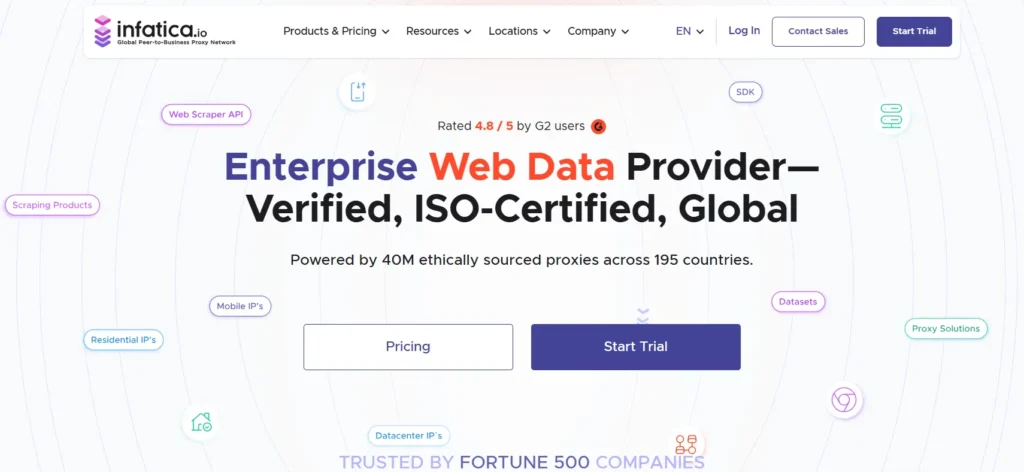
Infatica positions itself around verified, ethically sourced proxy infrastructure, which is important for retail teams that care about compliance and vendor risk. It offers residential proxies, proxy infrastructure, and scraping APIs with global coverage.
For retail intelligence, Infatica fits product data extraction, competitor monitoring, price intelligence, and marketplace research. It is especially worth testing when your company needs cleaner sourcing practices and stable performance.
The main decision point is target difficulty. For common retail sites, Infatica can be a strong option. For heavily protected marketplaces, compare it against Bright Data, Oxylabs, and Decodo before choosing.
Pro Tip: Run a pilot with your hardest 20 target URLs, not your easiest 200. Proxy vendors look similar until you test them against pages that block, delay, localize, or render content through JavaScript.
How to Choose Proxies for Retail Intelligence
Match Proxy Type to the Retail Task
Residential proxies are usually the safest default for retail intelligence because they use real consumer IPs. They work well for pricing pages, marketplace listings, review pages, and location-sensitive product data.
ISP proxies are useful when you need session stability. They are faster and more consistent than many rotating residential pools, but they still carry stronger trust signals than ordinary datacenter IPs.
Datacenter proxies are cheaper and faster, but they are easier to detect. Use them for low-risk pages, internal QA, or targets that do not heavily block automation.
Mobile proxies are useful for app-based retail tracking, mobile-only pricing, and ad verification. They are usually expensive, so use them only where mobile identity matters.
Study the IP Pool, Not Just the Size
A provider may claim millions of IPs, but pool quality matters more than the headline number. For retail intelligence, check geographic coverage, ASN diversity, city-level targeting, rotation controls, success rates, and whether the pool performs well on your actual target sites.
A smaller clean pool can beat a huge noisy pool if it gives fewer blocks, fewer CAPTCHAs, and more consistent localized results.
Understand Rotation Protocols
Rotation is not just “change IP often.” Retail scraping needs controlled rotation.
Use per-request rotation for broad crawling, such as collecting category URLs or search result pages. Use sticky sessions for product pages, cart checks, shipping estimates, and localized pricing. Use longer sessions when the website stores region, language, currency, or delivery preferences.
Bad rotation creates bad data. If the proxy changes halfway through a session, you may capture the wrong region or trigger anti-fraud systems.
Test Success Rate by Page Type
Do not judge a proxy provider from one homepage request. Test category pages, search pages, product pages, reviews, seller pages, and availability checks separately.
Retailers protect these pages differently. A provider may perform well on product pages but struggle with search pages. Another may handle static pages easily but fail when JavaScript rendering is required.
Check Compliance and Sourcing
Retail intelligence teams should collect public data responsibly. Avoid vendors with unclear sourcing, weak abuse controls, or suspiciously cheap residential traffic. Look for clear policies, business verification, documentation, and support for compliant use cases.
Cheap proxy traffic can become expensive if it causes legal, ethical, or data-quality problems later.
FAQs
What are the best proxies for retail intelligence?
The best proxies for retail intelligence are usually residential or ISP proxies from providers like Bright Data, Oxylabs, Decodo, SOAX, NetNut, IPRoyal, Webshare, Rayobyte, and Infatica. The right choice depends on your budget, target sites, countries, scraping volume, and whether you need raw proxies or managed scraping APIs.
Are residential proxies better for price monitoring?
Yes, residential proxies are usually better for price monitoring because retail websites tend to trust them more than datacenter IPs. They are especially useful when you need localized prices, regional availability, or marketplace data that changes based on location.
Should I use rotating or sticky proxies for ecommerce scraping?
Use rotating proxies for broad crawling and large-scale discovery. Use sticky sessions when you need consistent location, currency, shipping region, or cart behavior. Many retail intelligence workflows need both.
Can datacenter proxies work for retail intelligence?
Datacenter proxies can work on easier targets, but they are more likely to get flagged on major ecommerce sites. They are best for low-risk tasks, fast checks, and websites with minimal bot protection.
What proxy features matter most for retail data?
The most important features are geo-targeting, session control, IP pool quality, protocol support, success rate, concurrency, dashboard analytics, API access, and clear proxy sourcing. For tough targets, Web Unblocker or scraping API support can also matter.
How do proxies help with MAP monitoring?
MAP monitoring requires checking whether sellers are advertising prices below the minimum allowed price. Proxies help by letting brands check prices across regions, marketplaces, sellers, and device contexts without being blocked or served incomplete data.
How much should I spend on retail intelligence proxies?
Small tests can start with low-cost residential plans. Serious retail monitoring usually costs more because you need higher traffic limits, better targeting, cleaner IPs, and lower failure rates. Focus on cost per successful record, not cost per GB alone.
Are proxies legal for retail intelligence?
Proxies are legal tools, but how you use them matters. Stick to publicly available data, respect website terms where applicable, avoid personal data collection, and build rate limits that reduce unnecessary load on target websites.
Final Buying Advice
For enterprise retail intelligence, start with Bright Data or Oxylabs. For a strong balance of cost, scale, and usability, test Decodo, SOAX, or NetNut. For tighter budgets and early-stage projects, IPRoyal and Webshare are practical starting points. Rayobyte and Infatica are worth testing when ethical sourcing, US coverage, or compliance posture matters.
The smartest buying move is simple: run a real pilot. Pick your hardest retailers, test multiple page types, compare cost per successful record, and measure data accuracy. The proxy provider that wins that test is the one your pricing, product, and ecommerce teams can actually trust.