
Best Proxies For Data Labeling.
Data labeling sounds simple until the source data starts fighting back. One week your annotation team needs product images from different regions. The next week, your QA team has to verify location-based search results, marketplace listings, ads, local SERPs, or public web pages before they can label them correctly.
Then come the blocks, CAPTCHAs, throttling, duplicate pages, missing regional variants, and messy datasets.
That is where proxies become useful.
For data labeling workflows, proxies are not just about hiding an IP address. They help teams collect, validate, and review public web data from different locations, devices, carriers, and user environments.
A good proxy setup can improve dataset coverage, reduce collection failures, and make labeling work more consistent. A bad one can poison your dataset with gaps, duplicates, biased samples, or unstable sessions.
Below is a practical buyer’s guide to the best proxies for data labeling, built for AI teams, data vendors, QA teams, ecommerce intelligence teams, and researchers who need clean, repeatable access to public data.
Quick Comparison Table: Best Proxies For Data Labeling
| Proxy Provider | Best For | Proxy Types | IP Pool | Rotation Control | Geo Targeting | Best Use Case |
|---|---|---|---|---|---|---|
| Bright Data | Enterprise labeling pipelines | Residential, mobile, ISP, datacenter | 400M+ monthly residential IPs | Advanced | Country, city, carrier, ASN | Large-scale public data collection |
| Oxylabs | High-volume ML datasets | Residential, mobile, ISP, datacenter | 175M+ residential IPs | Strong | Country, city, state, ZIP | AI data pipelines and web scraping |
| Decodo | Balanced price and usability | Residential, mobile, ISP, datacenter | 125M+ IPs | Flexible | 195+ locations | Mid-sized labeling teams |
| SOAX | Mobile-heavy data labeling | Residential, mobile, ISP, datacenter | 191M+ total IPs | Clean dashboard controls | 195+ locations | App, mobile, and regional testing |
| NetNut | Stable sessions at scale | Residential, rotating residential, ISP | 85M+ residential IPs | Rotating and sticky | 195+ countries | Continuous data extraction |
| IPRoyal | Affordable labeling projects | Residential, ISP, mobile, datacenter | 32M+ proxy pool | Basic to moderate | Global targeting | Budget-sensitive projects |
| Webshare | Low-cost static and rotating proxies | Residential, static residential, datacenter | 80M+ residential IPs | Simple | Broad global coverage | Small teams and testing |
| Rayobyte | US-focused data operations | Residential, ISP, datacenter | 40M+ residential IPs | Practical controls | Strong US coverage | US market data labeling |
1. Bright Data
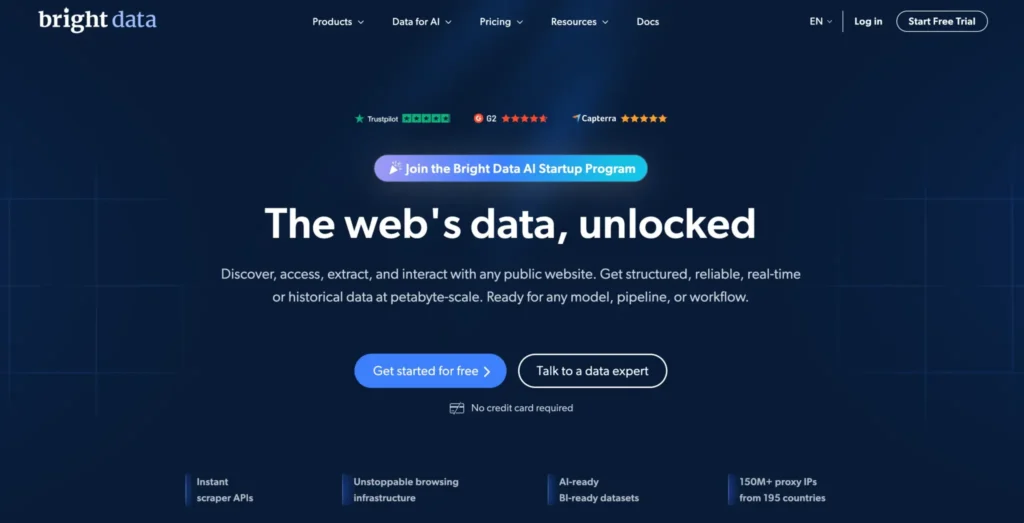
Bright Data is the heavyweight option for serious data labeling pipelines. It is best suited for teams that collect large volumes of public web data, verify labeled samples across regions, or need strict control over routing.
The platform offers residential, mobile, ISP, and datacenter proxies, plus broader web data tools. For data labeling, the biggest advantage is control. You can target by country, city, carrier, ASN, and other location variables, which is useful when labels depend on where the user appears to be browsing from.
For example, a marketplace dataset may show different prices, stock status, ads, delivery windows, or search rankings based on region. If your labeling team only sees one location, the labels may be incomplete. Bright Data helps solve that by giving teams more granular coverage.
The downside is complexity. It is powerful, but not always simple for beginners. Smaller labeling teams may find the dashboard, compliance checks, and pricing structure heavier than they need.
Pro-Tip: Use Bright Data when label accuracy depends on precise location conditions, not when you only need cheap proxy traffic.
2. Oxylabs
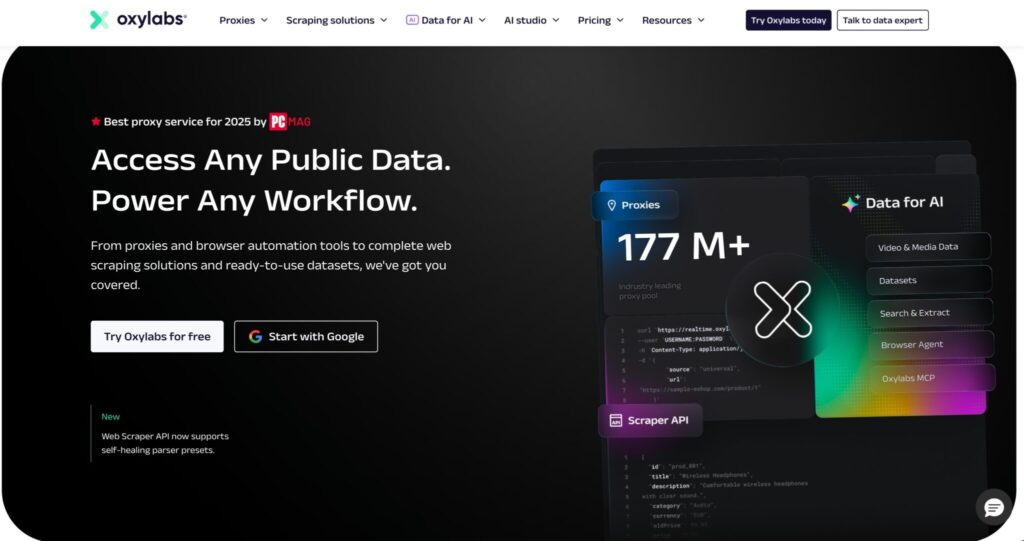
Oxylabs is another strong choice for data labeling teams that care about scale, success rates, and clean infrastructure. It works especially well for companies building AI datasets from public web sources, ecommerce catalogs, job boards, travel listings, public search pages, and localized content.
Its residential proxy network is large, and the platform supports advanced geo-targeting. For labeling workflows, Oxylabs is useful when you need stable access across many regions without constantly tuning your proxy stack.
Oxylabs also fits teams that have engineers managing scraping, enrichment, and preprocessing before human labelers begin their work. The better your raw collection layer, the less time your labelers waste fixing broken rows, blank pages, or blocked URLs.
It is not the cheapest option. But if your labeling pipeline handles high-volume data and failed requests cost real money, Oxylabs makes sense.
Pro-Tip: Pair Oxylabs residential proxies with sticky sessions when labelers need to review multi-step flows, such as category browsing or search refinement.
3. Decodo, Formerly Smartproxy
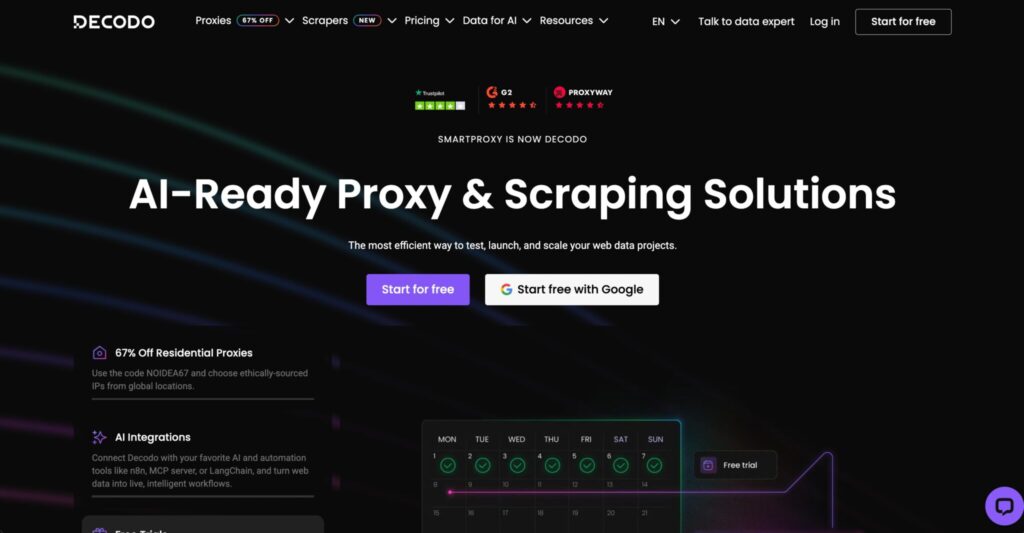
Decodo is a strong middle-ground provider. It gives you enough scale for serious data work without feeling as enterprise-heavy as Bright Data or Oxylabs.
For data labeling, Decodo works well when your team needs residential proxies, datacenter proxies, and practical rotation controls in one place. It is useful for ecommerce monitoring, SERP review, localized page validation, ad verification, and AI data collection.
The platform is easier to approach than some enterprise-first tools. That matters if your labeling team includes non-technical operations people who need to run checks, test proxy locations, or coordinate with freelancers and QA reviewers.
Decodo may not offer the same deep enterprise tooling as Bright Data, but it is a reliable option for teams that want speed, coverage, and usability.
Pro-Tip: Use Decodo for mixed labeling workflows where some tasks need residential proxies and others can run on faster datacenter IPs.
4. SOAX
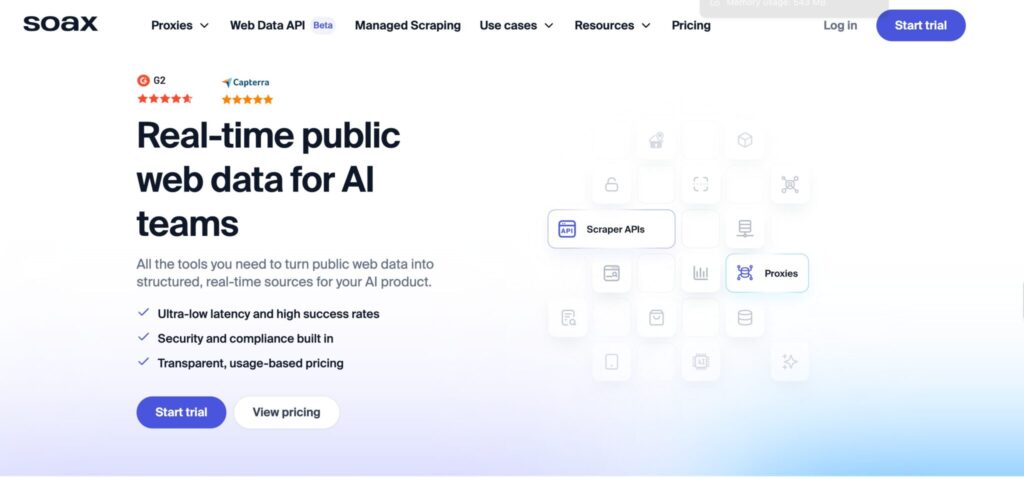
SOAX is a smart pick when your data labeling project depends on mobile or location-sensitive data. Many AI datasets are not purely desktop-based anymore. Teams label app screens, mobile search results, local listings, social content, ads, and region-specific experiences.
SOAX offers residential, mobile, ISP, and datacenter proxies with strong geo-targeting. Its mobile proxy coverage is especially helpful when you need to see how content appears through mobile carriers and mobile IP ranges.
This makes SOAX useful for labeling mobile SERPs, ad placements, app store content, local business listings, and location-based content variations. If your labels include “visible in region,” “mobile result type,” “ad shown,” “price shown,” or “availability status,” mobile proxies can make a real difference.
SOAX is also known for a clean interface, which helps operations teams manage proxy settings without constant developer support.
Pro-Tip: Use mobile proxies only when the target data actually changes on mobile networks. They are powerful, but usually more expensive than residential or datacenter proxies.
5. NetNut
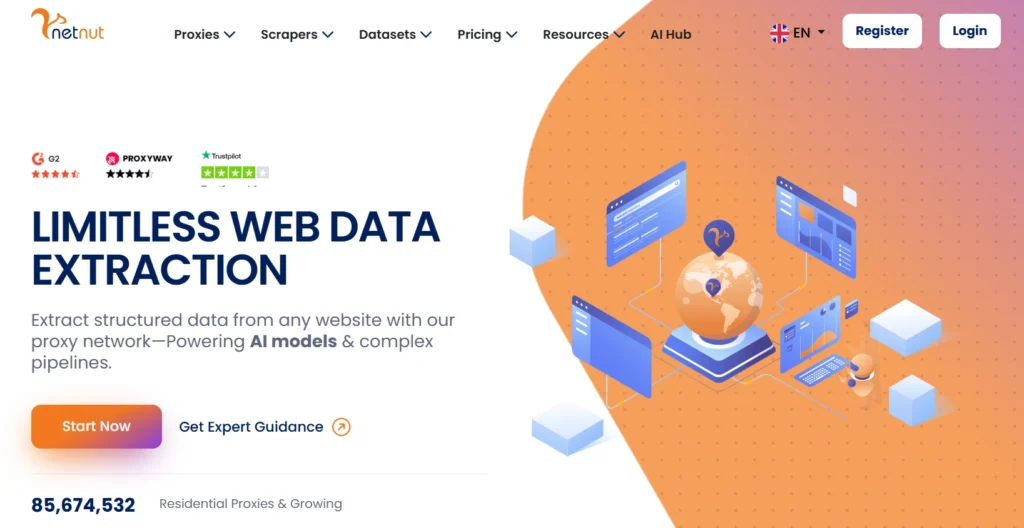
NetNut is built for teams that care about stable connections and consistent sessions. That makes it useful for data labeling pipelines where failed requests, session resets, and inconsistent page views can slow down review work.
Its rotating residential proxies are suitable for large-scale public data collection, while static residential options can support workflows that need longer sessions. This matters when your labelers or automated systems need to move through multiple pages without changing identity too often.
For example, a labeling task might require checking a product page, seller profile, reviews, delivery options, and related listings. If the proxy rotates too aggressively, the target site may show inconsistent content or trigger verification. NetNut gives teams more control over that balance.
NetNut is best for structured, repeatable collection rather than casual testing. Pricing may be less attractive for very small teams, but the stability can pay off for ongoing projects.
Pro-Tip: For annotation QA, use sticky sessions long enough to complete the review path, then rotate between tasks to reduce pattern repetition.
6. IPRoyal
IPRoyal is a practical option for smaller data labeling teams, early-stage AI projects, and agencies that need proxy coverage without enterprise-level costs.
It offers residential, ISP, mobile, and datacenter proxies. The pool is smaller than Bright Data or Oxylabs, but it is still large enough for many labeling workflows. IPRoyal is useful for basic public data collection, regional page checks, SEO data labeling, ecommerce validation, and small-scale AI dataset preparation.
The biggest appeal is affordability. If your project does not need very granular targeting or huge concurrency, IPRoyal can offer a good balance between cost and capability.
The tradeoff is that you may need more manual testing. Smaller pools can work well, but you should check success rates for your exact target sites before committing to a large labeling operation.
Pro-Tip: Start with a small test batch across your top target domains. Measure block rate, response time, duplicate rate, and regional accuracy before scaling.
7. Webshare
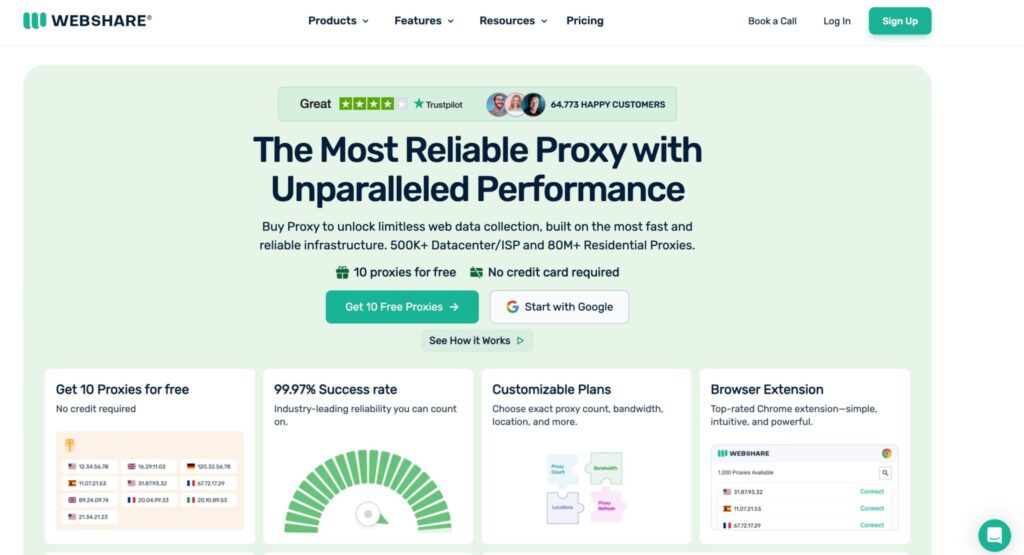
Webshare is a good choice for teams that want affordable proxies for testing, lightweight collection, or lower-risk labeling workflows. It offers rotating residential proxies, static residential proxies, and datacenter proxies.
For data labeling, Webshare can work well when your targets are not extremely protected or when your team mainly needs broad access rather than deep geo precision. It is also useful for building test datasets, validating collection scripts, or running smaller annotation projects.
The dashboard is simple, pricing is approachable, and the setup process is friendly for beginners. That makes it a good starting point for teams that do not yet know how much proxy traffic they will need.
It is not the most advanced choice for complex anti-bot environments. If your data sources are aggressive with blocking, you may outgrow Webshare and move to a more enterprise-grade platform.
Pro-Tip: Use Webshare datacenter proxies for fast, low-cost tasks first. Upgrade only the blocked or location-sensitive targets to residential proxies.
8. Rayobyte
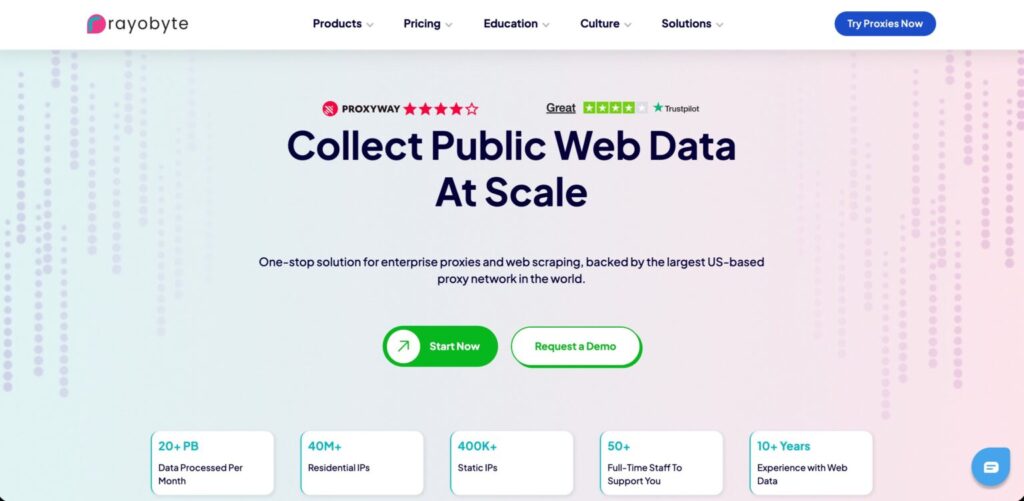
Rayobyte is a strong option for teams focused on US market data, ecommerce intelligence, public web scraping, and structured data workflows. It offers residential, ISP, and datacenter proxies, with a practical focus on ethical public web data collection.
For data labeling, Rayobyte can be useful when your datasets are heavily US-centered. Think retail listings, local search results, classifieds, business directories, pricing data, and regional ecommerce pages.
Its ISP and datacenter products are also helpful for workflows where speed matters. Residential proxies are often better for difficult targets, but datacenter and ISP proxies can be more efficient for stable sources.
Rayobyte may not be the first choice for teams that need extremely broad international coverage, but it is a solid pick for US-heavy operations and teams that want support from a provider focused on web data use cases.
Pro-Tip: Use Rayobyte ISP proxies for repeated QA checks where you need a more stable identity than rotating residential traffic.
How To Choose The Best Proxy For Data Labeling
Start With The Data Source, Not The Proxy Type
Do not buy residential proxies just because they sound premium. First, map your sources. Are you labeling ecommerce pages, app screens, search results, ads, job listings, travel listings, product images, or local business data?
If the site is simple and stable, datacenter proxies may be enough. If the site changes content by location or blocks datacenter IPs, residential proxies make more sense. If the content changes on mobile networks, mobile proxies become important.
Check IP Pool Quality, Not Just Pool Size
Large IP pools help, but quality matters more. A 100M IP pool with poor targeting, reused IPs, or weak success rates can perform worse than a smaller clean pool.
Look for these signals:
- Real residential or ISP-sourced IPs
- Country, state, city, or ZIP targeting
- Low duplicate IP reuse
- Clean session handling
- Clear usage policies
- Transparent dashboard reporting
For data labeling, bad IP quality can create bad labels. If your proxy shows the wrong region, your labeler may mark the wrong price, language, availability, or search result.
Understand Rotation Protocols
Rotation is one of the most important proxy settings for labeling workflows.
Request-based rotation changes IP after every request. It is good for large-scale collection where each URL stands alone.
Session-based rotation keeps the same IP for a set period. It is better when labelers or bots need to move through multiple pages in one flow.
Sticky sessions keep the same IP for longer. They help with accountless browsing paths, multi-page review, search refinement, and checkout visibility testing.
For most data labeling projects, the best setup is mixed. Use rotating residential proxies for broad collection, sticky residential or ISP proxies for QA review, and datacenter proxies for low-risk pages.
Measure Success Before Buying More Traffic
Never judge a proxy provider from the homepage alone. Run a small pilot first.
Track:
- Success rate by target domain
- CAPTCHA rate
- Average response time
- Cost per successful page
- Geo accuracy
- Duplicate content rate
- Labeler complaints
- Session stability
The metric that matters most is not price per GB. It is cost per usable labeled record.
Best Proxy Setup For Data Labeling Teams
A strong setup usually looks like this:
- Residential proxies for difficult public websites and regional content
- Datacenter proxies for fast collection from low-risk sources
- ISP proxies for stable sessions and repeated QA checks
- Mobile proxies for app, carrier, and mobile SERP validation
- Rotating sessions for large URL lists
- Sticky sessions for multi-page review tasks
- Central logging for errors, regions, IP type, and label quality issues
This gives your team flexibility without overspending on premium traffic for every task.
FAQs About Proxies For Data Labeling
What are proxies used for in data labeling?
Proxies help teams collect and verify public data from different regions, networks, and browsing environments. They are useful when labels depend on location, device type, search result variation, pricing, availability, or content visibility.
Are residential proxies better for data labeling?
Residential proxies are usually better for difficult or location-sensitive sources because they route traffic through real residential IPs. However, datacenter proxies can be faster and cheaper for simple sources that do not block aggressively.
What is the best proxy type for AI dataset collection?
For AI dataset collection, residential proxies are often the safest default. ISP proxies work well for stable sessions, datacenter proxies help with speed, and mobile proxies are best for app or mobile-specific datasets.
How many proxies do I need for a data labeling project?
It depends on request volume, target websites, regions, and rotation rules. A small QA project may need only a few GB of residential traffic, while a large AI labeling pipeline may need enterprise-scale bandwidth and millions of rotating IPs.
Should I use rotating or sticky proxies?
Use rotating proxies for large lists of independent URLs. Use sticky proxies when your labelers or bots need to complete a multi-page path with the same identity. Many teams need both.
Can proxies improve label accuracy?
Yes, if the labels depend on region, language, pricing, search visibility, ads, or availability. Proxies let reviewers see the version of the page that users in a specific market would see.
Are proxies legal for data labeling?
Proxies are legal tools, but how you use them matters. Stick to public data, respect website terms, avoid private information, follow privacy laws, and do not use proxies to bypass access controls or collect restricted data.
Which proxy provider is best overall for data labeling?
Bright Data and Oxylabs are the strongest choices for enterprise-scale labeling pipelines. Decodo is excellent for balanced usability and price. SOAX is strong for mobile and regional work. IPRoyal and Webshare are better for smaller budgets.
Final Verdict: Which Proxy Should You Choose?
For enterprise data labeling, start with Bright Data or Oxylabs. They offer the scale, targeting, and reliability needed for serious AI and web data pipelines.
For mid-sized teams, Decodo is the most balanced choice. It gives you strong coverage without overwhelming your workflow.
For mobile-heavy labeling, SOAX deserves a close look. Its mobile and regional proxy options are useful when labels depend on device or carrier conditions.
For budget-friendly projects, IPRoyal and Webshare are practical starting points. They are not as advanced as the top enterprise providers, but they can handle many smaller data labeling tasks well.
For US-focused datasets, Rayobyte is a solid fit, especially when you need a mix of residential, ISP, and datacenter proxies.
The smartest move is not picking the biggest proxy pool. It is choosing the provider that gives you the highest number of usable, accurate, and region-correct records for the lowest operational cost.