
Best Proxies For Threat Research.
Threat research is not normal browsing with a different IP. It is controlled investigation work where your team may need to inspect phishing kits, monitor fake login pages, collect public threat signals, verify regional exposure, check malware-linked infrastructure, or observe suspicious domains without exposing your office IP, analyst identity, or internal security tooling.
That is where proxies become more than a privacy add-on. A good proxy stack gives your analysts safer access, cleaner geo-visibility, stable sessions, and enough IP diversity to avoid bad data caused by blocks, CAPTCHAs, or location-based filtering. A poor proxy stack does the opposite.
It burns time, creates false negatives, leaks patterns, and may get your research environment flagged before you collect anything useful.
This guide ranks the best proxy providers for threat research based on IP pool quality, rotation control, geo-targeting, protocol support, compliance posture, dashboard usability, and value for security teams.
What Makes a Proxy Good for Threat Research?
For threat research, you are not just looking for “many IPs.” You need the right mix of residential, mobile, ISP, and datacenter proxies.
Residential proxies are useful when you need to view public pages the way real users in a specific country, city, or ISP would see them. Mobile proxies help when threat actors deliver different content to mobile carriers or app-based traffic.
ISP proxies offer a middle ground: they are more stable than rotating residential IPs while still looking closer to consumer traffic than a basic datacenter IP.
Datacenter proxies are fast and cheaper, which makes them useful for large-scale public scanning, enrichment, and repeat checks where stealth is less important.
Pro-Tip: Do not use one proxy type for every threat research task. Use datacenter proxies for speed, ISP proxies for stable monitoring, residential proxies for realistic access, and mobile proxies only when the target behavior truly depends on carrier or device signals.
Quick Comparison Table: Best Proxies For Threat Research
| Provider | Best For | Proxy Types | IP Pool Strength | Rotation Control | Geo-Targeting | Best Fit |
|---|---|---|---|---|---|---|
| Bright Data | Enterprise threat intelligence | Residential, ISP, mobile, datacenter | Extremely large | Advanced | Country, city, ASN, carrier | Large security teams |
| Oxylabs | Scalable cyber monitoring | Residential, ISP, mobile, datacenter | Very large | Strong | Global targeting | SOC teams and CTI vendors |
| Decodo | Balanced research workflows | Residential, ISP, mobile, datacenter | Large | Easy session control | 195+ locations | Mid-market teams |
| SOAX | Geo-sensitive investigations | Residential, mobile, ISP, datacenter | Very large | Flexible | Country, city, ISP, ASN | OSINT and brand protection |
| NetNut | Threat intelligence monitoring | Residential, ISP, mobile, datacenter | Large | Solid | 195+ countries | Continuous monitoring |
| IPRoyal | Budget-friendly research | Residential, ISP, mobile, datacenter | Medium-large | Sticky and rotating | Country, state, city | Small teams |
| Webshare | Affordable datacenter and residential | Residential, ISP, datacenter | Strong for price | Basic to moderate | Global | Developers and startups |
| Rayobyte | US-heavy static proxy use | Residential, ISP, datacenter | Strong US footprint | Good | Location-based | Repeat monitoring |
| DataImpulse | Low-cost public data collection | Residential, mobile, datacenter | Large | Simple | 195 countries | Cost-sensitive teams |
1. Bright Data: Best Overall Proxy Platform for Enterprise Threat Research
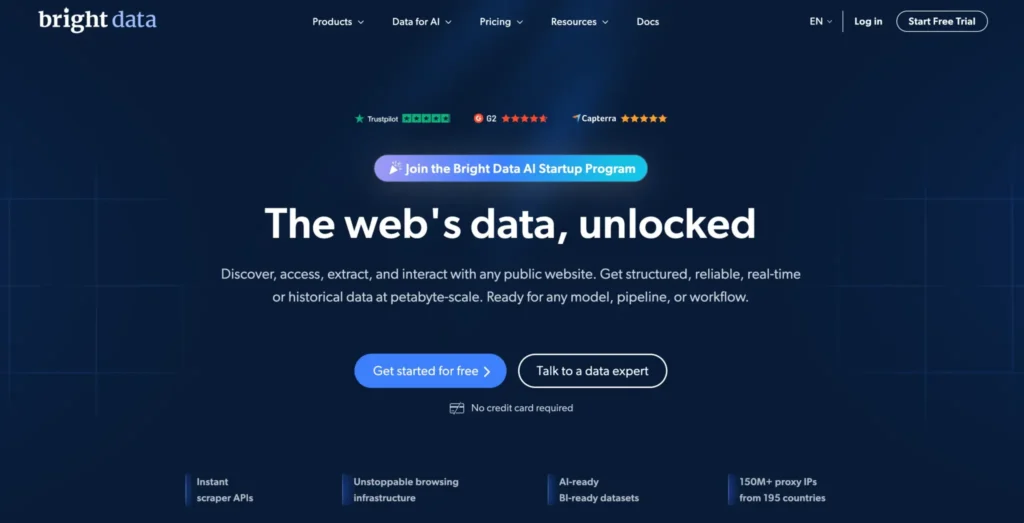
Bright Data is the provider I would shortlist first for mature security teams that need scale, controls, and compliance. Its proxy network includes residential, ISP, mobile, and datacenter options, which matters when a threat research workflow changes from phishing-page verification to domain monitoring to geo-based content checks.
The biggest advantage is control. Bright Data allows very specific targeting, including country, city, carrier, and ASN options. For threat research, that helps when a suspicious page behaves differently for users in Brazil, Germany, or the United States, or when a phishing kit only serves content through certain consumer networks.
It is not the cheapest option. Smaller teams may find the platform heavier than they need. But for security companies, anti-fraud teams, brand protection firms, and enterprise SOCs, the depth of tooling is hard to ignore.
Pro-Tip
Use Bright Data when you need auditability, advanced targeting, and proxy diversity in one place. It is overkill for small one-off checks, but strong for production-grade intelligence collection.
2. Oxylabs: Best for Scalable Cybersecurity Data Collection
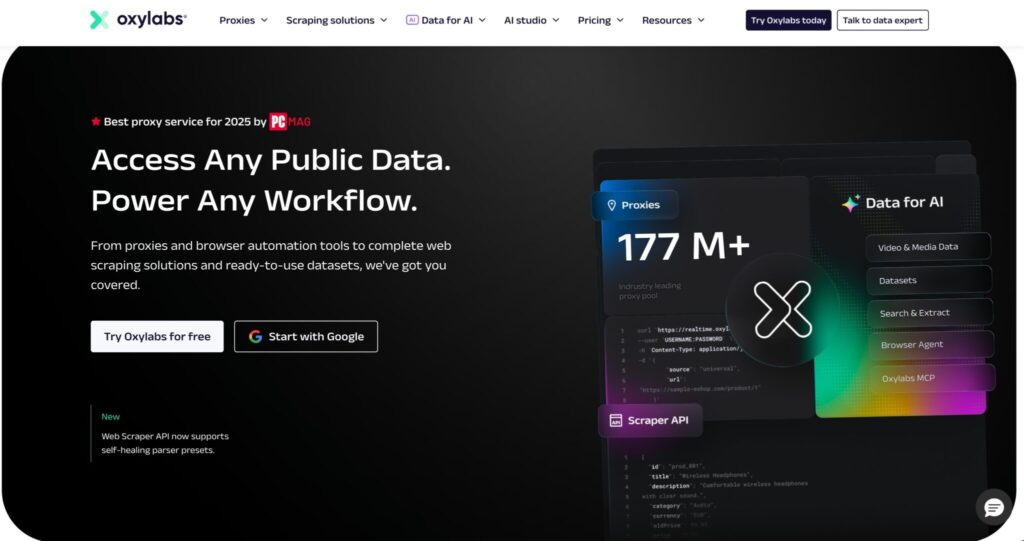
Oxylabs is another top-tier option for threat research, especially if your team needs to collect public threat data at scale. It offers residential proxies, datacenter proxies, ISP proxies, and mobile proxies, plus web scraping tools that can help reduce maintenance work.
For cybersecurity teams, Oxylabs works well when the task involves large-scale monitoring: phishing pages, fake domains, exposed assets, suspicious marketplaces, impersonation pages, or public web signals tied to threat actors. Its datacenter proxies are useful for fast, repeatable checks, while residential proxies help when the target blocks obvious infrastructure traffic.
The platform feels enterprise-focused, so pricing can climb as usage grows. Still, if your team values reliability and support, Oxylabs is one of the safest premium picks.
Pro-Tip
Use Oxylabs datacenter proxies for high-volume checks, then switch to residential or ISP proxies when you need realistic visibility from specific regions.
3. Decodo: Best Balance of Power, Ease, and Price
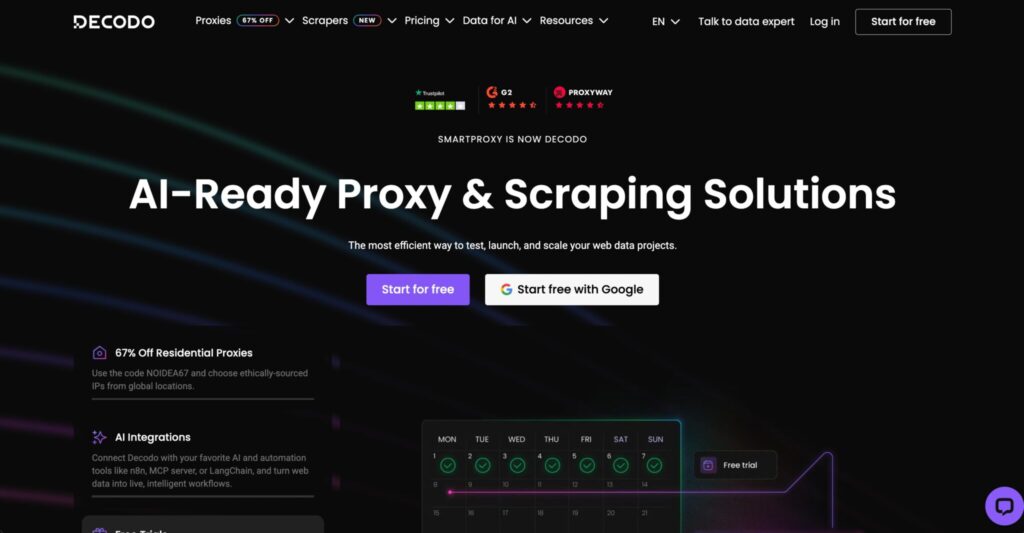
Decodo, formerly Smartproxy, is a strong middle ground. It is easier to manage than some enterprise-heavy platforms while still offering a large global IP pool, residential proxies, ISP proxies, mobile proxies, datacenter proxies, and scraping tools.
For threat research, Decodo is useful when analysts need a practical dashboard, fast setup, and enough control to run multiple workflows without involving a full engineering team. It works well for phishing page checks, ad fraud investigations, brand abuse monitoring, credential-stuffing surface research, and location-based public data collection.
Decodo also has a smoother learning curve. That matters if your team has security analysts who are strong in investigation work but do not want to spend days tuning proxy infrastructure.
Pro-Tip
Decodo is a good pick when your team wants reliable proxy access without building a heavy custom stack from day one.
4. SOAX: Best for Geo-Targeted Threat Research
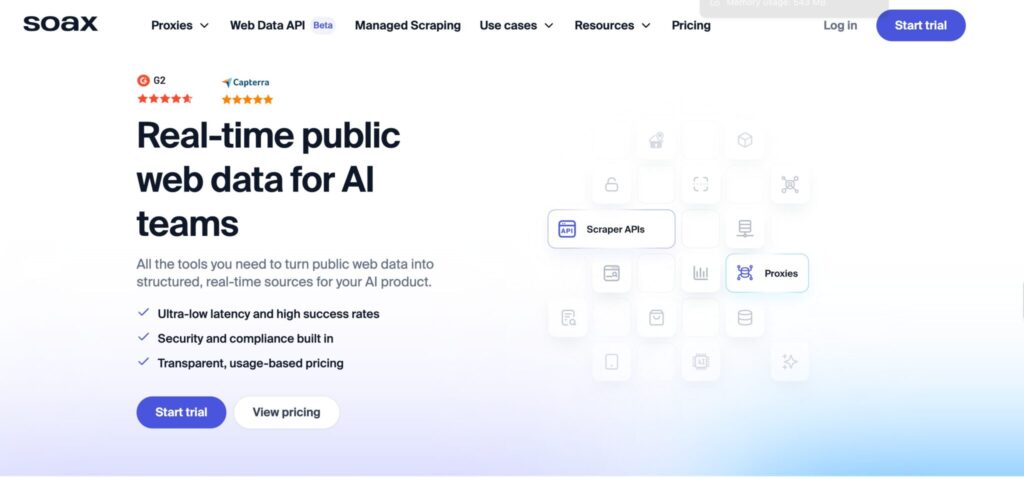
SOAX stands out for granular targeting and a strong cybersecurity use case fit. Its network includes residential, mobile, ISP, and datacenter proxies, with location options that are useful for threat researchers who need to compare how suspicious content appears across countries, cities, networks, and devices.
This is valuable because threat actors often segment visitors. A phishing page may show harmless content to datacenter IPs, block security vendors, redirect mobile users differently, or serve region-specific lures. SOAX gives analysts a flexible way to test those variations.
SOAX is also appealing for OSINT-style work where you need controlled identity separation across multiple investigations. The platform is not always as enterprise-heavy as Bright Data or Oxylabs, but that can be a strength for lean teams.
Pro-Tip
Use SOAX when regional accuracy matters more than raw speed. It is especially useful for checking localized phishing, fake brand pages, and geo-filtered scam funnels.
5. NetNut: Best for Continuous Threat Intelligence Monitoring
NetNut has an explicit threat intelligence use case, which makes it a natural fit for security teams monitoring public threat signals. Its residential and static residential proxy options can help analysts keep sessions stable while collecting data from public sources.
The value here is consistency. Some threat research workflows need frequent monitoring from stable IPs rather than constant rotation. For example, if you are watching a suspicious domain over several days, a static residential or ISP-style setup may reduce friction compared with aggressively rotating IPs on every request.
NetNut is a strong option for teams that want global visibility, anonymous collection, and long-running monitoring without constantly rebuilding sessions.
Pro-Tip
Do not rotate too aggressively when tracking the same threat source over time. Stable sessions can produce cleaner intelligence than fresh IPs on every request.
6. IPRoyal: Best Budget Pick for Small Security Teams
IPRoyal is a practical option for smaller research teams, freelancers, and early-stage security companies. It offers residential, ISP, mobile, and datacenter proxies, with flexible pricing that makes it easier to start small.
Its residential proxy pool is not as large as Bright Data or Oxylabs, but it is still strong enough for many practical tasks: public web checks, phishing investigation, SEO abuse monitoring, brand impersonation research, and basic geo-testing.
The biggest reason to consider IPRoyal is cost control. Not every threat research team needs an enterprise contract. Sometimes you need a manageable proxy setup that works, does not drain the budget, and supports rotating or sticky sessions.
Pro-Tip
Start with IPRoyal if you are testing proxy-based workflows for the first time. Upgrade later when you know your exact bandwidth, location, and session requirements.
7. Webshare: Best Affordable Proxy Stack for Developers
Webshare is a good fit for developer-led teams that want affordable datacenter, static residential, and rotating residential proxies. It is not the most advanced cybersecurity-specific platform, but it offers strong value for teams building internal tools.
For threat research, Webshare makes sense for repeatable checks, enrichment pipelines, and controlled public data collection. Its datacenter proxies are useful when speed and cost matter. Its residential options help when basic datacenter IPs are blocked or return misleading results.
The main trade-off is depth. You may not get the same high-touch support, advanced scraping ecosystem, or cybersecurity positioning found in premium providers. But for lean teams, Webshare can be very efficient.
Pro-Tip
Use Webshare for low-risk, high-volume collection tasks, then reserve premium residential pools for sensitive investigations where accuracy matters more.
8. Rayobyte: Best for Static and US-Focused Proxy Workflows
Rayobyte is a solid choice when your workflow benefits from static IPs, reliable datacenter proxies, and a strong US-based proxy footprint. Threat researchers may find it useful for recurring checks, domain monitoring, brand abuse verification, and public web collection where consistency matters.
Its residential and ISP options give teams more flexibility than pure datacenter providers. That said, Rayobyte feels strongest when you want dependable infrastructure rather than maximum global targeting depth.
For teams focused heavily on US threat surfaces, fake local business listings, region-specific scam pages, or repeat monitoring, Rayobyte is worth testing.
Pro-Tip
Use Rayobyte when you want controlled, repeatable traffic patterns. Not every threat research job needs huge IP churn.
9. DataImpulse: Best Low-Cost Option for Public Data Collection
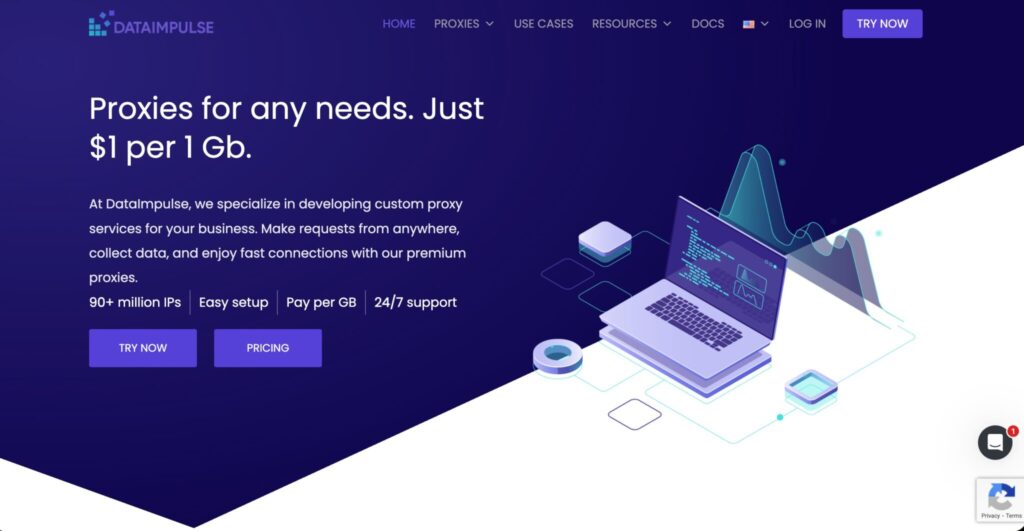
DataImpulse is attractive for teams that need affordable bandwidth and a large IP pool without complex procurement. It offers residential, mobile, and datacenter proxies across many countries, with simple pay-per-GB pricing.
For threat research, it is best suited for cost-sensitive public data collection, basic geo-checks, and enrichment workflows. It may not offer the same mature enterprise controls as Bright Data or Oxylabs, but the pricing can make sense for teams that need to run many checks without premium rates.
Use it carefully for high-sensitivity investigations. When accuracy, stability, and account support matter, a higher-end provider may be safer.
Pro-Tip
DataImpulse is a good secondary pool. Use it to reduce cost on broad collection, while keeping a premium provider for sensitive research targets.
How to Choose Proxies for Threat Research
Start With the Research Use Case
Pick proxies based on the job, not the provider’s marketing page. For phishing page verification, residential or ISP proxies are usually better. For large-scale domain enrichment, datacenter proxies may be enough. For mobile-only scams, use mobile proxies. For long-running monitoring, sticky residential or ISP sessions are often better than rapid rotation.
Check IP Pool Quality, Not Just Pool Size
A huge IP pool sounds impressive, but quality matters more. Look for ethically sourced residential IPs, clean reputation, strong location coverage, ASN targeting, and low failure rates. If your proxy IPs are already burned, you will get blocks instead of intelligence.
Understand Rotation Protocols
Rotation controls decide how long an IP stays assigned to your session. Per-request rotation is useful for broad scraping, but it can break login-free investigations where the target expects session continuity. Sticky sessions are better for watching a target over time. ISP proxies are best when you need stability with a residential-like profile.
Match Protocol Support to Your Tools
Most teams need HTTP and HTTPS support. SOCKS5 is useful for more flexible traffic routing, browser automation, and some OSINT tools. Check compatibility before buying, especially if your stack includes Maltego, custom Python collectors, browser profiles, headless browsers, or internal enrichment scripts.
Review Compliance and Abuse Controls
Threat research can involve risky public sources, so provider compliance matters. Choose vendors with clear acceptable-use policies, KYC processes, and ethical sourcing. That protects your team and reduces the risk of using a polluted or questionable network.
Best Proxy Setup by Threat Research Workflow
| Workflow | Recommended Proxy Type | Why |
|---|---|---|
| Phishing page verification | Residential or ISP | Looks closer to real user traffic |
| Malware infrastructure monitoring | Datacenter plus residential fallback | Fast checks with realistic rechecks |
| Brand impersonation research | Residential | Better regional visibility |
| Mobile scam investigation | Mobile | Matches carrier and device signals |
| Dark web adjacent OSINT gateways | ISP or residential | More stable identity separation |
| Large-scale IOC enrichment | Datacenter | Lower cost and higher speed |
| Long-running monitoring | Sticky residential or ISP | Keeps sessions consistent |
FAQs About Proxies for Threat Research
1. Are proxies legal for threat research?
Yes, proxies can be legal when used for lawful, authorized, and public data collection. The key is to avoid unauthorized access, credential misuse, system disruption, or violating platform terms.
2. Which proxy type is best for threat intelligence?
Residential proxies are usually the most versatile, but the best setup often combines residential, ISP, and datacenter proxies.
3. Are datacenter proxies enough for cybersecurity research?
They are enough for speed-focused checks and public enrichment, but they are easier to detect. Use residential or ISP proxies when targets block datacenter traffic.
4. What is a sticky session?
A sticky session keeps the same proxy IP for a set time. It is useful when you need continuity during investigation, monitoring, or page behavior analysis.
5. Do proxies protect my analysts from malware?
No. Proxies hide or separate network identity, but they do not replace sandboxing, isolated browsers, endpoint protection, DNS filtering, or safe detonation environments.
6. Should I use free proxies for threat research?
No. Free proxies are unreliable, often abused, and risky for sensitive work. They can leak traffic, inject content, or produce bad research data.
7. How many proxies does a threat research team need?
It depends on volume, regions, and workflows. A small team can start with one residential plan and one datacenter plan. Larger teams may need multiple pools, dedicated sub-users, API access, and usage monitoring.
Final Recommendation
If budget is not the main concern, start with Bright Data or Oxylabs. They offer the strongest mix of scale, proxy types, targeting, and enterprise readiness. If you want a balanced provider with easier setup, Decodo is the clean middle choice. For geo-sensitive investigations, SOAX deserves a serious look.
For continuous threat intelligence monitoring, NetNut fits well. For smaller budgets, IPRoyal, Webshare, Rayobyte, and DataImpulse can all work, especially when used as part of a layered proxy strategy.
The smartest threat research teams do not buy proxies blindly. They map proxy types to specific workflows, test failure rates, watch session behavior, and keep a clean separation between low-risk collection and sensitive investigations. That is how proxies become a real research asset instead of just another monthly tool bill.