
Best Proxies For Streaming Platforms.
Streaming looks simple from the outside. A viewer clicks play, the title loads, and the platform does the rest. Behind that clean experience, though, there is a messy stack of geo licensing, CDN routing, device rules, ad delivery, catalog testing, bitrate shifts, and fraud controls.
That is where proxies come in.
The best proxies for streaming platforms are not just about “changing location.” That is the cheap way to look at it. For serious teams, proxies help test how a streaming app behaves in different markets, verify local ads, monitor title availability, check regional landing pages, test mobile playback flows, and understand CDN performance from real locations.
A good proxy setup for streaming research needs three things: clean IPs, stable sessions, and precise geo targeting. Speed matters, but raw speed alone does not solve playback errors.
A fast datacenter proxy can still fail if the platform flags the ASN. A residential proxy can look more natural but may rotate too often.
ISP proxies often give the best balance for stable sessions, while mobile proxies are useful when the streaming experience depends on carrier level behavior.
Below is a practical buyer’s guide built for marketers, QA teams, media researchers, ad verification teams, and developers testing streaming products across regions.
Quick Comparison Table: Best Proxies For Streaming Platforms
| Proxy Provider | Best For | Proxy Types | Geo Targeting | Rotation Control | Streaming Testing Fit | Main Strength | Watch Out For |
|---|---|---|---|---|---|---|---|
| Bright Data | Enterprise streaming QA | Residential, ISP, mobile, datacenter | Country, city, ASN options | Strong sticky and rotating sessions | Excellent | Huge network and compliance controls | Pricing can feel high for small teams |
| Oxylabs | Large scale media research | Residential, ISP, mobile, datacenter | Country and city level | Sticky sessions and SOCKS5 support | Excellent | Stable infrastructure and premium support | Better suited to business users |
| Decodo | Balanced value and usability | Residential, ISP, mobile, datacenter | 195 plus locations | Flexible rotation and sticky sessions | Very strong | Easy dashboard and wide IP pool | Advanced enterprise controls are limited compared to top tier players |
| SOAX | Granular geo testing | Residential, mobile, ISP, datacenter | Country, city, ISP, ASN options | Strong rotation controls | Very strong | Clean geo filters and flexible setup | Costs can rise with heavy bandwidth |
| NetNut | Stable streaming research | Residential, ISP, mobile | Country and city targeting | Rotating and static options | Very strong | ISP backbone and low latency focus | Entry pricing may not suit tiny projects |
| IPRoyal | Budget friendly testing | Residential, ISP, mobile, datacenter | Country and state options | Sticky and rotating sessions | Good | Affordable plans and non expiring traffic options | Smaller pool than enterprise providers |
| Rayobyte | US focused media checks | Residential, ISP, datacenter | Country, region, city | Sticky sessions | Good | Strong static and ISP options | Not as global as the largest networks |
| Webshare | Cheap static proxy setup | Datacenter, ISP, residential | Country targeting | Static and rotating options | Good for basic checks | Low cost and simple dashboard | Less suited for complex streaming QA |
1. Bright Data
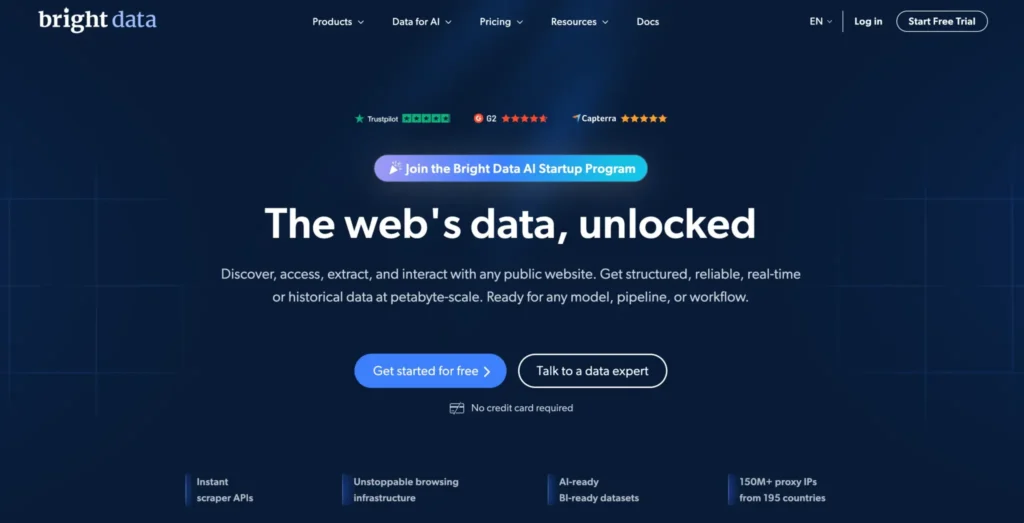
Bright Data is one of the strongest choices if you need a proxy stack for serious streaming platform testing. It offers residential, ISP, mobile, and datacenter proxies, which gives teams the freedom to test multiple scenarios without switching vendors.
For streaming QA, Bright Data’s biggest advantage is control. You can test from specific countries, cities, and network types, then decide whether you want sticky sessions or rotating sessions. This matters because video platforms often rely on session consistency. If your IP changes mid test, the player may throw an error, reset the catalog, or change the ad route.
Bright Data is best for teams checking content availability, localized landing pages, regional ad delivery, smart TV app behavior, mobile app flows, and CDN response across markets. The platform also has a stronger compliance layer than most budget providers, which is important when your use case involves media brands, agencies, or enterprise clients.
Pro Tip: Use ISP proxies for login based testing and residential proxies for broader regional checks. Mobile proxies are useful when testing carrier specific streaming behavior.
2. Oxylabs
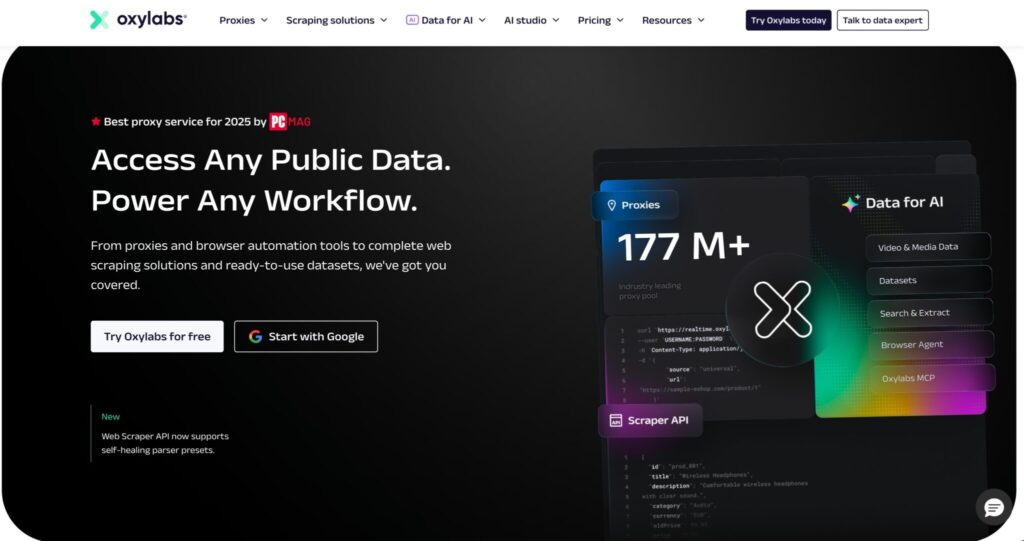
Oxylabs is built for companies that need reliable proxy infrastructure at scale. It works well for streaming related research because it offers residential, ISP, mobile, and datacenter proxies with strong geo coverage.
Where Oxylabs stands out is stability. If your team needs to run repeated tests across several countries, record catalog differences, verify video metadata, or monitor localized ads, predictable proxy behavior is more valuable than chasing the cheapest per GB rate.
Oxylabs also supports SOCKS5 on supported proxy products, which can be useful for certain apps, automation tools, and browser based testing environments. For streaming platform research, you can use sticky residential sessions for continuity and ISP proxies for longer tests where the same IP must stay active.
This is not the provider I would pick for a hobby setup. It is better for agencies, app testing teams, ad verification firms, and companies that care about account management and infrastructure quality.
3. Decodo
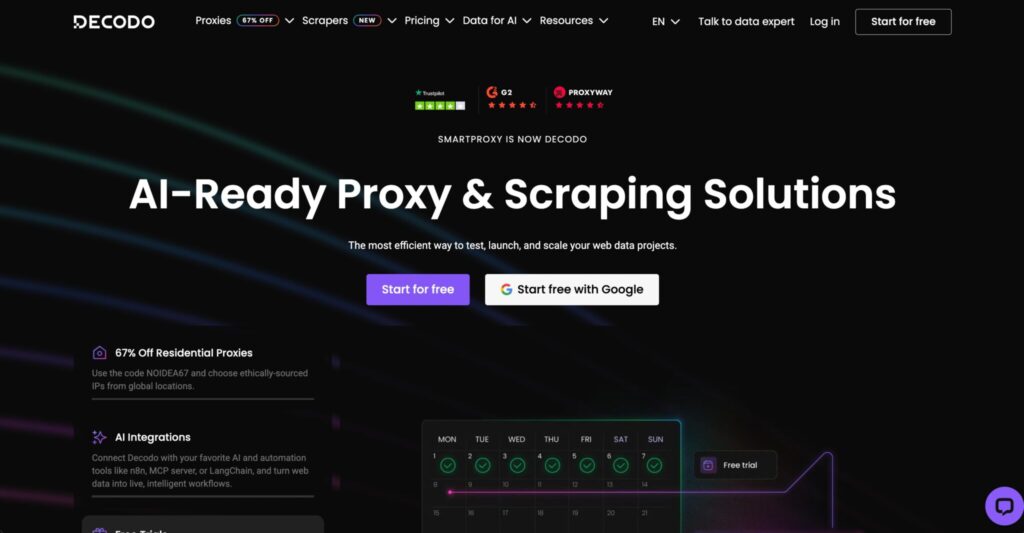
Decodo, formerly Smartproxy, hits a sweet spot between usability and power. It offers residential, static residential or ISP, mobile, and datacenter proxies, with a dashboard that is easier to work with than many enterprise platforms.
For streaming platforms, Decodo is a good pick if you want to test catalogs, landing pages, ad placements, and app behavior without spending days configuring your proxy environment. The provider offers broad location coverage and flexible session control, so you can choose rotating IPs for discovery tasks and sticky IPs for playback flow checks.
Decodo is especially useful for SEO and affiliate teams that also work with streaming keywords, regional SERPs, and localized offer pages. If you are checking how a platform promotes pricing, bundles, free trials, or content pages in different countries, Decodo gives enough accuracy without feeling too technical.
Pro Tip: For streaming pages that load many assets, avoid rapid rotation. Set a sticky session long enough to complete the full page load, playback check, and ad call.
4. SOAX
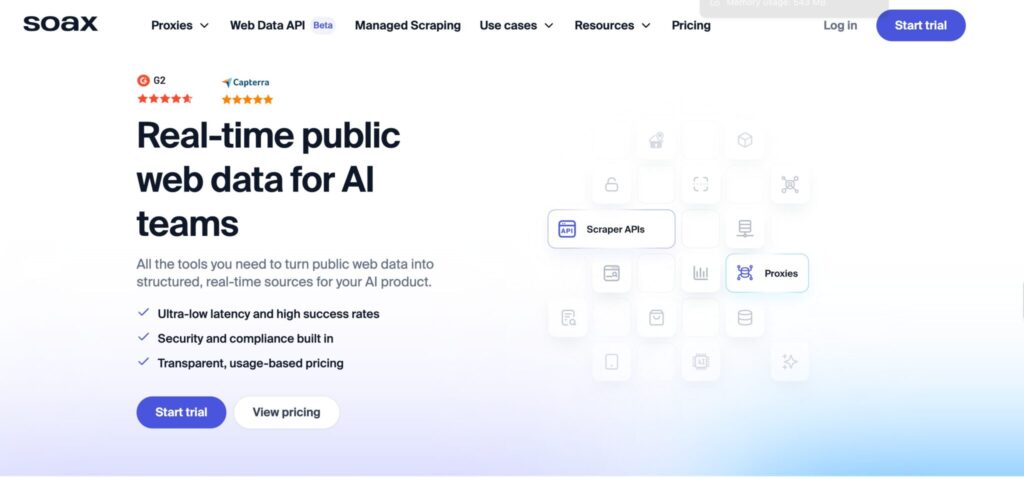
SOAX is a strong option when geo precision matters. Streaming platforms can behave differently not only by country, but also by city, ISP, network type, and device path. SOAX is useful because it gives detailed filtering across residential and mobile proxies.
For media research, that level of targeting can help with ad verification, regional campaign checks, CDN routing analysis, and local app testing. If a streaming service runs different promotions in London, Toronto, Sydney, or Los Angeles, a generic country level proxy may not be enough. SOAX gives you more control over where the request appears to come from.
Its residential and mobile proxy options are the most relevant for streaming use cases. Mobile proxies can be helpful when checking in app streaming behavior, mobile ads, or carrier linked content delivery.
The main thing to watch is bandwidth. Streaming pages, thumbnails, scripts, video previews, and repeated testing can burn traffic quickly. Build a test plan before running large crawls.
5. NetNut
NetNut is a strong choice for teams that care about speed, stability, and direct ISP style routing. It offers residential, ISP, and mobile proxies, which makes it suitable for streaming testing where latency and session quality matter.
For streaming platforms, NetNut is a good fit for checking regional availability, app flows, CDN performance, and localized ad delivery. ISP proxies are especially useful when you need a more stable IP identity than rotating residential proxies can provide.
NetNut’s mobile proxies also help with mobile app testing, which is important because many streaming users watch on phones and tablets. A desktop browser test does not always show the same experience as a mobile carrier route.
NetNut is not the cheapest option, but it can save time if your team is tired of unstable sessions, random connection drops, and low quality IPs.
6. IPRoyal
IPRoyal is a practical option for smaller teams, affiliate publishers, and marketers who need proxies for streaming related checks without enterprise pricing. It offers residential, ISP, mobile, and datacenter proxies.
The main appeal is flexibility. You can start smaller, test regional pages, check localized search results, verify offer pages, and run light QA without a huge monthly commitment. Its residential traffic options are useful for country level research, while ISP proxies work better for stable sessions.
For streaming platforms, IPRoyal is best for lighter use cases: checking if a landing page loads in a specific region, reviewing localized pricing pages, monitoring SERPs, or testing basic ad visibility. I would not use it as my first choice for a large media monitoring operation, but for lean teams it offers solid value.
Pro Tip: If your tests involve repeated logins, use ISP proxies instead of rotating residential IPs. Stable IP identity reduces random session breaks.
7. Rayobyte
Rayobyte is known for proxy infrastructure with strong datacenter and ISP options, plus a residential proxy pool. It is a good fit for US focused testing, static sessions, and teams that want reliable IPs for repeatable checks.
For streaming research, Rayobyte makes sense when your workflow depends on stable endpoints. ISP proxies can help with long running browser sessions, catalog checks, and ad verification tasks where the same IP should stay active. Residential proxies can be used for broader market checks, but sticky session behavior must be configured carefully.
Rayobyte may not be the first name for global streaming QA across dozens of countries, but it is useful for targeted projects, especially when the United States is a core market.
8. Webshare
Webshare is a budget friendly provider with datacenter, ISP, and residential options. Its biggest advantage is simplicity. You can set up proxies quickly, manage lists, and run basic tests without dealing with a heavy enterprise dashboard.
For streaming platforms, Webshare works best for basic page checks, regional landing page monitoring, QA staging, and lightweight ad verification. ISP proxies are the better pick here because they offer more session stability than standard rotating residential setups.
The tradeoff is depth. Webshare is not as feature rich as Bright Data or Oxylabs, and support options are more limited. Still, for smaller teams that need clean static proxies for simple testing, it can be a sensible starting point.
How To Choose Proxies For Streaming Platforms
Start With The Use Case
Do not buy proxies before defining the job. Streaming QA is not one single task. A catalog availability test has different needs from a mobile ad verification test. A CDN latency check is different from a pricing page review.
Use residential proxies for regional discovery, SERP checks, and broad catalog research. Use ISP proxies for stable sessions, account based QA, and repeated tests. Use mobile proxies for app testing, carrier behavior, and mobile ad verification. Use datacenter proxies only for internal testing, staging, or low risk public page monitoring.
Check IP Pool Quality, Not Just Pool Size
Large IP pools look impressive, but quality matters more. For streaming platforms, look at country coverage, city level targeting, ASN diversity, clean IP reputation, consent based sourcing, and session reliability.
A smaller clean pool can beat a huge noisy pool. If IPs are overused, flagged, or constantly failing, your tests will waste bandwidth and produce unreliable results.
Understand Rotation Protocols
Rotation controls decide how often your proxy IP changes. For streaming research, this is critical.
Rotating sessions work well for large scale discovery, such as checking regional page availability or collecting public metadata. Sticky sessions are better for full playback flows, login based QA, cart testing, subscription page checks, or ad journey verification.
HTTP and HTTPS proxies are enough for most browser based testing. SOCKS5 can help when you need broader protocol support for apps, automation tools, or device testing. Mobile proxy rotation should be handled carefully because frequent IP changes can break app sessions.
Measure Latency Before Scaling
Streaming tests are bandwidth heavy. A proxy that works for scraping text pages may perform poorly with media heavy pages. Before buying a large plan, test connection time, page load speed, video start time, ad load behavior, session drop rate, and failed requests.
Do this across the actual countries you care about. A provider can be excellent in the US and weak in a smaller market.
Respect Platform Rules
Many streaming services restrict VPNs, proxies, and location masking for consumer playback. For business use, keep your proxy work focused on authorized testing, public data checks, QA, ad verification, and localization research. Do not use proxies to bypass subscription rules, licensing restrictions, or account controls.
Best Proxy Type For Each Streaming Task
| Streaming Task | Best Proxy Type | Why It Works |
|---|---|---|
| Regional catalog checking | Residential | Natural location signals and broad country coverage |
| Login based QA | ISP | Stable IP identity and fewer mid session changes |
| Mobile app testing | Mobile | Real carrier routes and device aligned behavior |
| Ad verification | Residential or mobile | Better match for real user conditions |
| CDN performance checks | ISP or datacenter | Lower latency and repeatable endpoints |
| Pricing page checks | Residential | Useful for localized landing page research |
| Smart TV app testing | ISP | Stable sessions and consistent network behavior |
| Large public page monitoring | Residential rotation | Scales across markets without reusing one IP too often |
FAQs About Proxies For Streaming Platforms
1. What are the best proxies for streaming platforms?
The best proxies for streaming platforms are usually residential, ISP, and mobile proxies. Bright Data, Oxylabs, Decodo, SOAX, NetNut, IPRoyal, Rayobyte, and Webshare are strong options depending on budget and use case.
2. Are residential proxies good for streaming QA?
Yes, residential proxies are useful for regional testing, catalog checks, ad verification, and localized page research. For long sessions, ISP proxies may be more stable.
3. Are ISP proxies better than residential proxies for streaming?
ISP proxies are often better for stable streaming tests because they combine residential style IP ownership with datacenter like uptime and speed. Residential proxies are better for broad location coverage.
4. Can proxies improve streaming speed?
Not usually. Proxies add another network hop, so they can increase latency. For testing, the goal is accurate location and network behavior, not faster entertainment streaming.
5. Which proxy type is best for mobile streaming apps?
Mobile proxies are best for testing mobile streaming apps because they route traffic through carrier networks. They are useful for app QA, mobile ad checks, and region specific mobile behavior.
6. Should I use rotating proxies for streaming tests?
Use rotating proxies for discovery and monitoring. Use sticky sessions for playback flows, login journeys, and anything that needs the same IP during the full test.
7. Are datacenter proxies useful for streaming platforms?
Datacenter proxies can work for internal QA, staging tests, and public page monitoring. They are usually easier to detect, so they are not ideal for realistic regional streaming research.
8. What should I test before choosing a provider?
Test geo accuracy, session length, latency, playback page load, failed request rate, ad loading, ASN diversity, dashboard controls, and support response. A small pilot can save a lot of wasted budget.
Final Verdict
For enterprise streaming QA, Bright Data and Oxylabs are the strongest picks. For a balance of usability and price, Decodo and SOAX are excellent. NetNut is a smart choice when stable ISP style routing matters. IPRoyal and Webshare are better for smaller budgets, while Rayobyte is useful for targeted static and ISP proxy workflows.
The best setup is rarely one proxy type. A serious streaming testing stack usually combines residential proxies for market coverage, ISP proxies for stable sessions, and mobile proxies for app behavior. Pick based on the task, not the loudest pool size claim.