
A good 5G proxy does not just give you a random mobile IP. It gives you a believable mobile footprint, stable session control, carrier-level targeting, and enough rotation flexibility to match the job you are running.
That matters because mobile traffic behaves differently from datacenter traffic. A 5G proxy routes requests through IPs associated with real mobile carrier networks, usually 3G, 4G LTE, 5G, or mixed mobile pools.
These IPs often sit behind carrier-grade NAT, where many real mobile users may share the same outbound IP pattern. For professional use cases like ad verification, mobile app QA, localization testing, public web data collection, SERP monitoring, and market research, that mobile footprint can reduce friction compared with datacenter IPs.
The catch is simple: not every “5G proxy” is really worth paying 5G-level pricing for. Some providers sell mobile access with weak targeting. Some have tiny location coverage. Some rotate too aggressively and break sessions. Others look great on paper but become painful once your team needs logs, API controls, stable endpoints, or support during a live campaign.
This guide focuses on practical buying criteria: IP pool depth, 5G and LTE availability, rotation controls, sticky sessions, geo-targeting, protocol support, pricing style, and who each provider is actually best for.
Quick Picks: Best 5G Proxy Providers
| Category | Best Provider | Why It Stands Out |
|---|---|---|
| Best enterprise-grade 5G mobile proxy network | Oxylabs | Large 20M+ mobile IP pool, 140+ countries, ASN and city-level targeting, HTTP/HTTPS/SOCKS5, static 24-hour sessions, and stated 99.9% uptime. |
| Best premium data collection platform | Bright Data | Strong proxy infrastructure, mobile proxy access, Proxy Manager, enterprise compliance controls, and 7M mobile IPs mentioned across Bright Data mobile proxy references. |
| Best value for mixed mobile proxy workloads | Decodo | 10M+ mobile IPs, 160+ locations, 700+ carriers, HTTP(S)/SOCKS5, city-level targeting, and mobile pricing starting from $2.25/GB. |
| Best for clean geo-targeting and flexible plans | SOAX | 33M+ mobile IPs across 195+ locations, 3G/4G/5G/LTE support, and enterprise rates starting from $0.32/GB for high-volume needs. |
| Best for high-volume mobile data collection | NetNut | 5M+ mobile IPs in 100+ countries, 3G/4G/5G/LTE support, and stated 99.9% mobile success rates. |
| Best budget-friendly dedicated mobile proxies | IPRoyal | 4.5M+ mobile IPs, zero bandwidth and session limits, instant IP change, auto-rotation, and dedicated mobile proxy options. |
| Best for dedicated/shared mobile proxy ports | Proxy-Seller | Dedicated and shared 4G/5G/LTE plans, timer or on-demand rotation, SOCKS5 and HTTPS support, and unlimited bandwidth listed on mobile plans. |
| Best for developers building mobile proxy infrastructure | Proxidize | 4G LTE/5G mobile proxies, pay-per-GB or pay-per-proxy pricing, HTTP(S)/SOCKS support, rotation URL API, and speeds listed at 10 to 150 Mbps per proxy. |
What Is a 5G Proxy?
A 5G proxy is a proxy connection that routes your traffic through a mobile carrier network using mobile IP addresses. In practice, most providers sell mixed mobile proxy pools that include 3G, 4G LTE, 5G, and sometimes 5G NR access depending on location and carrier availability.
The main difference between a mobile proxy and a residential proxy is the network source. Mobile proxies use IPs from cellular networks, while residential proxies use home broadband or Wi-Fi connections. Decodo explains this difference clearly: mobile proxies route traffic through carrier networks, while residential proxies route through home internet connections.
For buyers, the key point is not just “5G speed.” It is trust. Mobile carrier IPs often look closer to real app and smartphone traffic than datacenter IPs. That makes them useful for testing how ads, apps, prices, SERPs, and localized pages appear to real mobile users.
Massive Comparison Table: Best 5G Proxy Providers
| Provider | Mobile IP Pool | Locations | Network Types | Rotation Control | Protocols | Pricing Style | Best For |
|---|---|---|---|---|---|---|---|
| Oxylabs | 20M+ mobile IPs | 140+ countries | 3G/4G/5G/LTE | Automatic rotation, static 24-hour sessions | HTTP, HTTPS, SOCKS5 | Starts at $7.50/GB on Starter, lower per GB on higher tiers | Enterprise scraping, ad verification, geo-testing |
| Bright Data | 7M mobile IPs referenced | 195+ countries mentioned in comparison pages | 3G/4G/5G mobile network references | Sticky and rotating sessions via proxy infrastructure | Product-dependent | Pay-as-you-go and enterprise-style plans | Large teams needing compliance, APIs, and proxy tooling |
| Decodo | 10M+ mobile IPs | 160+ locations | 3G/4G/5G | Rotating or sticky sessions | HTTP(S), SOCKS5 | From $2.25/GB | Strong value, app testing, AI data workflows |
| SOAX | 33M+ mobile IPs | 195+ locations | 3G/4G/5G/LTE | Rotating mobile proxies | HTTP(S), SOCKS5 commonly supported across SOAX proxy products | Starter/Business/Enterprise GB pricing | Geo-targeted research and clean targeting |
| NetNut | 5M+ mobile IPs | 100+ countries | 3G/4G/5G/LTE | Dynamic mobile rotation | HTTP/HTTPS/SOCKS5 listed across NetNut proxy products | Custom and plan-based | High-volume data teams |
| IPRoyal | 4.5M+ mobile IPs | Location count varies by plan | 3G/4G/5G/LTE | Instant IP switch, auto-rotation, 6-minute rotation limits on some plans | HTTP(S), SOCKS5 depending on setup | Per-day and longer mobile plans | Budget-conscious users needing dedicated mobile sessions |
| Proxy-Seller | Not clearly listed as one global pool | Location and carrier selection | 4G/5G/LTE | Link switch, 5/30-minute timer, manual options | HTTPS, SOCKS5 | From $10/IP listed in search result | Dedicated ports, SMM testing, QA, regional ad checks |
| Proxidize | Millions of mobile IPs from thousands of devices | Dozens of locations | 4G LTE/5G | Rotation URL API, fast rotation claims | HTTP(S), SOCKS | From $2/GB or per-proxy pricing | Developers, infrastructure builders, agency workflows |
1. Oxylabs: Best Enterprise 5G Proxy Provider
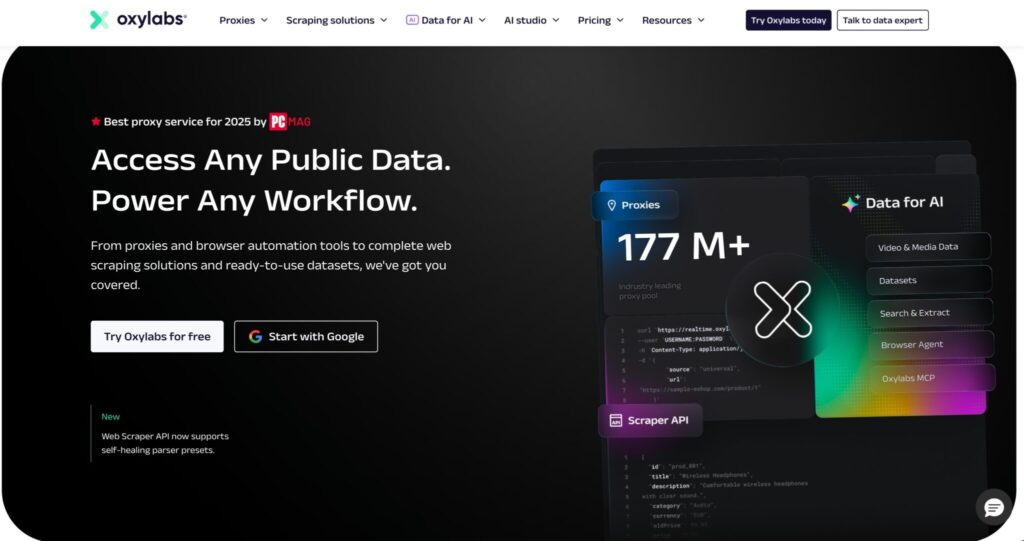
Oxylabs is the provider I would put at the top for teams that care about scale, targeting, and predictable network quality. Its mobile proxy page lists 20M+ mobile IPs, 140+ countries, 99.9% uptime, and targeting by continent, country, state, city, coordinate, and ASN.
That targeting depth matters. If you are verifying mobile ads in a specific metro area, testing app localization, or collecting public pricing data by region, country-level targeting may not be enough. City, ASN, and coordinate targeting give technical teams more control.
Oxylabs also supports HTTP/HTTPS/SOCKS5, unlimited concurrent sessions, automatic mobile IP rotation, and static 24-hour sessions. Those session options are useful because not every workflow needs constant rotation. Login testing, checkout QA, and multi-step mobile user journeys often need sticky sessions, while broad collection tasks usually need controlled rotation.
Pricing starts at $7.50/GB on the 4GB Starter plan, with lower per-GB pricing on higher tiers, including $6.67/GB on the Basic plan and $5/GB on the Advanced plan listed on the mobile proxy page.
Pros
Oxylabs has excellent enterprise coverage, strong targeting, and clean technical controls. It is also one of the better options if your team needs support, compliance review, and scale without stitching together smaller providers.
Cons
It may be overkill for small projects. If you only need a few dedicated 5G ports for light testing, Oxylabs can feel more platform-heavy than necessary.
Pro Tip
Use Oxylabs when location accuracy matters more than getting the cheapest GB. For serious mobile ad verification, ASN and city targeting can save you from false test results.
2. Bright Data: Best Premium Platform for Large Data Teams
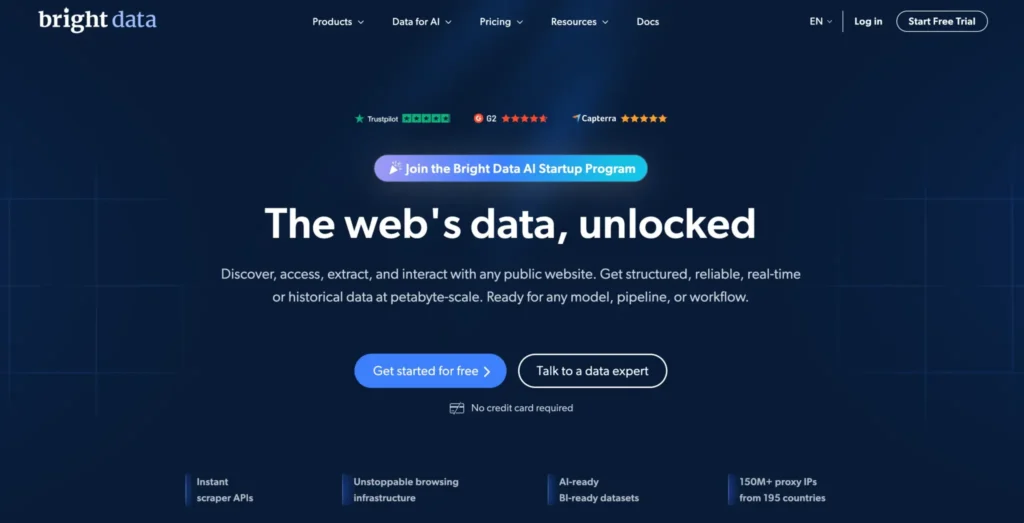
Bright Data is not just a proxy seller. It is a full data collection platform with proxy infrastructure, management APIs, Proxy Manager, compliance workflows, and broader scraping tools. Bright Data’s site references a large proxy infrastructure with residential, ISP, datacenter, and mobile networks, plus free Proxy Manager access as part of its proxy infrastructure.
For mobile proxies, Bright Data references access to a 7 million mobile IP network in its mobile proxy and web proxy materials. Its mobile proxies are positioned for data collection, social media account management, and ad verification, with shared or dedicated mobile IP options depending on requirements.
Bright Data is a strong fit when you need governance. If your team has legal review, procurement checks, user permissions, audit concerns, or enterprise data workflows, Bright Data feels more mature than many smaller mobile proxy vendors.
Pros
Bright Data has strong infrastructure, extensive documentation, proxy management tooling, and enterprise-grade controls. It is a good fit for companies that need mobile proxies as part of a larger data operation.
Cons
It can be expensive and more complex than necessary for smaller teams. If your main goal is buying five mobile ports for basic QA, you may not need the full Bright Data ecosystem.
Pro Tip
Bright Data makes the most sense when your proxy needs overlap with scraping APIs, Web Unlocker-style tools, datasets, or strict compliance controls.
3. Decodo: Best Value 5G Proxy Provider for Most Teams
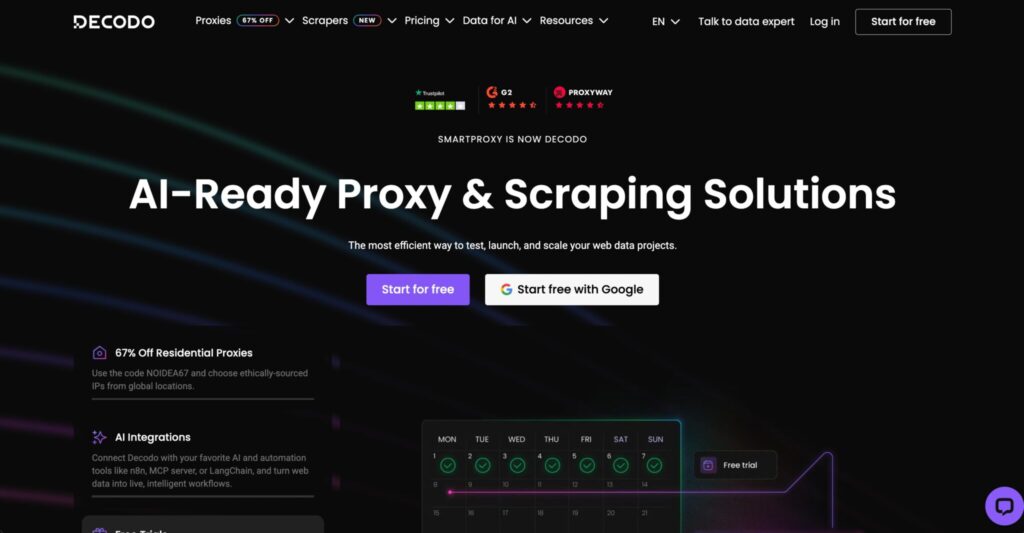
Decodo, formerly Smartproxy, has become one of the easiest providers to recommend for teams that want a balance of price, usability, and mobile coverage. Its mobile proxy page lists 10M+ ethically sourced IPs, 160+ global locations, 700+ mobile carriers, 99.76% success rate, city-level targeting, HTTP(S)/SOCKS5 support, and 3G/4G/5G carrier-grade proxies.
The pricing is also attractive. Decodo’s mobile proxy pricing page says plans start at $2.25/GB, while current listed promotional pricing shows smaller regular plans at $3.75/GB for 2GB, $3.50/GB for 8GB, and $3.25/GB for 25GB.
What makes Decodo practical is the setup experience. It is not as enterprise-heavy as Bright Data or Oxylabs, but it still gives enough controls for serious use. The provider supports rotating and sticky behavior, which matters for workflows where you need to choose between session continuity and IP freshness.
Pros
Decodo has strong mobile coverage, straightforward billing, friendly setup, and a good price-to-feature ratio. It is especially useful for app testing, public web data collection, ad checks, and mobile-localized content checks.
Cons
Very large enterprise users may still prefer Oxylabs or Bright Data if they need deeper account management, custom compliance review, or massive dedicated infrastructure.
Pro Tip
Start with Decodo if you are not sure how much traffic you need. Per-GB pricing lets you test real usage before committing to bigger monthly contracts.
4. SOAX: Best for Clean Geo-Targeting and Flexible Mobile Pools
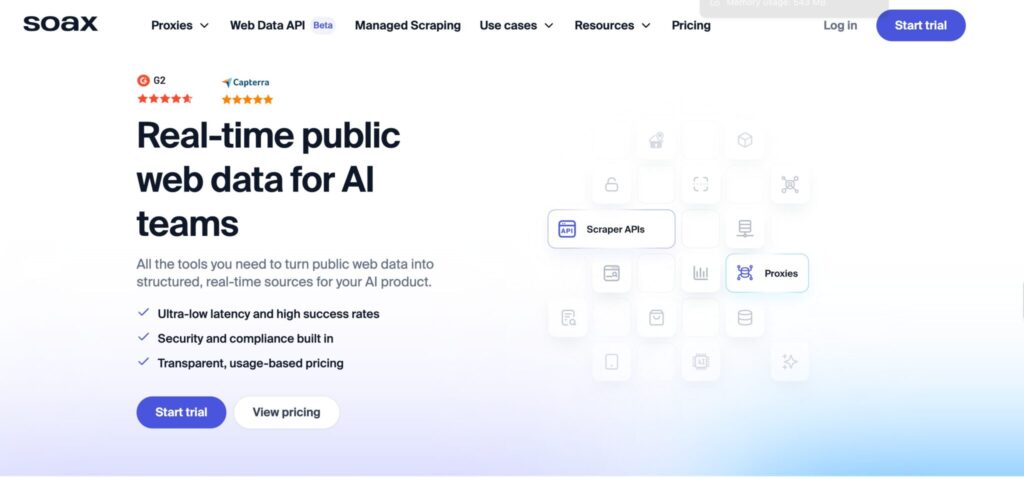
SOAX is strong in the mobile proxy category because it combines broad location coverage with flexible traffic-based pricing. Its mobile proxy page lists 33M+ mobile IPs, 195+ locations, and 3G/4G/5G/LTE support.
For teams running regional research, SOAX is appealing because it focuses heavily on targeting. Mobile proxy projects often fail not because the IP is bad, but because the targeting is too vague. If your campaign needs to check a local offer, SERP, app experience, or ad placement from a specific region, better targeting reduces wasted traffic.
SOAX also lists business and enterprise pricing, including a Business plan at $2/GB for 800GB and enterprise rates starting from $0.32/GB for high-volume needs.
Pros
SOAX offers a large stated mobile pool, strong location coverage, and pricing that becomes attractive at higher volume. It is a good middle ground for teams that want scale without immediately jumping into a fully enterprise platform.
Cons
Smaller users may find the better rates locked behind higher-volume plans. As with any large pool provider, test the exact target regions you need before scaling.
Pro Tip
For SOAX, test by country, city, and carrier where possible. A provider can have a large pool globally but still perform differently in your most important market.
5. NetNut: Best for High-Volume Mobile Data Collection
NetNut’s mobile proxy product lists 5M+ IP addresses across 100+ countries, 3G/4G/5G/LTE support, and 99.9% mobile success rates. It also emphasizes geo-selection by continent, country, state, city, and location.
NetNut is a good fit for teams that care about data collection reliability and larger-scale workflows. Its positioning is more business-focused than hobbyist-focused. If you are running continuous public data monitoring, mobile SERP tracking, or region-specific QA, NetNut deserves a test slot.
One thing I like about NetNut is that it does not try to position mobile proxies as magic. Its own materials mention that mobile proxies help collect data from the perspective of real mobile users. That is the right way to think about them: not just anonymity, but mobile-perspective testing.
Pros
NetNut offers strong mobile coverage, high-volume positioning, and useful geo-targeting options. It is practical for businesses that need mobile IPs as part of a data workflow.
Cons
Pricing transparency may not be as simple as budget providers. Teams should request a quote or test plan before assuming the final cost.
Pro Tip
Use NetNut for recurring data operations, not tiny one-off tasks. It is better suited to steady usage than occasional browser testing.
6. IPRoyal: Best Budget-Friendly Dedicated Mobile Proxy Option
IPRoyal is a strong choice for buyers who want mobile proxies without enterprise pricing complexity. Its mobile proxy pricing page lists over 4.5M genuine residential mobile IPs, zero bandwidth and session limits, auto-rotation, instant IP change, and no logging or tracking.
Its docs also explain the rotation limits clearly. On some plans, manual or automatic rotation is available every 6 minutes, depending on the plan length. That kind of detail matters because buyers often assume “instant rotation” means unlimited, continuous IP switching. It does not always work that way.
IPRoyal is especially appealing when you want dedicated mobile-style sessions for account management, app testing, or regional browsing tasks where unlimited bandwidth is useful.
Pros
IPRoyal is accessible, budget-friendly, and simple to understand. Unlimited bandwidth and session limits are attractive for users who do not want to worry about traffic meters.
Cons
Its mobile network scale and targeting depth may not match Oxylabs, Bright Data, or Decodo for enterprise geo-data workloads.
Pro Tip
Check rotation limits before buying. A 6-minute rotation window may be fine for account sessions but less ideal for fast, high-volume data collection.
7. Proxy-Seller: Best for Dedicated and Shared 5G Proxy Ports
Proxy-Seller is useful for buyers who prefer mobile ports rather than large per-GB pools. Its mobile proxy page lists dedicated and shared 4G/5G/LTE options, timer-based or on-demand switching, HTTPS/SOCKS5 support, user/password or IP allowlisting, and 24/7 support.
It also lists unlimited bandwidth on mobile proxy packages, with rotation by time and support for 5/30-minute timer behavior or manual switching. Proxy-Seller’s page mentions real carrier IPs, carrier-grade NAT patterns, and the ability to choose network generation and carrier during checkout where available.
This makes Proxy-Seller a practical option for agencies, QA teams, and marketers who need a fixed set of mobile proxy endpoints for defined locations.
Pros
Proxy-Seller is straightforward, supports dedicated or shared mobile access, and gives useful rotation controls. The setup is easier for non-enterprise buyers.
Cons
It may not be the best choice for massive per-GB scraping workloads. If you need huge global scale, look at Oxylabs, Bright Data, Decodo, SOAX, or NetNut first.
Pro Tip
Choose dedicated ports for sensitive workflows where shared reputation could affect results. Shared pools are better when cost matters more than identity consistency.
8. Proxidize: Best for Developers and Infrastructure Builders
Proxidize is a different kind of option. It is built for teams that want mobile proxy infrastructure, developer controls, and flexible buying models. Its pricing page lists 4G LTE/5G mobile proxies, pay-per-proxy and pay-per-GB options, HTTP(S)/SOCKS support, speeds from 10 to 150 Mbps per proxy, a rotation URL API, and near 100% uptime claims.
It also lists $2/GB pricing for pay-per-GB plans, access to the entire pool, unlimited threads, and premium support on the pricing page.
Proxidize is interesting for agencies and technical teams because it feels closer to infrastructure than a simple proxy subscription. If your workflow needs rotation URLs, API-controlled switching, or predictable endpoints for internal tools, it is worth testing.
Pros
Proxidize is developer-friendly, flexible, and strong for teams that want more control. The pay-per-GB and pay-per-proxy split makes it easier to match pricing to use case.
Cons
It may require more technical confidence than plug-and-play providers. Non-technical users may prefer Decodo or IPRoyal.
Pro Tip
Use pay-per-proxy for account-style workflows and pay-per-GB for collection workflows. Mixing those pricing models incorrectly is one of the fastest ways to overspend.
How to Choose the Best 5G Proxy Provider
1. Check the Real Mobile IP Pool, Not Just the Marketing Number
A big IP pool sounds impressive, but what matters is the active pool in the locations you need. A provider may advertise millions of IPs globally, but your project might only care about New York, London, Berlin, Mumbai, or Sydney.
Ask three questions before buying:
- How many mobile IPs are active in my target country or city?
- Can I target by carrier, ASN, city, or ZIP/postcode?
- Are the IPs shared, dedicated, peer-based, SIM-based, or infrastructure-backed?
For enterprise work, I would prioritize Oxylabs, Bright Data, Decodo, SOAX, and NetNut. For dedicated mobile port use, IPRoyal, Proxy-Seller, and Proxidize may be easier to manage.
2. Understand Rotation Protocols Before You Scale
Rotation is not one feature. It comes in several forms:
| Rotation Type | Best For | Risk |
|---|---|---|
| Per-request rotation | Large-scale public data collection | Can break multi-step sessions |
| Timed rotation | SERP checks, monitoring, repeated tasks | Wrong interval can waste IPs |
| Manual rotation | QA, account checks, controlled testing | Slower for automation |
| Sticky sessions | Logins, carts, app flows, ad dashboards | Too much stickiness can reduce pool diversity |
| API-triggered rotation | Developer workflows | Requires technical setup |
Decodo describes mobile IP behavior as either rotating or sticky depending on configuration, and that is the exact mental model buyers should use.
3. Match 5G, 4G LTE, and 3G to the Use Case
5G sounds best, but 4G LTE is often the practical default. Decodo explains that 5G is faster and lower latency than 4G, while 4G LTE is widely available, fast, and cost-effective for most scraping, automation, and app testing projects.
Use 5G when you need speed-sensitive workflows, parallel tasks, real-time checks, or app behavior that depends on modern mobile conditions. Use 4G LTE when coverage and stability matter more than peak speed. Use 3G only when testing legacy network conditions.
4. Look at Protocol Support
For most professional work, you want HTTP, HTTPS, and SOCKS5 support. SOCKS5 is useful when you need broader traffic compatibility, while HTTP/HTTPS is enough for many browser and scraper workflows.
Oxylabs, Decodo, Proxy-Seller, and Proxidize all list HTTP(S) and/or SOCKS5 support in their mobile proxy materials.
5. Do Not Ignore Compliance and Acceptable Use
Mobile proxies are legal tools when used properly, but they are not a license to break website rules, spam platforms, collect private data, or evade security systems. Decodo states that mobile proxies are legal as long as users comply with applicable privacy laws and website terms of service.
For business use, keep your workflows focused on public data, testing, ad verification, localization, brand protection, and QA. Avoid providers that do not explain sourcing, use restrictions, or abuse handling.
Final Verdict: Which 5G Proxy Provider Should You Choose?
If you want the best all-around enterprise mobile proxy provider, choose Oxylabs. It has the scale, targeting, uptime, protocol support, and session controls that serious teams need.
If you want a premium platform with stronger data tooling and compliance infrastructure, choose Bright Data.
If you want the best balance of price, usability, and mobile proxy quality, choose Decodo.
If your priority is geo-targeting and large mobile pool coverage, test SOAX.
If you run high-volume mobile data workflows, consider NetNut.
If you want a lower-cost dedicated mobile setup, start with IPRoyal or Proxy-Seller.
If you are a developer or agency building repeatable infrastructure, Proxidize is one of the more interesting options.
For most buyers, my practical recommendation is this: shortlist three providers, run the same test script across each one, and compare success rate, latency, session stability, IP diversity, and support response. Marketing pages tell you what a provider can do. A controlled test tells you what it can do for your exact target, location, and workflow.
FAQs About 5G Proxy Providers
1. What are 5G proxies used for?
5G proxies are used for mobile app testing, ad verification, mobile SERP tracking, localization checks, market research, eCommerce monitoring, and public web data collection. Decodo lists mobile app QA, ad verification, data extraction, eCommerce monitoring, and brand protection among common mobile proxy uses.
2. Are 5G proxies better than residential proxies?
They are better for mobile-specific use cases. If you need traffic to look like it comes from a mobile carrier network, 5G or 4G mobile proxies are usually a better fit. If you need broad web access from home broadband-style IPs, residential proxies may be cheaper and easier to scale.
3. Are 5G proxies faster than 4G proxies?
Usually yes, but only when the provider, carrier, location, and target server support that speed. Decodo explains that 5G proxies are faster and lower latency than 4G, while 4G LTE remains widely available and cost-effective.
4. Do mobile proxies rotate automatically?
Many do, but the controls vary by provider. Some offer per-request rotation, timed rotation, sticky sessions, or manual rotation. IPRoyal, for example, documents 6-minute rotation behavior depending on the purchased mobile plan.
5. What is the difference between shared and dedicated 5G proxies?
Shared mobile proxies are used by multiple customers or sessions, which lowers cost but can reduce control. Dedicated mobile proxies reserve a mobile connection or endpoint for your use, which can be better for account-based workflows, QA, and consistent identity testing.
6. Are 5G proxies expensive?
Yes, compared with datacenter proxies. Mobile proxy infrastructure depends on carrier networks, mobile devices, SIMs, or peer-based mobile IP sourcing, so pricing is usually higher. Current provider pricing varies widely, from low per-GB options like Decodo and Proxidize to premium enterprise plans from Oxylabs and Bright Data.
7. Can I use 5G proxies for Google Ads verification?
Yes, 5G and 4G mobile proxies are commonly used for ad verification and mobile localization checks. Use them to confirm whether ads, landing pages, and offers appear correctly in specific regions. Stay within ad platform rules and avoid using proxies for deceptive clicks or policy evasion.
8. What is the best 5G proxy provider for beginners?
Decodo is probably the easiest starting point for most beginners because it combines strong mobile coverage, simple pricing, and a clean setup. IPRoyal is also beginner-friendly if you prefer dedicated mobile proxy plans with unlimited bandwidth.
9. What is the best 5G proxy provider for enterprise scraping?
Oxylabs, Bright Data, SOAX, and NetNut are the strongest options for larger data teams. Oxylabs stands out for mobile IP pool size and targeting, while Bright Data stands out for platform depth and compliance controls.