
China is one of the trickiest proxy locations to buy properly.
On paper, every proxy company says it has “global coverage.” In real work, that usually means the United States, Germany, the UK, France, and maybe a few larger Asian markets. China is different.
The IP supply is harder to source, latency can be inconsistent, local websites may behave differently from global platforms, and a cheap proxy pool that works fine for US scraping can fall apart when you point it at Chinese search results, ecommerce pages, app stores, or ad verification workflows.
That is why picking the right China proxy provider is less about the lowest price and more about three things: real Chinese IP availability, session control, and clean rotation.
A good China proxy provider should let you choose the right proxy type for the job. Residential IPs are usually the safest option for local research and public data collection. Mobile proxies are better when you need traffic patterns that look like real mobile users.
ISP proxies are useful when you need longer sessions with better stability. Datacenter proxies can be fast and affordable, but they are easier to detect on stricter targets.
Below is a practical, field-style breakdown of the best China proxy providers worth considering in 2026.
Quick Verdict: Best China Proxy Providers
| Rank | Provider | Best For | China Proxy Types | Starting Price Snapshot | Key Strength | Main Limitation |
|---|---|---|---|---|---|---|
| 1 | Bright Data | Enterprise China data collection | Residential, mobile, ISP, datacenter | Residential pricing starts around $5.88/GB on published plans | Huge network, advanced targeting, strong compliance | Expensive for casual users |
| 2 | Oxylabs | Large-scale scraping and data teams | Residential, datacenter, SOCKS5 support | Residential starts around $6/GB on starter plans | Large China IP pool and enterprise tools | Higher cost than budget providers |
| 3 | Decodo | Best balance of price and usability | Residential, mobile, static residential | Residential starts from $3.75/GB on small plans | Easy dashboard, strong success rate claims | China pool depth may vary by proxy type |
| 4 | SOAX | Precise geo and carrier targeting | Residential, mobile | Residential starter listed at $3.60/GB | Good filtering, clean dashboard | Smaller China IP pool than top enterprise providers |
| 5 | NetNut | Stable residential and ISP-style use cases | Residential, static residential, mobile | Residential plans listed from around $3.53/GB to lower bulk rates | Strong infrastructure and account support | Better suited to teams than hobby users |
| 6 | IPRoyal | Affordable China residential proxies | Residential, mobile, ISP, datacenter | Residential from $1.75/GB at volume | Good value and non-expiring traffic positioning | Smaller ecosystem than Bright Data or Oxylabs |
| 7 | ProxyEmpire | City-level China targeting | Residential, mobile, static residential | Rotating residential promo pricing from $3.50/GB PAYG | Good location flexibility | Pricing depends heavily on promos and volume |
| 8 | Rayobyte | US-based support and ethical sourcing | Residential, ISP, datacenter, mobile | Residential pricing advertised as low as $0.50/GB | Strong business support and public data focus | China-specific depth should be tested before scale |
| 9 | Webshare | Low-cost self-service China proxies | Datacenter, residential | China residential listed from $7/month for 1GB | Simple, affordable entry point | Not as advanced for large scraping projects |
| 10 | MarsProxies | Budget China proxies for lighter projects | Datacenter, ISP, residential | Residential from $3.49/GB | Affordable plans and clear China location page | Less enterprise depth than top-tier vendors |
Pricing changes often, so treat these numbers as a snapshot and always check the live checkout page before buying.
What Is a China Proxy?
A China proxy routes your internet requests through an IP address located in China. To a target website, app, search engine, or ad platform, your request appears to come from a Chinese user instead of your actual location.
That matters when you need to see local search results, monitor Chinese ecommerce prices, verify regional ads, test localization, collect public web data, or check how a website behaves for users in China.
The most common types are:
Residential China proxies: IPs assigned by internet service providers to real users. These are usually the best choice for scraping, market research, local SERP checks, and ad verification.
Mobile China proxies: IPs from mobile carriers. These are useful for mobile-first platforms, app testing, and workflows where mobile behavior matters.
ISP China proxies: Static or semi-static IPs issued by ISPs. These are useful when you need longer sessions without constantly rotating.
Datacenter China proxies: Fast and cheap, but easier to detect. Good for low-risk browsing, testing, or high-speed tasks where reputation is less important.
Pro Tip: If your target website has aggressive anti-bot protection, start with residential proxies, not datacenter proxies. A cheap datacenter IP might look attractive, but one blocked request is still a failed request.
1. Bright Data: Best Overall China Proxy Provider for Enterprise Teams
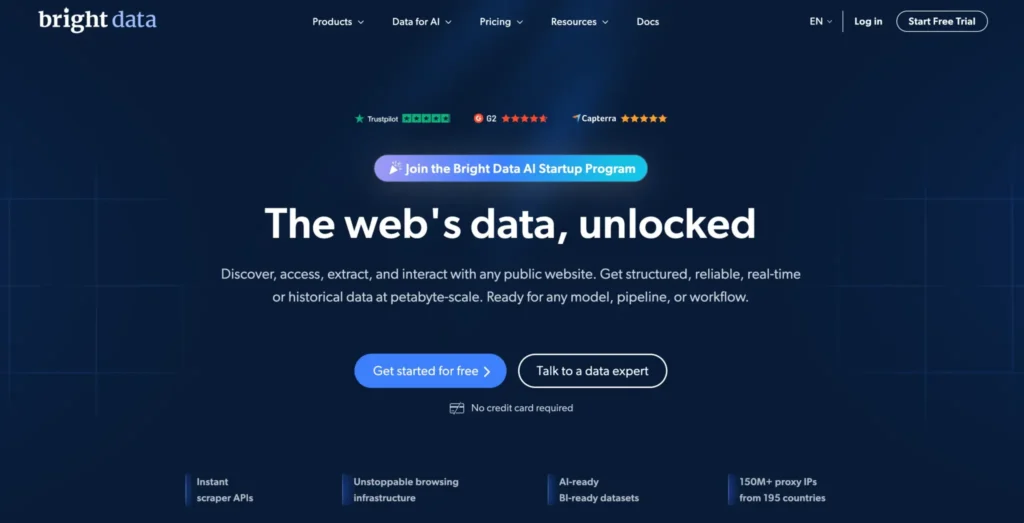
Bright Data is one of the most established names in the proxy and web data market. For China-specific work, it stands out because it offers real Chinese IPs across residential, mobile, ISP, and datacenter proxy networks. Bright Data also publishes dedicated China, Beijing, and Shanghai location pages, which is useful if you need more granular regional testing instead of generic “Asia” coverage.
The biggest reason to choose Bright Data is flexibility. You can build around residential rotation, use ISP proxies for more stable sessions, or move into its web scraping tools if you do not want to manage proxy logic yourself. Its main website claims over 400M residential proxy IPs globally and targeting by country, city, carrier, and ASN.
Bright Data is not the cheapest China proxy provider. Its residential pricing page lists plans starting from $5.88/GB, while its China location page has shown promotional pay as you go residential pricing at $4/GB during discount periods.
Why Bright Data is strong for China proxies
Bright Data is best for serious teams that care about success rate, compliance, and control. If you are collecting public data from Chinese websites at scale, testing regional content, or running multi-location ad verification, it gives you more levers than most providers.
Where Bright Data may not fit
It can feel heavy if you only need a few GB of traffic. The dashboard, pricing model, and compliance checks are built more for teams than casual users.
Pro Tip: Bright Data makes sense when proxy failure costs more than the proxy bill. If your use case is mission-critical, paying more for better controls can be cheaper than constantly debugging blocked requests.
2. Oxylabs: Best for Large-Scale China Web Scraping
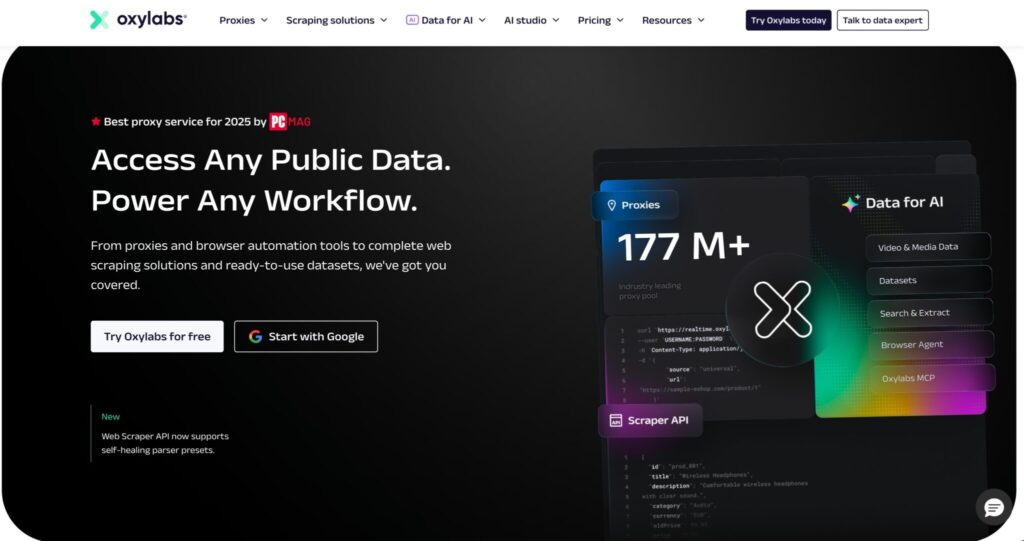
Oxylabs is another premium provider with strong China coverage. Its China proxy page lists 9,250,182 China IPs, and its residential proxy pool page claims 175M+ residential IPs across 195+ countries.
Oxylabs is especially good for teams that want scale, documentation, support, and a reliable rotation setup. Its residential proxies support sticky sessions, and its residential product FAQ confirms SOCKS5 support for residential and dedicated datacenter proxies.
Pricing is higher than budget vendors, but it is transparent. Oxylabs lists residential proxy plans starting at 5GB for $30, which works out to $6/GB, with lower per GB pricing on larger monthly tiers.
Why Oxylabs is strong for China proxies
Oxylabs is built for scale. If you are scraping public data, running search intelligence, monitoring marketplaces, or handling recurring data pipelines, it gives you a dependable setup with premium support.
Where Oxylabs may not fit
It is not the best choice if you only need a tiny test budget. You are paying for infrastructure, support, and reliability.
Pro Tip: For China scraping, test both rotating and sticky sessions. Rotating every request can work for simple public pages, but login flows, carts, and multi-step browsing often need session persistence.
3. Decodo: Best Value China Proxy Provider for Most Users
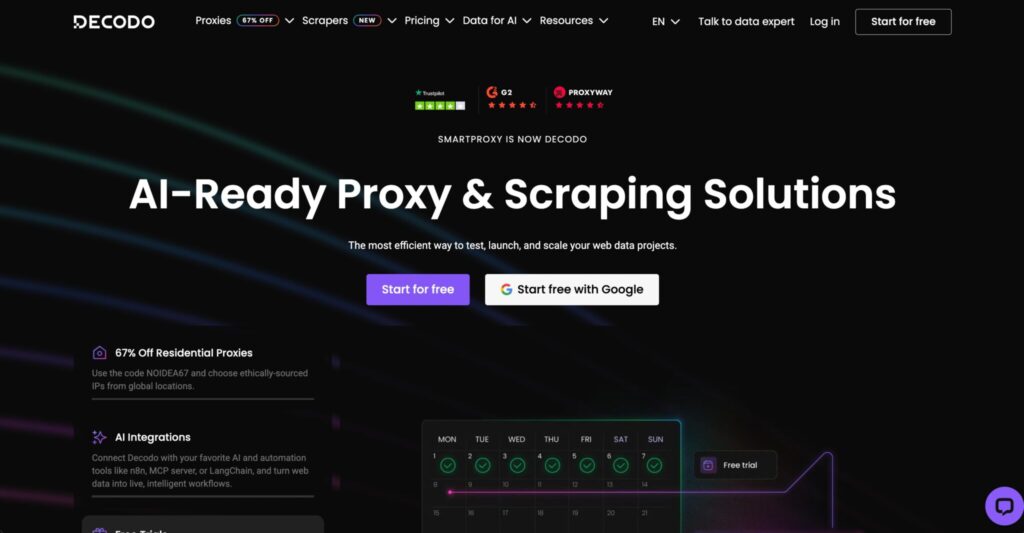
Decodo, formerly Smartproxy, is a strong middle-ground provider. It is easier to use than some enterprise platforms, but still powerful enough for serious scraping, SEO monitoring, price tracking, and ad verification.
Its China proxy page claims premium Chinese proxies with high success and uptime metrics, including HTTP(S) and SOCKS5 compatibility, city and country-level targeting, and 24/7 support.
Decodo’s residential pricing is one of its strongest selling points. Its residential proxy pricing page lists small plans starting at 3GB for $3.75/GB, 10GB at $3.50/GB, 25GB at $3.25/GB, and lower rates on larger plans. It also states that all plans include access to a 115M+ IP pool and advanced geo-targeting.
Why Decodo is strong for China proxies
Decodo is a good fit if you want a clean dashboard, self-service buying, and reasonable pricing. It is often easier for smaller teams than Bright Data or Oxylabs, while still giving you enough control for professional campaigns.
Where Decodo may not fit
If you need highly specialized China city coverage or enterprise-level custom routing, test availability first. Its general network is strong, but China can be a supply-sensitive region.
Pro Tip: Decodo is a good first paid test if you are moving away from free proxies. Start with a small residential plan, measure success rate on your real targets, then scale only after you know the pool performs well.
4. SOAX: Best for Geo-Targeting and Carrier-Level Filtering
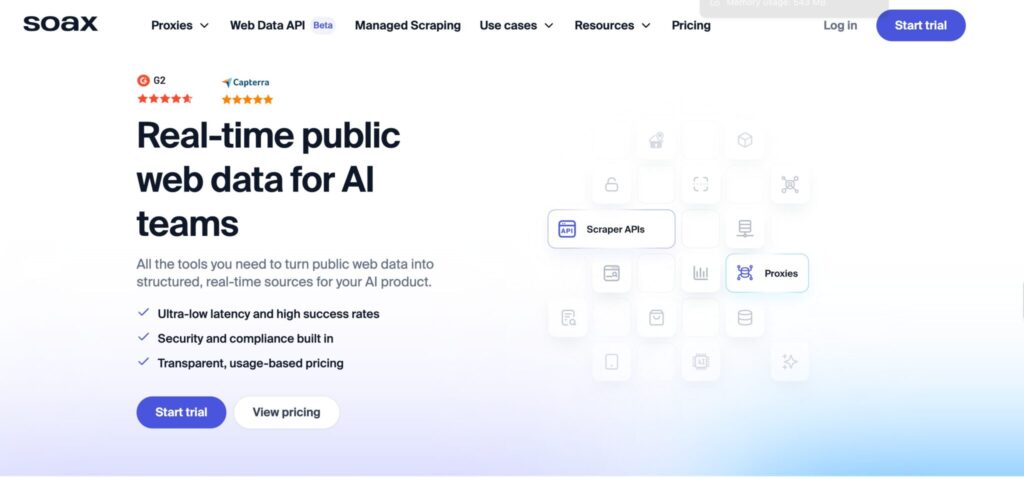
SOAX is a strong option when targeting accuracy matters. Its China proxy page lists access to 31,800 Chinese IPs and says users can target specific regions, cities, or carriers in China. It also claims 191M+ fresh IPs available worldwide.
SOAX is not just a proxy seller. It positions itself as a data extraction platform with proxies, scraping APIs, and web unblocker features. Its proxy page highlights 99.95% proxy success rate, 99.9% uptime, and ethically sourced proxies.
Pricing is also competitive. The China proxy page shows a residential starter plan at $90 billed monthly with 25GB included, listed as $3.60/GB.
Why SOAX is strong for China proxies
SOAX is useful for use cases where you need refined targeting. If you are comparing content by region, checking mobile behavior, or testing carrier-level results, SOAX gives you filters that budget vendors may not provide.
Where SOAX may not fit
The China pool is smaller than what Oxylabs lists. That does not automatically mean worse performance, but it does mean you should run a target-specific test before committing to large volume.
Pro Tip: Do not judge a China proxy provider by global pool size alone. A provider with a smaller but cleaner China pool can outperform a huge global network if the China IPs are fresh and well-managed.
5. NetNut: Best for Stable Residential and Static Proxy Workflows
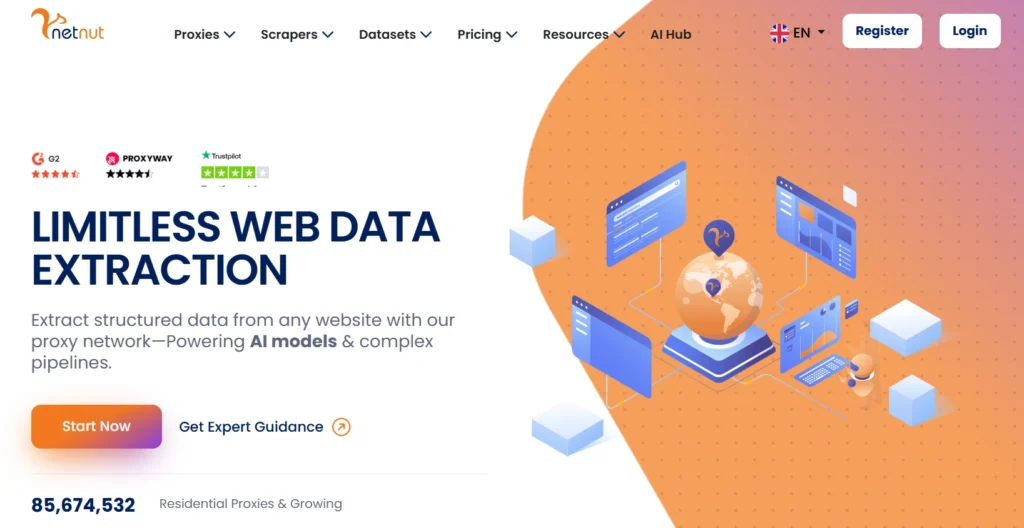
NetNut is a strong choice for teams that want reliable residential infrastructure and account support. Its website says it offers over 85M residential IPs across 195+ countries, and its China proxy page focuses on genuine residential China proxy IP addresses for precision and reliability.
One of NetNut’s strengths is its static residential proxy positioning. Its static residential page explains that direct ISP connectivity provides 24/7 IP availability and long sessions without depending on an end-user device.
NetNut’s residential pricing page lists tiers such as Starter at $3.53/GB, Advanced at $3.45/GB, Production at $3.32/GB, and lower bulk pricing on larger monthly plans.
Why NetNut is strong for China proxies
NetNut works well when you need stability. For account-based workflows, localized QA, and recurring monitoring, static or more stable residential options can be easier to manage than aggressive rotation.
Where NetNut may not fit
It is not always the simplest option for one-off users. NetNut often feels more sales-assisted and business-focused than fully casual.
Pro Tip: Use static residential or ISP-style proxies when your task needs identity continuity. Constantly changing IPs can look suspicious during multi-step sessions.
6. IPRoyal: Best Affordable China Residential Proxies
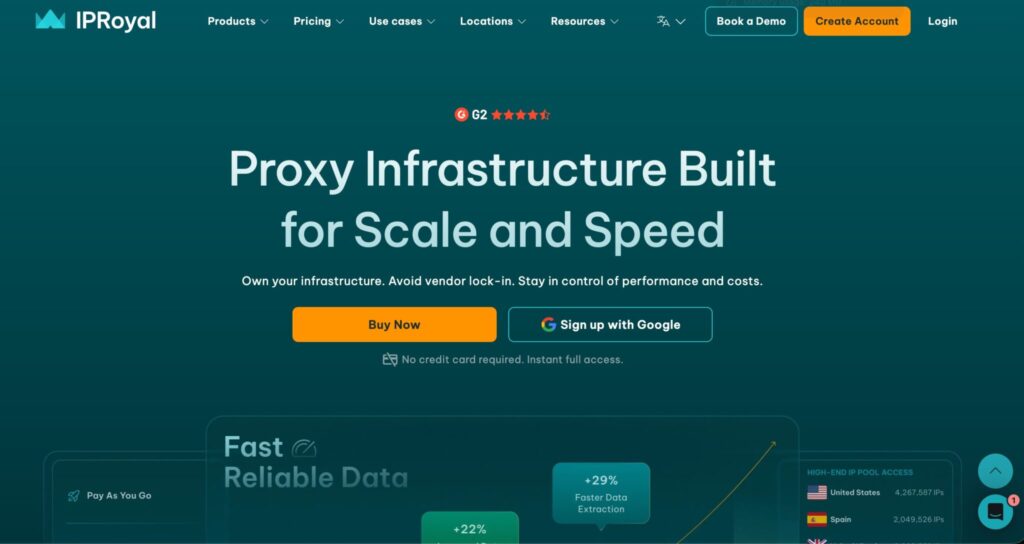
IPRoyal is a budget-friendly provider that has become popular because of its simple pricing and accessible dashboard. Its China location page lists 2,532,825 China IPs and says it provides residential, mobile, datacenter, and ISP proxy options with HTTP/HTTPS and SOCKS5 support.
The broader IPRoyal site lists residential proxies from $1.75/GB and a 32M+ residential proxy pool.
Why IPRoyal is strong for China proxies
IPRoyal is a good fit for smaller teams, freelancers, and marketers who need Chinese IPs without enterprise pricing. It gives you enough flexibility for SEO monitoring, regional research, and moderate public data collection.
Where IPRoyal may not fit
It is not as advanced as Bright Data or Oxylabs when it comes to scraping APIs, enterprise compliance workflows, and large-scale managed data collection.
Pro Tip: IPRoyal is a good “value test” provider. Use it when you need affordable China residential traffic, but benchmark it against a premium provider if your target sites are strict.
7. ProxyEmpire: Best for China City-Level Targeting
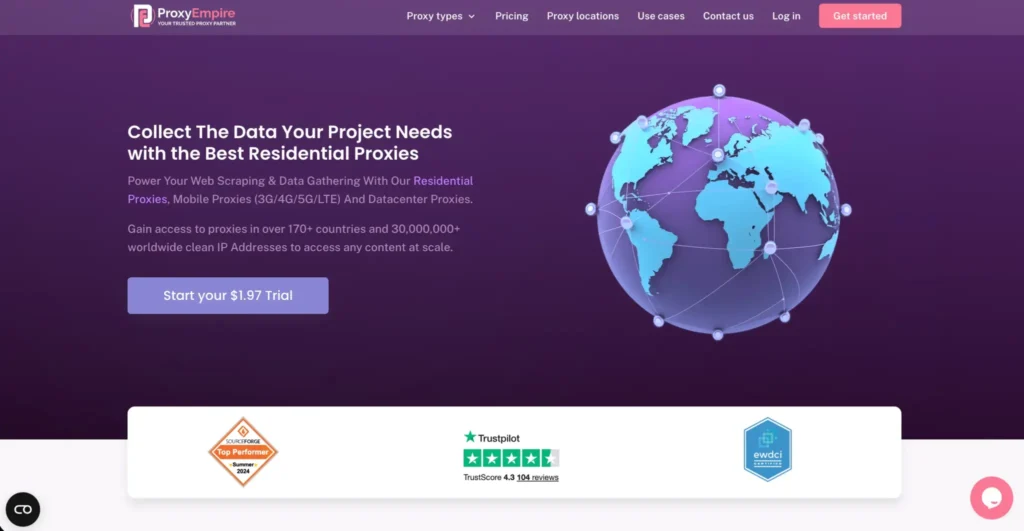
ProxyEmpire offers residential, mobile, and datacenter proxies across 170+ countries, with 30M+ clean IPs listed on its homepage. Its location page highlights country, region, and city targeting.
For China specifically, ProxyEmpire has dedicated China-related pages for residential and mobile proxies, including city pages such as Zhuzhou and Changzhou.
Its pricing table lists rotating residential pay as you go pricing at $7/GB, discounted to $3.50/GB during its displayed 50% promo, with bulk tiers dropping lower.
Why ProxyEmpire is strong for China proxies
ProxyEmpire is useful if you care about geo flexibility. City-level targeting can be valuable for ad verification, localized content checks, and regional ecommerce research.
Where ProxyEmpire may not fit
Pricing can depend heavily on promotional discounts. Also, like any location-heavy provider, real-time availability matters more than marketing pages.
Pro Tip: Before buying a large ProxyEmpire plan, ask support about live China availability for your exact city or region. Proxy pools move, and old location claims are not enough.
8. Rayobyte: Best for Ethical Public Data Collection Support
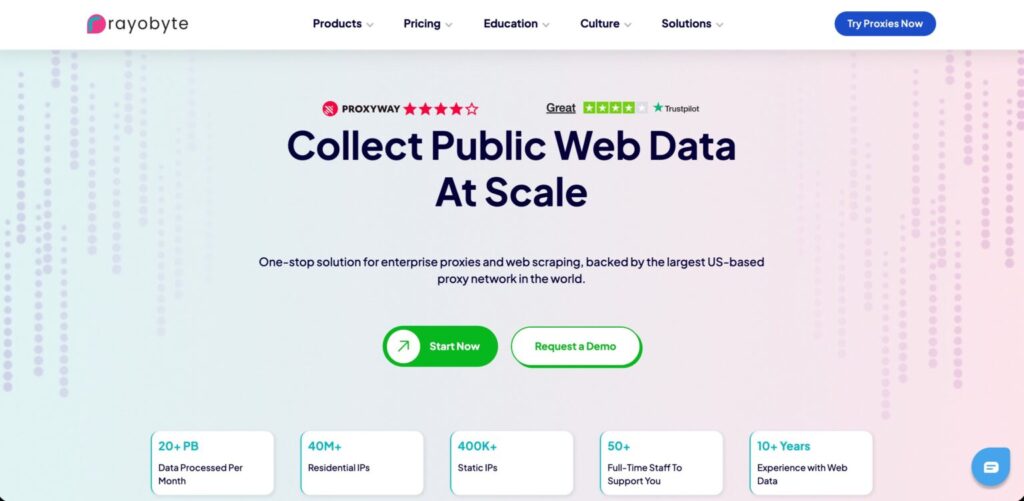
Rayobyte positions itself as a public web data gathering platform with proxies and scraping support. Its homepage claims 40M+ residential IPs, 400K+ static IPs, 20+ PB of data processed per month, and 10+ years of experience.
It also has a dedicated China proxy page and emphasizes support for China proxy projects.
Rayobyte pricing is attractive on paper. Its pricing page advertises residential proxies as low as $0.50/GB, static ISP proxies from $4.60/IP, static datacenter proxies from $1/IP, and rotating ISP proxies from $5/month.
Why Rayobyte is strong for China proxies
Rayobyte is worth considering if you want a provider that leans into ethical sourcing, public data use cases, and support. It can be useful for businesses that do not want a completely self-serve, no-human-help setup.
Where Rayobyte may not fit
You should verify China pool quality before scaling. Rayobyte is strong in public data infrastructure, but China-specific proxy performance depends on your target and proxy type.
Pro Tip: Ask for a small pilot or trial with your real target URLs. China proxy performance cannot be judged from homepage claims alone.
9. Webshare: Best Low-Cost China Proxy Option
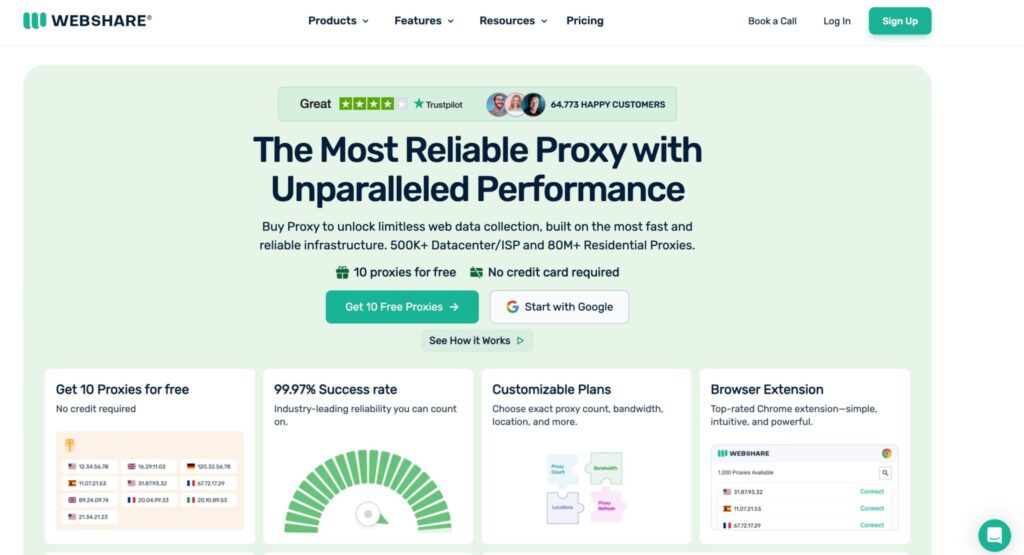
Webshare is one of the easiest self-service providers for users who want affordable proxies without a complex enterprise process. Its main site offers datacenter, static residential, and residential proxy products.
Its China proxy page lists China proxy prices from $0.029/IP and China residential proxy pricing from $7/month for 1GB.
Webshare also states that its HTTP proxies support SSL proxy use and SOCKS5 endpoints, which is useful if your tools require flexible protocol support.
Why Webshare is strong for China proxies
Webshare is affordable, simple, and fast to start. It makes sense for testing, light browsing, small SEO checks, and users who do not need a full enterprise data platform.
Where Webshare may not fit
It is not the first provider I would choose for heavy China scraping. You may run into limitations around filtering, success rate, or session control depending on the target.
Pro Tip: Webshare is good for early validation. Once you know the workflow works, compare success rate against a premium provider before moving to production.
10. MarsProxies: Best Budget China Proxies for Smaller Projects
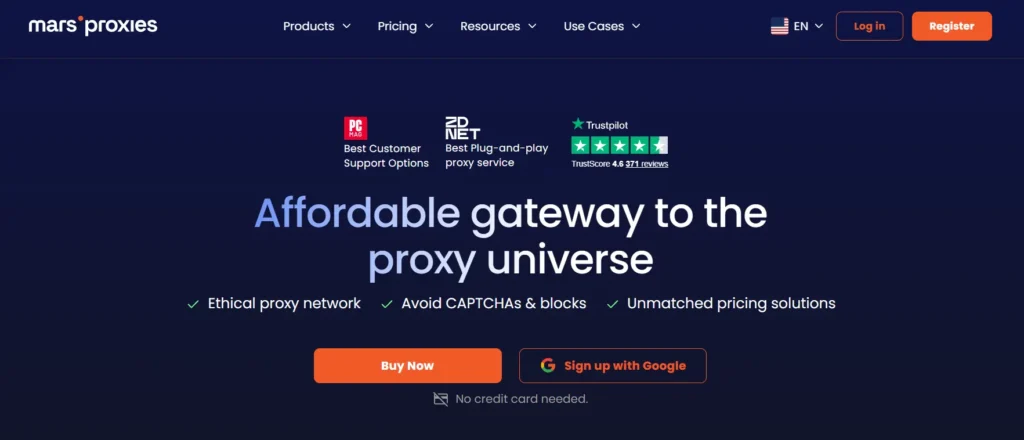
MarsProxies is a newer-style budget provider with a dedicated China proxy location page. It lists 198,653 China proxies across datacenter, ISP, and residential categories.
Its main site lists residential proxies from $3.49/GB, datacenter proxies from $0.89/proxy, and ISP proxies from $1.35/proxy.
Why MarsProxies is strong for China proxies
MarsProxies is attractive for smaller users who want simple access to China proxies without enterprise onboarding. It may work well for light market research, browsing checks, and smaller scraping tasks.
Where MarsProxies may not fit
It does not have the same enterprise tooling, compliance footprint, or advanced scraping ecosystem as Bright Data, Oxylabs, or SOAX.
Pro Tip: MarsProxies is worth testing for cost-sensitive projects, but use a stricter benchmark. Track connection success, target response codes, CAPTCHA rate, and average response time.
How to Choose the Best China Proxy Provider
Choosing China proxies is not the same as buying generic residential proxies. You need to think like an engineer and a buyer at the same time.
1. Check real China IP availability
Do not accept “global coverage” as proof. Ask whether the provider has live Chinese IPs right now. Then ask what proxy types are available in China: residential, mobile, ISP, or datacenter.
A provider with 100M global IPs may still have weak China inventory. Location-specific pool size matters more than global pool size.
2. Match proxy type to your use case
Use residential proxies for scraping public data, local search checks, ecommerce monitoring, and ad verification.
Use mobile proxies for mobile app testing, mobile SERP checks, and platform behavior that depends on carrier traffic.
Use ISP proxies for stable sessions, account workflows, and longer browsing patterns.
Use datacenter proxies only when speed and price matter more than reputation.
3. Look at rotation control
Rotation is one of the biggest factors in China proxy performance.
For simple scraping, rotating every request may work. For multi-step browsing, you need sticky sessions. For logged-in workflows, you may need a static or ISP-style proxy.
Good providers should let you control session length, rotation interval, and authentication method.
4. Check protocol support
Most scraping tools support HTTP and HTTPS proxies. Some automation tools, browsers, and custom systems may need SOCKS5.
Bright Data, Oxylabs, Decodo, IPRoyal, and Webshare all publish SOCKS5 or flexible protocol support in some form across their proxy products.
5. Test latency from your server location
China proxy latency depends on where your infrastructure sits. A request from India, Singapore, Germany, or the US can behave very differently.
Run a test from the same server location you will use in production. Track average response time, timeout rate, and success rate.
6. Avoid free China proxy lists for serious work
Free proxies are tempting. They are also slow, unstable, overused, and risky. For professional scraping, ad checks, or market research, free proxies usually cost more in wasted time than they save in cash.
7. Review compliance and acceptable use rules
China proxy projects can involve sensitive platforms and strict terms. Use proxies for legitimate purposes such as public data collection, localization testing, price monitoring, cybersecurity research, and ad verification. Avoid credential abuse, spam, fraud, unauthorized access, or any activity that violates a website’s terms or local laws.
Best China Proxy Provider by Use Case
| Use Case | Best Choice | Why |
|---|---|---|
| Enterprise public data collection | Bright Data | Strong compliance, multiple proxy types, advanced targeting |
| Large-scale scraping | Oxylabs | Large pool, solid documentation, strong scraping infrastructure |
| Best value for most users | Decodo | Good pricing, easy setup, strong usability |
| Carrier and city targeting | SOAX | Good filtering options for China workflows |
| Stable long sessions | NetNut | Strong residential and static residential positioning |
| Budget residential proxies | IPRoyal | Affordable pricing and China IP availability |
| City-level China tests | ProxyEmpire | Strong location-focused positioning |
| Ethical public data projects | Rayobyte | Good support and public data collection focus |
| Low-cost self-service testing | Webshare | Cheap entry point and simple dashboard |
| Small-budget experiments | MarsProxies | Affordable China plans and multiple proxy types |
FAQs About China Proxy Providers
What is the best China proxy provider overall?
Bright Data is the best overall China proxy provider for enterprise users because it offers residential, mobile, ISP, and datacenter China proxies with advanced targeting and compliance controls. For smaller teams, Decodo and IPRoyal offer a better balance of cost and usability.
Are China proxies legal?
China proxies are legal when used for legitimate tasks such as public data collection, market research, ad verification, SEO monitoring, app testing, and localization checks. The problem is not the proxy itself. The problem is misuse, such as fraud, spam, credential abuse, or accessing systems without permission.
Should I use residential or datacenter China proxies?
Use residential China proxies for most serious work. They look more like real local users and usually perform better on stricter websites. Datacenter proxies are faster and cheaper, but they are easier to detect and block.
Which China proxy provider is best for scraping?
Oxylabs, Bright Data, Decodo, and SOAX are the strongest options for scraping. Oxylabs and Bright Data are better for large-scale teams, while Decodo and SOAX are easier for smaller teams that still need quality.
Can I use free China proxies?
You can, but they are not recommended for professional work. Free China proxies are often slow, unstable, overloaded, and risky. They can also produce misleading test results because the IPs may already be blocked by your target websites.
What is the cheapest China proxy provider?
IPRoyal, Webshare, MarsProxies, ProxyEmpire during promos, and Rayobyte can all be affordable depending on your proxy type and traffic volume. The cheapest option is not always the best, so test success rate before buying a large plan.
Do China proxies work for local SEO tracking?
Yes, China proxies can help you view local SERPs and region-specific content from a Chinese IP perspective. For better accuracy, use residential proxies with country or city targeting, and keep your browser language, device type, and cookies consistent.
What is a sticky China proxy session?
A sticky session keeps the same proxy IP for a set period. This is useful for tasks that require continuity, such as browsing multiple pages, filling forms, testing carts, or checking logged-in experiences. Rotating every request is better for broad scraping, but sticky sessions are better for human-like flows.
How much do China proxies cost?
China proxy pricing varies by provider and proxy type. Budget residential plans can start around $1.75 to $3.50 per GB, while premium providers may charge more for stronger infrastructure, better targeting, and support. ISP and datacenter proxies may be priced per IP instead of per GB.
Final Verdict: Which China Proxy Provider Should You Pick?
If you want the safest overall pick, choose Bright Data. It gives you the most flexibility, the most mature platform, and several China proxy types under one roof.
If you run heavy scraping or public data pipelines, Oxylabs is just as serious and may be easier to fit into enterprise workflows.
If you want the best mix of price, usability, and performance, Decodo is the sweet spot for most users. It is simple enough for marketers and technical enough for scraping teams.
If your work depends on city, carrier, or region-level targeting, SOAX deserves a serious test.
If budget matters most, start with IPRoyal, Webshare, MarsProxies, or ProxyEmpire. Just do not skip testing. With China proxies, the only result that matters is how the provider performs on your actual target websites, during your working hours, from your real server location.