
Datacenter proxies are the workhorses of high-volume data collection. They are fast, affordable, easy to scale, and much simpler to manage than residential or mobile proxy networks. That is exactly why developers, SEO teams, market intelligence platforms, ad verification teams, and price monitoring businesses still rely on them heavily in 2026.
But there is a catch.
Not every datacenter proxy network is built for serious workloads. Some providers give you cheap IPs but weak subnet diversity. Some look attractive on pricing but become painful once you need stable sessions, SOCKS5 support, better geo coverage, or clean IP replacement. Others are excellent for enterprise scraping but too expensive for smaller teams.
A good datacenter proxy provider should give you three things: speed, predictable uptime, and enough IP diversity to keep your workflows running smoothly. Price matters, yes, but the cheapest proxy is not always the cheapest once you factor in failed requests, bans, support delays, and wasted engineering time.
Below is a practical, field-style breakdown of the 9 best datacenter proxy providers in 2026, with clear use cases, strengths, trade-offs, and technical notes.
When Should You Use Datacenter Proxies Over Residential?
Use datacenter proxies when your main priority is speed, cost control, and scale.
Datacenter proxies come from servers hosted in data centers, not from real household devices. That makes them faster and cheaper than residential proxies, but also easier for some websites to identify. Webshare explains this trade-off clearly: datacenter proxies are typically faster and cheaper, while residential proxies appear more like regular user connections and are harder to detect.
Datacenter proxies make the most sense for:
- SERP tracking
- Price monitoring
- Market research
- SEO audits
- Brand monitoring
- Public web data collection
- Ad verification
- Testing geo-specific content
- High-volume automation where speed matters more than maximum stealth
You should choose residential or ISP proxies instead when your target website has strict anti-bot systems, account-based workflows, checkout flows, or heavy fingerprinting.
Pro-Tip: Start with datacenter proxies for cost efficiency. If your success rate drops too much on a specific target, move only that target to residential or ISP proxies. Do not overpay for residential IPs across your entire workflow when datacenter IPs can handle 60 to 80 percent of the job.
9 Best Datacenter Proxy Providers in 2026
#1: Oxylabs: Best Datacenter Proxy for Enterprise Scale
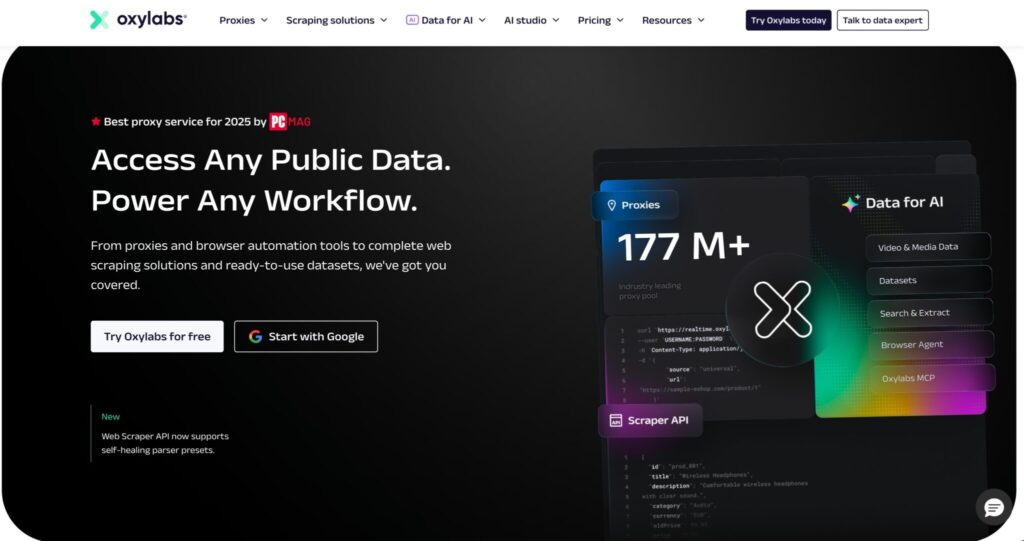
Oxylabs is one of the strongest choices if you need datacenter proxies for serious, high-volume operations. It is not the provider I would pick for a tiny side project, but for teams running large scraping pipelines, market intelligence platforms, or heavy SERP monitoring, Oxylabs is hard to ignore.
Its datacenter proxy product focuses on high uptime, transparent pricing, and large-scale scraping use cases. Oxylabs lists 99.9% uptime, transparent pricing, and a free starter option with 5 IPs upon registration. Its dedicated datacenter proxy page also highlights a 2M+ proxy pool, 188 countries, unlimited bandwidth under fair usage, HTTP and SOCKS5 support, and unlimited concurrent sessions.
What makes Oxylabs stand out is not just raw IP count. It is the enterprise polish: documentation, support quality, dedicated account management on bigger plans, and the ability to scale without constantly changing vendors.
For teams that care about operational stability, that matters. A cheap provider might work fine for 10,000 requests a day. Once you are running millions of requests, small issues become expensive.
Best for: Enterprise scraping, SERP tracking, price monitoring, AI data collection, and teams that need high-volume infrastructure.
Strengths:
- Large dedicated datacenter proxy pool
- Strong country coverage
- HTTP and SOCKS5 support
- Unlimited bandwidth under fair usage
- Enterprise-grade support and account management
- Good fit for large pipelines
Weaknesses:
- More expensive than budget providers
- May be overkill for beginners
- Some plans are better suited for business users than hobby users
Pro-Tip: Oxylabs works best when you already understand your request volume, target countries, and concurrency requirements. If you are still testing your use case, start small before committing to a larger plan.
#2: Decodo: Best Value Datacenter Proxies
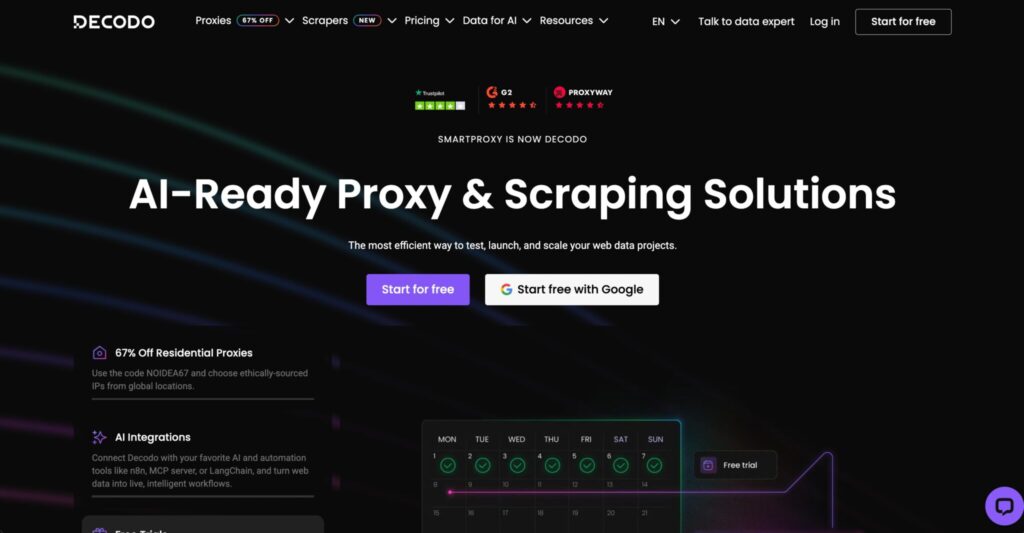
Decodo, formerly Smartproxy, is one of the strongest value picks in the datacenter proxy market. It hits a useful middle ground: easier to use than many enterprise-heavy providers, but more reliable and structured than many budget proxy sellers.
Decodo’s datacenter proxy page promotes shared and dedicated datacenter proxies, global coverage, and a 3-day free trial with 100MB. It also states that its datacenter proxies support HTTP(S) and SOCKS5, while its FAQ says datacenter proxies are generally the fastest proxy type and that Decodo uses servers with response times under 0.3 seconds.
The big appeal here is flexibility. You can use Decodo for scraping, automation, SEO workflows, and bulk data collection without feeling like you are managing a raw infrastructure product. The dashboard is friendly, the documentation is clear, and the setup does not feel painful.
Decodo is especially useful for teams that want datacenter proxies but do not want a complicated onboarding process.
Best for: Small to mid-size teams, SEO tools, agencies, developers, and data collection teams that want a balance between price and usability.
Strengths:
- Strong value for money
- Shared and dedicated datacenter options
- HTTP(S) and SOCKS5 support
- Good documentation
- 3-day trial available
- Easy dashboard experience
Weaknesses:
- Not as enterprise-heavy as Oxylabs or Bright Data
- Fair usage rules may matter for very high-volume users
- Detection risk still applies on strict targets
Pro-Tip: Decodo is a smart first paid provider for teams moving away from free proxies or unreliable cheap lists. It gives enough quality to test serious workflows without jumping straight into premium enterprise pricing.
#3: Webshare: Best Free Datacenter Proxy Tier
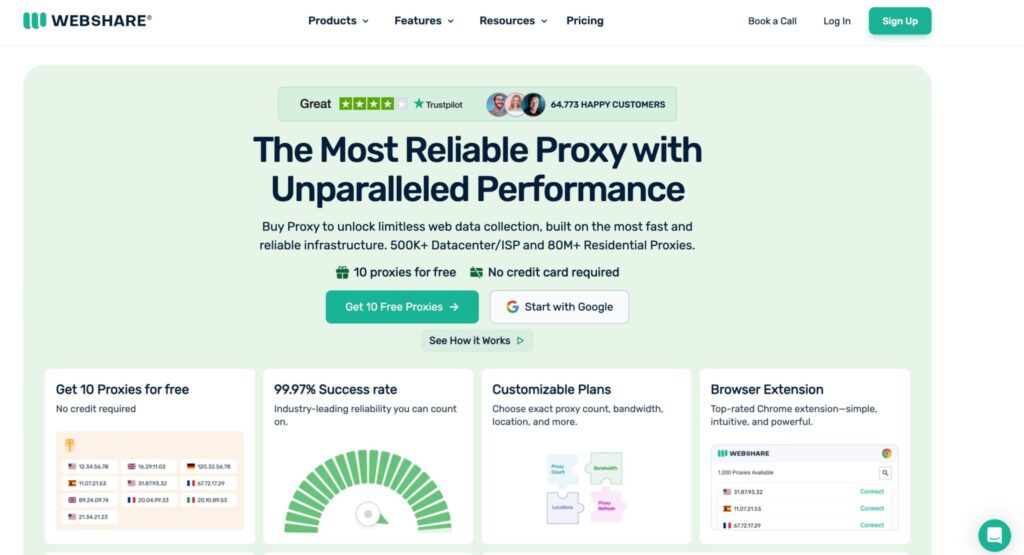
Webshare is a favorite among beginners, developers, and lean teams because it makes datacenter proxies extremely accessible. It offers a free tier, clear pricing, and an easy dashboard. That makes it one of the easiest providers to test before spending money.
Webshare says users can register and get 10 free premium proxies, while its broader site mentions a free proxy plan with up to 1GB per month and paid proxy servers starting at very low per-IP pricing. Its datacenter proxy page also says Webshare uses Tier-1 data centers with dedicated bandwidth and focuses on low latency and high throughput.
This is not the most advanced enterprise network on the list, but that is not Webshare’s main value. Its value is simplicity and price efficiency. You can spin up proxies quickly, test automation tools, run small scraping projects, or support basic SEO monitoring without dealing with sales calls.
Webshare is especially good for users who want low-cost dedicated or shared datacenter proxies with predictable pricing.
Best for: Beginners, developers, small businesses, lightweight scraping, SEO tools, and teams testing proxy workflows.
Strengths:
- Free datacenter proxy option
- Very affordable paid plans
- Simple dashboard
- HTTP and SOCKS5 support available
- Good for testing and smaller workflows
- Easy setup
Weaknesses:
- Not as feature-rich as premium enterprise providers
- Support depth may not match larger providers
- Less ideal for complex, high-risk targets
Pro-Tip: Use Webshare when you need a clean, low-cost way to validate your workflow. Once your request volume grows or target difficulty increases, you can upgrade within Webshare or move specific workloads to a stronger provider.
#4: Bright Data: Best Datacenter Proxy for Compliance-Heavy Environments
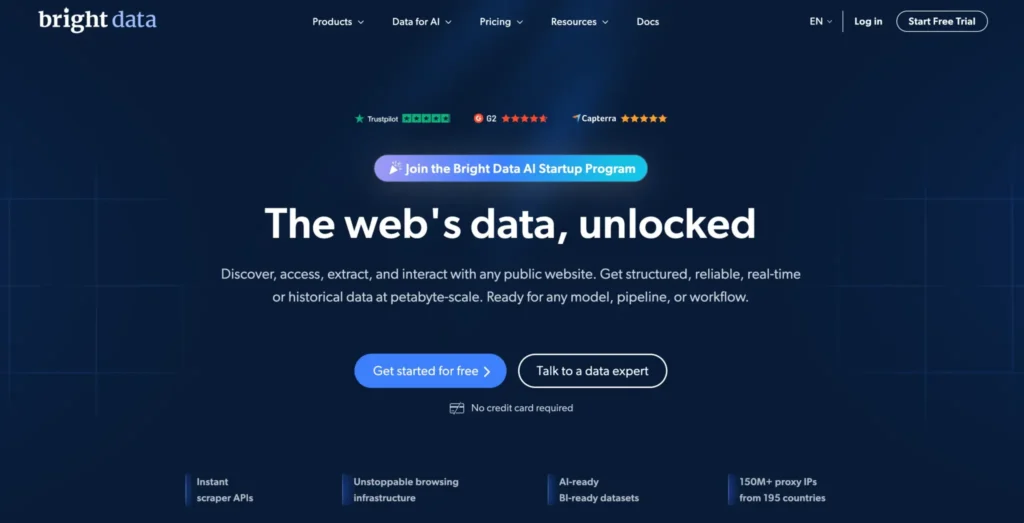
Bright Data is built for serious companies that care about compliance, governance, control, and scale. It is one of the most mature proxy platforms in the market, and its datacenter proxy network is designed for businesses that need dependable infrastructure with strong account controls.
Bright Data’s datacenter proxy pricing page lists a shared and dedicated pool of 1,300,000+ datacenter proxies, with shared plans starting at 10 IPs for $14 monthly, dedicated plans starting at 10 IPs for $22 monthly, and pay-as-you-go datacenter pricing from $0.60 per GB. Its documentation also describes a datacenter network with over 1.6 million IPs across 98+ countries.
Bright Data is not usually the cheapest option, but it is one of the strongest choices for teams that need governance, proxy manager tools, scalable billing, and a wider data collection ecosystem.
This provider is particularly attractive if your company already needs more than proxies, such as web scraping APIs, datasets, SERP tools, or structured data workflows.
Best for: Enterprise teams, compliance-heavy scraping, ad verification, market intelligence, and organizations that need a full data collection platform.
Strengths:
- Large datacenter proxy pool
- Strong compliance positioning
- Shared, dedicated, and pay-as-you-go options
- Free Proxy Manager on larger plans
- Good enterprise features
- Strong ecosystem beyond proxies
Weaknesses:
- Can feel expensive for small users
- More complex than beginner-friendly providers
- Some features may be unnecessary for simple scraping
Pro-Tip: Pick Bright Data when compliance and control are part of your buying decision. If you only need the cheapest IPs for basic scraping, it may be more platform than you need.
#5: SOAX: Best Datacenter Proxy for Combined Protocol Support
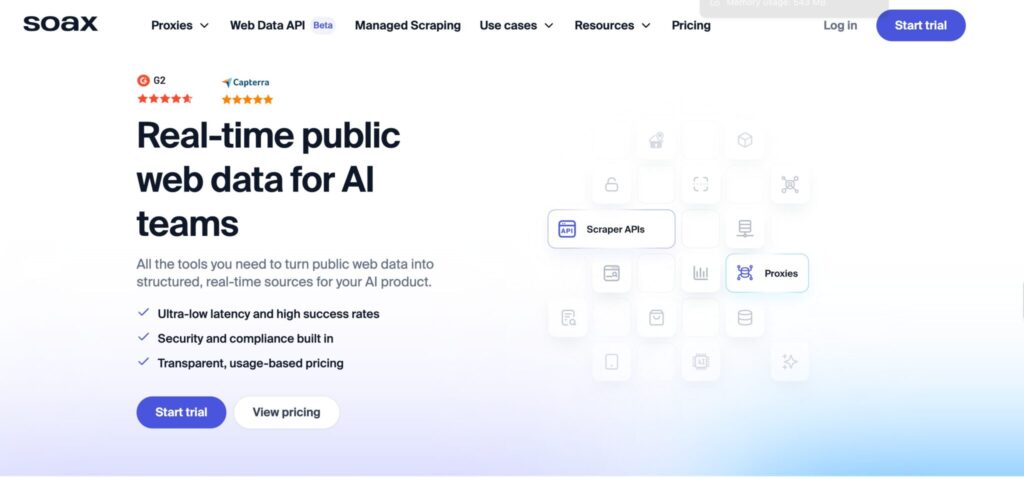
SOAX has become a strong mid-market option for teams that want flexible proxy access, clean dashboards, and bundled plans that include datacenter proxies alongside other data products.
Its datacenter proxy page lists US datacenter proxies bundled with Web Data API access, with plans starting at $90 monthly, including 145GB at $0.62 per GB. Higher plans reduce the per-GB rate, with listed options such as $0.49 per GB and $0.42 per GB depending on volume.
The main reason to consider SOAX is flexibility. It is not just a raw IP seller. It offers multiple proxy types, strong dashboard controls, and a business-friendly setup. For companies that want to test datacenter proxies while also having access to residential, mobile, or API-based data tools, SOAX makes sense.
SOAX is especially useful if your workflow may expand beyond datacenter proxies later.
Best for: Teams that want datacenter proxies with access to other proxy types and data tools.
Strengths:
- Flexible bundled plans
- Strong dashboard experience
- Datacenter proxies plus Web Data API access
- Good for growing teams
- Competitive per-GB pricing at higher volume
Weaknesses:
- Entry plan may be too large for very small users
- Current datacenter positioning is more focused on US datacenter proxies
- Not the cheapest per-IP option
Pro-Tip: SOAX is a good pick when you want one provider for multiple proxy types. If your entire workload is static datacenter IPs only, compare it carefully against per-IP providers.
#6: Proxy-Cheap: Best Budget Datacenter Proxy Option

Proxy-Cheap is exactly what the name suggests: a budget-friendly proxy provider for users who care about low prices and quick access. It is not trying to be Bright Data or Oxylabs. It is trying to give users affordable proxies that work for common online tasks.
Proxy-Cheap lists Datacenter IPv4 proxies starting around $1.18 per proxy, with current page messaging showing discounted monthly pricing around $1.49 per month.
The appeal is obvious. If you are testing small scripts, running basic automation, checking pages from different IPs, or building a low-budget data workflow, Proxy-Cheap can be attractive.
That said, budget proxies require realistic expectations. You may not get the same subnet quality, enterprise support, replacement flexibility, or large-scale reliability that you would expect from premium providers.
Best for: Budget users, small scraping tasks, basic automation, testing, and lightweight projects.
Strengths:
- Low entry pricing
- Simple buying process
- Good for budget-conscious users
- Useful for small experiments
- Datacenter IPv4 availability
Weaknesses:
- Not ideal for enterprise workloads
- Quality can vary by use case
- Less suitable for strict anti-bot targets
- Support and infrastructure depth may not match premium vendors
Pro-Tip: Use Proxy-Cheap for low-risk, low-cost testing. Avoid relying on it as your only provider if your business depends on high success rates across difficult targets.
#7: ProxyEmpire: Best Datacenter Proxy with Rollover Bandwidth
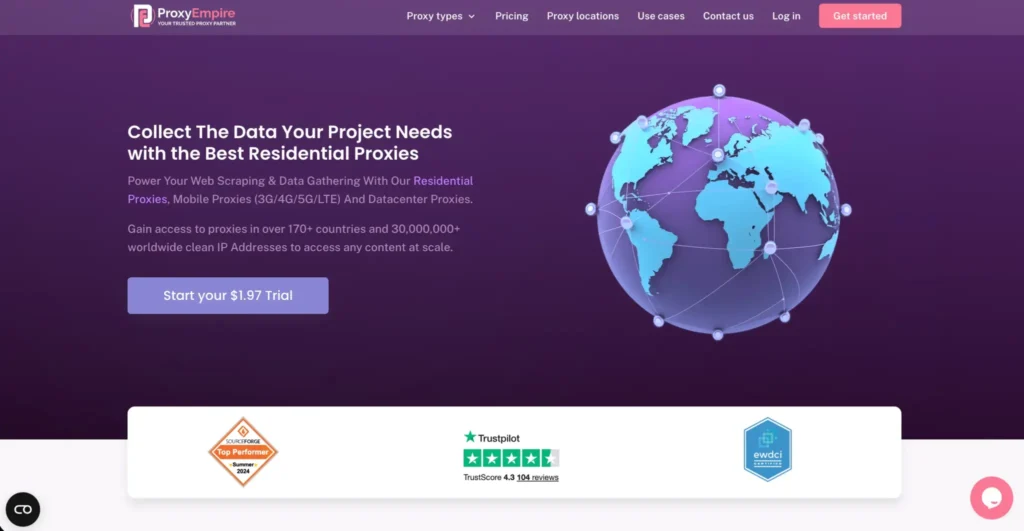
ProxyEmpire is an interesting option because it focuses heavily on flexible bandwidth and rotating proxy access. Its biggest selling point is rollover bandwidth, which is valuable for teams with uneven monthly usage.
ProxyEmpire’s rotating datacenter proxy page highlights speeds often under 100ms, rollover data, unlimited concurrent threads, 99.95% uptime, and support for high-volume use cases where speed and budget matter more than maximum stealth.
That rollover bandwidth feature can be a real money-saver. Many proxy plans punish inconsistent usage. You pay for bandwidth, fail to use all of it, then lose the unused amount at the end of the billing cycle. ProxyEmpire’s model is better for teams with campaign-based workloads, seasonal scraping, or irregular research projects.
It is also useful for buyers who want rotating datacenter proxies without managing every static IP manually.
Best for: Teams with uneven bandwidth usage, rotating datacenter workflows, SEO scraping, ad verification, and market research.
Strengths:
- Rollover bandwidth
- Rotating datacenter proxy option
- Unlimited concurrent threads
- Strong speed claims
- Useful for campaign-based scraping
Weaknesses:
- Smaller datacenter footprint than the biggest enterprise providers
- Not always the first choice for strict targets
- Buyers should test target-specific success rates before scaling
Pro-Tip: ProxyEmpire is worth testing if your monthly usage fluctuates. Rollover bandwidth can make the real cost lower than providers with cheaper headline rates but expiring traffic.
#8: Rayobyte: Best Dedicated Datacenter Proxy Provider
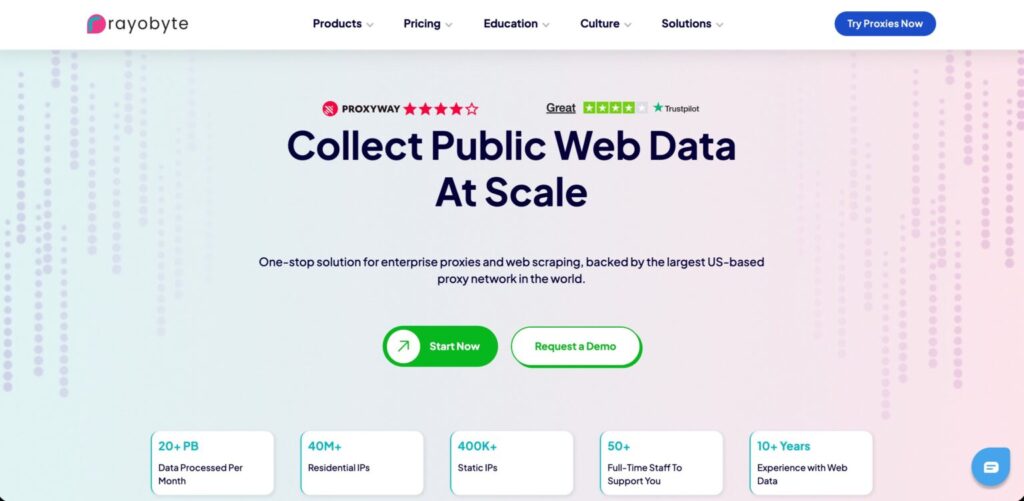
Rayobyte has long been known for datacenter proxies, especially dedicated and semi-dedicated setups. It is a strong pick for users who want more control over static proxy infrastructure instead of relying only on rotating pools.
Rayobyte explains the trade-off clearly: rotating datacenter proxies help users access a larger pool without managing IPs manually, while dedicated datacenter proxies offer a single static connection that is cheap, fast, and reliable, but requires smarter rotation management when IPs get blocked.
That makes Rayobyte appealing for technically capable teams. If you understand how to manage IP rotation, retries, request pacing, and target segmentation, dedicated datacenter proxies can be extremely cost-efficient.
Rayobyte also puts emphasis on abuse prevention, detection, and response, which matters if you are buying proxies for business use and want a provider that takes network reputation seriously.
Best for: Dedicated datacenter proxies, static IP workflows, technically capable teams, and users who want more proxy control.
Strengths:
- Strong dedicated datacenter proxy positioning
- Static and rotating datacenter options
- Good for advanced users
- Useful for cost-efficient scraping at scale
- Clear explanation of proxy type trade-offs
Weaknesses:
- Requires more technical handling
- Dedicated proxies can burn out if used carelessly
- Beginners may prefer a simpler rotating provider
Pro-Tip: Rayobyte is best when you have someone technical managing proxy logic. Dedicated IPs are powerful, but only if you control request patterns properly.
#9: DataImpulse: Best Budget Datacenter Proxy
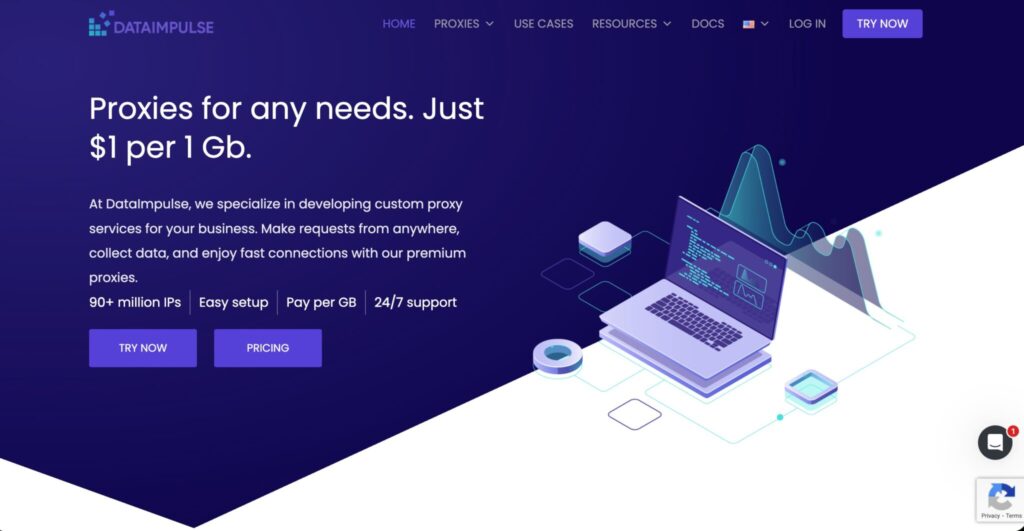
DataImpulse has become a strong budget pick for teams that want pay-as-you-go datacenter proxies without a large monthly commitment. Its pricing is one of the most attractive on this list.
DataImpulse’s datacenter proxy page lists pricing from $0.50 per GB, 195 locations globally, 99.9% uptime, sub-100ms latency, 30-minute sticky sessions, country targeting, and pay-as-you-go billing with no subscription requirement.
This makes DataImpulse especially useful for users who do not want to buy large monthly packages. You can top up, test, and scale based on actual usage. That is helpful for freelancers, small teams, SEO consultants, and anyone building early-stage automation workflows.
The ability to use sticky sessions up to 30 minutes is also useful for tasks where you need short session continuity instead of rotating IPs on every request.
Best for: Budget scraping, pay-as-you-go users, SEO monitoring, testing, and small to mid-volume data collection.
Strengths:
- Very low starting price
- Pay-as-you-go billing
- 195 location coverage
- 99.9% uptime claim
- Sticky sessions up to 30 minutes
- Good fit for low-budget teams
Weaknesses:
- Less established than older premium providers
- Enterprise buyers may want more mature controls
- Target-specific success rates should be tested before large use
Pro-Tip: DataImpulse is one of the easiest providers to test when budget matters. Use it for lightweight and mid-volume workflows, then keep a premium backup provider for harder targets.
Best Datacenter Proxy Providers in 2026: Quick Comparison Table
| Provider | Best For | Starting Price / Entry Point | Proxy Style | Protocol Support | Main Strength | Best Fit |
|---|---|---|---|---|---|---|
| Oxylabs | Enterprise scale | From around $1.20/IP, with free IPs on registration | Shared and dedicated datacenter | HTTP, SOCKS5 | Huge pool, uptime, enterprise support | Large scraping and SERP systems |
| Decodo | Best value | From around $0.02/IP, 3-day trial available | Shared and dedicated datacenter | HTTP(S), SOCKS5 | Fast, easy, balanced pricing | Agencies, developers, mid-size teams |
| Webshare | Free tier | 10 free proxies, paid proxy servers from very low per-IP pricing | Shared, private, dedicated | HTTP, SOCKS5 | Free plan and simple dashboard | Beginners and small teams |
| Bright Data | Compliance-heavy teams | Shared from $14/month, dedicated from $22/month, pay-as-you-go from $0.60/GB | Shared, dedicated, pay-per-GB | HTTP, HTTPS, SOCKS5 depending setup | Governance, scale, Proxy Manager | Enterprises and compliance teams |
| SOAX | Combined proxy access | Datacenter plans from $90/month with 145GB included | US datacenter bundled plans | HTTP(S), SOCKS5 across proxy products | Flexible plans and data tools | Growing data teams |
| Proxy-Cheap | Budget IPv4 proxies | Around $1.18 per proxy / discounted monthly pricing shown | Datacenter IPv4 | Depends on plan | Low-cost entry | Budget users and testing |
| ProxyEmpire | Rollover bandwidth | Rotating datacenter plans, pricing varies | Rotating datacenter | HTTP, SOCKS5 | Rollover data and unlimited threads | Uneven monthly usage |
| Rayobyte | Dedicated datacenter control | Varies by IP type and volume | Dedicated, semi-dedicated, rotating | HTTP, HTTPS, SOCKS5 depending plan | Static IP control | Technical scraping teams |
| DataImpulse | Budget pay-as-you-go | From $0.50/GB | Rotating and sticky datacenter | HTTP(S), SOCKS5 | Low per-GB cost, no subscription | Lean teams and SEO monitoring |
How to Choose the Best Datacenter Proxy Provider
Choosing a datacenter proxy provider is not just about picking the cheapest plan. You need to match the provider to your workload.
1. Check IP Pool Quality, Not Just IP Count
A big IP pool sounds impressive, but pool quality matters more than the headline number.
Look at:
- ASN diversity
- Subnet diversity
- Country coverage
- Replacement rules
- Dedicated vs shared access
- Abuse history
- Target-specific success rates
If 10,000 IPs come from a narrow range of subnets, your target site may flag them faster than a smaller but cleaner pool.
Pro-Tip: Ask providers about subnet diversity and replacement policy before buying a large plan. Many buyers only ask about IP count, which is a beginner mistake.
2. Decide Between Shared, Dedicated, and Rotating Datacenter Proxies
Shared datacenter proxies are cheaper because multiple users use the same IP pool. They are fine for low-risk tasks but can suffer from noisy-neighbor problems.
Dedicated datacenter proxies give you exclusive use of the IP. That means better control, more predictable performance, and fewer surprises. They cost more, but they are usually worth it for repeatable workflows.
Rotating datacenter proxies automatically switch IPs based on request, time, or session rules. They are useful when you need scale without manually managing IP lists.
Rayobyte sums up the trade-off well: rotating datacenter proxies reduce manual management, while dedicated datacenter proxies are fast and reliable but require smarter handling when blocks happen.
3. Review Rotation Protocols Carefully
Rotation is where many proxy setups succeed or fail.
Look for:
- Per-request rotation
- Sticky sessions
- Session duration controls
- Username/password session parameters
- API-based rotation
- Country-level rotation
- City or region targeting when needed
For scraping, per-request rotation works well when each request is independent. For workflows that need continuity, such as browsing a multi-page catalog, sticky sessions are safer.
DataImpulse, for example, promotes sticky sessions up to 30 minutes, which can help when short session continuity matters.
4. Match Protocol Support to Your Tools
Most web scraping setups work fine with HTTP or HTTPS proxies. But SOCKS5 is useful when you need broader traffic support, custom applications, browsers, or tools that do not rely only on standard web traffic.
Decodo states that its datacenter proxies support HTTP(S) and SOCKS5, while Oxylabs also lists HTTP and SOCKS5 support for dedicated datacenter proxies.
Pro-Tip: Do not assume SOCKS5 is included on every plan. Check before buying, especially if you use anti-detect browsers, custom automation tools, or non-browser traffic.
5. Calculate Real Cost, Not Sticker Price
Proxy pricing can be per IP, per GB, per port, per thread, or per monthly package.
A provider that charges $0.50/GB may be cheaper for light users. A provider that charges per IP with unlimited bandwidth may be better for high-volume users. A rollover bandwidth provider may be better if usage changes month to month.
The right pricing model depends on your traffic pattern.
Ask yourself:
- Do I need fixed IPs or rotating bandwidth?
- Is my usage steady or seasonal?
- How much failed traffic should I expect?
- Do unused GBs expire?
- Are replacements free?
- Are concurrent threads limited?
6. Test Against Your Real Target Before Scaling
No proxy provider can guarantee perfect performance across every website. A provider may work beautifully on SERPs but struggle on a retail target. Another may work well for ad verification but perform poorly on social platforms.
Run a small test before scaling.
Track:
- Success rate
- Median response time
- Timeout rate
- CAPTCHA rate
- Block rate
- Cost per successful request
That last metric matters most. Cheap proxies with a 40 percent failure rate are often more expensive than premium proxies with a 90 percent success rate.
FAQs: Best Datacenter Proxy Providers in 2026
Are datacenter proxies detectable?
Yes, datacenter proxies can be detectable. They come from data center infrastructure rather than real household ISP connections, so some websites can identify and block them more easily than residential proxies. Decodo and Webshare both note that datacenter proxies are generally faster and cheaper, but easier for websites to flag compared with residential proxies.
When should I choose datacenter over residential proxies?
Choose datacenter proxies when speed, cost efficiency, and high request volume matter more than maximum stealth. They are a strong fit for SERP tracking, price monitoring, basic scraping, ad verification, and public data collection. Choose residential proxies when your target has stricter bot detection or requires IPs that look like real consumer connections.
What’s the difference between shared and dedicated datacenter proxies?
Shared datacenter proxies are used by multiple customers, so they cost less but carry higher risk of performance drops or previous abuse. Dedicated datacenter proxies are reserved for one customer, giving you better control, cleaner usage history, and more stable performance. Decodo describes dedicated proxies as offering exclusive IP control and better reliability, while shared proxies are more budget-friendly but carry higher block risk.
How fast are datacenter proxies?
Datacenter proxies are usually the fastest proxy type because they run on server-grade infrastructure. Speed varies by provider, location, target website, and network route. Decodo claims response times under 0.3 seconds for its datacenter proxy infrastructure, while ProxyEmpire promotes rotating datacenter proxy speeds often under 100ms.
What is the cheapest datacenter proxy option in 2026?
Among the providers listed here, DataImpulse is one of the cheapest pay-as-you-go options, with datacenter proxies starting from $0.50/GB. Webshare is also very affordable and offers a free tier with 10 proxies, making it one of the best entry points for beginners.
Are datacenter proxies good for web scraping?
Yes, datacenter proxies are good for web scraping when the target website does not aggressively block data center IPs. They are especially useful for large-scale public data collection, SERP monitoring, price tracking, and market research. For difficult websites, you may need residential, ISP, or mobile proxies instead.
Should I use rotating or sticky datacenter proxies?
Use rotating datacenter proxies when each request can stand alone, such as scraping search result pages or product listings. Use sticky sessions when your workflow needs short-term continuity, such as browsing multiple pages in the same region or keeping a session stable for a few minutes. DataImpulse, for example, supports sticky sessions up to 30 minutes.
Which datacenter proxy provider is best overall?
Oxylabs is the best overall choice for enterprise scale. Decodo is the best value pick for most small to mid-size teams. Webshare is best for beginners and free testing. Bright Data is best for compliance-heavy companies. DataImpulse is best for budget pay-as-you-go usage.
Conclusion: Best Datacenter Proxy Providers in 2026
The best datacenter proxy provider depends on your workload.
- If you want enterprise-grade scale, choose Oxylabs.
- If you want the best mix of price, usability, and performance, choose Decodo.
- If you need a free or beginner-friendly option, start with Webshare.
- If compliance and governance matter, go with Bright Data.
- If you want flexible bundled access, test SOAX.
- If your budget is tight, compare Proxy-Cheap and DataImpulse.
- If rollover bandwidth matters, ProxyEmpire deserves a close look.
- If you want dedicated datacenter control, Rayobyte is one of the strongest technical picks.
Datacenter proxies are not magic. They will not beat every anti-bot system, and they are not the right fit for every target. But for speed, scale, and cost efficiency, they remain one of the most practical tools in the proxy market.
The smart move is simple: start with a provider that fits your budget, test against your real target, measure cost per successful request, and scale only after the numbers make sense.