
Germany is one of the trickier proxy markets to get right.
On paper, buying German proxies sounds simple. Pick a provider, select Germany, copy the proxy endpoint, and start running requests. In practice, the quality gap between providers is huge. Some German IP pools are clean, stable, and useful for serious market research. Others burn fast, trigger blocks, or quietly route you through random neighboring countries while still being sold as “Germany proxies.”
That matters because Germany is a high-value market for search intelligence, price monitoring, ad verification, ecommerce research, travel fare tracking, streaming checks, app localization, and DACH-region testing. It is also a privacy-sensitive market.
If your work touches personal data, account activity, or user-level identifiers, you need to think beyond speed and price. GDPR applies to personal data processing in the EU, and the European Commission clearly states that GDPR protects personal data regardless of the technology used for processing.
So, the best Germany proxy provider is not just the cheapest one with a German flag in the dashboard. You want clean IP sourcing, strong targeting, flexible rotation, practical compliance controls, and pricing that does not punish you once your traffic grows.
Below is a practical buyer’s guide to the 9 best Germany proxy providers in 2026, based on German coverage, proxy type variety, pricing structure, rotation control, scale, dashboard usability, and fit for real business use cases.
What Makes a Proxy Great for Germany?
A good German proxy should do four things well: give you real German IPs, keep request quality stable, support the right session behavior, and allow you to operate responsibly.
The first point is location accuracy. Germany is not a small digital market. If you are checking local SERPs, retail pricing, delivery availability, streaming catalogs, or ad placements, a vague “Europe” endpoint will not cut it. You need Germany-level targeting at minimum. City-level targeting is even better for local SEO, marketplace monitoring, and regional price research across Berlin, Munich, Hamburg, Frankfurt, Cologne, and other key cities.
The second point is proxy type. Residential proxies are best when you need real-user IP reputation. Datacenter proxies are better when speed and low cost matter more than stealth. ISP proxies sit in the middle because they offer residential-style ASN credibility with more static behavior. Mobile proxies are useful for app testing, mobile ad verification, social platform workflows, and carrier-specific checks.
The third point is rotation. For scraping or SERP collection, rotating sessions help spread traffic across many IPs. For login-based workflows, ad account checks, cart testing, or localized browsing, sticky sessions are safer because you keep the same IP for a set period. The wrong rotation setting can break your workflow even if the proxy provider itself is strong.
The fourth point is compliance. Germany is part of the EU, so proxy work involving personal data must be planned carefully. GDPR does not ban proxy use, but it does require lawful, fair, and transparent handling of personal data. The European Commission notes that data protection rules apply inside and outside the EU when EU personal data is involved, including safeguards for international transfers.
Pro Tip: For Germany, avoid choosing only by “price per GB.” Look at block rate, targeting depth, sticky session duration, refund terms, IP quality, and whether the provider explains its sourcing standards. Cheap traffic becomes expensive fast when half your requests fail.
9 Best Germany Proxy Providers 2026
#1: Oxylabs: Best Overall Germany Proxy Provider
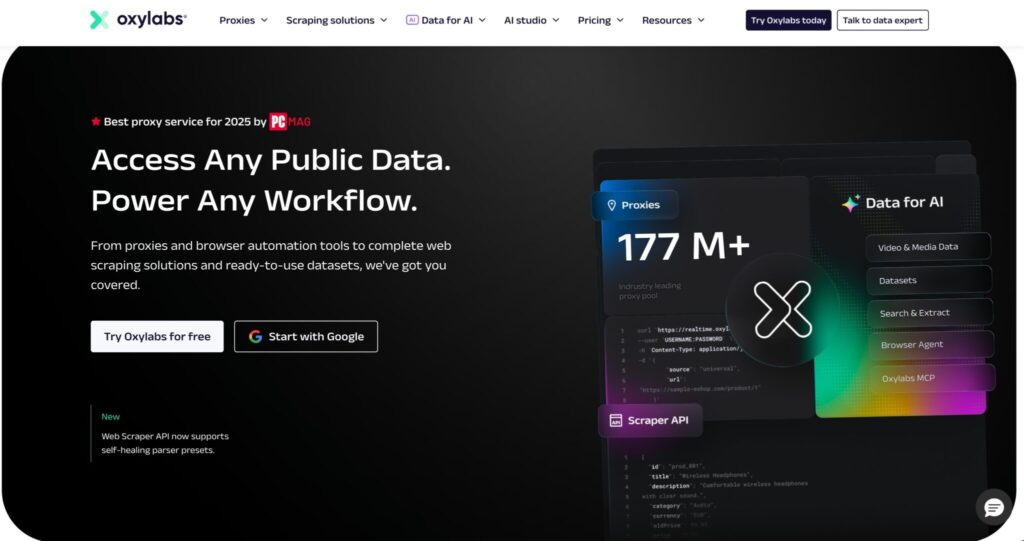
Oxylabs is the strongest overall choice for teams that need dependable German IP coverage, large-scale scraping capacity, and enterprise-grade support. It is not the cheapest provider on this list, but it is one of the most reliable options when proxy failure directly affects revenue, reporting, or client deliverables.
For Germany specifically, Oxylabs offers residential German proxy servers and mentions a pool of more than 3 million German IPs on its Germany proxy page. It positions these proxies for use cases such as web scraping, price monitoring, ad verification, and other location-based data collection work.
The product range is also broad. You can use residential proxies for difficult targets, datacenter proxies for faster high-volume jobs, ISP proxies for stable sessions, and mobile proxies for mobile-heavy testing. Oxylabs also offers advanced scraping infrastructure, which makes it attractive for teams that do not want to build every unblocker and retry system manually.
Pricing depends on proxy type. Its residential proxy pricing page shows plans starting at 5GB for $30, billed monthly, which works out to $6 per GB on the starter plan. Larger plans reduce the per-GB cost. Its datacenter proxy pricing page also lists German availability among supported datacenter locations, with pay-per-IP pricing from $1.20 per IP on the displayed plan.
Oxylabs is best for agencies, ecommerce intelligence teams, ad verification companies, cybersecurity researchers, and data teams that want fewer moving parts. It may feel too heavy for a beginner who only needs a few German IPs for light browsing or small SEO checks.
Best for: enterprise scraping, ad verification, price intelligence, high-volume German research
Main strength: large German pool and mature infrastructure
Possible drawback: higher starting cost than budget providers
#2: Decodo: Best Value Germany Proxy Provider
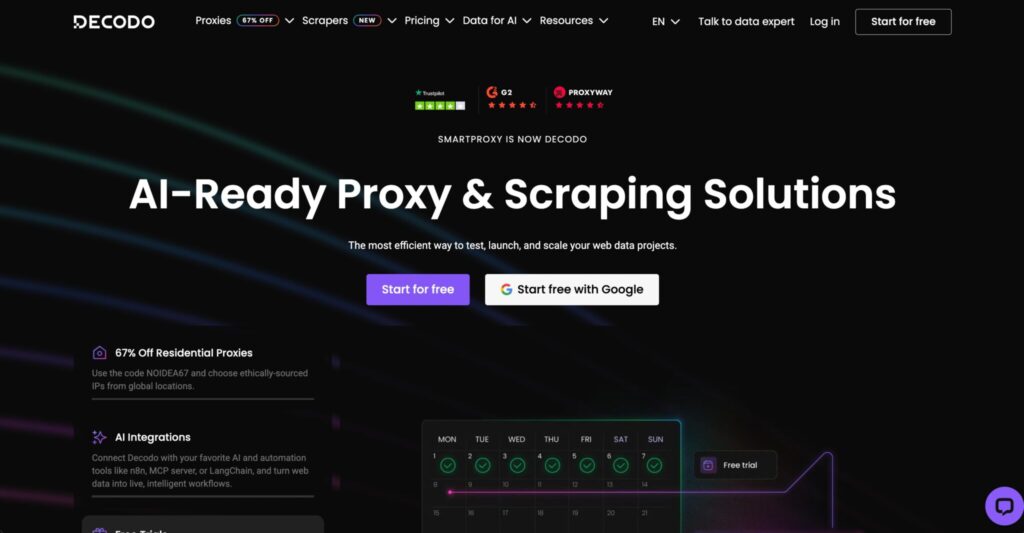
Decodo, formerly Smartproxy, has become one of the best value choices for German proxies because it blends strong infrastructure with beginner-friendly usability. Its Germany proxy page lists residential, datacenter, ISP, and mobile German IP options, along with advanced targeting and support.
The biggest appeal is balance. Decodo feels easier to use than many enterprise platforms, but it still has enough depth for serious data work. The dashboard is clean, the setup process is quick, and the provider has enough proxy types to support different workflows without pushing users into complicated enterprise sales calls.
Its homepage states that Decodo has 125M+ IPs, 99.99% uptime, and 195+ locations. Residential proxy pricing starts from $2 per GB according to its pricing page, with smaller monthly plans showing higher per-GB pricing and larger plans reducing the rate.
For Germany, Decodo is especially useful for SEO monitoring, localized SERP checks, ecommerce price collection, travel pricing research, and ad preview testing. It is also a good pick for teams that want residential and ISP-style options without moving to a much more expensive enterprise stack.
Pro Tip: Use Decodo residential proxies for German SERP and ecommerce data. Use ISP proxies when you need a stable German identity for longer browser sessions.
Best for: value-focused teams, SEO tools, ecommerce tracking, agencies
Main strength: strong balance of price, usability, and German proxy options
Possible drawback: not as enterprise-heavy as Oxylabs or Bright Data for complex governance needs
#3: Webshare: Best Free Germany Proxy Tier
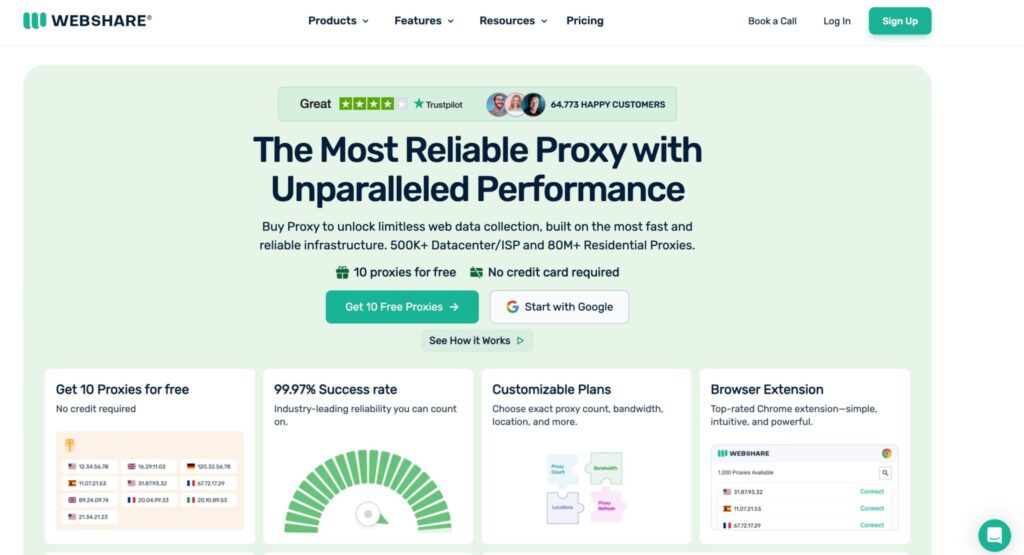
Webshare is the provider I would point to when someone wants to test Germany proxies without committing to a large budget. It is affordable, easy to understand, and unusually transparent for smaller users.
Its Germany proxy location page lists German proxy availability and shows a free proxy option with up to 1GB per month, along with paid proxy server options. The same page also lists rotating residential proxies starting at $1.4 per GB and static residential options with per-IP pricing.
Webshare’s general free proxy page says users can get 10 premium proxies for free, and its proxy server page explains that the free option includes 10 proxies with up to 1GB per month without a trial period or credit card requirement.
That makes Webshare attractive for testing, small SEO tasks, basic German browsing, lightweight automation, or internal QA. It is not the provider I would choose for highly sensitive data collection or very difficult targets, but it is excellent for budget-conscious users who want control over costs.
The dashboard is another plus. Webshare is built for self-serve users. You can buy, filter, configure, and rotate proxies without needing a long onboarding process. For freelancers, small affiliate teams, and startup operators, that matters.
Best for: free testing, small projects, budget German proxy access
Main strength: free tier and low-cost paid plans
Possible drawback: lacks the deeper compliance and managed infrastructure of premium enterprise providers
#4: Bright Data: Best Germany Proxy for GDPR-Compliant Data Collection
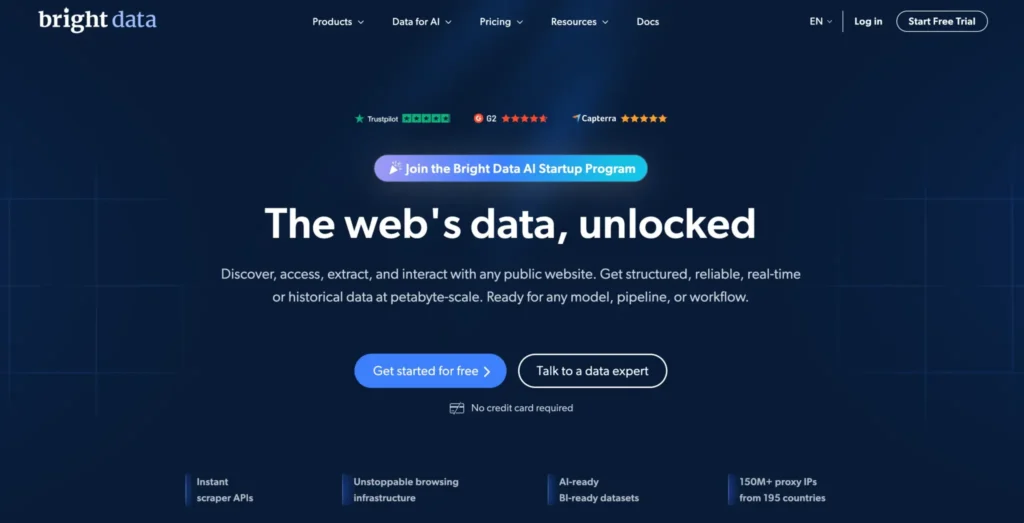
Bright Data is one of the most advanced proxy platforms on the market. It is not the simplest or cheapest option, but for compliance-aware teams, it deserves serious attention.
Its Germany proxy page lists residential, ISP, and datacenter proxy options and shows residential pay-as-you-go pricing at $8 per GB, discounted to $4 per GB at the time shown on the page through a promotional offer. Bright Data also states on its pricing page that it offers residential, datacenter, mobile, and ISP proxies, plus web scraping APIs and other data collection products.
The key reason Bright Data ranks highly for Germany is governance. Its GDPR trust page says the company is committed to complying with relevant data protection requirements, including GDPR and CCPA. That does not automatically make every user’s scraping project compliant, of course. Compliance depends on your use case, legal basis, data type, retention, security, and purpose. Still, Bright Data gives enterprise teams more structure than many low-cost providers.
Bright Data is best suited for larger companies, market intelligence teams, and legal or compliance-sensitive research teams. If you need German proxies for regulated workflows, public web data collection, brand protection, ad verification, or enterprise-grade scraping, it is one of the safer names to evaluate.
Pro Tip: If your Germany proxy workflow touches personal data, do not rely on the proxy provider alone. Document your purpose, data categories, retention policy, and opt-out handling before you scale.
Best for: compliance-aware data collection, enterprise research, brand protection
Main strength: mature platform and strong compliance positioning
Possible drawback: more complex and expensive than beginner-focused tools
#5: SOAX: Best Germany Proxy for Rotating Operations
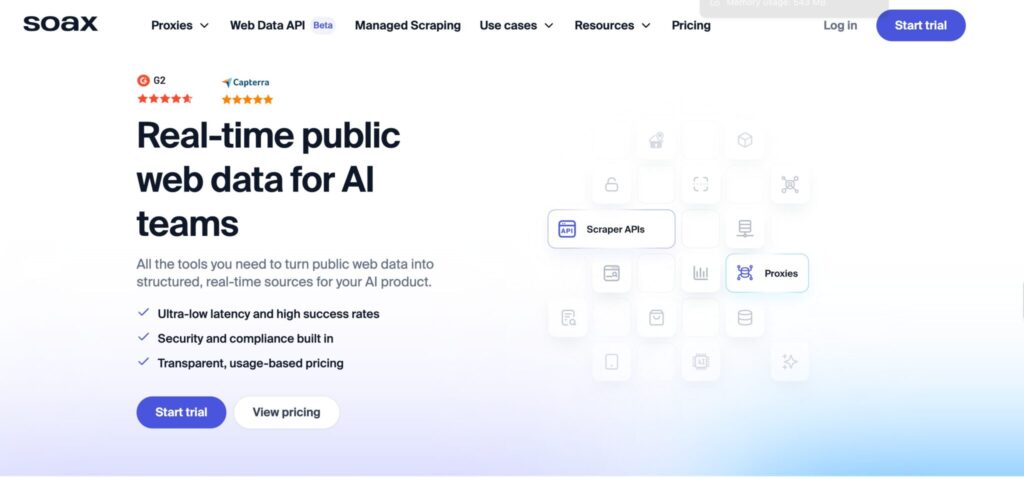
SOAX is a strong fit for users who need flexible rotating proxies with clean targeting controls. It has built a reputation around residential and mobile proxies, and its Germany location page lists German proxy access with pricing tied to bundled proxy and scraping API plans. The Germany page shows 1,110,960 German IPs available at the time captured by search results and lists starter pricing at $3.60 per GB with 25GB included.
SOAX’s residential proxy page also lists 155M+ IPs and bundled plans that include residential proxies and Web Data API access. Its pricing page mentions a three-day 400MB trial for $1.99, which is useful for testing before moving into a paid plan.
Where SOAX works well is controlled rotation. If you are collecting German search results, testing ad placements, gathering marketplace data, or running localized research in batches, rotation settings matter. SOAX gives enough control to make those workflows practical without overwhelming the user.
The provider is less ideal if you only need a handful of static German IPs for long-term browser sessions. It is better when your workflow benefits from fresh IPs, flexible targeting, and repeatable request patterns.
Best for: rotating German residential proxies, SERP tracking, ad checks, marketplace scraping
Main strength: targeting and rotation flexibility
Possible drawback: monthly bundle pricing may be too much for casual users
#6: DataImpulse: Best Budget Germany Proxy Provider
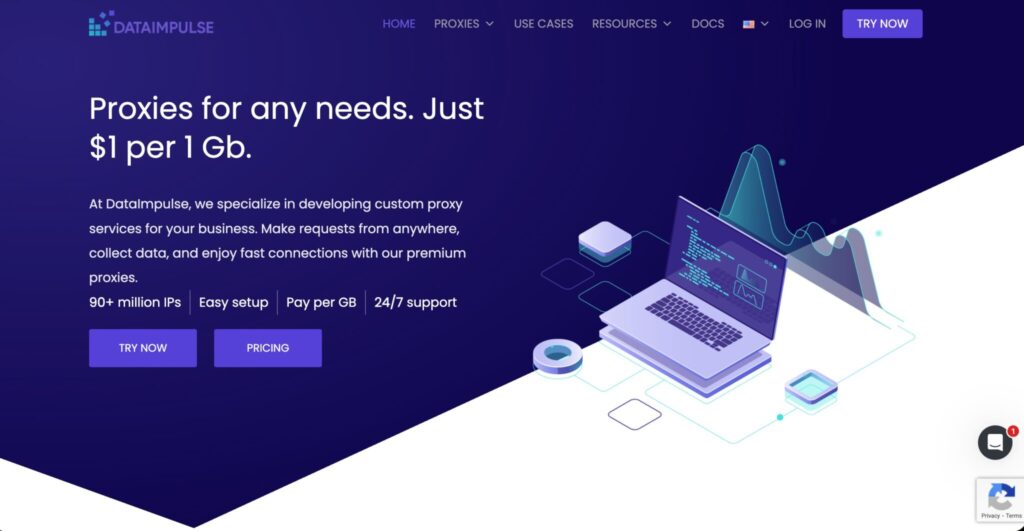
DataImpulse is one of the strongest budget options for German residential proxies. It is built for users who care about cost per GB and simple pay-as-you-go usage.
Its Germany residential proxy page highlights German residential proxies for scraping, SEO, and marketing use cases. It also mentions proxy rotation by time interval or per new request, specific country plans, 24/7 support, API access, and pricing at $1 per GB with custom pricing for 1TB+ usage. Its residential proxy page states that DataImpulse has 90M+ ethical residential IPs worldwide and coverage across 195 countries, with typical pricing starting from $1 per GB.
That pricing is hard to ignore. For data teams running high-volume but not extremely sensitive German tasks, DataImpulse can make the economics work. It is particularly attractive for price monitoring, SERP tracking, ad verification, and basic public web data collection.
The tradeoff is that DataImpulse does not have the same enterprise polish as Oxylabs, Bright Data, or Decodo. You may need to spend more time tuning retries, headers, rotation timing, and concurrency. Still, for budget-conscious teams, the value is strong.
Pro Tip: Start DataImpulse with conservative concurrency. Cheap residential bandwidth is useful, but German targets can still rate-limit aggressively if your request behavior looks unnatural.
Best for: budget scraping, SEO monitoring, high-volume testing
Main strength: $1 per GB residential pricing
Possible drawback: less premium support and enterprise tooling than top-tier platforms
#7: IPRoyal: Best Germany Proxy for Bulk Operations
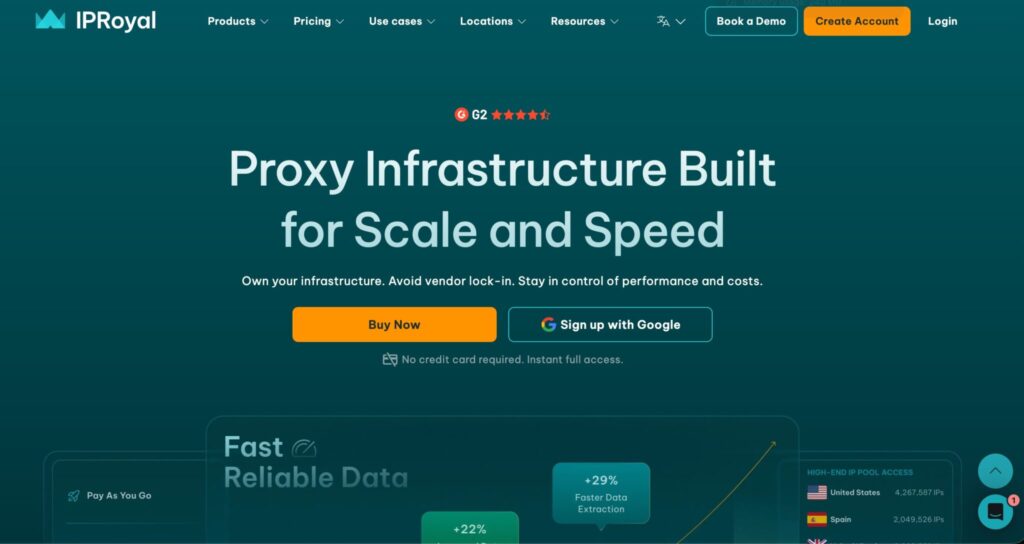
IPRoyal is a strong middle-ground provider for users who need German proxies at scale without moving into enterprise pricing. It offers residential, ISP, datacenter, and mobile proxy options, making it flexible enough for different German workflows.
Its Germany residential proxy page says IPRoyal offers hundreds of thousands of German residential proxies with HTTP(S) and SOCKS5 support, 99.9% uptime, and sticky plus rotating sessions. Another Germany proxy page lists more than 2,016,461 unique German IPs in its network.
IPRoyal’s pricing page lists residential proxy plans starting at $7 per GB for 1GB, with lower per-GB pricing on larger plans. Its homepage also promotes residential proxies from $1.75 per GB and a 32M+ proxy pool, along with ISP, datacenter, and mobile proxy options.
IPRoyal is useful for bulk workflows where you want Germany coverage, SOCKS5 support, and both sticky and rotating behavior. It is a practical choice for affiliate testing, ecommerce checks, SEO rank tracking, sneaker or retail monitoring, and account-safe browsing when configured carefully.
It may not be the first pick for the hardest enterprise scraping jobs, but for cost-sensitive operators who still want a recognizable provider, IPRoyal sits in a comfortable spot.
Best for: bulk German proxy usage, SOCKS5 workflows, mixed proxy needs
Main strength: broad proxy type support and German IP volume
Possible drawback: residential pricing can vary depending on plan size and billing model
#8: ProxyCheap: Best Germany Proxy for Budget DACH Operations

ProxyCheap is built for affordability. If your work covers the DACH region, meaning Germany, Austria, and Switzerland, and you need low-cost residential, static residential, datacenter, or mobile proxy options, ProxyCheap is worth testing.
Its Germany location page promotes affordable German proxy servers and easy setup. The main ProxyCheap site lists several product types, including static residential, rotating residential, datacenter IPv4, datacenter IPv6, static mobile, and rotating mobile proxies. It shows rotating residential pricing from $4.99 per GB, static residential from $2.12 per month after discount, datacenter IPv4 from $1.49 per month after discount, and rotating mobile from $5.99 per GB.
ProxyCheap’s residential proxy page also says it offers 50M+ residential IPs across 195+ countries with SOCKS5/HTTPS support and 99.9% uptime.
The strongest use case here is budget-controlled regional work. If you are checking German websites, running QA across DACH markets, testing localized funnels, or doing smaller research batches, ProxyCheap can be cost-effective.
The weak point is that it is not as polished as the enterprise names. You should test IP quality before using it for sensitive or revenue-critical workflows. For budget projects, though, it gives plenty of flexibility.
Best for: low-cost DACH testing, smaller German research tasks, mixed proxy types
Main strength: affordable product range
Possible drawback: not the strongest choice for enterprise-grade compliance workflows
#9: NodeMaven: Best Germany Proxy for Clean GDPR-Sensitive Workflows
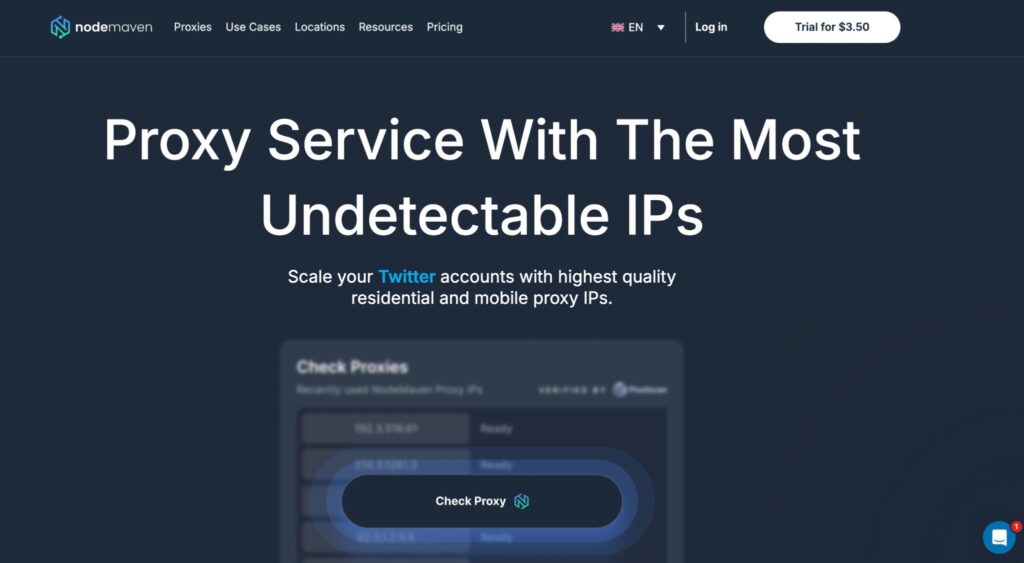
NodeMaven is a newer-style proxy provider focused on IP quality filtering and cleaner sessions. It is especially interesting for users who care less about the biggest possible pool and more about reducing wasted bandwidth, failed sessions, and suspicious IP behavior.
Its Germany proxy page says users can get German IPs for automation, scraping, and localized access, and it advertises a 750MB trial for $3.50. NodeMaven’s pricing page says residential proxies start at $2.20 per GB on monthly plans, with pay-as-you-go rates also available. It also notes that plans include access to both residential and mobile proxy pools, traffic rollover, and cashback on used bandwidth.
NodeMaven’s residential proxy page highlights a real-time filtering algorithm designed to deliver higher-quality IPs and reduce interruptions. That positioning makes sense for German workflows where fewer clean sessions may outperform a huge but noisy pool.
For GDPR-sensitive work, NodeMaven is not a legal shield, and no proxy provider should be treated that way. But its quality-first positioning makes it a sensible option for teams that want cleaner routing, fewer broken sessions, and better control over how traffic behaves.
Best for: quality-focused German sessions, localized automation, controlled scraping
Main strength: IP filtering and clean-session focus
Possible drawback: newer brand compared with Oxylabs, Bright Data, or Decodo
Quick Comparison: Best Germany Proxy Providers
| Provider | Best For | Germany Proxy Types | Starting Price Snapshot | Rotation Support | Best Use Case | Main Drawback |
|---|---|---|---|---|---|---|
| Oxylabs | Best overall | Residential, datacenter, ISP, mobile | Residential starter shown at $6/GB, datacenter from $1.20/IP | Yes | Enterprise scraping, ad verification, price monitoring | Higher entry cost |
| Decodo | Best value | Residential, datacenter, ISP, mobile | Residential plans starting from $2/GB | Yes | SEO, ecommerce, agency workflows | Less governance-heavy than Bright Data |
| Webshare | Best free tier | Free, datacenter, static residential, rotating residential | Free 10 proxies with up to 1GB/month, residential from $1.4/GB | Yes | Testing, small SEO tasks, budget browsing | Not ideal for complex scraping |
| Bright Data | Best for compliance-aware teams | Residential, ISP, datacenter, mobile | Germany page shows residential PAYG at $8/GB, promo $4/GB | Yes | Enterprise data collection, brand protection | Complex for beginners |
| SOAX | Best rotating operations | Residential, mobile | Starter shown at $3.60/GB with 25GB included | Strong | SERP tracking, ad checks, marketplace scraping | Bundle cost may be high for small users |
| DataImpulse | Best budget residential | Residential | $1/GB | Yes | Budget scraping, SEO monitoring | Less enterprise polish |
| IPRoyal | Best bulk operations | Residential, ISP, datacenter, mobile | Residential page shows $7/GB for 1GB, homepage says from $1.75/GB | Yes | Bulk German IP workflows | Pricing depends heavily on plan size |
| ProxyCheap | Best budget DACH operations | Residential, static residential, datacenter, mobile | Rotating residential from $4.99/GB | Yes | Regional testing, budget QA | Test quality before heavy use |
| NodeMaven | Best clean-session workflows | Residential, mobile, ISP-style options | From $2.20/GB monthly, trial 750MB for $3.50 | Yes | Quality-focused automation and localized access | Newer provider |
How to Choose the Best Germany Proxy Provider
Choosing a Germany proxy provider is not just about picking the largest IP pool. A provider with 100 million global IPs may still perform poorly if its German subnet quality is weak, its rotation is clumsy, or its dashboard makes targeting difficult.
1. Match Proxy Type to the Job
Use residential proxies for ecommerce scraping, localized search results, public web data collection, and websites that block datacenter traffic quickly.
Use datacenter proxies for speed-heavy jobs, uptime checks, infrastructure testing, and low-risk scraping where IP reputation is not the main issue.
Use ISP proxies when you need a stable German IP that looks more residential than normal datacenter hosting. They are useful for account sessions, cart testing, checkout monitoring, and ad preview workflows.
Use mobile proxies for mobile app QA, mobile ad verification, carrier testing, and platforms that treat mobile traffic differently.
2. Check Germany-Level Targeting
At minimum, your provider should support Germany as a selectable country. For serious SEO and ads work, look for city-level targeting. German SERPs, shopping results, and delivery availability may differ between Berlin, Munich, Hamburg, and smaller cities.
3. Test Rotation Before Scaling
A provider may advertise rotation, but the practical controls matter more. Can you rotate per request? Can you hold a sticky session for 10, 30, or 60 minutes? Can you create session IDs? Can you avoid rotating during a checkout or login flow?
For scraping, rotation helps. For identity-sensitive workflows, aggressive rotation can create more problems than it solves.
4. Watch ASN and ISP Diversity
A German proxy pool with many IPs but weak ASN diversity can burn quickly. If all your German traffic comes from a narrow set of networks, target websites may detect patterns. Better providers spread traffic across a more natural mix of ISPs and regions.
5. Review Compliance and Sourcing Claims
Do not ignore sourcing. Ethical residential proxy sourcing matters, especially in the EU. Ask whether the provider explains how residential IPs are obtained, whether users consent, and what acceptable-use controls exist.
6. Run a Small Pilot
Before buying a big package, test these metrics:
| Test Area | What to Check |
|---|---|
| Location accuracy | Does the IP resolve to Germany consistently? |
| Block rate | How many requests fail on your real target sites? |
| Speed | Is response time stable during peak hours? |
| Rotation | Does session behavior match your workflow? |
| Dashboard | Can your team manage users, spend, and locations easily? |
| Support | Does support understand German targeting issues? |
| Cost | What is the real cost after failed requests and retries? |
Pro Tip: The “best” provider is the one that performs on your target sites, not the one with the nicest homepage. Always test against your actual German domains before committing.
FAQs: Best Germany Proxy Providers 2026
Do German proxies need to be GDPR-compliant?
The proxy itself is only one part of the compliance picture. If your workflow processes personal data from Germany or the EU, GDPR may apply. The European Commission explains that GDPR protects personal data regardless of technology, including automated and manual processing when data is organized by predefined criteria.
For public web scraping, compliance depends on what you collect, why you collect it, how you store it, and whether personal data is involved. Business data, prices, search results, and public product pages are usually lower risk than user profiles, emails, behavioral data, or personal identifiers.
Which German ISPs do proxy providers cover?
Providers rarely publish full German ISP lists because pools change constantly. In practice, you may see IPs associated with major German networks, regional ISPs, hosting companies, mobile carriers, and broadband providers, depending on the proxy type. Residential and mobile proxies usually offer more natural ISP diversity, while datacenter proxies are easier to identify as server traffic.
If ISP targeting matters, ask the provider directly or test with a sample. For ad verification and ecommerce research, ISP diversity often matters more than raw IP count.
What are German proxies used for?
German proxies are commonly used for localized SEO tracking, Google SERP monitoring, ecommerce price intelligence, ad verification, travel fare checks, brand protection, app localization, streaming availability checks, cybersecurity research, and QA testing.
They are especially useful when a website changes content based on location. A user in India, the US, or the UK may not see the same search results, prices, shipping options, ads, or streaming catalog as a user in Germany.
Are free Germany proxies safe?
Free proxies can be useful for basic testing, but they should not be used for sensitive work. Random public free proxies may log traffic, inject content, fail often, or expose your workflow to unnecessary risk. A structured free tier from a known provider, like Webshare’s free proxy offer, is safer than downloading unknown proxy lists from random websites.
For business use, paid proxies are usually worth it because you get authentication, dashboard controls, support, and more predictable performance.
Are residential Germany proxies better than datacenter Germany proxies?
Residential proxies are better for websites that are sensitive to IP reputation. They look more like normal user traffic because the IPs are associated with residential internet connections. Datacenter proxies are faster and cheaper, but they are easier for websites to detect and block.
For serious scraping, ad verification, and ecommerce research, residential usually wins. For speed checks, uptime monitoring, and low-risk automation, datacenter proxies can be enough.
Can I use Germany proxies for streaming?
Yes, German proxies can help test streaming availability, regional content libraries, and playback behavior from a German location. However, streaming platforms are aggressive about blocking proxy and VPN traffic. Residential and ISP proxies usually perform better than datacenter proxies for this use case.
Do not assume every German proxy will work with every streaming platform. Test before buying a large plan.
What is the best Germany proxy provider for scraping?
For enterprise scraping, Oxylabs and Bright Data are the safest premium choices. For strong value, Decodo is a very practical pick. For budget scraping, DataImpulse is attractive because of its $1 per GB residential pricing. For rotating German workflows, SOAX is also a strong option.
The right choice depends on your target sites, request volume, compliance needs, and tolerance for failed requests.
What is the cheapest Germany proxy provider?
DataImpulse is one of the cheapest residential options in this list at $1 per GB. Webshare is also very affordable and offers a free tier for small tests. ProxyCheap can be attractive for low-cost static, datacenter, and rotating options.
That said, the cheapest provider is not always the lowest-cost provider after retries, blocks, and wasted bandwidth. Always calculate cost per successful request.
Should I choose sticky or rotating German proxies?
Use rotating proxies when you collect large amounts of public data and want to spread requests across many IPs. Use sticky sessions when you need a stable identity, such as testing a shopping cart, checking an account area, validating ads, or browsing a German site over several minutes.
A good provider should support both.
Conclusion | Best Germany Proxy Providers 2026
The best Germany proxy provider depends on how serious your workflow is.
If you want the safest overall pick for enterprise data collection, Oxylabs is the strongest choice. If you want a practical balance of price, usability, and German proxy coverage, Decodo is hard to beat. If you need a free or low-cost starting point, Webshare is the easiest recommendation.
For compliance-aware enterprise research, Bright Data stands out. For rotating German operations, SOAX is strong. For budget residential scraping, DataImpulse gives excellent cost control. IPRoyal, ProxyCheap, and NodeMaven round out the list for bulk usage, budget DACH testing, and cleaner session workflows.
My practical advice is simple: shortlist two providers, run the same German target test on both, and compare cost per successful result. That one metric will tell you more than any marketing page.
For most buyers in 2026, the safest shortlist is:
- Oxylabs for premium reliability.
- Decodo for best overall value.
- Webshare for low-cost testing.
- DataImpulse for budget-heavy residential traffic.
- Bright Data for compliance-sensitive enterprise teams.