
Mobile proxy APIs sit in a strange corner of the proxy market. Everyone wants the trust score of real carrier IPs, but not everyone needs a massive enterprise platform with sales calls, compliance checks, and a dashboard full of knobs they may never touch.
That is why choosing a mobile proxy API is not just about “who has the most IPs.” That number looks good on a landing page, but it does not tell you whether your requests will survive rate limits, whether your sessions will stay stable, whether you can target by country or carrier, or whether your scraping workflow will fail at 2 a.m. because IP rotation was too aggressive.
The best mobile proxy APIs give you three things at once: real mobile carrier routing, predictable rotation control, and clean integration into your stack. You should be able to plug the proxy endpoint into Python, Node.js, Puppeteer, Playwright, Selenium, anti-detect browsers, SEO tools, ad verification systems, or internal testing scripts without spending half a day guessing the right session format.
For this guide, I focused on mobile proxy providers that are useful for serious workflows: web scraping, mobile app testing, ad verification, SERP tracking, localized QA, market research, and automation that needs a high-trust mobile IP footprint. I also looked closely at IP pools, rotation protocols, sticky session control, supported protocols, pricing flexibility, and how developer-friendly the setup feels.
Quick Verdict: Best Mobile Proxy APIs at a Glance
| Rank | Mobile Proxy API Provider | Best For | Mobile IP Pool / Coverage | Rotation Style | Protocol Support | Pricing Snapshot | Overall Fit |
|---|---|---|---|---|---|---|---|
| 1 | Bright Data | Enterprise mobile proxy control | Large mobile network with advanced geo/session controls | Random, session-based, manual rotation controls | HTTP, HTTPS, SOCKS5 support across proxy products | Custom and usage-based pricing | Best for enterprise teams needing control and scale |
| 2 | Oxylabs | Premium mobile scraping and data operations | Mobile proxies across many global locations | Per-request rotation plus sticky sessions up to 24 hours | HTTP, HTTPS, SOCKS5 | Mobile pricing shown from $7.50/GB on starter tier and lower at higher tiers | Best premium option for serious data teams |
| 3 | Decodo | Developer-friendly mobile proxy API | 10M+ mobile IPs, 700+ carriers, 160+ locations | Rotating or sticky sessions | HTTP/S and SOCKS5 through integrations | Starts from $2.25/GB on mobile proxy pricing page | Best balance of usability and price |
| 4 | SOAX | Flexible mobile data collection | Mobile proxies across a broad global network | Rotation and location controls | HTTP, HTTPS, SOCKS5 | Bundled proxy plans start around $3.60/GB | Best for flexible mid-market teams |
| 5 | IPRoyal | Affordable mobile proxy workflows | Real mobile carrier IPs, mobile device based model | Custom rotation, automatic rotation options | HTTP/HTTPS and SOCKS5 | Time-based mobile plans, rotating mobile billed per GB in docs | Best for budget-conscious users |
| 6 | Infatica | Custom mobile rotation workflows | 5M+ mobile IPs listed on official site | Per-request, timed rotation, or sticky sessions | HTTP/SOCKS listed | Mobile IPs listed from $1 to $8 per GB | Best for custom rotation logic |
| 7 | ProxyEmpire | Location-targeted mobile proxy campaigns | Rotating mobile and dedicated mobile options | Rotating mobile, on-demand rotation for some plans | Common proxy integrations | Rotating mobile plans shown from $9/GB list price, often discounted | Best for geo-focused campaigns |
| 8 | DataImpulse | Low-cost mobile proxy API access | 16M+ mobile IPs in 195 countries | Rotating mobile proxies | HTTP(S)/SOCKS5 supported on broader platform | Mobile pricing starts at $2/GB | Best low-cost API-style mobile access |
What Is a Mobile Proxy API?
A mobile proxy API lets your application send requests through IP addresses assigned by mobile carriers. Instead of your traffic coming from a datacenter or home broadband IP, it appears to originate from 3G, 4G, LTE, or 5G mobile networks.
That matters because mobile carrier IPs usually carry a higher trust profile than datacenter IPs. Many websites, apps, search engines, ad platforms, and social platforms treat mobile traffic differently because mobile carrier NAT means many real users can share related IP ranges. That does not make mobile proxies magic, but it does give them a strong advantage for certain workloads.
A proper mobile proxy API usually gives you:
- A proxy gateway endpoint
- Username and password authentication or API token access
- Country, city, state, or carrier targeting
- Sticky session support
- Per-request or timed IP rotation
- HTTP, HTTPS, or SOCKS5 protocol support
- Usage tracking through dashboard or API
- Integration examples for scripts, browsers, and scraping tools
Bright Data, for example, documents IP rotation controls across mobile and other rotating proxy networks, where shared rotating pools assign a random proxy based on zone configuration and targeting parameters. Oxylabs states that its mobile proxies can rotate automatically with a new IP on each request and also support 24-hour sticky sessions. Decodo explains sticky and rotating sessions as two different session types, where sticky sessions keep the same IP for a set period and rotating sessions switch IPs with each request.
Best Mobile Proxy APIs Reviewed
1. Bright Data: Best Enterprise-Grade Mobile Proxy API
Bright Data is the provider I would put at the top for teams that need maximum control, compliance processes, advanced targeting, and infrastructure depth. It is not the lightest platform, and it may feel like too much if you only need a few GB of mobile traffic. But for enterprise scraping, ad verification, fraud monitoring, competitive intelligence, SERP collection, or QA across many geographies, Bright Data has one of the strongest setups.
Its mobile proxy configuration documentation focuses on IP type, geolocation targeting, cache proxy, and advanced configuration options, which makes it useful for teams that want more than a simple rotating endpoint. Its rotation documentation also explains how rotating proxies work across residential, datacenter, ISP, and mobile networks, with random assignment based on configuration such as country targeting.
Where Bright Data stands out is session logic. You can build a workflow where each request rotates, or you can preserve identity during a specific task. That matters for multi-step journeys, checkout testing, app flows, and localized browsing paths where changing IP midway can break the session.
Best use cases:
- Enterprise scraping
- SERP data collection
- Ad verification
- Brand protection
- Mobile app QA
- Price intelligence
- Large-scale public web data pipelines
Strengths:
- Strong proxy infrastructure
- Advanced session and geo controls
- Good developer documentation
- Works well for complex scraping stacks
- Enterprise compliance and account controls
Weaknesses:
- Can be expensive for smaller users
- Platform depth may feel heavy for simple use cases
- Some use cases may require approval or compliance review
Pro-Tip: Use Bright Data when you need more than “rotate my IP.” Its real value appears when your project needs repeatable geo targeting, stable session controls, and production-grade monitoring.
2. Oxylabs: Best Premium Mobile Proxy API for Data Teams
Oxylabs is another premium mobile proxy provider built for teams that care about stability, compliance, and performance. Its mobile proxy product supports automatic rotation, new IPs per request, and sticky sessions up to 24 hours. It also supports HTTP, HTTPS, and SOCKS5 protocols, which gives developers flexibility when working with scraping tools, browsers, or custom scripts.
Pricing is not bargain-bin cheap, but the structure is clearer than many enterprise-first providers. Oxylabs lists mobile proxy pricing tiers such as Starter at 4GB for $7.50/GB, Basic at 15GB for $6.67/GB, Advanced at 100GB for $5/GB, and Corporate at 715GB for $3.50/GB.
The API experience is smooth if your team already knows how to work with proxy gateways. You can route requests through a gateway endpoint, use credentials, define session behavior, and plug the proxies into tools like Scrapy, Playwright, Puppeteer, Selenium, or browser automation stacks.
Best use cases:
- Large-scale web scraping
- Market research
- E-commerce monitoring
- SEO rank tracking
- App localization testing
- Data extraction at scale
Strengths:
- Premium infrastructure
- Strong mobile rotation controls
- 24-hour sticky sessions
- HTTP, HTTPS, and SOCKS5 support
- Good for production data workflows
Weaknesses:
- More expensive than budget providers
- May be excessive for small one-off campaigns
- Trial and onboarding may require more business context
Pro-Tip: Oxylabs is a strong pick when reliability matters more than squeezing every cent out of bandwidth. For sensitive targets, cheaper mobile traffic can become expensive if your success rate drops.
3. Decodo: Best Mobile Proxy API for Ease of Use
Decodo, formerly Smartproxy, is one of the most balanced options in this list. It gives you enough technical control for serious work but keeps the buying and setup process friendlier than many enterprise-heavy providers.
Its official mobile proxy page lists 10M+ 3G, 4G, and 5G mobile IPs from 700+ carriers across 160+ locations. Decodo also describes mobile proxy rotation as either switching IP with each new request or keeping the same IP for the full session, depending on configuration.
The mobile proxy pricing page lists plans starting at $2.25/GB, with regular plans such as 2GB, 8GB, and 25GB tiers shown with promotional discounts at the time of checking.
Decodo’s big advantage is usability. Developers can move quickly, marketers can understand the dashboard, and smaller teams do not need to fight through enterprise procurement just to test a mobile proxy workflow.
Best use cases:
- SEO monitoring
- SERP tracking
- App testing
- Social media QA
- Automation testing
- Mid-volume scraping
- Small and mid-sized agency workflows
Strengths:
- Clean dashboard
- Good pricing-to-feature balance
- Strong carrier/location coverage
- Sticky and rotating session options
- Easy to connect with common tools
Weaknesses:
- May not offer the same deep enterprise controls as Bright Data
- Very large projects may need custom terms
- Promotional prices can change
Pro-Tip: Decodo is a smart first serious mobile proxy API for teams that want to test mobile traffic without getting buried in enterprise complexity.
4. SOAX: Best Flexible Mobile Proxy API for Mid-Market Teams
SOAX is a strong choice if you want flexible proxy usage across mobile, residential, ISP, datacenter, and Web Data API products under a bundled plan. Its pricing page says credits can be used across all proxy types and Web Data API, with Starter pricing shown at $3.60/GB for 25GB and higher tiers reducing the per-GB cost.
SOAX’s mobile proxy page highlights 3G, 4G, 5G, and LTE mobile proxies and also lists broad global coverage. The provider is a good fit for teams that do not want to commit all usage to one proxy type. For example, you may use mobile IPs for strict targets, residential proxies for general scraping, and datacenter proxies for simple high-speed requests.
This flexible approach can save money. Mobile proxies are expensive, so it rarely makes sense to route every request through mobile IPs. A hybrid setup is often better: datacenter for easy pages, residential for moderate targets, mobile for high-friction mobile-first platforms.
Best use cases:
- Flexible scraping projects
- SEO teams
- Ad verification
- Price monitoring
- Mixed proxy workflows
- Agencies managing multiple client campaigns
Strengths:
- Cross-product credit usage
- Strong mobile/residential mix
- Flexible plan structure
- Useful for teams testing different proxy types
- Good targeting controls
Weaknesses:
- May require testing to find the best setup per target
- Not always the cheapest for tiny workloads
- Some developer docs may feel less deep than enterprise-first platforms
Pro-Tip: Use SOAX when you need mobile proxies, but not for every request. Build routing logic that sends only high-risk or mobile-sensitive requests through mobile IPs.
5. IPRoyal: Best Budget-Friendly Mobile Proxy API
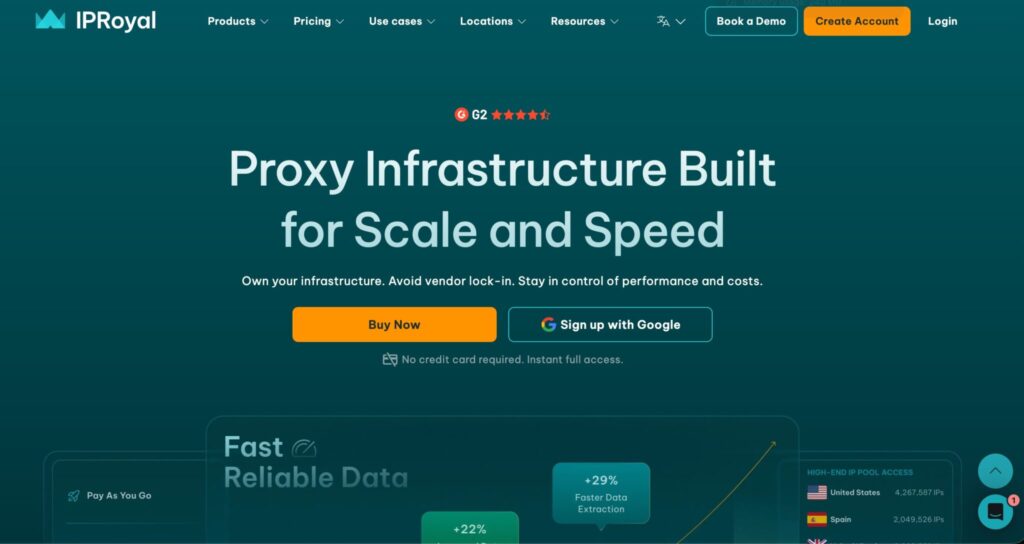
IPRoyal is a practical option for users who want real mobile proxy access without paying enterprise-level prices. Its documentation says rotating mobile proxies are billed per GB and rotate automatically on each request. It also describes mobile proxies as physical mobile devices with 3G, 4G, or 5G SIM cards.
IPRoyal’s mobile quick-start guide says its mobile proxies support HTTP/HTTPS and SOCKS5, country, state, and city-level geo-targeting, and custom rotation options.
That makes it attractive for smaller teams, freelancers, agencies, and users testing mobile workflows. It may not have the same enterprise polish as Bright Data or Oxylabs, but it offers enough for many real-world use cases.
Best use cases:
- Smaller scraping jobs
- Social media testing
- Localized app testing
- Budget SEO projects
- Automation experiments
- Solo developer workflows
Strengths:
- Affordable entry point
- HTTP/HTTPS and SOCKS5 support
- Custom rotation options
- Good for testing mobile proxy workflows
- Time-based and per-GB mobile options
Weaknesses:
- Smaller perceived enterprise footprint
- Not ideal for very complex global operations
- May require more manual testing for strict targets
Pro-Tip: IPRoyal works well when you need mobile IP authenticity but do not need a giant proxy platform. Start small, test success rates, then scale only where it performs.
6. Infatica: Best for Custom Rotation Logic
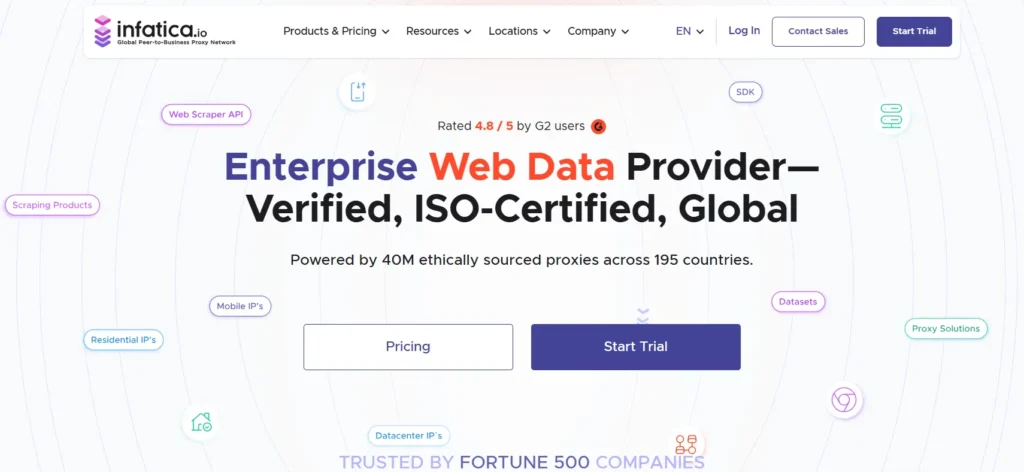
Infatica is useful for teams that care a lot about how mobile IPs rotate. Its mobile proxy documentation says users can choose timed rotation every 5, 10, 15, up to 60 minutes, rotation with each request, or sticky sessions.
That kind of rotation flexibility is valuable. Some websites punish too much rotation because every request looks like a new user. Others punish long sessions because one IP sends too many requests. Infatica gives you options to tune the balance.
Its official website lists mobile IPs from $1 to $8 per GB and mentions 5M+ mobile IP addresses, peer-to-business HTTP/SOCKS proxy access, IP rotation, and mobile ISPs.
Best use cases:
- Custom scraping workflows
- Timed rotation setups
- Mobile ISP testing
- Medium-scale data collection
- Projects requiring session tuning
Strengths:
- Flexible rotation periods
- Sticky, timed, and per-request options
- HTTP/SOCKS support
- Good fit for custom scripts
- Useful for teams that test rotation logic carefully
Weaknesses:
- Smaller listed mobile pool than some premium competitors
- Needs hands-on testing before heavy scaling
- Pricing range can vary depending on plan and volume
Pro-Tip: Infatica is worth testing when your main issue is not IP quantity, but rotation timing. A 10-minute sticky session can sometimes beat aggressive per-request rotation.
7. ProxyEmpire: Best for Geo-Targeted Mobile Campaigns
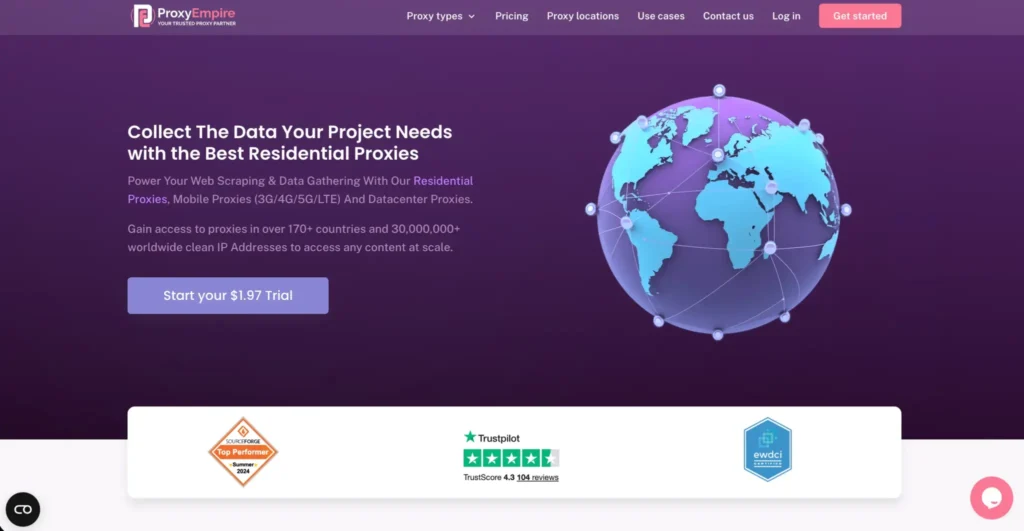
ProxyEmpire is known for strong location targeting and mobile proxy options. Its rotating mobile proxy page describes real 3G, 4G, 5G, and LTE mobile IPs that rotate on every request. It also lists rotating mobile plans from $9/GB at list price, with promotional discounts shown on the page at the time of checking.
Its pricing table includes rotating mobile, dedicated mobile, and custom plans. The same page lists dedicated mobile options such as USA 5G mobile proxies with access to locations in 38 states and rotate-on-demand functionality.
ProxyEmpire is worth considering for campaigns where location matters as much as IP type. For example, localized ad checks, regional SERP monitoring, marketplace testing, and country or city-specific app QA.
Best use cases:
- Geo-targeted ad verification
- Local SEO testing
- Region-specific scraping
- Marketplace monitoring
- Dedicated mobile proxy campaigns
Strengths:
- Rotating and dedicated mobile options
- Strong geo-focused positioning
- On-demand rotation on some dedicated plans
- Useful for regional campaigns
- Trial-style entry offers often available
Weaknesses:
- Discounted pricing may change
- Not always the cleanest fit for enterprise API teams
- Dedicated mobile plans can become expensive
Pro-Tip: ProxyEmpire is strongest when the campaign depends on geography. For broad scraping without strict geo needs, compare its cost per successful request against Decodo, SOAX, and DataImpulse.
8. DataImpulse: Best Low-Cost Mobile Proxy API Option
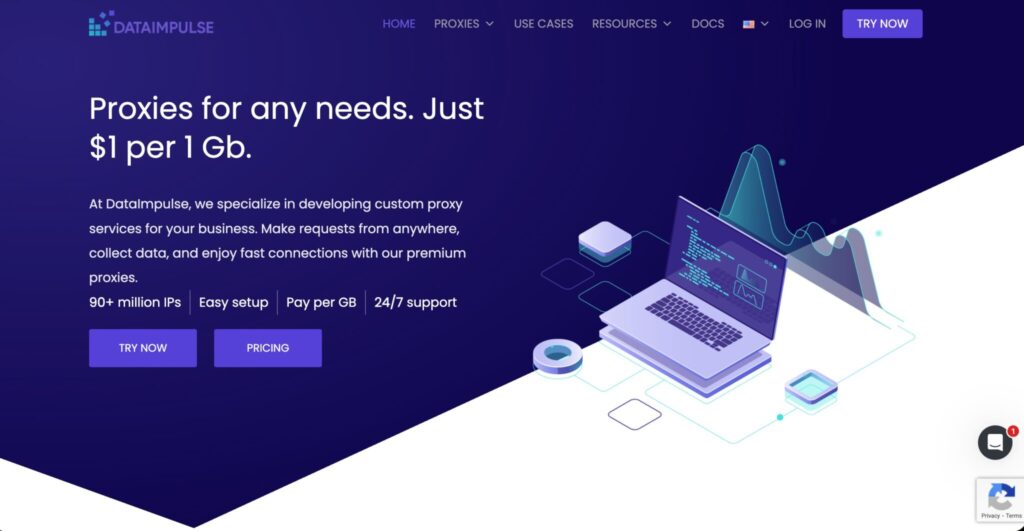
DataImpulse is one of the more interesting low-cost mobile proxy options. Its mobile proxy page lists 16M+ mobile IPs in 195 countries and pricing from $2 per GB.
The provider positions itself around simple setup, pay-per-GB pricing, and accessible proxy services. Its homepage also highlights 90M+ IPs across its broader proxy network and pricing from $1 per GB for general proxy services.
For mobile APIs, DataImpulse is best viewed as a cost-efficient option that deserves testing before production scaling. The pricing is attractive, but success depends on your target, concurrency, rotation configuration, and geographic needs.
Best use cases:
- Budget mobile scraping
- Testing mobile proxy viability
- Small data collection jobs
- Mobile SEO checks
- App and ad checks
- Cost-sensitive workflows
Strengths:
- Low entry price
- 16M+ listed mobile IPs
- 195-country coverage
- Simple pay-per-GB model
- Good for testing and cost control
Weaknesses:
- Less enterprise polish than premium providers
- Requires careful success-rate testing
- Support and tooling depth may matter for larger teams
Pro-Tip: DataImpulse is attractive on price, but do not judge it by cost alone. Track cost per successful request, not cost per GB.
How to Choose the Best Mobile Proxy API
Choosing a mobile proxy API is not like buying shared hosting. The cheapest plan can be the most expensive if half your requests fail. The biggest IP pool can also disappoint if targeting is weak or sessions break under load.
Here is the selection framework I would use.
1. Start With the Use Case, Not the Provider
Mobile proxies are expensive compared with datacenter and many residential proxies. Use them where they actually matter.
Good use cases for mobile proxy APIs include:
- Mobile app testing
- Ad verification on mobile networks
- SERP tracking from mobile locations
- Social platform QA
- Public web scraping on strict targets
- Marketplace testing
- Price monitoring where mobile view differs from desktop
- Localized testing by country, city, carrier, or ASN
Bad use cases include simple scraping targets, basic uptime checks, or pages that work fine with datacenter proxies. In those cases, mobile IPs are overkill.
2. Check the Mobile IP Pool Quality
Do not be impressed by IP pool size alone. Ask better questions:
- Are the IPs real mobile carrier IPs?
- Do they support 3G, 4G, LTE, or 5G routing?
- Can you target by country?
- Can you target by state or city?
- Can you target by carrier or ASN?
- Is the pool shared, dedicated, or mixed?
- Are IPs refreshed often?
- Does the provider disclose sourcing standards?
For example, Decodo lists 10M+ mobile IPs across 700+ carriers and 160+ locations. DataImpulse lists 16M+ mobile IPs in 195 countries. Infatica lists 5M+ mobile IPs on its site. Those numbers help, but you still need to test them against your actual target.
3. Understand Rotation Protocols
Rotation is where many mobile proxy projects succeed or fail.
There are three common rotation styles:
| Rotation Type | How It Works | Best For | Risk |
|---|---|---|---|
| Per-request rotation | New IP on each request | Scraping independent pages | Can break login or multi-step flows |
| Timed rotation | IP changes every set period | Browsing flows, testing, scraping batches | Too short or too long can reduce success |
| Sticky session | Same IP remains for a session window | Logins, carts, app flows, account-level tasks | Too many actions from one IP may trigger limits |
Decodo describes sticky sessions as keeping the same IP for a set time, while rotating sessions switch IPs with each request. Infatica supports timed rotation, per-request rotation, and sticky sessions. Oxylabs supports per-request rotation and 24-hour sticky sessions.
4. Look for Protocol Support
Most developers will want HTTP and HTTPS. SOCKS5 is useful when you need lower-level routing, browser tooling, messaging apps, or certain automation environments.
Oxylabs states that its mobile proxies support HTTP, HTTPS, and SOCKS5. IPRoyal’s quick-start guide also lists HTTP/HTTPS and SOCKS5 support for mobile proxies.
5. Test API Integration Before Buying Volume
Before committing to a large plan, run a simple benchmark:
- 1,000 requests to your target
- 3 countries if geo matters
- 3 session modes if available
- 3 concurrency levels
- Success rate tracking
- Median response time
- Block rate
- CAPTCHA rate
- Cost per successful request
This gives you real numbers. Provider marketing cannot replace this.
6. Measure Cost Per Successful Request
Mobile proxy pricing often looks simple: $2/GB, $5/GB, $8/GB. That is not the real cost.
Real cost looks like this:
Total proxy spend ÷ successful usable responses = cost per successful response
A $7/GB provider with a 95% success rate may beat a $2/GB provider with a 45% success rate. Especially if failed requests waste bandwidth, compute time, retries, and engineering hours.
7. Check Compliance and Usage Rules
Use mobile proxy APIs for legitimate workflows: public data collection, app QA, ad verification, SEO monitoring, price tracking, and internal testing. Avoid anything involving account abuse, credential attacks, spam, fraud, or bypassing access controls.
Premium providers often require KYC or usage approval for a reason. It protects the network and reduces abuse.
Best Mobile Proxy API by Use Case
| Use Case | Best Pick | Why |
|---|---|---|
| Enterprise web data collection | Bright Data | Strong controls, large infrastructure, advanced rotation |
| Premium mobile scraping | Oxylabs | Stable, polished, strong sticky session support |
| Best value for most teams | Decodo | Good balance of price, usability, and mobile coverage |
| Mixed proxy workflows | SOAX | Credits can work across proxy types and Web Data API |
| Budget mobile testing | IPRoyal | Affordable, simple, supports key protocols |
| Custom rotation tuning | Infatica | Timed, per-request, and sticky rotation options |
| Geo-targeted campaigns | ProxyEmpire | Strong location-focused mobile proxy positioning |
| Low-cost API testing | DataImpulse | $2/GB mobile starting point and large listed mobile pool |
Technical Setup: How Mobile Proxy APIs Usually Work
A typical mobile proxy API setup looks like this:
- Create an account.
- Choose mobile proxy plan.
- Select location or carrier targeting.
- Generate proxy credentials.
- Pick rotation mode.
- Add proxy host, port, username, and password to your script or browser.
- Send requests through the proxy gateway.
- Monitor bandwidth, errors, and success rates.
A basic Python request flow may look like this:
import requests

proxy_host = "proxy-provider-host"
proxy_port = "12345"
username = "your-username-session-abc123"
password = "your-password"

proxies = {"http": f"http://{username}:{password}@{proxy_host}:{proxy_port}",
    "https": f"http://{username}:{password}@{proxy_host}:{proxy_port}",}

response = requests.get("https://example.com", proxies=proxies, timeout=30)
print(response.status_code)
print(response.text[:500])
For sticky sessions, many providers let you add a session ID inside the username string. For example:
username-country-us-session-mytest123The format changes by provider, but the idea is the same: the provider sees the session token and tries to keep the same mobile IP for that session window.
Common Mistakes When Buying Mobile Proxy APIs
Using Mobile Proxies for Everything
Mobile IPs are powerful, but expensive. Route only the traffic that needs mobile trust. Use datacenter or residential proxies for easier targets.
Rotating Too Often
Per-request rotation sounds safer, but it can look unnatural for multi-step workflows. If one user loads a page, clicks, adds to cart, and submits a form, the IP should usually stay stable.
Ignoring Headers and Fingerprints
Your IP is only one signal. If your TLS fingerprint, user agent, cookies, device profile, and behavior look wrong, a mobile IP will not save you.
Not Testing by Country
A provider may perform well in the US but poorly in Germany, Brazil, India, or Japan. Always test the exact regions you need.
Buying Based on IP Pool Size Alone
A giant pool with poor targeting or unstable sessions can underperform a smaller pool with cleaner routing.
FAQs About Mobile Proxy APIs
1. What is the best mobile proxy API overall?
For enterprise-level control, Bright Data is the strongest overall choice. For premium data operations, Oxylabs is excellent. For most small to mid-sized teams, Decodo offers one of the best mixes of usability, pricing, and mobile proxy features.
2. Are mobile proxies better than residential proxies?
Mobile proxies are usually better for mobile-first platforms, app testing, ad verification, and strict targets where carrier IP trust matters. Residential proxies are often cheaper and better for broader scraping tasks. The best setup often uses both.
3. What is the difference between rotating and sticky mobile proxies?
Rotating mobile proxies change IPs per request or at intervals. Sticky mobile proxies keep the same IP for a set session period. Sticky sessions are better for logins, forms, carts, and multi-step tasks. Rotating sessions are better for independent scraping requests.
4. Do mobile proxy APIs support SOCKS5?
Many do, but not all. Oxylabs and IPRoyal both list SOCKS5 support for mobile proxies. Always check this before buying if your tool requires SOCKS5.
5. Why are mobile proxies expensive?
Mobile proxies depend on real carrier networks, mobile IP routing, device or SIM-based infrastructure, and limited clean inventory. That makes them more expensive than datacenter proxies and often more expensive than residential proxies.
6. Can I use mobile proxy APIs for SEO rank tracking?
Yes, mobile proxy APIs are useful for mobile SERP tracking, local search checks, and location-specific SEO monitoring. They are especially useful when desktop and mobile results differ.
7. Which mobile proxy API is best for beginners?
Decodo and IPRoyal are easier starting points for most beginners. Decodo has a cleaner balance of usability and scale, while IPRoyal is attractive for budget-conscious users.
8. Which provider has the cheapest mobile proxy API?
DataImpulse lists mobile proxy pricing from $2/GB, and Decodo lists mobile proxy plans starting from $2.25/GB. However, cheapest does not always mean lowest real cost. Always test cost per successful request.
9. Are mobile proxy APIs legal?
Mobile proxy APIs can be legal when used for legitimate purposes such as public data collection, testing, ad verification, SEO monitoring, and research. Misuse can violate laws, contracts, or platform terms. Stay within approved use cases and respect access rules.
Final Verdict: Which Mobile Proxy API Should You Choose?
Pick Bright Data if you need enterprise-level controls, advanced targeting, and production-grade infrastructure.
Pick Oxylabs if you want premium mobile proxy reliability with strong sticky session support and clean protocol options.
Pick Decodo if you want the best practical balance for most teams: good pricing, easy setup, mobile carrier coverage, and simple session control.
Pick SOAX if your workflow needs mobile, residential, ISP, and datacenter proxies under one flexible setup.
Pick IPRoyal if you want affordable mobile proxy access for smaller workflows.
Pick Infatica if rotation control is your main technical requirement.
Pick ProxyEmpire if geo-targeted mobile campaigns matter most.
Pick DataImpulse if you want low-cost mobile proxy API access and are willing to test performance carefully before scaling.
The smartest buying move is simple: shortlist two premium providers and one budget provider, run the same test against your real target, and compare success rate, latency, block rate, and cost per successful response. Mobile proxy APIs are not won on landing-page claims. They are won in your logs.