
Best Mobile Proxy Networks.
Mobile proxies sit in a strange little corner of the proxy market. Everyone wants them because they look more natural than datacenter IPs, often perform better on mobile-first platforms, and give you access to real carrier-grade IP ranges. At the same time, they are not cheap, not always easy to benchmark, and not every provider is clear about how much control you actually get.
That is where most buyers make mistakes.
They look at one headline number, usually the size of the IP pool, then pick the provider with the biggest claim. That sounds logical, but it is not enough. A mobile proxy network with 20 million IPs can still be the wrong fit if it gives you weak session control, limited carrier targeting, poor dashboard visibility, or unpredictable costs.
On the other hand, a smaller dedicated mobile proxy setup can beat a huge rotating pool if your workflow needs stable sessions, repeatable logins, app testing, or account management.
The better question is not “Which mobile proxy provider has the most IPs?” It is “Which network gives me the right mix of mobile IP quality, rotation control, targeting depth, protocol support, speed, and pricing for my use case?”
That is exactly what this guide covers.
Quick Verdict: Best Mobile Proxy Networks by Use Case
| Use Case | Best Pick | Why It Fits |
|---|---|---|
| Enterprise-scale scraping and data collection | Oxylabs | Large mobile IP pool, 140+ countries, ASN/city targeting, strong uptime claims. |
| Premium compliance-focused teams | Bright Data | Strong infrastructure, 7M+ mobile IPs listed in docs, deep targeting controls, mature tooling. |
| Balanced price and usability | Decodo | Mobile plans start from $2.25/GB with self-serve setup and flexible plan sizes. |
| Geo-targeting and mobile-heavy workflows | SOAX | Mobile proxy page lists 33M+ 3G/4G/5G/LTE IPs in 195+ locations and a low-cost trial. |
| Large teams needing mobile and residential in one stack | NetNut | Lists 5M+ mobile IPs, 100 countries, 3G/4G/5G/LTE support, and bandwidth-based plans. |
| Dedicated mobile proxy users | IPRoyal | Offers dedicated mobile proxy pricing by duration, starting from daily and monthly plans. |
| Rollover bandwidth and flexible mobile plans | ProxyEmpire | Rotating mobile plans are listed by GB, with dedicated mobile packages also available. |
| Budget mobile proxy testing | Infatica | Lists mobile IPs from $1 to $8 per GB and a 7-day mobile trial. |
| US-based 4G/5G proxy infrastructure | Proxidize | Offers US 4G/5G mobile proxies, dozens of locations, SOCKS5 support, and fair-usage unlimited data. |
What Is a Mobile Proxy Network?
A mobile proxy network routes your traffic through IP addresses assigned by mobile carriers. These IPs usually come from 3G, 4G, LTE, or 5G networks. In practical terms, your connection appears to come from a real mobile device or carrier network rather than a cloud server.
That matters because many websites, apps, and ad platforms treat mobile carrier IPs differently from datacenter IPs. Mobile IPs are harder to classify as “proxy traffic” because carriers often use carrier-grade NAT, where many real users share overlapping public IP ranges. This does not make mobile proxies magic. It simply means they tend to carry higher trust signals when used responsibly.
The best mobile proxy networks usually give you:
- Rotating mobile IPs
- Sticky sessions
- Country, city, carrier, or ASN targeting
- HTTP, HTTPS, and sometimes SOCKS5 support
- API or dashboard-based proxy control
- Bandwidth-based or per-port pricing
- Session refresh options
Pro Tip: Do not buy mobile proxies just because they sound stronger. If your target does not require mobile IP trust, residential or ISP proxies may cost less and run more predictably.
Massive Comparison Table: Best Mobile Proxy Networks
| Provider | Best For | Mobile Pool / Coverage | Rotation Control | Protocols | Pricing Snapshot | Main Strength | Main Limitation |
|---|---|---|---|---|---|---|---|
| Oxylabs | Enterprise data collection | 20M+ mobile IPs, 140+ countries | Rotating sessions, geo filters, ASN targeting | HTTP(S), SOCKS5 support noted across proxy stack | Starter mobile plan lists 4GB at $7.50/GB, billed $30 monthly | Very strong targeting and scale | Premium pricing for smaller users |
| Bright Data | Compliance-heavy enterprises | Docs list 7M mobile IPs | Advanced session and geo controls | Proxy Manager supports SOCKS5 with proxy setup | Public pricing varies by proxy product and account setup | Mature tooling and compliance controls | May require more setup than beginner tools |
| Decodo | Value and ease of use | Mobile proxy product with self-serve plans | Rotating and session-based usage | Works with common apps and integrations | Starts from $2.25/GB, listed regular plans include 2GB, 8GB, 25GB, 50GB | Strong balance of price and simplicity | Less enterprise-heavy than Oxylabs or Bright Data |
| SOAX | Precise mobile targeting | 33M+ IPs, 195+ locations | Rotation and targeting controls | Standard proxy integrations | 3-day 400MB trial for $1.99 | Strong mobile focus and geo coverage | Can become costly at high volume |
| NetNut | Large mixed proxy operations | 5M+ mobile IPs, 100 countries | Auto-rotating mobile IPs | HTTP/HTTPS/SOCKS5 listed across proxy offering | Annual starter mobile plan lists 13GB at $6.46/GB | Good fit for teams using multiple proxy types | Entry plans are not the cheapest |
| IPRoyal | Dedicated mobile sessions | Dedicated mobile proxy product | Duration-based dedicated mobile access | Common proxy tool compatibility | Starts from $10.11/day or $130/month | Easy for account-based workflows | Less ideal for huge rotating scraping jobs |
| ProxyEmpire | Flexible mobile buyers | Rotating and dedicated mobile products | On-demand IP rotation in dedicated packages | Common proxy integrations | Rotating mobile pay-as-you-go listed from $4.50/GB promo price | Good plan variety and rollover angle | Published discounts may change often |
| Infatica | Trial-based testing | 5M+ mobile IPs listed | IP rotation and mobile ISPs | HTTP/SOCKS support across platform | Mobile IPs listed from $1 to $8 per GB, 7-day trial for $8 | Affordable testing path | Fewer advanced public details than top enterprise providers |
| Proxidize | US mobile proxy infrastructure | US-based 4G/5G physical device network | Rotation controls, fair usage model | HTTP(S) and SOCKS5 support | Starts from $2/GB or $59 per proxy on pricing page | Strong for US mobile workflows | Mainly US-focused compared with global pools |
Detailed Reviews of the Best Mobile Proxy Networks
1. Oxylabs
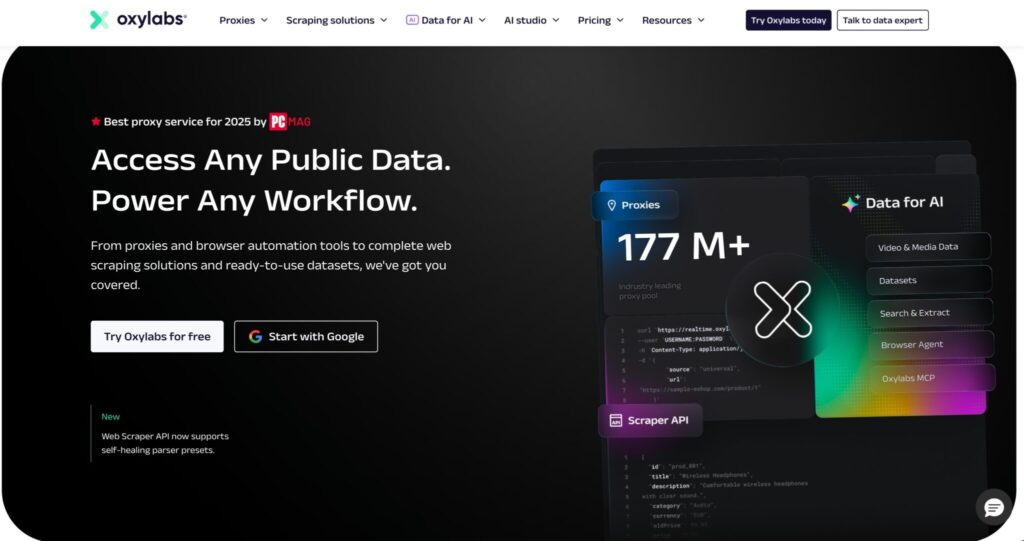
Oxylabs is one of the strongest picks for companies that need mobile proxies at scale. Its mobile proxy page lists 20M+ mobile IPs across 140+ countries, with filtering by continent, country, state, city, coordinates, and ASN. That level of targeting is useful if you run location-sensitive checks, ad verification, public data collection, or mobile SERP monitoring.
The pricing is not bargain-bin cheap, but it is clear. Oxylabs lists mobile proxy plans starting with 4GB at $7.50/GB, billed $30 monthly, and larger plans with lower per-GB rates. The Advanced plan lists 100GB at $5/GB, while higher-volume plans drop further.
What makes Oxylabs stand out is the infrastructure maturity. You get strong targeting options, enterprise-grade support, and proxy products that fit into larger web data workflows. It is not the provider I would pick for a tiny one-off test, but it makes sense when reliability matters more than shaving a few dollars off the invoice.
Best for: Enterprise scraping, ad verification, market research, large mobile datasets.
Pro Tip: Use Oxylabs when you need location accuracy and clean reporting, not when your only goal is the lowest possible mobile proxy cost.
2. Bright Data
Bright Data is usually discussed as a premium proxy infrastructure provider rather than a simple mobile proxy seller. Its documentation lists a mobile proxy network with 7M mobile IPs worldwide, and its proxy pricing page highlights mobile proxy features such as city, ASN, and ZIP code targeting, session control, Proxy Manager, API access, and SOCKS5 support through Proxy Manager.
The biggest reason to consider Bright Data is control. If your team cares about compliance, auditability, user permissions, dashboards, and technical documentation, Bright Data feels more like infrastructure than a basic proxy rental service. That is a good thing for mature teams.
The tradeoff is complexity. Beginners may find the setup heavier than Decodo, IPRoyal, or ProxyEmpire. Pricing and product availability can also vary depending on account type and selected proxy product, so it is worth checking the dashboard or sales page before planning long-term costs.
Best for: Data teams, compliance-heavy workflows, enterprise operations, advanced proxy routing.
Pro Tip: Bright Data is strongest when you have technical staff who can use its controls properly. If you only need five mobile IPs for a small workflow, it may be more platform than you need.
3. Decodo
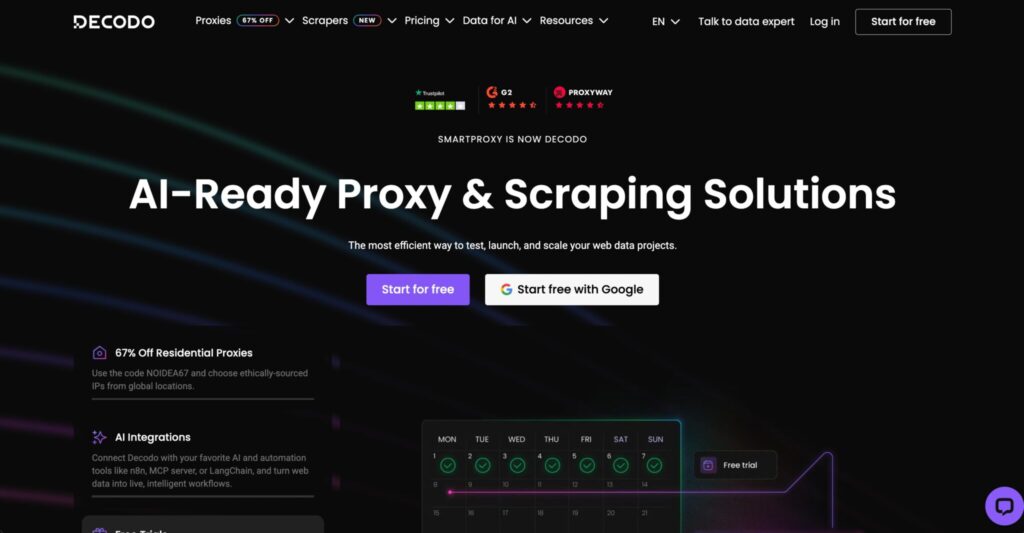
Decodo, formerly Smartproxy, is one of the easiest mobile proxy networks to recommend for buyers who want a clean balance of price, usability, and scale. Its mobile proxy pricing page lists plans starting at $2.25/GB, with smaller regular plans such as 2GB, 8GB, 25GB, and 50GB shown on the pricing table.
The appeal is simple: Decodo does not feel overly enterprise-only. You can start smaller, test your target, check your success rate, then scale if the economics work. That makes it especially useful for agencies, SEO teams, app testers, and mid-sized scraping teams that need mobile IPs but do not want a long sales process.
Decodo is also known for being beginner-friendly compared with some premium infrastructure providers. You may not get the same deep enterprise controls as Bright Data, but the learning curve is smoother.
Best for: Agencies, mid-sized data projects, SEO monitoring, app QA, mobile-first testing.
Pro Tip: Decodo is a strong first serious mobile proxy provider because you can test without locking yourself into a huge plan.
4. SOAX
SOAX has built a strong reputation around geo-targeted proxy access, and its mobile proxy page lists 33M+ 3G/4G/5G/LTE mobile IPs across 195+ locations. It also advertises a 3-day 400MB trial for $1.99, which is useful if you want to test connection quality before buying a larger plan.
SOAX is a good fit when targeting matters. If you need to test mobile views across countries, cities, or networks, SOAX gives you a practical toolset. It is often chosen by teams working on ad verification, mobile SEO checks, price monitoring, and public data collection.
The main caution is cost control. Mobile proxies can burn bandwidth quickly, especially if you pull heavy pages, images, app assets, or JavaScript-heavy sites. SOAX can work well, but you should run a small pilot and estimate GB usage before scaling.
Best for: Geo-targeted mobile testing, ad verification, mobile SEO, localized data checks.
Pro Tip: Before scaling SOAX, measure bandwidth per successful task, not just bandwidth per request. Failed or repeated tasks are where mobile proxy budgets quietly leak.
5. NetNut
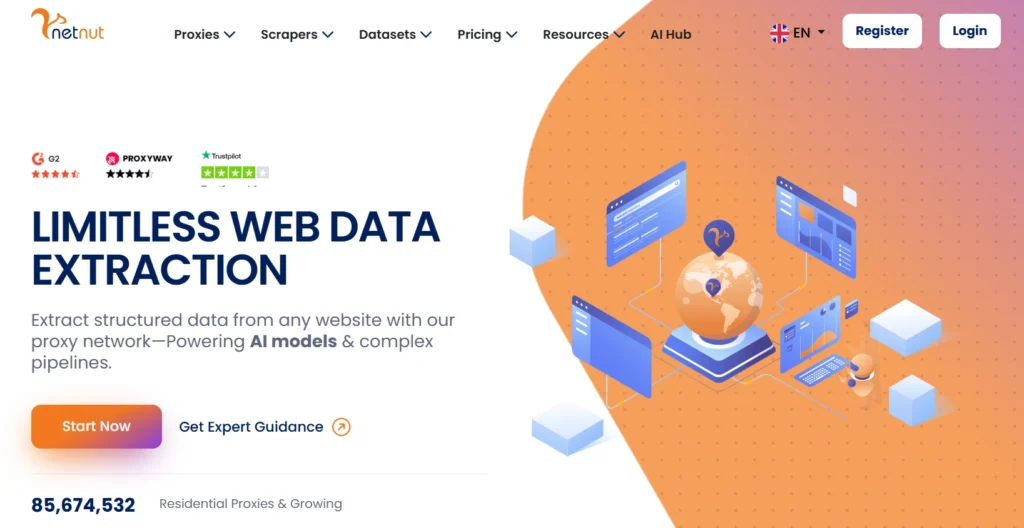
NetNut is a strong option for teams that need both residential and mobile proxy coverage. Its official site lists 85M+ residential IPs and 5M mobile IPs across 100 countries, with 3G/4G/5G/LTE support.
The mobile proxy pricing page lists multiple bandwidth-based plans. For example, the annual starter mobile plan shows 13GB at $6.46/GB, while larger annual plans reduce the per-GB cost. Monthly plans are also listed, but at higher per-GB rates.
NetNut makes sense if your team wants one provider for several proxy types. You may use residential proxies for broad scraping, ISP proxies for longer stable sessions, and mobile proxies only where mobile carrier trust is needed. That blended approach often keeps costs healthier than sending every request through mobile IPs.
Best for: Teams using multiple proxy types, data collection, ad verification, larger proxy operations.
Pro Tip: Do not route all traffic through NetNut mobile proxies by default. Use mobile only for targets where residential or ISP proxies underperform.
6. IPRoyal
IPRoyal takes a different approach from pure rotating mobile pool providers. Its mobile proxy pricing page lists dedicated mobile proxy access by duration, with 24-hour plans starting from $10.11/day and 30-day plans starting from $130/month. Longer 60-day and 90-day plans show lower monthly equivalents.
That makes IPRoyal interesting for workflows where stability matters more than huge rotation volume. Think account management, mobile app testing, social media workflows, and cases where a consistent mobile identity is useful.
It is not the first provider I would choose for massive public web scraping. Dedicated mobile proxies can be expensive if you need thousands of fresh IPs per day. But for stable sessions, IPRoyal gives you a cleaner buying model than many bandwidth-only providers.
Best for: Dedicated mobile sessions, account workflows, mobile app checks, small teams.
Pro Tip: If your workflow needs the same mobile identity for hours or days, dedicated mobile proxies can outperform rotating pools, even if the headline pool size looks smaller.
7. ProxyEmpire
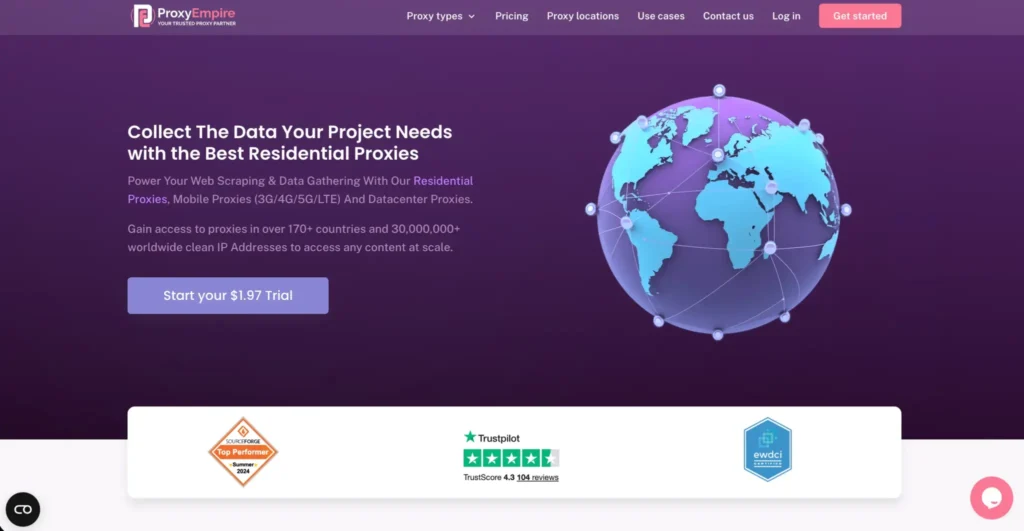
ProxyEmpire offers both rotating mobile proxies and dedicated mobile proxy packages. Its pricing table lists rotating mobile plans, including pay-as-you-go and larger GB bundles, while its dedicated mobile proxy page mentions packages with on-demand IP rotation.
One useful angle is flexibility. ProxyEmpire tends to appeal to buyers who want several proxy types, plan sizes, and targeting options without immediately jumping into an enterprise contract. The rotating mobile plans are easier to understand if you prefer paying by bandwidth, while dedicated packages are better when you want more control.
The caution is that displayed discounts and promotional pricing can change. Always check the active checkout price before comparing it against Decodo, SOAX, or NetNut.
Best for: Flexible mobile proxy buying, mixed proxy users, agencies, rollover-conscious buyers.
Pro Tip: ProxyEmpire is worth testing when you need mobile proxies but want both rotating and dedicated options under one provider.
8. Infatica
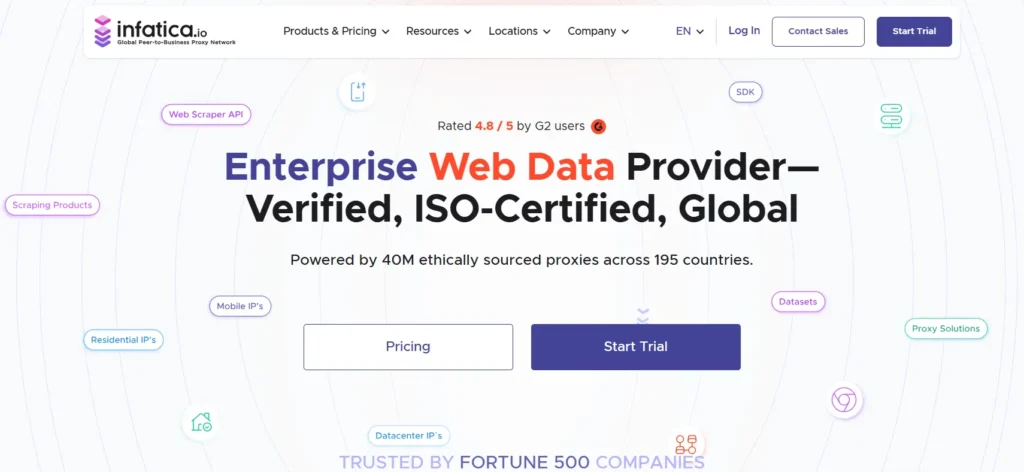
Infatica is a practical option for users who want to test mobile proxies without a huge upfront commitment. Its site lists mobile IPs from $1 to $8 per GB, 5M+ IP addresses, IP rotation, mobile ISPs, and a 7-day trial for $8.
The main appeal is affordability and trial access. If you are still validating your target, use case, or bandwidth requirements, Infatica gives you a lower-friction way to test mobile proxy behavior.
That said, Infatica may not be the strongest choice for enterprise buyers who need deep targeting documentation, dedicated account architecture, or heavy compliance workflows. It is better for smaller to mid-sized users who want usable mobile proxies without getting buried in complex setup.
Best for: Budget testing, smaller scraping projects, mobile proxy trials, flexible GB usage.
Pro Tip: Use Infatica to validate whether mobile proxies actually improve your success rate before upgrading to a larger provider.
9. Proxidize
Proxidize is different from many global rotating pool providers because it focuses heavily on mobile proxy infrastructure and US-based 4G/5G access. Its mobile proxy page lists real carrier IPs from physical devices, dozens of US locations, up to 150 Mbps depending on plan, fair-usage unlimited data, and a 30-day money-back guarantee.
Its pricing page says mobile proxy plans start from $2/GB or $59 per proxy, which gives buyers a choice between bandwidth-based and per-proxy style planning.
Proxidize is especially interesting if you need US mobile IPs and want more infrastructure-style control. It is not necessarily the best fit if you need a huge global footprint across 100+ countries, but for US workflows, it deserves a serious look.
Best for: US mobile proxy workflows, 4G/5G testing, dedicated infrastructure buyers.
Pro Tip: Proxidize is a better fit for controlled mobile environments than broad global scraping where you need many countries.
How to Choose the Best Mobile Proxy Network
1. Start with the IP Pool, But Do Not Stop There
A large IP pool helps, but it does not guarantee success. You need to know how often the same IP repeats, how clean the pool is, whether the IPs are real mobile carrier IPs, and how much targeting control you get.
Ask these questions:
- How many mobile IPs are active monthly?
- Which countries and carriers are supported?
- Can I target by city, ASN, carrier, or ZIP code?
- Does the provider publish uptime or success-rate claims?
- Are IPs peer-sourced, SIM-based, carrier-based, or mixed?
For example, Oxylabs emphasizes 20M+ mobile IPs and 140+ countries, while SOAX lists 33M+ mobile IPs and 195+ locations. Those numbers are useful, but the better provider depends on your target countries, budget, and session rules.
2. Understand Rotation Protocols
Rotation decides how often your IP changes. This is one of the most important buying factors.
Common rotation modes include:
- Per request rotation: Every request may use a new IP.
- Timed rotation: IP changes after a set period, such as 1, 5, 10, or 30 minutes.
- Sticky sessions: You keep the same IP for a defined session.
- On-demand rotation: You manually request a new IP.
- Dedicated mobile rotation: You control rotation on a dedicated mobile device or port.
For scraping public pages, rotating sessions often work well. For account management, app testing, checkout flows, dashboards, or login-based tasks, sticky sessions are safer and more stable.
Pro Tip: If a provider only says “rotating mobile proxies” but does not explain session length, ask support before buying.
3. Check Protocol Support
Most mobile proxy users need HTTP and HTTPS. SOCKS5 matters if you run browser automation, apps, custom tools, Telegram-style workflows, or traffic that does not behave like standard web requests.
Providers such as Bright Data, NetNut, Proxidize, and Proxy-Seller mention SOCKS5 or HTTP(S)/SOCKS support across their proxy products or mobile proxy pages.
4. Compare Pricing by Successful Task, Not Just Price per GB
Mobile proxies are expensive because mobile bandwidth is expensive. A provider at $3/GB can cost more than a provider at $7/GB if the cheaper provider has lower success rates and forces more retries.
Track these metrics during testing:
- GB used per 1,000 successful tasks
- Failure rate
- Average response time
- CAPTCHA or challenge rate
- Repeat IP frequency
- Session drop rate
- Cost per completed workflow
This gives you a real buying metric. Price per GB is only the starting point.
5. Match Provider Type to Workflow
Here is the simple version:
- Need huge scale? Choose Oxylabs, Bright Data, SOAX, or NetNut.
- Need value and easy setup? Choose Decodo or Infatica.
- Need dedicated sessions? Choose IPRoyal, ProxyEmpire dedicated mobile, Proxy-Seller, or Proxidize.
- Need US mobile infrastructure? Choose Proxidize.
- Need flexible rotating mobile by GB? Choose Decodo, ProxyEmpire, SOAX, Infatica, or NetNut.
Mobile Proxies vs Residential Proxies
Mobile proxies use carrier-assigned mobile IPs. Residential proxies use IPs assigned to home internet users. Both can look like real user traffic, but they behave differently.
Mobile proxies usually cost more and offer stronger trust on mobile-first platforms. Residential proxies are usually cheaper, easier to scale, and better for broad public web collection. ISP proxies sit somewhere else entirely: they are static, fast, and stable, but not mobile.
Use mobile proxies when the target environment is mobile-sensitive. Use residential proxies when you need broad coverage at lower cost. Use ISP proxies when you need long sessions and speed.
FAQs About Mobile Proxy Networks
1. What is the best mobile proxy network overall?
Oxylabs is the strongest overall pick for enterprise users because it lists 20M+ mobile IPs, 140+ countries, ASN targeting, and clear uptime claims. Decodo is the better balanced pick for buyers who want easier setup and lower entry pricing.
2. Are mobile proxies better than residential proxies?
Not always. Mobile proxies are better when you need mobile carrier IP trust, app testing, mobile ad verification, or mobile-first access. Residential proxies are usually better for broad scraping because they cost less and offer larger general-purpose pools.
3. Why are mobile proxies expensive?
Mobile proxies rely on carrier-grade mobile networks, real mobile devices, SIM-based infrastructure, or peer-based mobile access. That makes supply more limited and operationally expensive compared with datacenter or regular residential proxies.
4. What is a sticky session in mobile proxies?
A sticky session keeps the same mobile IP for a set time. This helps when your workflow needs continuity, such as logging into an account, testing a mobile app session, or completing a multi-step process.
5. Should I choose rotating or dedicated mobile proxies?
Choose rotating mobile proxies for public data collection, monitoring, and large-scale checks. Choose dedicated mobile proxies when you need stable sessions, account workflows, or manual control over when the IP changes.
6. Which mobile proxy provider is best for beginners?
Decodo is beginner-friendly because it offers self-serve mobile proxy plans starting from $2.25/GB. IPRoyal is also simple if you want dedicated mobile proxy access by day or month.
7. Which provider has the largest mobile proxy pool?
SOAX lists 33M+ mobile IPs, while Oxylabs lists 20M+ mobile IPs. Pool size is useful, but targeting, success rate, speed, and rotation control matter just as much.
8. Can mobile proxies support SOCKS5?
Some providers support SOCKS5 directly or through their proxy tools. Bright Data mentions SOCKS5 with Proxy Manager, Proxidize lists HTTP(S) and SOCKS5 support, and NetNut lists HTTP/HTTPS/SOCKS5 across its proxy offering.
9. What is the cheapest mobile proxy network?
Among the providers checked, Proxidize lists mobile pricing from $2/GB, Decodo lists plans starting from $2.25/GB, and Infatica lists mobile IPs from $1 to $8 per GB. Actual cost depends on bandwidth, country, plan type, and success rate.
Final Verdict: Which Mobile Proxy Network Should You Pick?
- If you want the most enterprise-ready mobile proxy network, start with Oxylabs. It has the strongest mix of scale, targeting, and commercial maturity for serious data operations.
- If you want a premium infrastructure platform with advanced controls, consider Bright Data, especially if your team already works with proxy managers, APIs, and compliance workflows.
- If you want the best balance between price, setup, and usability, Decodo is the safest middle-ground choice.
- If your project depends heavily on geo-targeted mobile testing, SOAX is worth testing early.
- If you want dedicated mobile sessions rather than a giant rotating pool, look at IPRoyal, ProxyEmpire, Proxy-Seller, or Proxidize.
The smartest move is simple: shortlist two providers, run the same workflow on both, measure cost per successful task, and then scale the winner. Mobile proxy buying gets much easier when you stop comparing marketing claims and start comparing real output.