
Best Proxies For AI Dataset Collection.
AI teams do not fail at dataset collection because they lack crawlers. They fail because the collection layer breaks under pressure.
A few thousand requests may work fine from a local machine. Then the same pipeline scales to millions of pages, multiple geos, JavaScript-heavy sites, rate limits, fingerprint checks, region-specific content, redirects, and CAPTCHA walls. Suddenly, the dataset is full of gaps, duplicate entries, soft blocks, wrong regional pages, and half-loaded HTML.
That is where proxies become more than a scraping accessory. For AI dataset collection, the proxy layer controls coverage, reliability, bias reduction, and repeatability. Good proxies help you collect cleaner public web data across markets, devices, and network types. Bad proxies quietly poison your dataset.
This guide compares the best proxy providers for AI dataset collection, focusing on IP pools, rotation controls, session handling, geo-targeting, compliance posture, and real-world usability for large-scale data workflows.
Quick Comparison Table: Best Proxies For AI Dataset Collection
| Provider | Best For | Proxy Types | IP Pool Strength | Rotation Controls | Geo Targeting | Scraping/API Tools | Main Limitation |
|---|---|---|---|---|---|---|---|
| Bright Data | Enterprise AI data pipelines | Residential, mobile, ISP, datacenter | Very large global pool | Strong session and rotation options | Country, city, carrier, ASN | Web Unlocker, datasets, scraping tools | Expensive for small teams |
| Oxylabs | High-volume public data collection | Residential, datacenter, ISP, mobile | Large premium pool | Advanced rotation and sticky sessions | Strong global coverage | Web Unblocker, Scraper APIs | Premium pricing |
| Decodo | Balanced price and scale | Residential, mobile, datacenter, ISP | Large ethically sourced pool | Flexible rotation and sessions | 195+ locations | Web Scraping API | Some advanced use cases need tuning |
| SOAX | Clean geo-targeted scraping | Residential, mobile, ISP, datacenter | Strong global pool | Precise rotation settings | Country, region, city, ISP | Web Data API | Can get costly at volume |
| NetNut | Stable enterprise collection | Residential, mobile, datacenter, ISP | Large direct ISP-style network | Good session control | Global targeting | Scraping tools and account support | Less beginner-focused |
| IPRoyal | Budget-conscious AI teams | Residential, datacenter, ISP, mobile | Medium to large pool | Basic to solid rotation | Broad country targeting | Proxy-focused stack | Not as advanced as enterprise tools |
| Webshare | Affordable proxy infrastructure | Residential, static residential, datacenter | Large residential pool | Simple rotation | Country targeting | API and dashboard | Fewer managed scraping features |
| Zyte | Teams wanting managed extraction | Smart proxy and scraping API | API-managed access | Automated access management | Target-dependent | Zyte API with rendering and extraction | Less suited if you only want raw proxies |
| Rayobyte | Datacenter-heavy datasets | Datacenter, ISP, residential | Strong datacenter inventory | Rotation available | Useful country coverage | Scraping and proxy tools | Residential pool smaller than top giants |
1. Bright Data
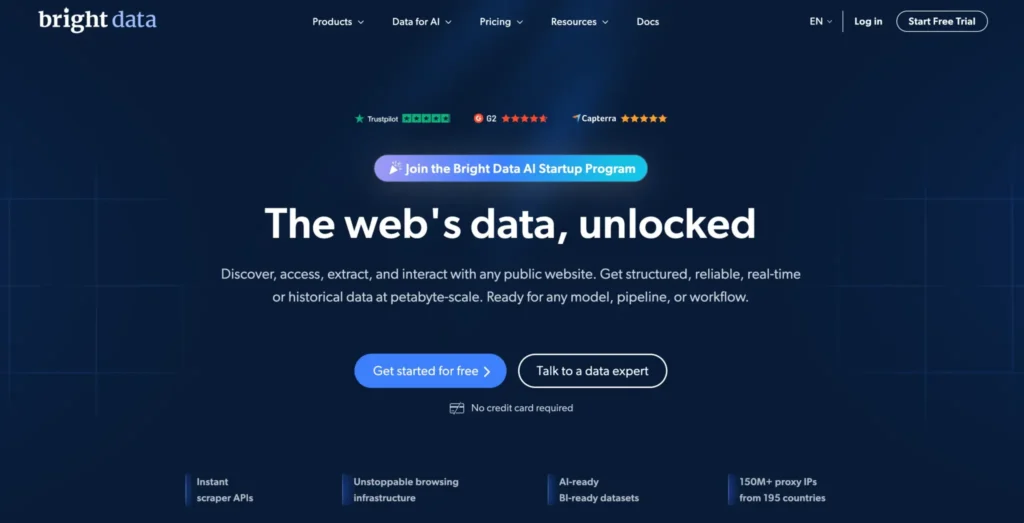
Bright Data is one of the strongest choices for serious AI dataset collection, especially when the project requires wide geographic coverage, multiple proxy types, and advanced scraping infrastructure beyond raw IP access.
Its biggest advantage is depth. You can use residential proxies for distributed public web collection, mobile proxies for mobile-specific content, ISP proxies for stable sessions, and datacenter proxies for faster, lower-cost collection on less protected targets. For AI teams building multilingual datasets, search datasets, ecommerce corpora, travel datasets, job market datasets, or local SERP datasets, that flexibility matters.
Bright Data also offers tools around the proxy layer, including web unlocking, scraping APIs, and ready-made datasets. That makes it useful for teams that do not want to build every part of the collection stack internally.
Pro-Tip: Use Bright Data’s residential network for hard targets and datacenter or ISP proxies for predictable sources. This keeps cost under control while protecting dataset coverage.
The main drawback is price and complexity. Small teams may find the dashboard, rules, zones, and compliance checks heavy at first. For enterprise-scale AI data operations, though, it is one of the most complete options.
2. Oxylabs
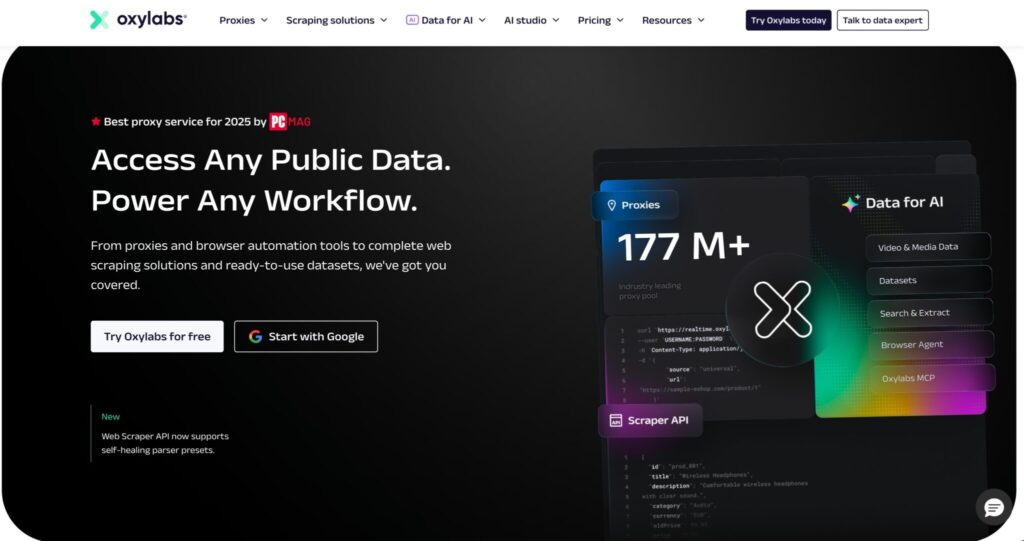
Oxylabs is built for large-scale data collection. It fits AI teams that need dependable proxy infrastructure, strong account support, and scraping products that reduce engineering workload.
Its residential proxy network is large, and its datacenter proxy inventory is especially useful when collecting from sources that do not need residential-grade access. Oxylabs also offers Web Unblocker and scraping APIs, which can handle parts of the anti-bot and rendering problem for you.
For AI dataset collection, Oxylabs works well when the data pipeline needs consistency. Think product intelligence datasets, public search data, pricing datasets, review datasets, or market monitoring feeds. You can combine rotation, sessions, and geo-targeting to reduce blocks while keeping collection patterns stable enough for repeatable data jobs.
Pro-Tip: For recurring AI training datasets, keep a stable configuration per source. Changing rotation rules too often can introduce collection variance that later shows up as messy training data.
Oxylabs is not the cheapest provider. It is best for teams that care more about success rate, account support, and long-term reliability than squeezing every gigabyte to the lowest price.
3. Decodo
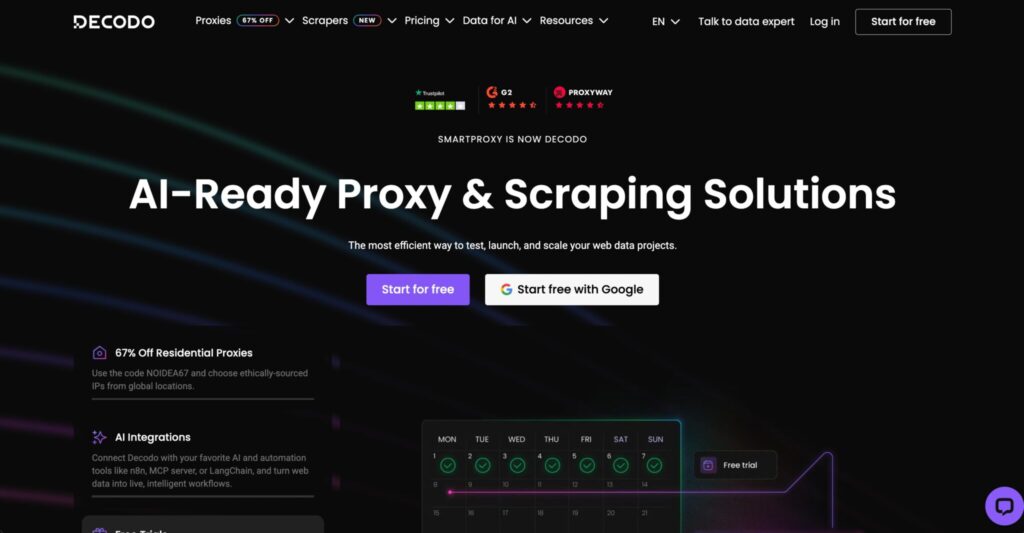
Decodo, formerly Smartproxy, is a strong middle-ground provider for AI dataset collection. It gives you large-scale residential coverage, flexible pricing, scraping APIs, and a user experience that is easier than many enterprise-first platforms.
For AI projects, Decodo makes sense when you need serious capability but do not want to start with a heavy enterprise contract. Its residential proxies are useful for public web crawling, SERP collection, ecommerce monitoring, social listening, and localized data collection. The platform also supports mobile, datacenter, and ISP options, which gives you room to match proxy type to target difficulty.
Its Web Scraping API is helpful for teams that want to collect structured public data without managing every retry, browser render, or block event manually.
Pro-Tip: Start with residential proxies for discovery crawls, then move repeatable, low-risk sources to datacenter proxies once you know which domains tolerate them.
Decodo’s biggest strength is balance. It is powerful enough for professional data work, but not as intimidating as some enterprise platforms. For many AI startups, that is exactly the sweet spot.
4. SOAX
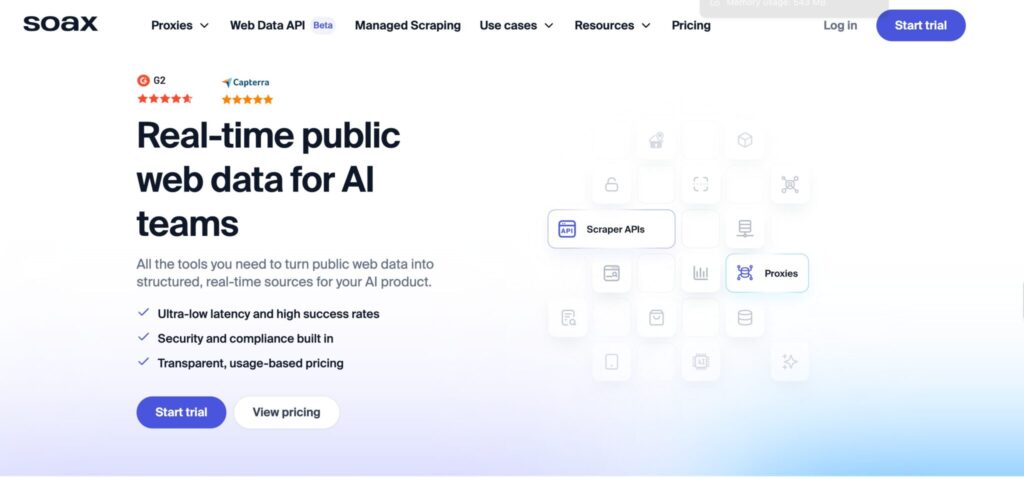
SOAX is a good pick when precise geo-targeting matters. AI dataset collection often needs location diversity, not just request volume. If your dataset must capture regional pricing, local search results, language variations, localized marketplace listings, or country-specific public content, SOAX deserves attention.
It offers residential, mobile, ISP, and datacenter proxies under a unified usage model. The platform’s targeting controls are one of its strongest points, especially for teams that need to test different locations and proxy types across the same workflow.
SOAX also places strong emphasis on compliance and responsible data extraction, which matters more in AI dataset work than many teams admit. If your dataset will be used for model training, audits, or commercial products, messy sourcing can become a long-term risk.
Pro-Tip: Build location tags into your dataset schema. Do not just collect the page. Store country, city, proxy type, timestamp, language, and response status for every record.
The main concern is cost at scale. SOAX is flexible, but large AI crawling operations should model bandwidth needs carefully before committing.
5. NetNut
NetNut is designed for scale, stability, and business-grade web data collection. Its network includes a large residential pool and mobile IPs, with a focus on reliable access for scraping, ad verification, and market intelligence.
For AI dataset collection, NetNut works best when you want fewer moving parts and stronger account-level support. It is a good fit for teams that collect public data continuously rather than running one-off scraping jobs.
Its session stability is useful for targets where you need to maintain state across multiple pages, such as category browsing, paginated listings, or multi-step public search paths. Rotating too aggressively on those targets can create inconsistent data, while sticky sessions can keep collection cleaner.
Pro-Tip: Use sticky sessions for multi-page journeys and rotating sessions for broad discovery crawling. The wrong setting can reduce accuracy even when the request technically succeeds.
NetNut may not feel as plug-and-play for beginners as some lower-cost tools, but it is a strong option for mature AI data workflows.
6. IPRoyal
IPRoyal is a practical option for budget-conscious teams that still need real residential proxy access. It is not as feature-heavy as Bright Data or Oxylabs, but it can work well for smaller AI dataset projects, validation crawls, regional checks, and early-stage data collection.
The platform offers residential, datacenter, ISP, and mobile proxies. Its pricing is often attractive for teams that need to control costs while testing dataset ideas. Non-expiring residential traffic is also useful for teams that collect data in bursts rather than every day.
IPRoyal is best for less complex collection jobs where you can manage more of the scraping logic yourself. If you already have your own crawler, retry system, parser, and queue management, IPRoyal can provide the proxy layer without forcing you into a heavier platform.
Pro-Tip: Do not use the cheapest residential setup for every source. Segment targets by difficulty, then reserve better proxy pools for websites that actually need them.
The trade-off is that you may need more hands-on tuning. For advanced AI data pipelines, that means your engineering team must carry more responsibility.
7. Webshare
Webshare is a strong value option, especially for teams that need affordable datacenter and residential proxy access with a clean dashboard and API.
It is useful for AI dataset collection when your targets are not extremely protected or when you need a large number of IPs for distributed crawling. Webshare’s residential and static residential options can support different collection patterns. Rotating residential proxies are better for broad crawling, while static residential proxies can help when you need stable sessions.
Webshare is not the most advanced managed scraping platform. That is also part of its appeal. It gives technical teams control without wrapping everything in a complex enterprise system.
Pro-Tip: Use Webshare for low-to-medium difficulty targets and save premium providers for sources with stricter rate limits or frequent blocks.
For AI teams watching cost per million pages, Webshare can be a smart part of a multi-provider stack.
8. Zyte
Zyte is different from traditional proxy-first providers. It is better described as a full-stack web scraping API with proxy management, browser rendering, unblocking, and extraction features handled behind the scenes.
That makes it valuable for AI dataset teams that care more about clean output than managing IP rotation manually. If your team wants to collect public web data from complex, JavaScript-heavy, or frequently changing sites, Zyte can reduce engineering time.
Instead of tuning every proxy rule yourself, you send requests through Zyte API and let the system handle access management, rendering, and extraction options. This is especially useful when building datasets from websites with changing layouts.
Pro-Tip: Use managed scraping APIs when engineering time is more expensive than bandwidth. Raw proxies are cheaper only if your internal team can maintain the crawler well.
The downside is control. If your team wants full proxy-level visibility and custom network behavior, Zyte may feel less flexible than a raw proxy provider.
9. Rayobyte
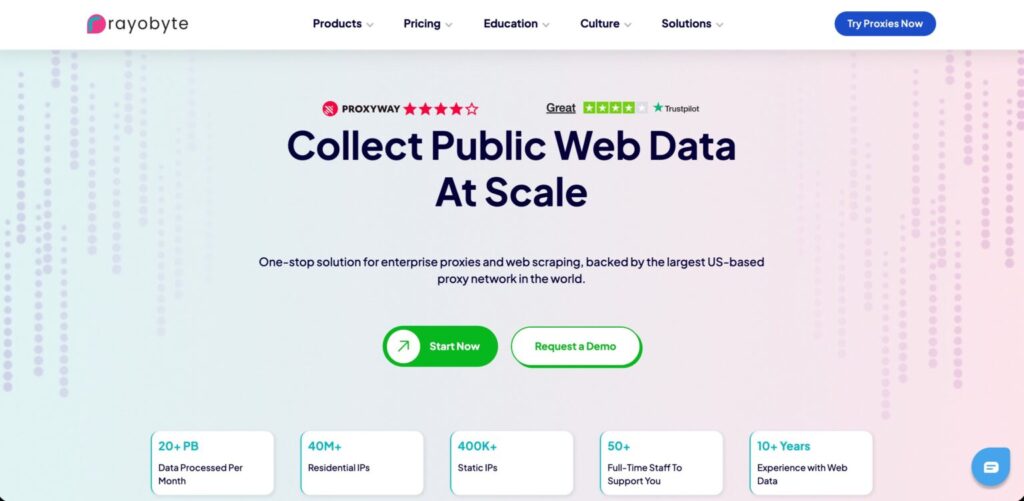
Rayobyte is worth considering for AI teams that need strong datacenter proxy coverage and do not always require residential IPs. Datacenter proxies are fast, cheaper, and easier to scale, which makes them useful for public sources with lighter protection.
For dataset collection, Rayobyte can work well for collecting from open directories, public pages, low-risk sites, and sources where speed matters more than residential authenticity. Its ISP and residential options add flexibility when datacenter IPs are not enough.
The key is target matching. Many teams waste money by using residential proxies everywhere. A provider like Rayobyte can help lower collection costs when paired with smarter routing logic.
Pro-Tip: Build a proxy decision tree: datacenter first for easy targets, ISP for stable identity, residential for difficult public sources, mobile only when mobile-specific results matter.
Rayobyte is not always the first name mentioned for AI dataset collection, but it can play a useful role in a cost-optimized stack.
How To Choose Proxies For AI Dataset Collection
Start With Dataset Requirements, Not Provider Hype
Before choosing a provider, define what the dataset needs. Are you collecting text, product data, search results, public forum pages, prices, images, or metadata? Do you need city-level location accuracy? Do pages require JavaScript rendering? How often will you refresh the dataset?
A proxy choice that works for one dataset can fail badly for another.
Understand IP Pool Quality
A big IP pool sounds impressive, but quality matters more than the headline number. Look for diversity across countries, ISPs, subnets, and connection types. A smaller clean pool can outperform a huge noisy pool if your targets are sensitive.
For AI dataset collection, pool quality affects coverage and bias. If your proxies overrepresent certain countries or networks, your dataset may quietly become skewed.
Match Proxy Type To Target Difficulty
Datacenter proxies are fast and affordable, but easier to detect. Residential proxies look more like normal user traffic and work better for protected public websites. ISP proxies offer stable sessions with residential-like trust. Mobile proxies are useful when the content differs on mobile networks or apps.
Do not default to the most expensive type. Use the cheapest proxy that collects complete, accurate, and compliant data.
Check Rotation Protocols
Rotation controls can make or break a collection job. Per-request rotation is useful for large discovery crawls. Sticky sessions are better for multi-page paths. Time-based rotation works well when a website allows short browsing windows but blocks repetitive behavior.
The best providers let you control rotation by session, time, country, city, and sometimes ASN or carrier.
Look At Failure Handling
AI datasets need clean records, not just successful requests. Your proxy setup should help track blocked pages, redirects, CAPTCHAs, partial loads, empty responses, and wrong-language pages.
A request that returns HTTP 200 is not always a valid data point. Build validation into the pipeline.
Consider Compliance And Data Governance
AI dataset collection has legal, privacy, and ethical risks. Collect public data responsibly, respect robots.txt where applicable, avoid private or sensitive data, follow website terms, and document collection sources.
For model training, documentation is not optional. Keep logs for source URLs, collection date, proxy region, parser version, and consent or licensing status where relevant.
Recommended Stack By Use Case
| Use Case | Best Proxy Choice |
|---|---|
| Enterprise AI training datasets | Bright Data or Oxylabs |
| Startup data collection | Decodo or SOAX |
| Budget testing and validation | IPRoyal or Webshare |
| Managed extraction | Zyte |
| Datacenter-heavy crawling | Rayobyte |
| Geo-sensitive datasets | SOAX or Bright Data |
| Continuous public data feeds | NetNut or Oxylabs |
FAQs
What are the best proxies for AI dataset collection?
Bright Data, Oxylabs, Decodo, SOAX, and NetNut are strong choices for serious AI dataset collection. IPRoyal and Webshare are better for budget-focused teams, while Zyte is useful when you want managed scraping instead of raw proxy control.
Are residential proxies better for AI data scraping?
Residential proxies are better for harder public websites because they route traffic through real residential networks. They are not always necessary, though. Datacenter proxies can work well for open, low-protection sources and cost far less.
How important is IP rotation for AI datasets?
IP rotation is critical when collecting at scale, but aggressive rotation is not always better. Use per-request rotation for broad crawling and sticky sessions for multi-page journeys. The goal is clean data, not just more requests.
Should AI teams use one proxy provider or multiple?
Larger teams often use multiple providers. This reduces dependency on one network, improves coverage, and gives better fallback options when a source starts blocking certain IP ranges.
What proxy type is best for localized AI datasets?
Residential and mobile proxies are usually best for localized datasets because they can capture country, city, carrier, and device-specific content. ISP proxies can also work when stable sessions are needed.
Can proxies improve dataset quality?
Yes. Better proxies can improve coverage, reduce missing records, and capture region-specific variations. They do not fix bad parsing, weak deduplication, or poor source selection, so the full pipeline still matters.
Are free proxies safe for AI dataset collection?
Free proxies are a bad idea for serious dataset collection. They are unreliable, slow, often abused, and risky from a security and compliance perspective. Use paid, reputable providers with clear sourcing and support.
What is the biggest mistake teams make with proxies?
The biggest mistake is treating proxies as a block-bypass tool instead of a data quality layer. The proxy setup affects location accuracy, freshness, coverage, and repeatability. For AI datasets, those details matter.