
Amazon data is messy, competitive, and painfully valuable.
If you run price monitoring, marketplace intelligence, review analysis, inventory tracking, ASIN research, or competitive catalog mapping, Amazon is usually one of the first targets on the list. The problem is that Amazon is also one of the hardest eCommerce sites to collect public data from at scale.
A basic datacenter proxy may work for a few test requests. Then the problems begin. Product pages return inconsistent content. Search pages behave differently by region. Review pages change layout. Requests slow down. CAPTCHAs appear. Some sessions get throttled. Some data comes back incomplete. That is why the proxy choice matters so much.
For Amazon scraping, the best proxy is not simply the cheapest IP address you can buy. You need clean residential or ISP IPs, strong location targeting, session control, healthy rotation, enough bandwidth, and a provider that can support high-frequency public web data collection without turning your pipeline into a repair job.
Before we start, a quick but important note: Amazon’s own policies, robots.txt rules, and API options should be reviewed before any scraping project. Amazon’s Product Advertising API exists as an official way to access some product data, and Amazon publishes robots.txt directives for automated crawlers. Use this guide for compliant public data collection planning, not for accessing private accounts, protected systems, checkout flows, or restricted seller data.
What Makes a Proxy Great for Amazon Scraping?
A good Amazon scraping proxy has to do more than hide your real IP. It has to keep data quality stable across different Amazon pages, marketplaces, and request patterns.
1. Residential IPs usually beat cheap datacenter IPs
Amazon traffic comes from millions of normal home users every day. Residential proxies look closer to that real-user traffic profile because they route requests through household IP addresses. That does not mean they are magic, but they are usually better for Amazon product pages, reviews, SERPs, seller pages, and localized pricing.
Datacenter proxies can still be useful for lightweight scraping, testing, and low-risk pages, but they tend to get filtered faster on sensitive eCommerce targets. If your Amazon scraping project matters, residential proxies should be your default starting point.
2. Marketplace-level geo-targeting is non-negotiable
Amazon.com, Amazon.co.uk, Amazon.de, Amazon.in, and Amazon.ca can show different prices, shipping options, availability, taxes, currencies, sellers, review counts, and ranking positions.
That means your proxy provider should support country-level targeting at minimum. City, state, or ZIP targeting is useful when you need localized availability or delivery-sensitive pricing. Decodo, for example, lists country, continent, state, city, and ZIP targeting for residential proxies, while SOAX promotes residential coverage across 195 countries.
3. Rotation control matters more than raw IP pool size
A huge IP pool looks great in marketing copy. But for Amazon scraping, rotation strategy is where the real difference appears.
You need two modes:
Rotating sessions for search result pages, bestseller pages, category pages, and large-scale price checks.
Sticky sessions for flows where continuity matters, such as paginated reviews, seller storefronts, product variants, and localized browsing.
If your provider only rotates aggressively on every request, you may get unstable sessions. If it keeps sticky sessions too long, you may burn the same IP with too many requests. The sweet spot depends on your volume, page type, and crawl frequency.
4. Scraper APIs can be better than raw proxies
Some providers now offer Amazon-specific scraper APIs instead of only selling raw proxies. These APIs handle proxy routing, retries, parsing, and structured outputs.
Oxylabs has an Amazon Scraper API for listings, prices, ASINs, seller details, Q&A, bestseller data, and parsed product results. Decodo also offers an Amazon Product Scraper API that can return raw HTML, structured JSON, or table format.
For engineering teams, raw proxies offer more control. For SEO teams, affiliate teams, price intelligence teams, and non-technical operators, scraper APIs can save weeks of maintenance.
5. Clean sourcing and compliance controls matter
For serious projects, avoid shady proxy pools. You want ethical sourcing, clear acceptable-use policies, support responsiveness, and account controls. Amazon scraping already has legal and operational risk. Using low-quality proxies makes that risk worse.
7 Best Proxies for Amazon Scraping in 2026
#1 — Oxylabs: Best Overall Amazon Scraping Proxy
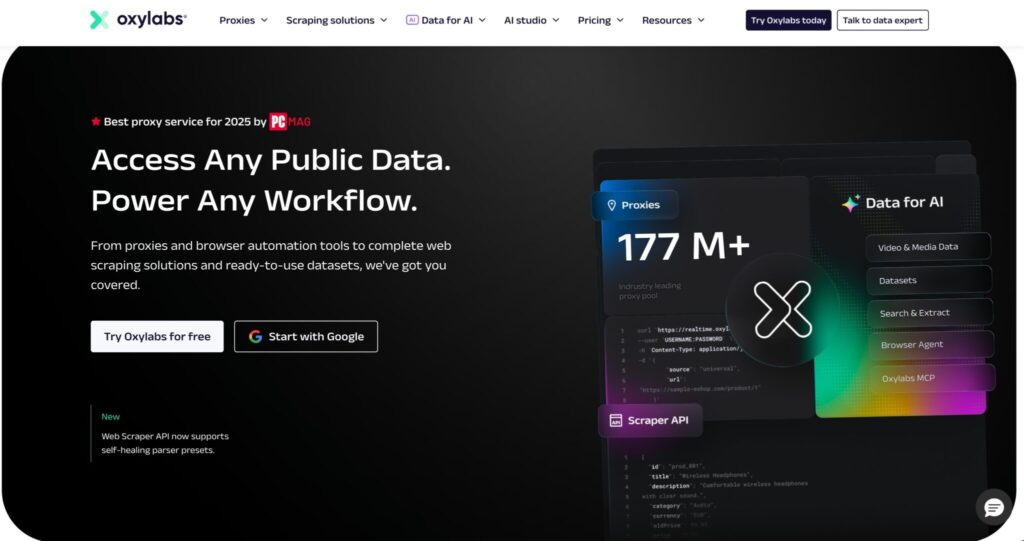
Oxylabs is the strongest overall choice for Amazon scraping when reliability matters more than saving every last dollar.
It works well for teams that need product data, price monitoring, review tracking, bestseller monitoring, seller intelligence, and marketplace research at serious scale. The biggest advantage is that Oxylabs gives you both proxy infrastructure and Amazon-specific scraping tools. Its Amazon Scraper API supports product listings, prices, ASINs, seller details, Q&A, bestseller data, and parsed outputs, which makes it useful when you do not want to build every extraction layer from scratch.
Oxylabs also promotes a large proxy network, including 175M+ residential IPs and 2M datacenter IPs. For Amazon scraping, that matters because you can combine residential proxies for sensitive pages with datacenter proxies for simpler, lower-risk jobs.
Where Oxylabs stands out is stability. Amazon pages are dynamic. Product pages shift layouts, prices change constantly, sellers rotate, and localized content can vary. A weaker proxy setup may return pages, but the extracted fields can be incomplete or inconsistent. Oxylabs is built more for production scraping than casual scraping, so it fits teams that need dependable output.
The downside is pricing. Oxylabs is not usually the cheapest option. It is better for agencies, data companies, Amazon sellers with serious research operations, SaaS tools, and marketplace intelligence teams.
Best for: Enterprise Amazon scraping, price intelligence, product monitoring, review scraping, seller tracking.
Proxy types: Residential, datacenter, mobile, ISP, scraper APIs.
Why choose it: Strong infrastructure, Amazon-specific endpoints, structured output options, high reliability.
Watch out for: Higher pricing than budget providers.
Pro-Tip: Use Oxylabs Amazon Scraper API if your team cares more about clean product data than managing headers, retries, parsers, and failed sessions manually.
#2 — Decodo: Best Value Amazon Scraping Proxy
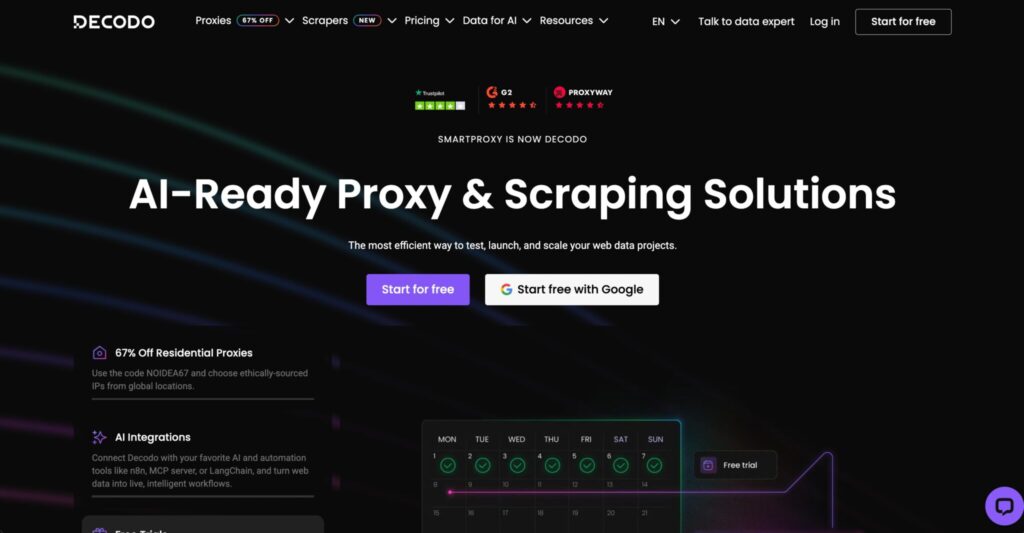
Decodo, formerly Smartproxy, is one of the best value options for Amazon scraping in 2026. The company officially rebranded from Smartproxy to Decodo in April 2025, so you may still see older reviews using the Smartproxy name.
For Amazon scraping, Decodo sits in a very practical middle ground. It is more affordable than many enterprise-first providers, but it still has the features needed for serious public data collection. Its residential proxy plans include access to a 115M+ IP pool, 195+ locations, geo-targeting, and unlimited concurrent sessions. Pricing starts from $2/GB on the official residential proxy pages, with smaller plans priced higher per GB.
The Amazon Product Scraper API is also a major plus. It can extract Amazon product data and return results in raw HTML, structured JSON, or table format. Decodo says failed requests are automatically retried and users pay only for successful requests, which is attractive for teams that care about predictable data output.
Decodo is especially useful for affiliate marketers, Amazon sellers, SEO teams, and mid-sized eCommerce intelligence projects. It has enough power for production use without feeling as heavy or expensive as enterprise-only platforms.
Best for: Value-focused Amazon scraping, mid-sized scraping projects, affiliate research, pricing intelligence.
Proxy types: Residential, static residential, mobile, datacenter, scraper APIs.
Why choose it: Strong price-to-performance ratio, large residential pool, Amazon scraper API, good geo-targeting.
Watch out for: Very large enterprise users may still prefer Oxylabs or Bright Data for deeper infrastructure and support.
Pro-Tip: Use rotating residential sessions for search result and category pages, then use sticky sessions when collecting review pages or product variants from the same marketplace.
#3 — Webshare: Best Free Amazon Scraping Proxy
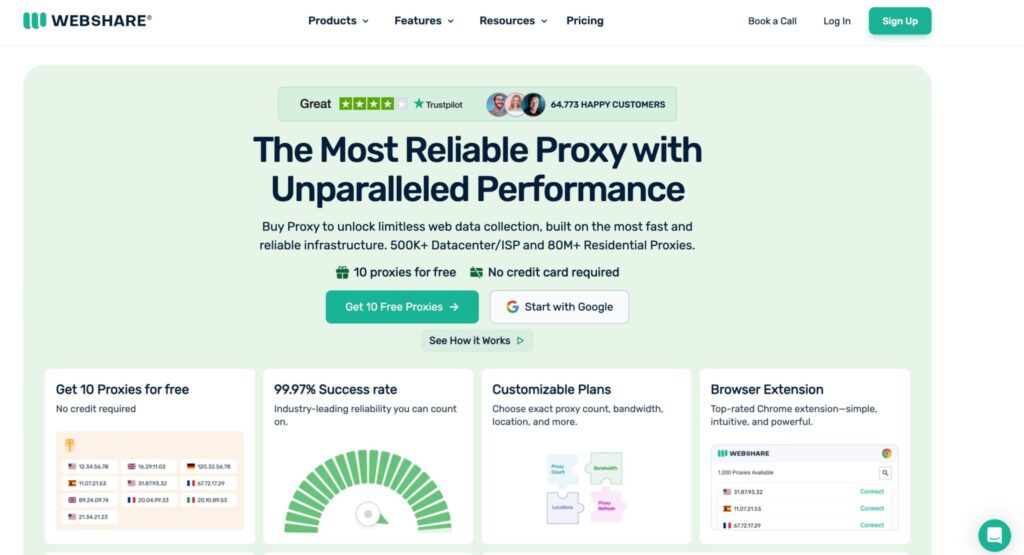
Webshare is the best pick for testing, small experiments, and budget-conscious scraping workflows.
Its biggest appeal is affordability. Webshare offers datacenter proxy servers, static residential proxies, and residential proxies. The official website lists proxy server plans starting from $2.99/month and static residential plans from $6/month. Webshare also advertises a free option with 10 proxies and up to 1GB/month, which is helpful for small tests before committing budget.
For Amazon scraping, Webshare is not the first choice for heavy enterprise workloads. It does not have the same Amazon-specific scraper API depth as Oxylabs, Decodo, or Bright Data. But it is a great starting point if you need to validate a scraper, test request patterns, check page layouts, or run smaller data collection jobs.
The interface is simple, and that matters. Not every user wants to spend hours configuring proxy zones, APIs, permissions, and session rules. Webshare is easy to understand, which makes it beginner-friendly.
The tradeoff is that cheaper proxy setups may require more manual tuning. If you are scraping Amazon SERPs, product pages, and reviews at scale, expect to manage request pacing, rotation, retries, and parsing yourself.
Best for: Beginners, testing, low-volume Amazon scraping, budget setups.
Proxy types: Datacenter, static residential, residential.
Why choose it: Free plan, low entry pricing, easy dashboard, good for experiments.
Watch out for: Not ideal for large-scale Amazon scraping without extra engineering work.
Pro-Tip: Use Webshare to test your Amazon scraper logic first. Once your parser and data model are stable, move high-volume scraping to a stronger residential or scraper API provider.
#4 — SOAX: Best Amazon Scraping Proxy for Reliable Data Quality
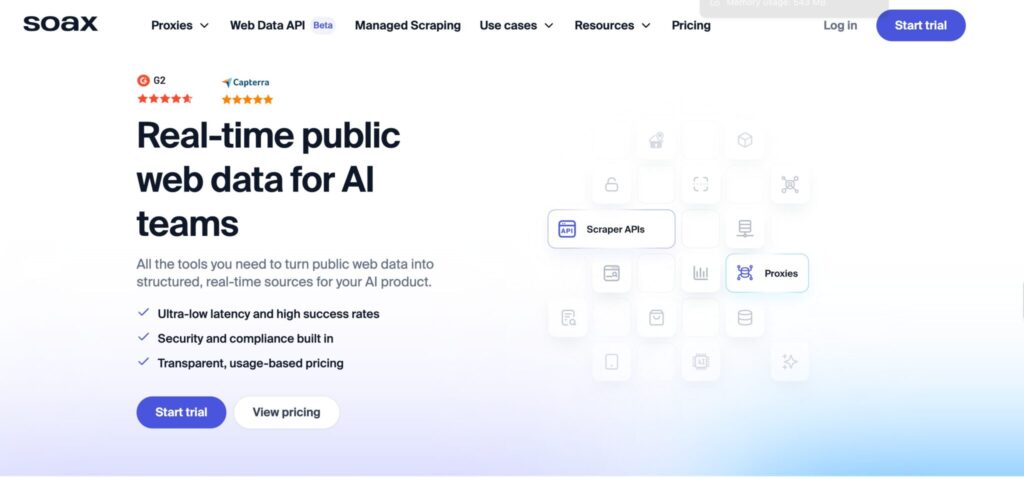
SOAX is a strong option for teams that care about clean residential coverage, flexible targeting, and reliable data collection.
Its residential proxy network includes 155M+ IPs across 195 countries, with HTTP(S), SOCKS5, and other protocol support. SOAX also highlights unlimited concurrent sessions, ethically sourced proxies, and 99.9% network uptime on its official residential proxy page.
For Amazon scraping, SOAX is especially useful when geo-targeting matters. If you are checking product availability, price differences, regional search positions, or marketplace-specific seller data, strong location coverage can make your dataset more accurate.
SOAX is also a good fit for users who want more control than a fully managed scraper API but more reliability than a low-cost proxy pool. It is not just for Amazon. It can support broader eCommerce monitoring across Walmart, eBay, Target, Etsy, and regional marketplaces, which helps if your project compares Amazon against other retailers.
The downside is that SOAX may feel more advanced than Webshare or DataImpulse for beginners. It is better suited for users who understand sessions, regions, bandwidth planning, and scraping pipelines.
Best for: Geo-sensitive Amazon scraping, price comparison, regional product tracking, marketplace monitoring.
Proxy types: Residential, mobile, datacenter, ISP-style options depending on plan availability.
Why choose it: Strong residential coverage, high uptime claim, flexible protocol support, good for data quality.
Watch out for: May require more setup knowledge than beginner-focused tools.
Pro-Tip: For Amazon price scraping, always match proxy location to the target marketplace. Do not use random global traffic if you need clean US, UK, Germany, India, or Canada pricing.
#5 — DataImpulse: Best Budget Amazon Scraping Proxy
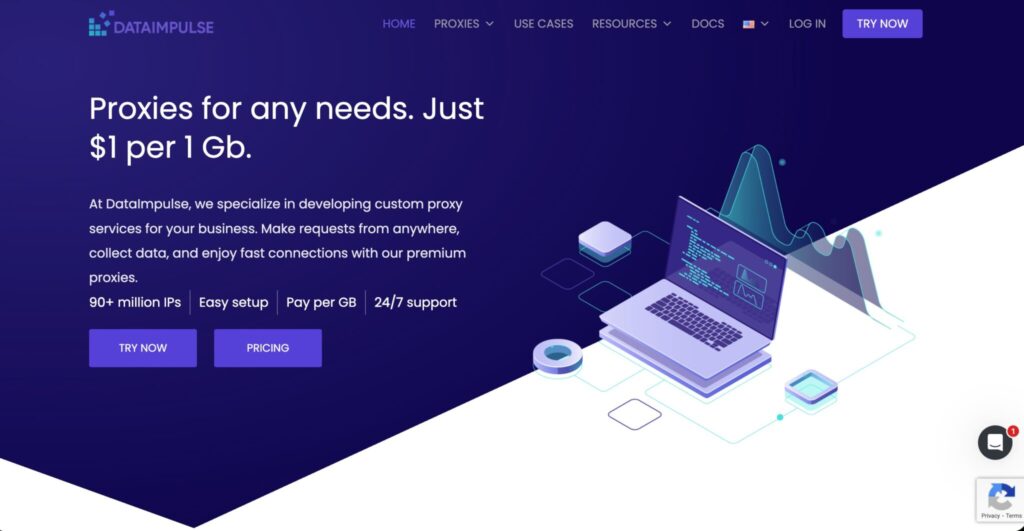
DataImpulse is one of the most attractive budget proxy providers for Amazon scraping.
Its main selling point is simple pricing. DataImpulse advertises residential proxies from $1 per GB, a 90M+ IP pool, pay-per-GB billing, easy setup, and 24/7 support. It also lists mobile proxies from $2/GB, datacenter proxies from $0.5/GB, and premium residential proxies from $5/GB on its location/pricing information.
For small businesses, Amazon affiliates, indie developers, and price monitoring side projects, that pricing is hard to ignore. If you are collecting public product titles, prices, ratings, and availability from a controlled set of ASINs, DataImpulse can be a cost-effective starting point.
It is also useful for price comparison use cases. DataImpulse specifically positions its proxies for collecting pricing data, and its pay-as-you-go model helps users avoid large monthly commitments.
The main limitation is that budget proxies usually require more responsibility from your side. You need to manage retries, session logic, request pacing, parser stability, and data validation. For heavy Amazon scraping, that can become a real workload.
Best for: Budget Amazon scraping, price checks, smaller datasets, pay-as-you-go users.
Proxy types: Residential, mobile, datacenter, premium residential.
Why choose it: Very low starting price, pay-per-GB model, large claimed IP pool.
Watch out for: Less managed scraping support than API-first providers.
Pro-Tip: Start with a small ASIN list and track success rate, response time, and usable data percentage. Cheap bandwidth only helps if the pages return clean, extractable data.
#6 — IPRoyal: Best Amazon Scraping Proxy for Bulk Operations
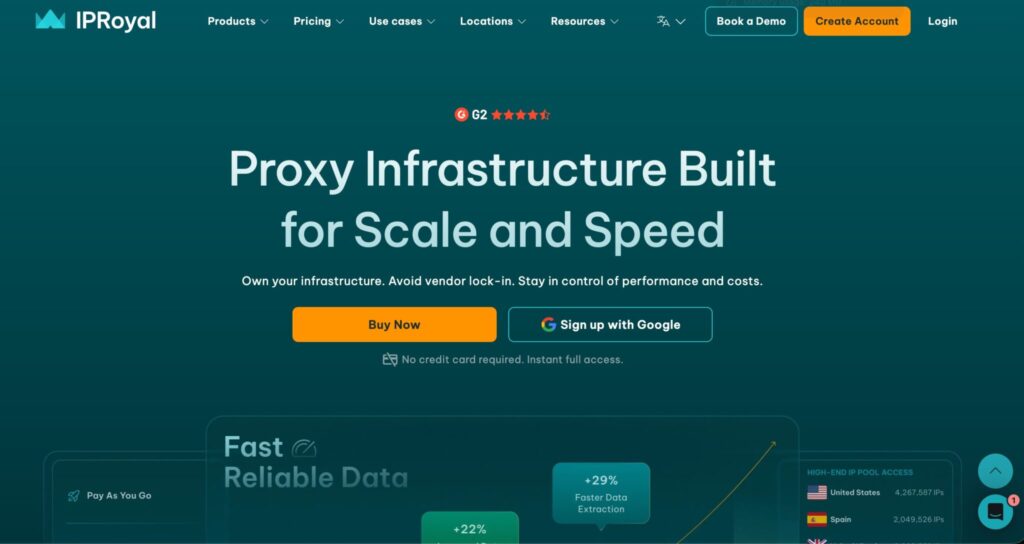
IPRoyal is a good fit for users who want affordable residential proxies with flexible purchasing.
Its residential proxy page lists custom packages starting at $1.75, on-demand purchasing, adjustable traffic volumes, and scalability positioning. Its pricing page mentions 32M+ genuine residential IP addresses for web scraping.
For Amazon scraping, IPRoyal is most interesting for bulk operations where cost control matters. If you are scraping thousands of product pages, tracking price movement across multiple categories, or monitoring review counts across large ASIN groups, bandwidth cost can rise quickly. IPRoyal’s model can appeal to teams that want residential traffic without enterprise pricing.
It is also a practical choice for users who need simple proxy access rather than a full managed scraping stack. You can integrate it into your own Python scraper, browser automation setup, no-code scraping tool, or custom monitoring system.
The tradeoff is that IPRoyal is not as Amazon-specialized as Oxylabs, Decodo, or Bright Data. You will likely do more work yourself around retries, parsing, and content validation.
Best for: Bulk scraping, cost-controlled residential traffic, large ASIN monitoring.
Proxy types: Residential, ISP, datacenter, mobile.
Why choose it: Affordable residential access, flexible traffic purchasing, useful for scaling lists.
Watch out for: Less Amazon-specific tooling compared with scraper API providers.
Pro-Tip: Use IPRoyal for repeatable, structured jobs where your scraper is already stable. If your code is still breaking often, an Amazon scraper API may save more money than cheaper bandwidth.
#7 — Bright Data: Best Enterprise Amazon Scraping Platform
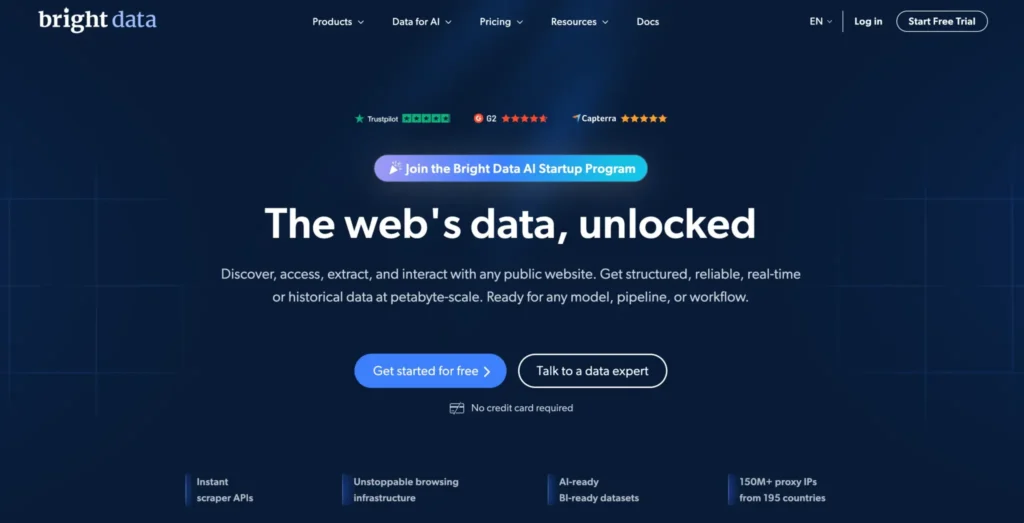
Bright Data is one of the most complete enterprise platforms for Amazon scraping.
It offers Amazon-specific scraping products for collecting product data, best sellers, prices, reviews, images, ratings, seller information, product search data, and global Amazon datasets. This makes Bright Data especially strong when the goal is not just proxy access but a full data collection system.
Bright Data also offers Web Unlocker, which is designed for scraping use cases where users send requests and the system handles many of the access and delivery challenges. Its residential proxy pricing page lists plans starting from $5.88/GB, while its Web Unlocker pricing page positions the tool as a site unblocker for web data collection.
For Amazon scraping, Bright Data is best for companies that need scale, compliance controls, structured datasets, and multiple product options. It is not just a proxy provider. It is closer to a full web data platform.
That depth comes with complexity and cost. Smaller users may find Bright Data expensive or heavier than needed. But for enterprise marketplace intelligence, retail analytics, and data products, it is one of the most capable options.
Best for: Enterprise Amazon scraping, structured datasets, review data, seller intelligence, large retail analytics.
Proxy types: Residential, datacenter, ISP, mobile, Web Unlocker, scraper APIs, datasets.
Why choose it: Amazon-specific scraping products, strong enterprise tooling, large data platform features.
Watch out for: Pricing and setup may be too heavy for small projects.
Pro-Tip: Choose Bright Data when your team needs recurring Amazon datasets or managed extraction, not just IP rotation.
Quick Comparison for Amazon Scraping Proxies
| Provider | Best For | Amazon-Specific Tools | Proxy Network Strength | Rotation Control | Pricing Style | Skill Level Needed | Best Use Case |
|---|---|---|---|---|---|---|---|
| Oxylabs | Best overall | Yes | Very strong residential and datacenter infrastructure | Strong | Premium, API and proxy plans | Intermediate to advanced | Enterprise product, price, review, seller, and bestseller scraping |
| Decodo | Best value | Yes | 115M+ residential IPs with broad geo-targeting | Strong | From $2/GB on larger residential plans | Beginner to intermediate | Mid-sized Amazon scraping, affiliate research, pricing intelligence |
| Webshare | Best free/testing option | No dedicated Amazon API | Good for budget testing | Basic to moderate | Free and low-cost monthly plans | Beginner | Testing scrapers, small jobs, lightweight Amazon monitoring |
| SOAX | Best for data quality | General scraping tools | 155M+ residential IPs across 195 countries | Strong | Bandwidth-based | Intermediate | Geo-sensitive Amazon price and availability monitoring |
| DataImpulse | Best budget pick | No dedicated Amazon API | 90M+ IPs claimed | Moderate | From $1/GB residential | Beginner to intermediate | Budget scraping, price comparison, controlled ASIN lists |
| IPRoyal | Best for bulk operations | No dedicated Amazon API | 32M+ residential IPs listed | Moderate | Flexible traffic packages | Intermediate | Large ASIN lists, bulk product checks, cost-controlled scraping |
| Bright Data | Best enterprise platform | Yes | Enterprise-grade proxy and scraping ecosystem | Strong | Premium bandwidth, unlocker, datasets | Advanced | Large retail analytics, Amazon datasets, seller and review intelligence |
How to Choose the Best Proxy for Amazon Scraping
Choosing the right proxy depends on the type of Amazon data you need. A review scraper, a Buy Box tracker, and a price monitoring system do not all need the same setup.
Step 1: Define the Amazon pages you need
Start by listing the exact page types:
- Product detail pages
- Search result pages
- Category pages
- Best seller pages
- Review pages
- Seller pages
- Offer listing pages
- Q&A pages
- Inventory or availability pages
Product pages are usually easier than review pagination or offer listings. Search pages can be very sensitive because Amazon changes ranking, ads, sponsored results, and localization. If your project touches multiple page types, choose a stronger residential provider or scraper API.
Step 2: Match proxy type to the workload
Residential proxies: Best default choice for Amazon scraping. Use them for product pages, reviews, search pages, and localized data.
ISP proxies: Useful when you need stable sessions with residential-like trust. They are good for longer-running monitoring workflows.
Datacenter proxies: Fine for tests and simple low-volume jobs, but less reliable for serious Amazon scraping.
Mobile proxies: Useful for mobile-specific Amazon experiences, but usually more expensive and not necessary for most product data scraping.
Scraper APIs: Best when you want structured data and fewer engineering headaches.
Step 3: Plan your rotation protocol
Rotation is not just “change IP often.” You need a pattern.
For Amazon SERPs, use frequent rotation because each page request can be independent.
For product pages, rotate often but avoid looking random in a way that breaks consistency.
For reviews, use sticky sessions because pagination often behaves better when requests stay within a session.
For seller pages, use medium-length sessions so you can collect related pages without forcing a fresh identity every time.
For price tracking, keep marketplace and location consistent. Changing locations during the same monitoring cycle can create false price changes.
Step 4: Measure usable data, not just success rate
A 200 status code does not mean your scrape worked. You need to track:
- Valid title returned
- Correct ASIN returned
- Price field present
- Rating field present
- Review count present
- Marketplace matched
- No CAPTCHA page
- No blank or partial HTML
- Parser confidence score
- Duplicate or stale content detection
The best Amazon scraping setup is the one that returns clean, consistent fields.
Step 5: Respect boundaries
Do not scrape private account pages, checkout pages, personal user data, seller dashboards, or anything behind login. Keep request rates reasonable, respect robots.txt where applicable, and consider Amazon’s official Product Advertising API when it fits your use case. Amazon’s Conditions of Use say users may use Amazon services only as permitted by law, and Amazon publishes robots.txt files that automated systems should review before crawling.
FAQs: Best Proxies for Amazon Scraping 2026
Why does Amazon block proxies?
Amazon protects its platform from abuse, fraud, automated overload, fake traffic, inventory manipulation, spam, and data misuse. Some proxy traffic looks abnormal because too many requests come from the same IP range, headers are inconsistent, sessions behave strangely, or request frequency is too high.
Does Amazon serve fake data to detected scrapers?
Amazon can show different content depending on location, session, device type, availability, cookies, and request behavior. Sometimes scrapers interpret localized or incomplete pages as “fake data.” The safer assumption is that Amazon serves dynamic data, and poor scraping setups often collect inconsistent results.
Is Amazon scraping legal?
It depends on what you scrape, how you scrape it, where you operate, and how you use the data. Public product data scraping may be treated differently from scraping private account pages, seller dashboards, personal information, or copyrighted content at scale. Always review Amazon’s terms, robots.txt, official APIs, and local laws before running a project. For business-critical scraping, ask a lawyer.
What type of proxy is best for Amazon scraping?
Residential proxies are usually the best starting point because they look closer to normal consumer traffic. ISP proxies can work well when you need stable sessions. Datacenter proxies are cheaper but usually less reliable for Amazon at scale.
Are free proxies good for Amazon scraping?
Free public proxies are usually a bad idea. They are slow, abused, unstable, and risky. A legitimate free tier from a known provider, such as Webshare’s free proxy option, can be useful for testing, but it should not be treated as a production Amazon scraping setup.
Should I use proxies or an Amazon scraper API?
Use raw proxies if you want full control over crawling, parsing, storage, retries, and request behavior. Use an Amazon scraper API if you want structured results faster and do not want to maintain the full scraping stack yourself. Oxylabs, Decodo, and Bright Data all offer Amazon-specific scraping options.
How many proxies do I need for Amazon scraping?
It depends on request volume, page type, target marketplaces, rotation rules, and retry rate. A small ASIN tracker may only need a modest residential bandwidth plan. A large price intelligence system tracking thousands of products across multiple countries needs a much larger pool, better rotation, and stronger data validation.
Can I scrape Amazon reviews with proxies?
Technically, yes, but review pages can be harder than basic product pages because pagination, sorting, localization, and layout changes can affect extraction. Use sticky sessions, slower request rates, and strong parsing validation. For large review projects, an Amazon-specific scraper API may be more reliable.
Which proxy provider is best for beginners?
Webshare is the easiest starting point for basic testing. Decodo is better if you want a beginner-friendly provider that can also grow into more serious Amazon scraping. DataImpulse is attractive if your main concern is budget.
Which proxy provider is best for enterprise Amazon scraping?
Oxylabs and Bright Data are the strongest enterprise choices. Oxylabs is excellent for reliable Amazon scraping infrastructure and APIs. Bright Data is better when you need a broader web data platform with Amazon datasets, scraper tools, and enterprise controls.
Conclusion | Best Proxies for Amazon Scraping 2026
The best proxy for Amazon scraping depends on your workload.
Choose Oxylabs if you want the best overall balance of reliability, Amazon-specific scraping features, and production-grade infrastructure.
Choose Decodo if you want strong value, a large residential pool, and a practical Amazon scraper API without going fully enterprise.
Choose Webshare if you are testing, learning, or running smaller scraping jobs on a tight budget.
Choose SOAX if location accuracy, residential quality, and stable data collection are your main priorities.
Choose DataImpulse if you want a low-cost residential proxy option for controlled Amazon scraping projects.
Choose IPRoyal if you need affordable residential traffic for bulk ASIN monitoring and already have a working scraper.
Choose Bright Data if you want enterprise-grade Amazon scraping, datasets, and a complete data collection platform.
For most users, the best starting path is simple: test with Webshare or DataImpulse, scale with Decodo, and move to Oxylabs or Bright Data when Amazon data becomes a serious business asset.