
Best Proxies For Competitive Price Tracking.
Competitive price tracking sounds simple from the outside. Pick a few competitor websites, scrape product prices, compare them with your catalog, and adjust your pricing strategy.
Then reality shows up.
Retail sites change layouts, show different prices by country or city, block repeated requests, hide offers behind JavaScript, and sometimes display one price to a normal shopper and another to a suspicious crawler. If your proxy setup is weak, your dashboard will not just miss data. It may show the wrong data.
That is why proxies matter so much for price intelligence. The right proxy network helps your scraper look like real regional traffic, rotate IPs without breaking sessions, and collect pricing data at scale without constant blocks.
For ecommerce brands, marketplaces, travel sites, agencies, and retail analytics teams, this is not a technical extra. It is the plumbing behind accurate market visibility.
Below is a practical buyer’s guide to the best proxies for competitive price tracking, with a focus on IP pool quality, rotation controls, geo-targeting, stability, and real-world usability.
Quick Comparison Table: Best Proxies For Competitive Price Tracking
| Provider | Best For | Proxy Types | Rotation Control | Geo-Targeting | Pricing Fit | Main Strength |
|---|---|---|---|---|---|---|
| Bright Data | Enterprise price intelligence | Residential, ISP, datacenter, mobile | Advanced sticky and rotating sessions | Country, city, ZIP, ASN | Premium | Huge network and granular controls |
| Oxylabs | Large-scale retail scraping | Residential, datacenter, ISP, mobile | Flexible session control | Country, city, state, ZIP | Premium | Strong infrastructure for ecommerce data |
| Decodo | Mid-market price monitoring | Residential, ISP, datacenter, mobile | Rotating and sticky sessions | 195+ locations | Mid-range | Fast setup and strong value |
| SOAX | Geo-specific tracking | Residential, mobile, ISP, datacenter | Auto rotation and sticky sessions | Country, city, ASN, ISP | Mid-range | Clean targeting and flexible plans |
| NetNut | High-volume workflows | Residential, static residential, datacenter | Session-based rotation | 195+ locations | Mid to premium | Stable connections for scale |
| IPRoyal | Budget-conscious teams | Residential, datacenter, ISP, mobile | Auto-rotate and sticky sessions | Country, state, city | Affordable | Low entry cost and simple controls |
| Webshare | Low-cost testing | Residential, static residential, datacenter | Rotating residential options | Broad global coverage | Budget | Cheap bandwidth and easy dashboard |
| Rayobyte | Datacenter and ISP-heavy tracking | Datacenter, ISP, residential | Plan-dependent rotation | Multiple regions | Budget to mid-range | Good for predictable retail targets |
1. Bright Data
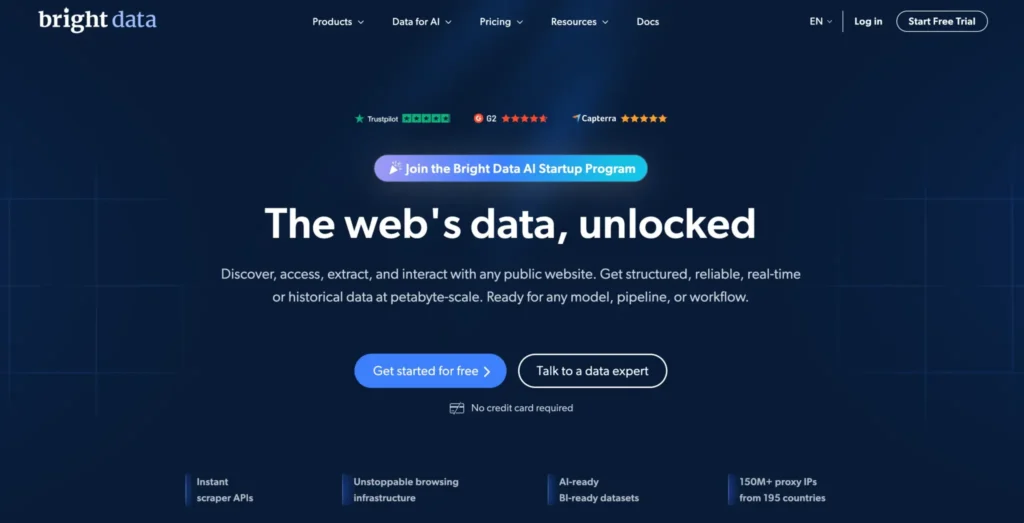
Bright Data is the heavyweight option for serious price intelligence programs. If you are tracking thousands or millions of SKUs across multiple countries, it gives you the kind of control that smaller proxy tools often lack.
Its biggest advantage is targeting depth. You can test how prices appear in different cities, postal areas, carriers, and regions, which is valuable for retailers dealing with dynamic pricing, regional promotions, and marketplace localization. The platform also supports residential, ISP, mobile, and datacenter proxies, so teams can match the proxy type to the target website instead of using one network for every job.
For competitive price tracking, Bright Data works best when accuracy matters more than the cheapest possible bandwidth. It is not the simplest platform for beginners, but technical teams will appreciate the session controls, rotation options, and scraping ecosystem.
Pro-Tip: Use sticky residential sessions for product pages with cart or location flow. Use rotating sessions for broad catalog discovery.
2. Oxylabs
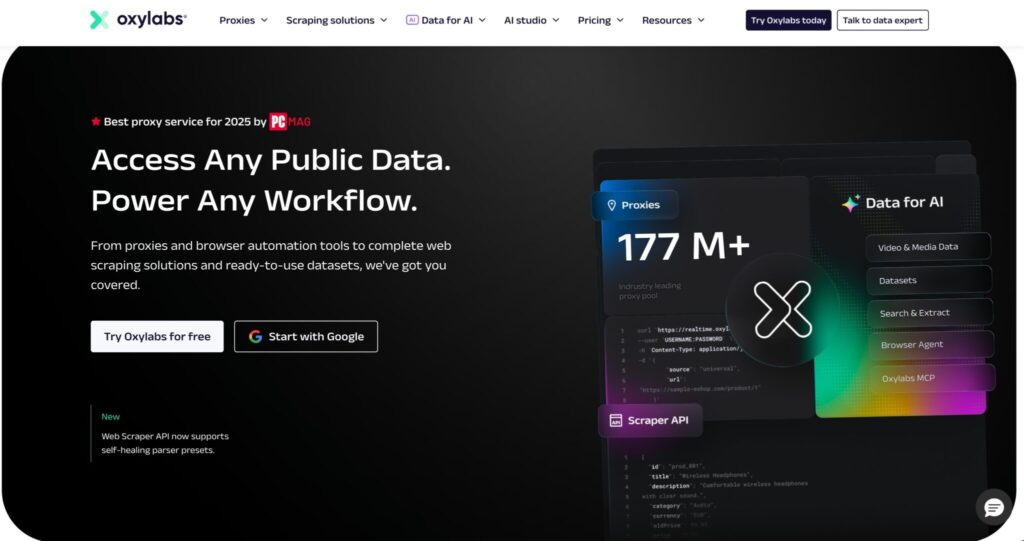
Oxylabs is another enterprise-grade choice built for large-scale web intelligence. Its price monitoring solution is clearly aimed at companies that need reliable access to product, seller, availability, and regional pricing data.
The residential pool is large, the location coverage is wide, and the session controls are strong enough for complex ecommerce scraping. Oxylabs also offers scraper APIs, which can reduce the engineering load if your team does not want to manage browser rendering, headers, retries, and anti-bot issues in-house.
For price tracking, Oxylabs is a strong fit for brands, retailers, price comparison engines, and data companies that need repeatable collection jobs rather than one-off scraping. The pricing is not aimed at hobby users, but the stability can justify the cost when missed prices directly affect revenue decisions.
Pro-Tip: For marketplaces with heavy blocking, test Oxylabs Web Scraper API before building a full custom stack.
3. Decodo
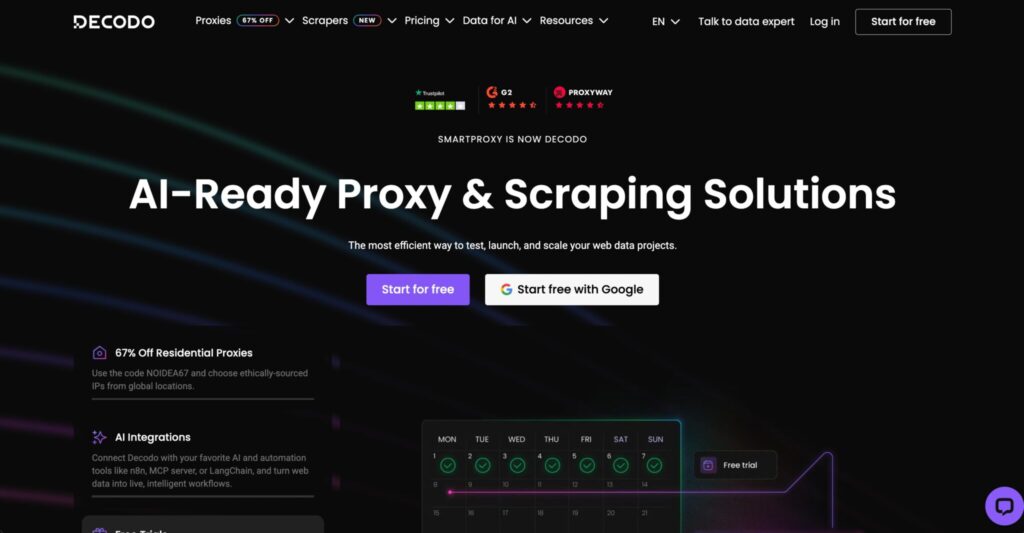
Decodo, formerly Smartproxy, is one of the most practical options for growing teams that need dependable proxies without enterprise-level complexity. It offers a large residential pool, broad location coverage, and both rotating and sticky session support.
The dashboard is beginner-friendly, but the network is capable enough for serious price tracking. That makes Decodo a good middle ground for ecommerce brands, SEO agencies, affiliate teams, and SaaS companies building competitor monitoring tools.
For pricing data, Decodo works well when you need to track product pages, search result pages, category listings, and regional price differences across common ecommerce platforms. It may not offer the same ultra-granular controls as Bright Data in every area, but it is easier to deploy and usually more approachable for smaller teams.
Pro-Tip: Start with rotating residential proxies for category pages, then switch to sticky sessions for carts, shipping estimators, or location-based checkout checks.
4. SOAX
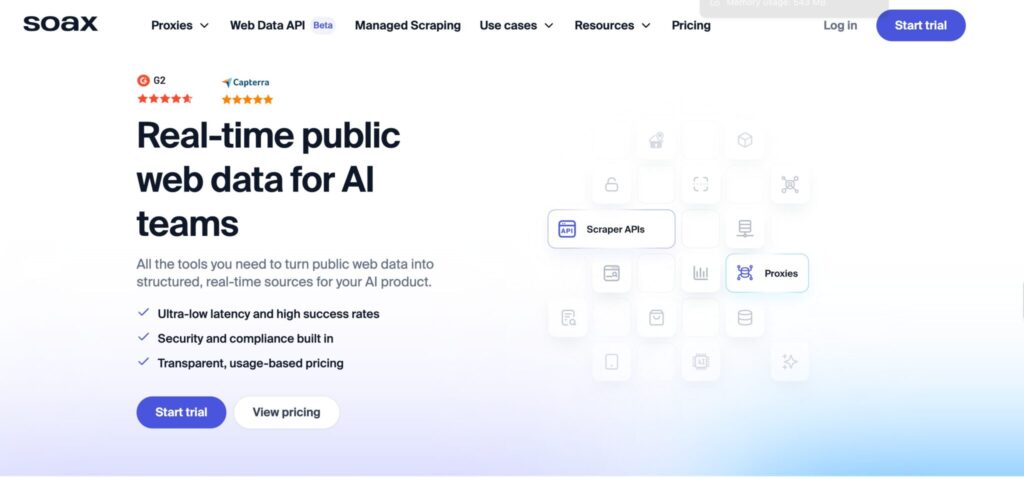
SOAX is a strong choice when location accuracy is important. Competitive price tracking often fails because the scraper collects the “default” price instead of the local price. SOAX helps solve that with strong geo-targeting across residential, mobile, ISP, and datacenter proxies.
The platform supports automatic IP rotation and sticky sessions, which gives teams flexibility across different workflows. For example, you can rotate aggressively while collecting thousands of product listing pages, then hold an IP longer when checking a product page that depends on session continuity.
SOAX also has a clean pricing structure where credits can be used across different proxy types and web data tools. That is useful for price tracking teams that need to test residential, mobile, and datacenter performance before choosing the most efficient setup.
Pro-Tip: Use SOAX when you need to compare pricing by city, mobile network, or ISP-level location behavior.
5. NetNut
NetNut is built for teams that care about stable data collection at volume. Its residential and rotating residential products are positioned for public web data collection, and the network offers broad global coverage.
For competitive price tracking, NetNut fits use cases where consistency is more important than experimenting with the cheapest proxy possible. If your scraper runs every hour, checks large catalogs, or supports internal pricing decisions, random downtime can become expensive. NetNut’s value comes from reliable throughput and business-friendly infrastructure.
It is a good fit for mature ecommerce monitoring systems, travel fare tracking, stock availability checks, and brand protection teams. The interface is straightforward, and the rotation model is easy to understand, which helps teams avoid overcomplicating their setup.
Pro-Tip: Track success rate by target domain. NetNut may perform very well on some ecommerce sites, but you should still benchmark it against residential and ISP alternatives.
6. IPRoyal
IPRoyal is a strong budget-friendly option for teams that want residential proxies without a large monthly commitment. Its residential proxy setup includes rotation options, sticky sessions, and flexible purchasing, making it useful for early-stage price tracking projects.
The biggest appeal is cost control. Not every company starts with millions of requests. Some only need to monitor 20 competitors, 5,000 SKUs, or a few markets. For those teams, IPRoyal can be a practical starting point.
It may not be the first pick for complex enterprise scraping, but it works well for lightweight to mid-sized workflows where you need real residential IPs, basic geo-targeting, and simple rotation settings.
Pro-Tip: Use IPRoyal for test runs before committing to a premium provider. It is useful for validating target difficulty and bandwidth needs.
7. Webshare
Webshare is one of the better low-cost options for teams testing price tracking at smaller scale. It offers rotating residential, static residential, and datacenter proxies, with pricing that is attractive for budget-sensitive users.
The platform is easy to use, and the pricing is clear enough for beginners. Webshare is especially useful when you are scraping less-protected targets, running proof-of-concept jobs, or building a basic competitor price tracker before moving into heavier infrastructure.
Its static residential and datacenter options can also work well for sites that do not require constant residential rotation. However, for aggressive ecommerce targets with advanced bot protection, you may need a stronger residential provider or a scraper API.
Pro-Tip: Do not overpay for residential traffic if datacenter proxies work on your target. Test Webshare datacenter proxies first on easy retail sites.
8. Rayobyte
Rayobyte is a good option for teams that want a mix of datacenter, ISP, and residential proxies. It is especially worth considering when your targets are not extremely protected and you want predictable pricing for recurring monitoring.
For price tracking, Rayobyte’s datacenter proxies can work well on accessible retail sites, product catalogs, and inventory pages. ISP proxies are useful when you need more trust than datacenter IPs but do not want the variable nature of rotating residential networks.
Rayobyte is not always the flashiest provider, but it can be cost-effective for structured, repeatable scraping jobs. If your team already knows which competitor sites you need to monitor, it is worth testing.
Pro-Tip: Use ISP proxies for competitors that allow browsing but flag obvious datacenter traffic.
How To Choose The Best Proxy For Competitive Price Tracking
1. Match Proxy Type To Target Difficulty
Not every site needs residential proxies. For simple competitor stores, datacenter proxies may work and cost much less. For Amazon-style marketplaces, travel sites, sneaker retailers, or platforms with advanced bot systems, residential or mobile proxies usually perform better.
A smart setup uses multiple proxy types. Datacenter for easy pages. ISP proxies for stable sessions. Residential proxies for tougher targets. Mobile proxies only where mobile pricing, app-like behavior, or strict anti-bot checks matter.
2. Check IP Pool Quality, Not Just Pool Size
A huge IP pool looks impressive, but quality matters more. You need clean IPs, low block rates, healthy geographic distribution, and enough available IPs in your target regions.
For price tracking, the real question is simple: can the provider repeatedly access the exact competitor pages you care about without showing distorted prices or constant CAPTCHAs?
3. Rotation Protocols Matter
Rotation is not just “change IPs often.” It needs to match the task.
Use fast rotation for collecting product listing pages, search pages, and broad catalogs. Use sticky sessions when the website needs continuity, such as location selection, cart simulation, shipping checks, or multi-step product flows.
Bad rotation creates broken data. If your IP changes halfway through a localized session, the site may reset the region and show a default price.
4. Prioritize Geo-Targeting
Competitive pricing is often local. A product may cost one amount in New York, another in London, and another in Mumbai. Some ecommerce sites also personalize price by ZIP code, currency, warehouse, or delivery zone.
Choose a provider with country, city, and ideally ZIP or ASN-level targeting if local price accuracy matters.
5. Measure Success Rate Per Domain
Do not judge a proxy provider by marketing claims alone. Run a benchmark across your real targets. Track status codes, CAPTCHA rate, response time, price extraction accuracy, and cost per successful page.
The cheapest proxy can become expensive if 40% of requests fail.
FAQs
What are the best proxies for competitive price tracking?
Bright Data and Oxylabs are best for enterprise-scale tracking. Decodo and SOAX are strong for mid-market teams. IPRoyal and Webshare are better for budget testing. Rayobyte works well for datacenter and ISP-based workflows.
Are residential proxies necessary for price monitoring?
Not always. Residential proxies are useful for protected sites, localized pricing, and marketplaces. For easier retail websites, datacenter or ISP proxies may be enough.
What is the best rotation setting for price scraping?
Use rotating IPs for large product lists and sticky sessions for location-based flows, carts, and checkout-related price checks.
Can proxies show different prices by location?
Yes. Proxies can help you view prices from different countries, cities, or regions, depending on the provider’s geo-targeting controls.
Are mobile proxies better for price tracking?
Mobile proxies can help with strict anti-bot systems and mobile-specific pricing, but they are usually more expensive. Use them only when residential or ISP proxies fail.
How much bandwidth do I need for price tracking?
It depends on page size, request frequency, JavaScript rendering, and number of SKUs. Start with a small test, measure bandwidth per successful page, then scale from real usage data.
What is the biggest mistake in proxy-based price tracking?
Using one proxy type for every target. The better approach is to segment websites by difficulty and assign datacenter, ISP, residential, or mobile proxies based on actual block rates.
Final Verdict
The best proxy for competitive price tracking depends on how serious your operation is.
For enterprise teams, Bright Data and Oxylabs offer the strongest control, targeting, and scale. For growing ecommerce and analytics teams, Decodo and SOAX offer a better balance of power, usability, and cost. NetNut is a strong pick for high-volume stability, while IPRoyal, Webshare, and Rayobyte are practical choices for smaller budgets or controlled tracking workflows.
The real test is not the size of the proxy pool. It is whether your scraper collects clean, local, repeatable pricing data from the sites that matter to your business. Start with a benchmark, measure success rate by domain, and build your proxy stack around accuracy, not hype.