
Best Proxies For Data Annotation.
Data annotation sounds simple until your team starts collecting live web examples, verifying regional content, checking search results, testing local user experiences, or reviewing datasets across different markets. Then the boring part becomes the expensive part: access.
A proxy setup can make or break a data annotation pipeline. The right proxy network helps annotation teams see public web content from the right country, city, ISP, device type, or session pattern. The wrong one gives you noisy data, blocked requests, duplicate samples, broken sessions, or mislabeled examples that quietly weaken your AI model.
For data annotation, proxies are not just about “getting around blocks.” That is a shallow way to look at it. The better use case is controlled access. You want consistent location signals, stable sessions, clean IP pools, predictable rotation, and enough diversity to avoid training your model on a narrow slice of the web.
This guide breaks down the best proxy providers for data annotation, especially for teams working on AI datasets, search evaluation, ecommerce labeling, ad review, SERP annotation, brand monitoring, content classification, and geo-specific web research.
Quick Comparison Table: Best Proxies For Data Annotation
| Provider | Best For | Proxy Types | IP Pool Strength | Rotation Control | Geo Targeting | Best Annotation Use Case | Main Limitation |
|---|---|---|---|---|---|---|---|
| Bright Data | Enterprise annotation pipelines | Residential, ISP, datacenter, mobile | Very large global pool | Strong session controls | Country, city, ZIP, ASN | Large-scale AI data collection and validation | Can feel expensive for small teams |
| Oxylabs | High-volume public data workflows | Residential, datacenter, ISP, mobile | Huge enterprise-grade network | Strong rotation and scraping tools | Country, city, state-level options | SERP, ecommerce, web content annotation | Enterprise setup may be more than beginners need |
| Decodo | Balanced price and usability | Residential, datacenter, ISP, mobile | Large global network | Rotating and sticky sessions | Wide country coverage | Mid-sized annotation teams | Advanced enterprise controls are lighter than top-tier tools |
| SOAX | Geo-sensitive labeling tasks | Residential, mobile, ISP, datacenter | Strong residential and mobile coverage | Flexible rotation windows | City, region, ASN targeting | Local app, mobile, and regional dataset checks | Pricing can rise with heavy bandwidth use |
| NetNut | Stable enterprise sessions | Residential, static residential, datacenter, mobile | Strong ISP-backed network | Good for sticky sessions | Global country coverage | Long-session data QA and account-safe workflows | Less beginner-friendly than budget tools |
| IPRoyal | Budget-conscious annotation teams | Residential, ISP, datacenter, mobile | Smaller but useful pool | Sticky and rotating sessions | Country and city options | Small dataset projects and manual labeling | Not as deep for advanced automation |
| Webshare | Low-cost static and rotating proxies | Datacenter, ISP, residential | Good affordable coverage | Simple rotation setup | Global coverage | Testing, small scraping jobs, QA labeling | Fewer advanced data tools |
| Rayobyte | Ethical ISP and datacenter workflows | Residential, ISP, datacenter | Solid US and global coverage | Static and rotating options | Location-based targeting | Stable collection jobs and QA projects | Residential pool is smaller than giants |
Why Data Annotation Teams Need Proxies
Data annotation depends on context. A product listing in the US may look different from the same listing in Germany. Search results shift by country, city, language, device, history, and sometimes even ISP patterns. Ad placements change by region. Prices change. Local news results change. Some websites serve different layouts by geography.
Without proxies, your annotation team may label a narrow version of reality.
A clean proxy setup helps teams:
- Collect public web samples from different markets
- Validate location-specific search and ecommerce results
- Check ads, prices, listings, and page layouts by region
- Build balanced datasets for AI model training
- Reduce duplicate or biased collection patterns
- Maintain stable sessions for multi-step annotation tasks
- Test mobile and desktop variations separately
The best setup usually combines residential proxies for realism, ISP proxies for stability, datacenter proxies for cheap high-speed tasks, and mobile proxies when the dataset depends on carrier-level or app-like behavior.
1. Bright Data
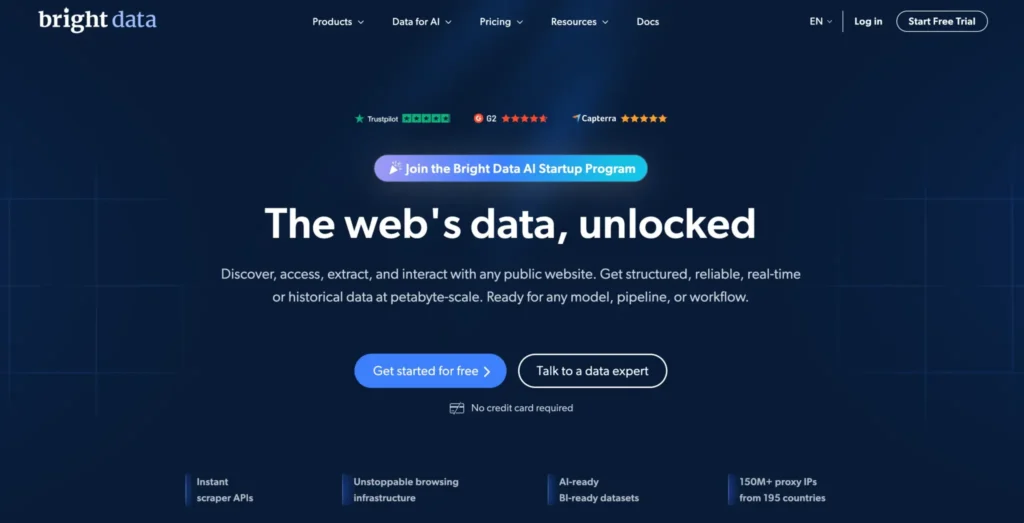
Bright Data is one of the strongest choices for serious data annotation workflows where scale, targeting, compliance, and control matter more than finding the cheapest GB price.
Its biggest advantage is flexibility. You get residential, ISP, datacenter, and mobile proxies, along with scraping APIs and dataset tools. For annotation teams, that means you can support several workflows from one platform: SERP collection, ecommerce price labeling, ad verification, social content checks, app localization review, and large-scale public data extraction.
Bright Data is especially useful when your labeling project needs precise geo targeting. If your team needs to compare how a page appears in California, Texas, London, Mumbai, or Berlin, strong location controls reduce the risk of mislabeled samples.
Session control is another major point. Some annotation jobs need fresh IPs on every request. Others need sticky sessions because the annotator has to move through several steps on the same site. Bright Data handles both well.
Pro Tip: Use residential proxies for page-level realism, but use ISP proxies for annotation tasks where stability matters more than maximum IP diversity.
Best For
Bright Data is best for enterprise AI teams, data vendors, search evaluation companies, and annotation operations that need strict controls, large IP diversity, and reliable infrastructure.
Watch Out For
It is not the most beginner-friendly or cheapest option. Smaller teams may feel like they are paying for features they do not fully use.
2. Oxylabs
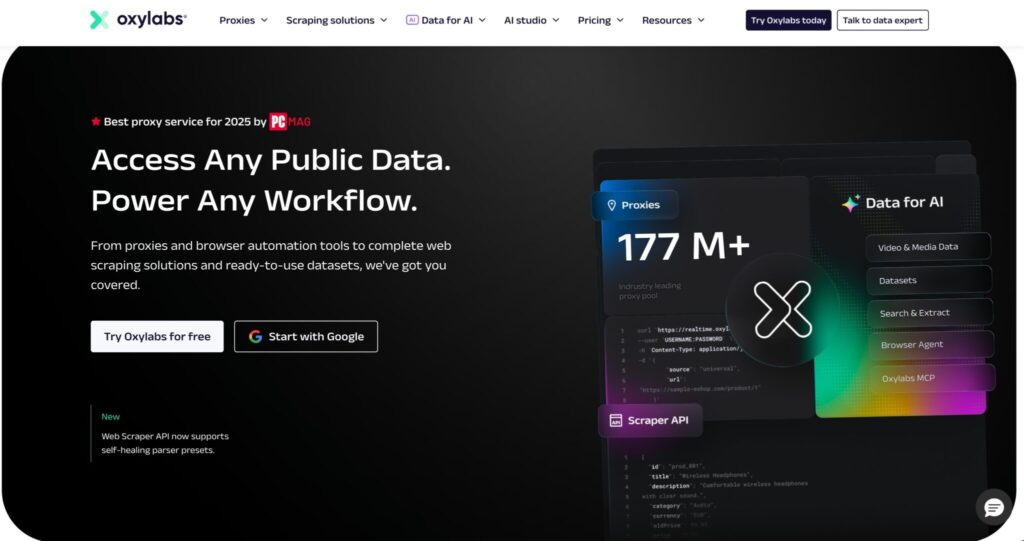
Oxylabs is built for companies that collect public web data at scale. That makes it a strong fit for data annotation pipelines where clean, structured, repeatable data access matters.
The provider offers residential, datacenter, ISP, and mobile proxy options, plus scraping products like Web Unblocker and Web Scraper API. For annotation teams, that matters because proxy management is only one part of the job. You also need reliable request handling, parsing, retry logic, and clean output.
Oxylabs performs especially well for SERP annotation, ecommerce data labeling, review classification, marketplace monitoring, and public content datasets. Its residential network is large, and its enterprise tooling helps when multiple teams or automated systems need access.
For AI dataset operations, Oxylabs works best when you have a technical team that can build workflows around its infrastructure. It is not just a plug-and-play proxy list. It is more like a data access layer.
Pro Tip: For annotation projects that require high accuracy, separate your proxy pools by task type. Do not mix SERP collection, ecommerce scraping, and QA browsing in one messy setup.
Best For
Oxylabs is best for large annotation teams, AI data vendors, SERP intelligence platforms, and enterprise scraping teams.
Watch Out For
The platform may be too advanced for simple manual annotation projects. If you only need a few proxies for basic QA, this may be more than necessary.
3. Decodo
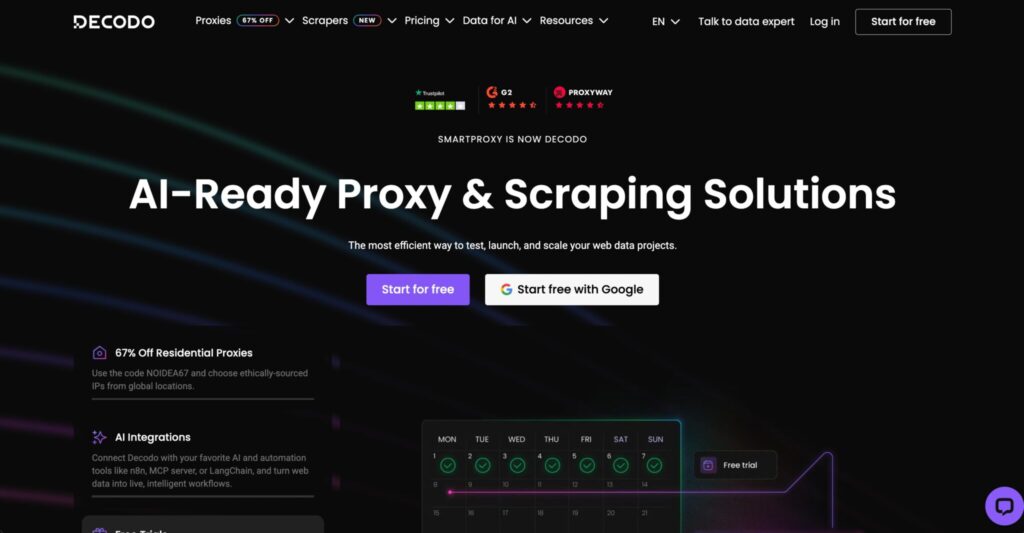
Decodo, formerly known as Smartproxy, is a strong middle-ground provider for data annotation teams that want good proxy quality without heavy enterprise complexity.
Its residential proxy network is large, the dashboard is easier to understand than many enterprise platforms, and the pricing tends to be more approachable for mid-sized teams. Decodo supports rotating and sticky sessions, which is important for annotation workflows because not every task needs the same rotation behavior.
For example, if your team is collecting page snapshots for labeling, rotating IPs can help create broader coverage. But if annotators need to log into a controlled research account or move through multi-page flows, sticky sessions are safer.
Decodo is also useful for teams doing location-based annotation, product intelligence labeling, search result evaluation, and ad placement checks. It does not feel as heavy as Bright Data or Oxylabs, which is a benefit for teams that want speed and simplicity.
Pro Tip: For annotation QA, create one proxy profile per region. It keeps testing cleaner and makes it easier to identify whether a labeling issue comes from the website, the annotator, or the proxy route.
Best For
Decodo is best for mid-sized teams, agencies, AI startups, and data annotation projects that need a balance of price, usability, and global coverage.
Watch Out For
It may not offer the same depth of enterprise compliance controls or custom data infrastructure as the highest-end platforms.
4. SOAX
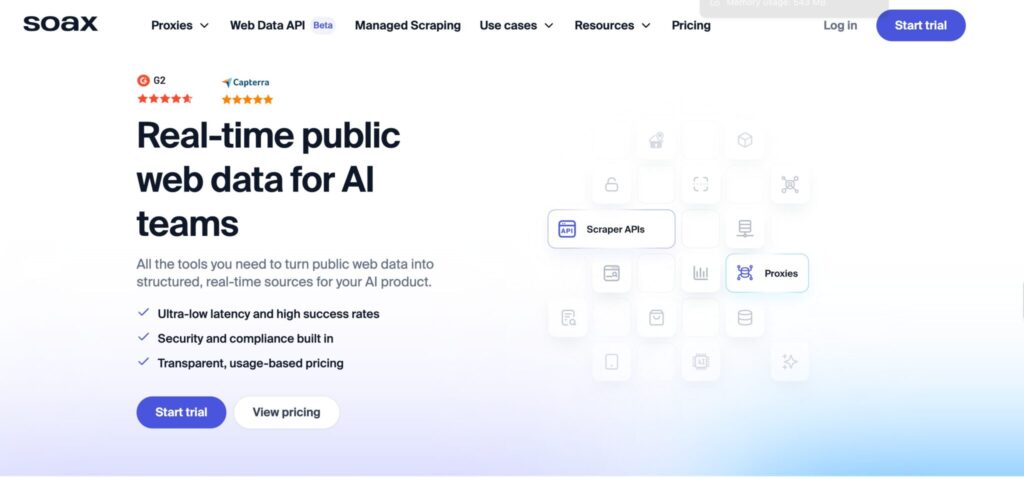
SOAX is a good choice when your annotation work depends heavily on geo accuracy. It offers residential, mobile, ISP, and datacenter proxies, with detailed targeting controls that help teams test how content appears in specific markets.
For data annotation, SOAX fits well when the dataset is sensitive to location. Think local search labeling, regional ad review, multilingual content validation, price comparison, delivery availability checks, or app-like mobile web behavior.
Its mobile proxy options also make it useful for projects where desktop residential traffic is not enough. Some platforms show different content to mobile networks. If your annotation team labels mobile experiences, using only datacenter proxies can distort the data.
Rotation flexibility is another benefit. You can tune sessions based on the task. Fast rotation works for broad sample collection. Sticky sessions work better for review workflows and multi-step browsing.
Pro Tip: When labeling location-sensitive pages, always record proxy country, city, ASN, device type, and timestamp with the annotation. That metadata can explain strange results later.
Best For
SOAX is best for geo-targeted annotation, mobile web testing, local content datasets, and teams that need a clean mix of residential and mobile IPs.
Watch Out For
Heavy bandwidth usage can get expensive, so it is smart to estimate GB needs before scaling.
5. NetNut
NetNut is a strong option for annotation workflows that need stability, long sessions, and enterprise-grade residential coverage. It is often a good fit for teams that care less about the lowest price and more about keeping collection workflows predictable.
Its rotating residential and static residential products are useful for data annotation because different labeling tasks behave differently. Some tasks need many IPs across many locations. Others need the same IP for longer browsing flows. NetNut handles both use cases well.
For example, if your team is annotating ecommerce checkout availability, travel listings, account dashboards, or multi-page content flows, a stable session is often better than constant IP rotation. Random rotation can break continuity and create bad data.
NetNut also supports common protocols like HTTP, HTTPS, and SOCKS5, which gives technical teams flexibility when integrating proxies into scraping tools, browsers, or internal annotation systems.
Pro Tip: Do not rotate too aggressively during human-in-the-loop annotation. If the same annotator appears to jump locations every few clicks, session quality drops fast.
Best For
NetNut is best for enterprise annotation workflows, stable session tasks, market research datasets, and long-running data QA projects.
Watch Out For
The platform is not always the simplest entry point for beginners, and smaller teams may prefer Decodo, IPRoyal, or Webshare.
6. IPRoyal
IPRoyal is a practical option for smaller data annotation teams that need residential or ISP proxies without signing up for a heavy enterprise plan.
It supports residential, ISP, datacenter, and mobile proxies. The biggest appeal is accessibility. The dashboard is easier to work with, and the pricing model is friendly for teams testing new annotation workflows before committing to larger vendors.
For data annotation, IPRoyal works well for small-scale SERP checks, product data labeling, content review, regional screenshot collection, and manual QA tasks. Its sticky session options are useful when an annotator needs to keep the same IP for a set period.
It may not match the giant proxy pools of Bright Data or Oxylabs, but not every annotation project needs a massive network. Sometimes you need clean coverage, simple controls, and a cost that does not scare the finance team.
Pro Tip: Start with a small sample job before buying large bandwidth. Check block rates, page load consistency, and whether your target regions return the expected content.
Best For
IPRoyal is best for small teams, AI startups, freelancers, and agencies running controlled data labeling projects.
Watch Out For
It is not the strongest choice for very large automated annotation pipelines that need deep custom routing and enterprise support.
7. Webshare
Webshare is a strong budget-friendly choice for teams that need affordable proxies for testing, QA labeling, and smaller data collection projects.
It offers datacenter, static residential, and rotating residential proxies. For annotation workflows, Webshare is useful when you need quick access to proxy infrastructure without building a complex enterprise setup.
Static residential proxies are helpful for stable workflows. Datacenter proxies are useful for high-speed, low-cost collection where realism is not the priority. Rotating residential proxies work better when you need broader web access and lower detection risk.
Webshare is not as feature-rich as Bright Data or Oxylabs, but that is partly the point. It is simple, affordable, and easy to deploy.
Pro Tip: Use Webshare datacenter proxies for low-risk collection and save residential traffic for pages where location realism or anti-bot sensitivity matters.
Best For
Webshare is best for smaller annotation teams, QA testing, early-stage dataset collection, and budget-sensitive workflows.
Watch Out For
It lacks some advanced scraping APIs, enterprise controls, and premium managed support found in higher-end providers.
8. Rayobyte
Rayobyte is a good fit for annotation teams that care about ethical sourcing, ISP proxies, and stable data collection. Its product range includes datacenter, ISP, and residential proxies, with a strong emphasis on clean proxy infrastructure.
For data annotation, Rayobyte works well when you need stable routes for product pages, local listings, search checks, or public web collection. ISP proxies are especially useful because they offer a nice middle ground: more credible than datacenter IPs, often faster and more stable than rotating residential pools.
Rayobyte is also worth considering for teams that prefer long-term proxy management over rapid-fire rotation. Some annotation projects do not need millions of IPs. They need reliable IPs that do not fail halfway through a batch.
Pro Tip: ISP proxies are often the sweet spot for annotation QA. Use them when you need trust signals and speed, but not constant residential rotation.
Best For
Rayobyte is best for ISP-heavy workflows, stable collection jobs, QA annotation, and teams that want ethical proxy sourcing.
Watch Out For
If your project needs massive global residential diversity, Bright Data, Oxylabs, SOAX, or Decodo may be stronger.
How To Choose The Best Proxy For Data Annotation
1. Match Proxy Type To The Annotation Task
Residential proxies are best when your team needs realistic user-like access. Use them for SERP annotation, ecommerce pages, marketplace listings, ad checks, and regional content review.
ISP proxies are best when you need stable, fast, credible IPs. They work well for QA labeling, repeated checks, and workflows where rotating every few requests creates noise.
Datacenter proxies are best for speed and low cost. Use them for low-risk pages, internal testing, metadata checks, and public sources that do not require residential realism.
Mobile proxies are best for app-like behavior, mobile web testing, carrier-specific content, and social or local mobile experiences.
2. Check IP Pool Quality, Not Just Pool Size
A huge IP pool sounds impressive, but pool quality matters more. Look for clean IPs, real geographic diversity, low reuse, stable uptime, and transparent sourcing.
For annotation, bad IPs do more than cause blocks. They can poison your dataset. If the proxy returns unusual layouts, wrong regions, CAPTCHA pages, or partial content, your annotators may label broken data.
3. Use The Right Rotation Protocol
Rotation is not always good. It depends on the job.
Use per-request rotation when collecting broad samples across many pages. Use sticky sessions when annotators need to browse multiple pages in one flow. Use time-based rotation when you want freshness but still need some browsing continuity.
A good setup lets you choose between rotating sessions, sticky sessions, and custom TTL values.
4. Track Metadata With Every Label
For serious annotation work, store proxy metadata beside the label. At minimum, track country, city, proxy type, session ID, timestamp, target URL, device type, and language setting.
This helps your team audit strange labels later. Without metadata, you may not know whether a difference came from the page, the annotator, the region, or the proxy.
5. Start With A Test Batch
Before buying a large plan, run a test batch of 500 to 1,000 requests or manual checks. Measure success rate, block rate, duplicate content, page load time, CAPTCHA frequency, location accuracy, and annotation consistency.
The best proxy is not always the biggest one. It is the one that returns clean, usable data for your specific workflow.
Best Proxy Setup For Most Data Annotation Teams
For most professional teams, a blended setup works best:
- Residential proxies for public web collection and geo-specific pages
- ISP proxies for stable QA workflows and repeat checks
- Datacenter proxies for low-cost testing and non-sensitive pages
- Mobile proxies only when mobile behavior matters
If budget allows, Bright Data or Oxylabs are the safest enterprise picks. Decodo and SOAX are strong mid-market choices. IPRoyal and Webshare are better for smaller teams. Rayobyte is useful when ISP stability is the priority.
FAQs
What are the best proxies for data annotation?
The best proxies for data annotation are residential, ISP, and mobile proxies, depending on the task. Bright Data, Oxylabs, Decodo, SOAX, NetNut, IPRoyal, Webshare, and Rayobyte are strong options for different budgets and workflows.
Are residential proxies better for AI data labeling?
Residential proxies are usually better when your annotation team needs realistic regional access. They help collect public web data as it appears to normal users in different locations.
When should I use ISP proxies for annotation?
Use ISP proxies when you need stable sessions, fast speeds, and stronger trust signals than datacenter proxies. They are useful for QA checks, repeated testing, and multi-page workflows.
Do proxies improve dataset quality?
Yes, when used correctly. Proxies help diversify location, device, and network signals, which can reduce bias in datasets. Poor-quality proxies can do the opposite by returning blocked pages or incorrect regional content.
What is the best rotation setting for annotation?
For broad data collection, per-request rotation can work well. For human annotation and multi-step review, sticky sessions are usually better because they keep the browsing context stable.
Are datacenter proxies good for data annotation?
Datacenter proxies are good for low-cost, high-speed tasks where realism is not required. They are not ideal for sensitive targets, geo-specific pages, or platforms that treat datacenter traffic differently.
How many proxies do I need for a data annotation project?
It depends on request volume, target websites, locations, and session length. A small manual project may need only a few proxy endpoints, while a large AI dataset pipeline may need thousands of rotating IPs across many regions.
Should I use mobile proxies for annotation?
Use mobile proxies only when mobile network behavior matters. They are useful for app testing, mobile SERP checks, social feeds, local mobile ads, and carrier-specific content.
What is the biggest proxy mistake in data annotation?
The biggest mistake is treating all proxy traffic the same. Annotation teams should separate proxy pools by task, region, and session behavior. Mixing everything together makes the dataset harder to trust.