
E-commerce looks simple from the outside. A product page, a price, a checkout button, a few reviews, and maybe a discount badge. Behind the scenes, though, serious online stores are constantly watching prices, checking stock, testing regional pages, tracking ad placements, monitoring competitors, and protecting their own listings from copycats.
That is where proxies come in.
A good e-commerce proxy setup lets your team collect public market data from different locations, test storefront experiences by country or city, verify ads, run price intelligence workflows, and separate legitimate business accounts without sending every request through the same IP address.
The key word is legitimate. Proxies are not a shortcut for breaking marketplace rules, scraping private data, or hammering websites with reckless automation. The best e-commerce teams use them with rate limits, compliance checks, clean data policies, and respect for platform terms.
For this guide, I focused on providers that make sense for real e-commerce work: residential coverage, sticky sessions, rotating sessions, geo-targeting, reliability, dashboard quality, pricing flexibility, and support for price monitoring or market research workflows.
Why E-Commerce Teams Need Proxies?
E-commerce teams use proxies because online stores do not always show the same page to every visitor. Pricing, shipping, stock status, product ranking, promotions, seller visibility, reviews, and ad placements can change by region, device, IP reputation, and session behavior.
A pricing team might need to monitor how a product appears in the United States, Germany, India, and the United Kingdom. A marketplace seller might need to check whether competitors are undercutting them across different ZIP codes. A brand protection team may need to identify unauthorized sellers or copied listings. A QA team may need to test checkout flows from different countries without relying on a VPN that does not match real user traffic.
Residential proxies are often the best fit for sensitive e-commerce data collection because they route traffic through ISP-assigned residential IPs. Datacenter proxies are faster and cheaper, but they are easier for large e-commerce platforms to classify as automation traffic. ISP proxies sit in the middle: they offer more stability than rotating residential proxies while still looking closer to residential traffic.
The proxy type you choose depends on the task:
| E-Commerce Task | Best Proxy Type | Why It Works |
|---|---|---|
| Competitor price tracking | Rotating residential | Helps distribute public data requests across regions |
| Stock availability monitoring | Residential or ISP | Better for regional availability checks |
| Marketplace account management | ISP or static residential | Stable sessions reduce login friction |
| Ad verification | Residential or mobile | Shows ads as real regional users may see them |
| Product page scraping | Residential with rotation | Better for larger catalog monitoring |
| Checkout and UX testing | Static residential or ISP | Keeps the session stable through multi-step flows |
| Bulk crawling low-risk pages | Datacenter | Cheap and fast when targets are not strict |
Pro-Tip: Do not buy the largest IP pool just because the number looks impressive. For e-commerce, three things matter more: clean IP quality, stable sessions, and location accuracy.
9 Best Proxies for E-Commerce in 2026
#1: Oxylabs: Best E-Commerce Proxy for Enterprise Retailers
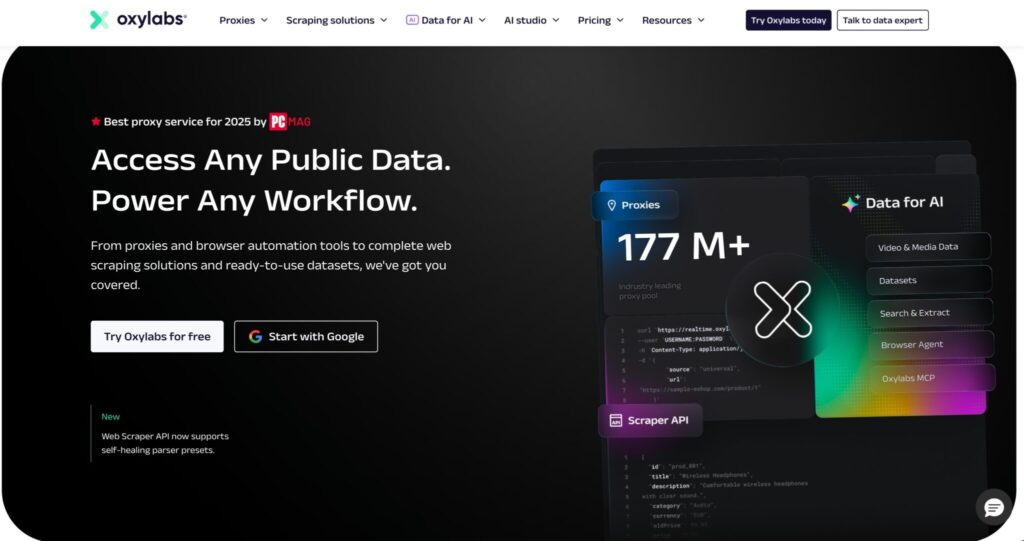
Oxylabs is the provider I would put at the top for enterprise e-commerce teams that care about scale, reliability, and managed data collection. It is not the cheapest option, but that is not the point. Oxylabs is built for companies that need structured workflows around public web data, not just a pile of proxy endpoints.
The company lists a residential proxy pool of 175M+ IPs and 2M datacenter IPs, along with scraping tools such as Web Unblocker, Web Scraper API, Headless Browser, and data-focused products. Its e-commerce solution is positioned around accessing real-time public marketplace and retail data, which makes it a natural fit for price intelligence, product availability tracking, review monitoring, and competitive research.
For e-commerce, Oxylabs makes the most sense when you are monitoring thousands or millions of product URLs, dealing with multiple countries, or running a team that needs support, account management, and infrastructure reliability. Their residential proxies support SOCKS5, and the residential product includes city-level targeting, which is valuable when pricing or availability changes by metro area.
The biggest strength is depth. You can use raw proxies, scraping APIs, Web Unblocker, or managed data solutions depending on how much infrastructure you want to own. A small Shopify seller probably does not need all of that. A retail intelligence platform absolutely might.
Best for: Enterprise retailers, pricing intelligence teams, brand protection teams, and large-scale public e-commerce data collection.
Pros
- Huge residential IP pool
- Strong scraping infrastructure
- Suitable for large e-commerce monitoring projects
- City-level targeting
- Enterprise support and account guidance
Cons
- More expensive than budget providers
- Can feel heavy for small teams
- Best value appears when you operate at scale
Pro-Tip: Use Oxylabs when the business cost of missing data is higher than the proxy bill. If your pricing engine affects revenue daily, cheap unstable proxies are not really cheap.
#2: Decodo: Best Value E-Commerce Proxy
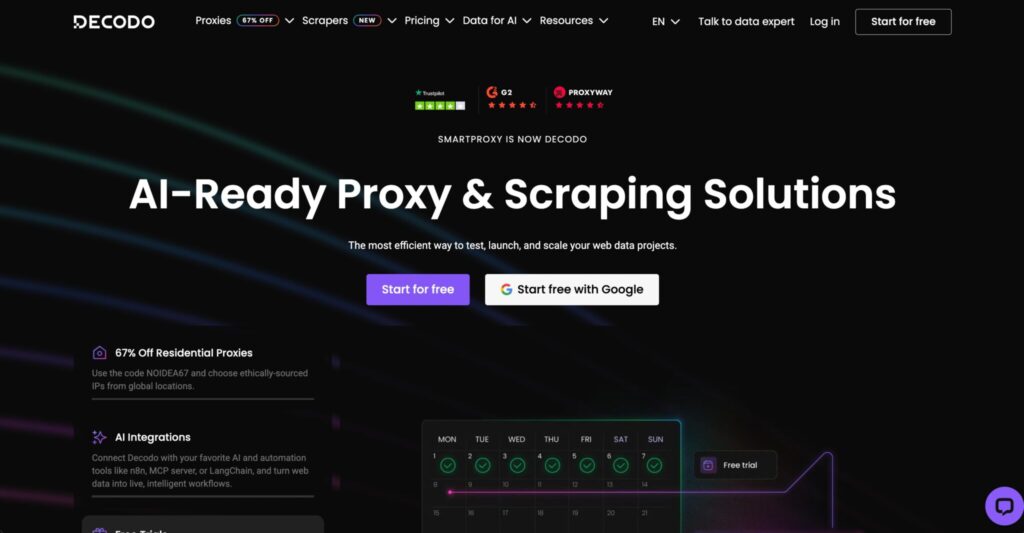
Decodo, formerly Smartproxy, is one of the best value picks for e-commerce teams that want strong performance without jumping straight into enterprise pricing. It offers residential, static residential, mobile, and datacenter proxies, with a residential pool listed at 115M+ IPs across 195+ locations. The residential proxy page also mentions rotating and sticky session options, 24/7 tech support, a 3-day free trial, and a 14-day money-back option.
For e-commerce, Decodo is strong because it balances ease of use and technical flexibility. You can use rotating residential proxies for price monitoring, static residential proxies for account-based workflows, and mobile proxies when you need mobile-like traffic for ad or app testing. Decodo also publishes guidance around choosing residential, datacenter, ISP, and mobile proxies by use case, including differences in detection resistance, session control, pricing, and performance.
The interface is beginner-friendly, but it does not feel toy-like. Developers can integrate it into scrapers and monitoring tools, while non-technical growth teams can still understand bandwidth, location settings, and session choices.
For most mid-market e-commerce teams, Decodo is a practical sweet spot. You get enough IP diversity for serious price tracking, enough session control for multi-step workflows, and enough support to avoid spending every week troubleshooting proxy failures.
Best for: Mid-sized e-commerce teams, price monitoring tools, developers, agencies, and value-focused data teams.
Pros
- Strong residential coverage
- Good pricing-to-performance balance
- Rotating and sticky sessions
- Easy dashboard
- Suitable for both developers and non-technical teams
Cons
- Enterprise teams may still prefer Oxylabs or Bright Data
- Advanced scraping layers may cost more depending on usage
- Not always the cheapest for very small users
Pro-Tip: For product-page monitoring, start with rotating residential proxies. For login-based internal testing or marketplace account work, use static residential or ISP-style setups where available.
#3: Webshare: Best E-Commerce Proxy for Startups and Developers
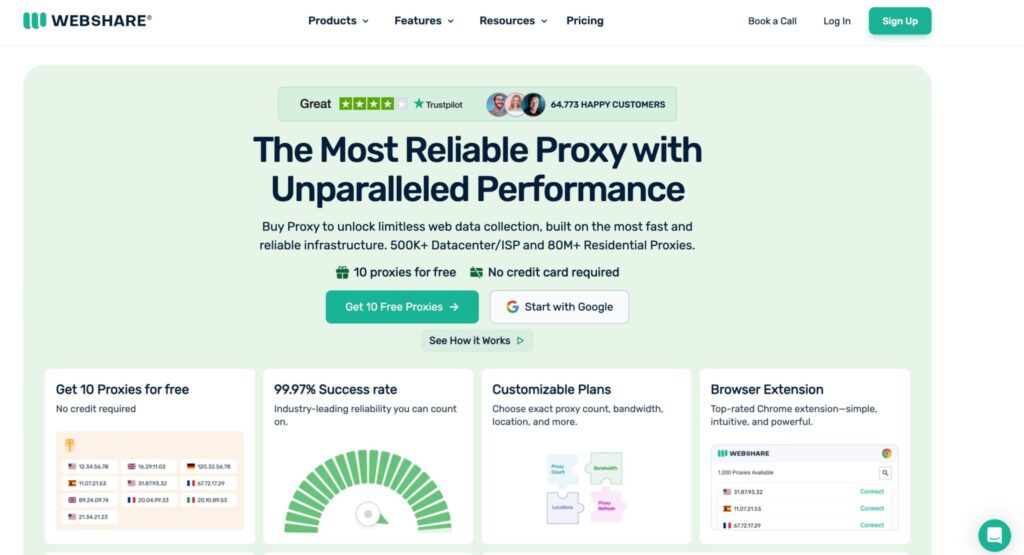
Webshare is one of the most practical options for startups, solo developers, and e-commerce teams that want affordable proxies without dealing with enterprise sales calls. It offers three main proxy products: datacenter proxy servers, static residential, and residential proxies. Its site lists proxy servers with 400K+ IPs and 99.97% uptime, while its residential page lists 80M+ ethically sourced residential IPs and pricing as low as $1.40/GB.
Webshare also has a dedicated e-commerce proxy use case page, positioning its proxies for scraping operations and offering a free start with 10 proxies and no credit card requirement.
What makes Webshare interesting is its developer-friendly setup. The dashboard is clean, the pricing is approachable, and the product choices are not confusing. If you are building a small internal price tracker, testing a scraper, monitoring a niche product category, or running lightweight catalog research, Webshare is easy to justify.
It is not the most advanced provider in this list. You do not get the same level of managed scraping infrastructure that you would from Oxylabs or Bright Data. But that may be a benefit if you already have your own crawler and just need stable proxy access at a reasonable cost.
Best for: Startups, indie developers, small e-commerce teams, and lightweight price monitoring.
Pros
- Affordable entry point
- Simple product lineup
- Free start available
- Residential, static residential, and datacenter options
- Good fit for custom developer workflows
Cons
- Less advanced than enterprise data platforms
- Support depth may not match premium providers
- More DIY setup for scraping logic
Pro-Tip: Use Webshare datacenter proxies for low-risk pages and residential proxies for stricter e-commerce targets. Mixing both can lower cost without sacrificing reliability where it matters.
#4: Bright Data: Best E-Commerce Proxy with Pre-Built Datasets
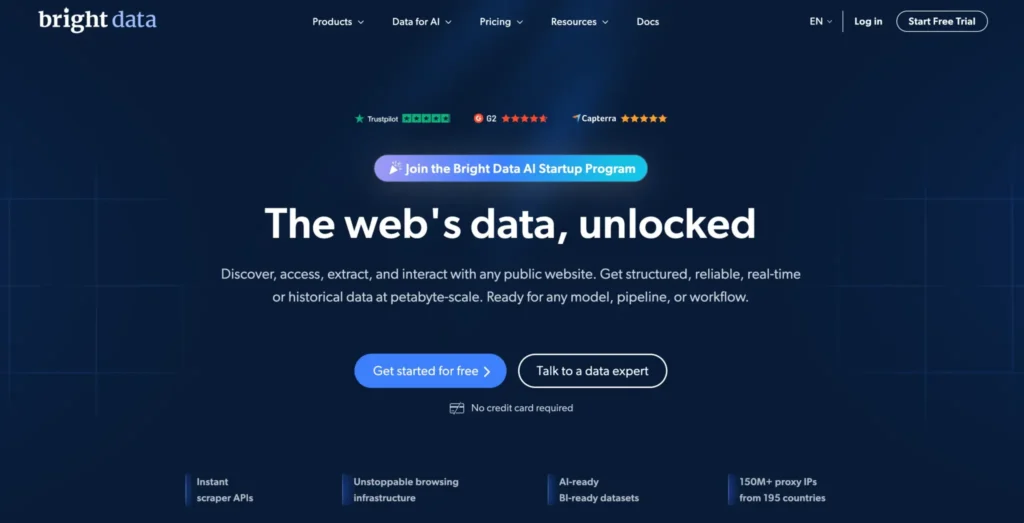
Bright Data is more than a proxy provider. It is a full web data platform, and that makes it especially useful for e-commerce teams that want ready-made datasets, scraper APIs, and proxy infrastructure under one roof.
Bright Data lists 400M+ residential proxy IPs and targeting by country, city, carrier, and ASN. Its e-commerce scraper is designed to collect public data such as trending products, best-selling products, prices, product reviews, and more. Its e-commerce datasets cover marketplaces and retailers such as Amazon, Walmart, Target, and eBay, with product fields like title, seller name, brand, description, price, currency, availability, ratings, and reviews depending on the dataset.
This is the right pick when your team wants the data outcome, not just the proxy layer. For example, a marketplace analytics company may not want to build every scraper from scratch. A brand may want ready-to-use datasets for category research. A pricing intelligence team may need structured data delivered reliably rather than spending months maintaining crawlers.
Bright Data is powerful, but it can be expensive and more complex than basic proxy services. Smaller teams may find it overbuilt. Larger teams, especially those with revenue tied to data quality, will appreciate the flexibility.
Best for: Data-heavy e-commerce teams, product intelligence platforms, brands, and companies that want datasets plus proxies.
Pros
- Huge proxy network
- Strong e-commerce scraper tools
- Ready-made e-commerce datasets
- Advanced targeting
- Good for enterprise-scale data work
Cons
- Premium pricing
- More complex than basic proxy tools
- May be too much for small monitoring projects
Pro-Tip: If your team keeps fixing broken scrapers every week, compare the cost of engineering time against Bright Data’s scraper or dataset options. Sometimes the expensive tool is cheaper than constant maintenance.
#5: SOAX: Best E-Commerce Proxy for Multi-Region Price Collection
SOAX is a strong fit for e-commerce teams that care about location precision. Its residential proxy page lists 155M+ IPs in 195+ locations, unlimited concurrent sessions, ethically sourced proxies, 99.9% network uptime, automatic IP rotation, and sticky sessions. Its location page also highlights country, region, and city targeting.
For e-commerce price monitoring, location accuracy matters. A retailer may show different prices in New York, London, Berlin, Mumbai, or Sydney. Shipping availability can shift by region. Promotions may appear in one city and not another. If you are collecting product intelligence across markets, you need proxies that let you test those markets with control.
SOAX also publishes rotation guidance, including flexible rotation options in the dashboard. That is useful because not every e-commerce task needs the same rotation pattern. Product listing pages may work better with frequent rotation. Checkout testing or account-based workflows need sticky sessions, so your cart and session tokens do not break mid-flow.
SOAX is not the cheapest provider, but it is a smart mid-to-premium choice for teams that need accuracy, not just volume.
Best for: Regional price tracking, global product monitoring, localized market research, and ad verification.
Pros
- Strong residential pool
- Good location targeting
- Automatic rotation and sticky sessions
- Suitable for multi-region research
- Supports high-concurrency workflows
Cons
- Budget users may find cheaper options elsewhere
- Requires proper setup to control costs
- Not as dataset-focused as Bright Data
Pro-Tip: For price monitoring, separate jobs by country or region. Do not mix all locations in one messy pool. Clean location logic gives cleaner pricing data.
#6: IPRoyal: Best E-Commerce Proxy for Account Management
IPRoyal is a good pick for teams that need affordable proxies for account-based e-commerce workflows, testing, and lighter data collection. Its residential proxy product lists 32M+ IPs across 195+ countries, rotating and sticky sessions, HTTP(S) and SOCKS5 support, country, state, and city-level targeting, a 99.4% success rate, and roughly 0.5s response time. Its homepage also positions ISP proxies for e-commerce automation, ad verification, and long-session reliability.
That ISP angle matters. For marketplace work, session stability can be more important than rapid rotation. If you are logging into a seller dashboard, testing ad placements, reviewing localized storefronts, or managing legitimate regional business accounts, you usually want a stable IP that does not change every request.
IPRoyal is not the largest provider in this guide, and it does not offer the same scraping infrastructure as Bright Data or Oxylabs. But it is accessible, flexible, and easier to fit into smaller budgets. For account management and sticky-session workflows, that is a real advantage.
Best for: Marketplace account management, ad verification, regional QA, and budget-conscious teams needing sticky sessions.
Pros
- Affordable compared with premium providers
- Residential, ISP, datacenter, and mobile options
- Sticky and rotating sessions
- HTTP(S) and SOCKS5 support
- Good for long-session reliability
Cons
- Smaller IP pool than top enterprise providers
- Less built-in scraping infrastructure
- Better for controlled workflows than massive crawling
Pro-Tip: For account work, avoid aggressive rotation. A stable ISP or static residential IP is usually safer for session continuity than rotating residential IPs.
#7: Proxy-Cheap: Best Budget E-Commerce Proxy

Proxy-Cheap is for teams that need to control spend. It offers rotating residential, datacenter IPv4, datacenter IPv6, static residential, mobile, and SOCKS5 proxy products. Its homepage lists rotating residential from $4.99/GB, datacenter IPv4 from $1.49/month after displayed discount, static residential, mobile options, browser extensions, usage analytics, and 24/7 customer support. Its rotating residential page also shows 1 GB at $4.99/GB.
For e-commerce, Proxy-Cheap is best suited for budget testing, small competitor checks, lighter scraping, SEO research, ad verification, and simple regional browsing. It is not the provider I would choose for mission-critical enterprise pricing systems, but it can work well when you need affordable coverage and are willing to test IP quality before scaling.
The product range is useful. Datacenter proxies can handle simple monitoring tasks. Rotating residential proxies can help with product-page collection. Static residential or ISP-style options can help with longer sessions. SOCKS5 support is available across several proxy types, which gives developers more flexibility.
Best for: Budget e-commerce research, small teams, side projects, and early-stage testing.
Pros
- Low starting prices
- Wide product range
- Browser extensions
- Usage analytics
- Good for testing ideas cheaply
Cons
- Not as premium as Oxylabs, Bright Data, or SOAX
- Quality may vary more by use case
- Requires testing before larger rollouts
Pro-Tip: Start with a small paid test. Run your real target pages, real locations, and real request volume. Proxy quality cannot be judged from the pricing page alone.
#8: ProxyEmpire: Best E-Commerce Proxy for Flexible Data Collection
ProxyEmpire is a flexible provider with residential, mobile, datacenter, and other proxy products. Its homepage lists 30M+ clean IPs, 170+ countries, 99.9% uptime, 24/7 support, and a trial option. Its locations page highlights country, regional, and city targeting, which is useful for e-commerce teams doing location-sensitive research.
The reason ProxyEmpire fits e-commerce is its flexibility. You can use residential proxies for product page monitoring, mobile proxies for app or ad testing, and datacenter proxies for basic data jobs where speed matters more than stealth. The geo-targeting options also help with regional pricing and localized product availability checks.
ProxyEmpire is a good fit for teams that do not want to commit to one narrow proxy type. Maybe your current project is price scraping, but next month you need ad verification or mobile testing. Having several proxy classes under one account makes that easier.
It is not as widely discussed as Oxylabs, Bright Data, or Decodo, but it has enough range to deserve a place in this list, especially for data teams that run different e-commerce workflows every month.
Best for: Flexible e-commerce data collection, regional price checks, mobile testing, and mixed proxy workflows.
Pros
- Residential, mobile, and datacenter options
- 170+ country coverage
- Country, region, and city targeting
- Trial available
- Useful for mixed data workflows
Cons
- Smaller pool than enterprise leaders
- Less known than the top-tier brands
- Needs testing for demanding targets
Pro-Tip: Use ProxyEmpire when your workflow changes often. One month may need mobile proxies, another month may need residential rotation, and another may only need datacenter speed.
#9: DataImpulse: Best Budget E-Commerce Proxy
DataImpulse is another strong budget-friendly choice, especially for price comparison and public web scraping. Its web scraping page lists a 90M IP pool of ethically sourced residential, mobile, and datacenter addresses from 195 countries, with pricing starting from $1/GB. Its residential proxy page also lists 90M+ ethical residential IPs and coverage across 195 countries.
For e-commerce, the standout is pricing flexibility. DataImpulse’s price comparison page says residential proxies start at $1/GB, no subscription is required, and traffic does not expire. That is attractive for small businesses that do not run monitoring jobs every day but still need reliable access when they do.
The platform is especially appealing for teams running periodic price checks, market research, ad verification, SERP tracking, or small-scale data collection. It may not have the enterprise polish of Bright Data or Oxylabs, but for budget-conscious e-commerce users, the value is hard to ignore.
Best for: Budget price monitoring, small teams, pay-as-you-go data collection, and occasional scraping projects.
Pros
- Low starting price
- No-subscription option
- Traffic does not expire
- 90M+ IP pool
- Good fit for price comparison workflows
Cons
- Less enterprise-grade than premium providers
- May need more hands-on setup
- Not ideal for teams needing managed datasets
Pro-Tip: DataImpulse is ideal when your monitoring schedule is uneven. If you only collect pricing data a few times per month, non-expiring traffic can be more cost-efficient than monthly bandwidth plans.
Massive Comparison Table: Best E-Commerce Proxies in 2026
| Provider | Best For | Main Proxy Types | IP Pool and Coverage | Rotation and Sessions | Geo-Targeting | E-Commerce Strength | Pricing Fit | Best Use Case |
|---|---|---|---|---|---|---|---|---|
| Oxylabs | Enterprise retailers | Residential, datacenter, ISP, mobile, scraper APIs | 175M+ residential IPs, 2M datacenter IPs | Rotation, sticky sessions, Web Unblocker support | Country, city, and more | Large-scale public marketplace data | Premium | Enterprise price intelligence |
| Decodo | Best value | Residential, static residential, mobile, datacenter | 115M+ residential IPs, 195+ locations | Rotating and sticky options | Country, state, city, ZIP depending on product | Balanced price, performance, usability | Mid-range | Product monitoring and scraping |
| Webshare | Startups and developers | Datacenter, static residential, residential | 80M+ residential IPs, 400K+ proxy server IPs | Rotating residential and static options | Global location support | Affordable developer workflows | Budget to mid-range | Lightweight price trackers |
| Bright Data | Datasets and scraper tools | Residential, ISP, mobile, datacenter, scraper APIs | 400M+ residential proxy IPs | Advanced proxy and scraper controls | Country, city, carrier, ASN | Datasets, scrapers, and premium data tools | Premium | Product datasets and market intelligence |
| SOAX | Multi-region pricing | Residential, mobile, ISP, datacenter | 155M+ residential IPs, 195+ locations | Automatic rotation and sticky sessions | Country, region, city | Accurate regional price collection | Mid to premium | Multi-country pricing checks |
| IPRoyal | Account workflows | Residential, ISP, mobile, datacenter | 32M+ residential IPs, 195+ countries | Rotating and sticky sessions | Country, state, city | Long-session reliability | Budget to mid-range | Marketplace account management |
| Proxy-Cheap | Budget users | Residential, datacenter, mobile, SOCKS5 | Broad product coverage | Rotating, static, SOCKS5 options | Popular countries and locations | Low-cost testing | Budget | Small e-commerce research |
| ProxyEmpire | Flexible data teams | Residential, mobile, datacenter | 30M+ clean IPs, 170+ countries | Rotating and session-based options | Country, region, city | Mixed proxy workflows | Mid-range | Regional monitoring and mobile testing |
| DataImpulse | Low-cost price checks | Residential, mobile, datacenter | 90M+ IPs, 195 countries | Pay-as-you-go proxy access | Country and advanced targeting options | Cheap price comparison workflows | Budget | Periodic price scraping |
How to Choose the Best Proxy for E-Commerce
1. Start with the Use Case, Not the Brand
Do not start by asking, “Which proxy provider is best?” Start with a sharper question: “What exactly are we doing?”
If you are monitoring public prices across 20 countries, you need strong residential coverage and clean geo-targeting. If you are managing legitimate seller accounts, you need stable ISP or static residential proxies. If you are crawling low-risk pages at high speed, datacenter proxies may be enough.
Here is a simple rule:
- Use residential proxies for product pages, regional pricing, public marketplace data, and harder targets.
- Use ISP or static residential proxies for accounts, dashboards, checkout testing, and long sessions.
- Use datacenter proxies for fast, cheap, lower-risk scraping.
- Use mobile proxies for mobile ads, app testing, and mobile-first e-commerce checks.
2. Treat IP Pool Size Carefully
Large IP pools sound impressive, but pool quality matters more than pool size. A 100M IP network with poor location accuracy or unstable sessions can perform worse than a smaller, cleaner provider.
For e-commerce, ask these questions:
- Are the IPs ethically sourced?
- Can I target the right country, region, city, or ZIP code?
- Can I keep the same IP long enough to complete a checkout flow?
- Can I rotate per request for catalog monitoring?
- Does the provider support HTTP(S), SOCKS5, or both?
- Can I track bandwidth by project?
Pro-Tip: Run a 3-day test before signing an annual plan. Test real product URLs, not just a homepage or a proxy checker.
3. Understand Rotation Protocols
Rotation controls how often your proxy IP changes.
For e-commerce, the three common patterns are:
| Rotation Type | Best For | Risk |
|---|---|---|
| Per-request rotation | Large-scale public product scraping | Can break sessions if used during login or checkout |
| Time-based rotation | Price monitoring and category tracking | Needs tuning for each target |
| Sticky sessions | Account management and checkout testing | Less IP diversity if overused |
A common mistake is using per-request rotation for everything. That can break carts, login sessions, and multi-step browsing flows. Another mistake is using one sticky IP for too many requests, which creates an obvious usage pattern.
The best setup usually combines both. Use rotating residential proxies for public product pages, and use sticky sessions for flows that need continuity.
4. Match Proxy Type to Platform Sensitivity
Not all e-commerce sites behave the same way. A small independent store may tolerate datacenter proxies. A major marketplace may require residential or ISP proxies with careful request pacing. A mobile-first shopping app may require mobile proxies for accurate testing.
A clean proxy setup should also include:
- User-agent consistency
- Reasonable request delays
- Retry logic that does not spam
- Regional headers that match proxy location
- Clean session handling
- Respect for robots.txt and platform terms
- No collection of personal, private, or restricted data
5. Watch Total Cost, Not Just Price Per GB
Cheap proxies can become expensive when failure rates are high. If half your requests fail, your effective price doubles. If poor data causes bad pricing decisions, the real cost is even higher.
Compare providers by:
- Cost per successful request
- Ban or block rate
- Response time
- Location match accuracy
- Support speed
- Dashboard reporting
- Data expiry rules
- Refund or trial options
Pro-Tip: Build a small benchmark sheet. Track 100 to 500 real requests per provider across your target sites. Measure success rate, speed, data accuracy, and cost. That beats guessing from review pages.
FAQs: Best Proxies for E-Commerce in 2026
What proxy type works best for Amazon scraping?
For public Amazon product data, residential proxies are usually the safest starting point because they look closer to normal consumer traffic than datacenter IPs. For session-based workflows, ISP or static residential proxies may work better because they keep the IP stable.
Use official APIs where available, respect Amazon’s terms, avoid private data, and use rate limits. Proxies should support compliant public data collection, not reckless scraping.
How do proxies help with e-commerce multi-account management?
Proxies can help separate legitimate business accounts by region, team, or workflow. For example, an agency managing several client storefronts may want each account to use a stable, consistent IP setup.
For this use case, ISP proxies or static residential proxies are usually better than rotating residential proxies. Constant IP changes during login can trigger security checks or session interruptions.
Can I use proxies to check competitor prices automatically?
Yes, proxies are commonly used for public price monitoring. A typical setup checks product pages from different regions, records price, stock status, shipping information, seller name, discount, and review count, then stores the data in a dashboard.
Keep the frequency reasonable. For many stores, hourly or daily checks are enough. High-frequency monitoring should be limited to important SKUs where price changes affect revenue.
How often should I run e-commerce price monitoring?
It depends on the category. Fast-moving categories like electronics, travel accessories, supplements, fashion drops, and marketplace products may need several checks per day. Slower categories may only need daily or weekly checks.
A smart setup checks high-value products more often and long-tail products less often. That saves bandwidth and reduces unnecessary requests.
Are residential proxies better than datacenter proxies for e-commerce?
Residential proxies are usually better for strict e-commerce targets because they come from ISP-assigned residential networks. Datacenter proxies are faster and cheaper, but they are easier to detect as non-consumer traffic.
That said, datacenter proxies still have a role. Use them for low-risk pages, internal testing, and fast crawling where the target does not require residential trust.
What is the difference between rotating proxies and sticky proxies?
Rotating proxies change IPs automatically, either per request or after a set time. Sticky proxies keep the same IP for a longer session.
For product scraping, rotating proxies are often better. For login, checkout testing, account management, and cart flows, sticky proxies are usually better.
Which provider is best for small e-commerce teams?
For small teams, Webshare, DataImpulse, Proxy-Cheap, and IPRoyal are the most budget-friendly choices. Webshare is strong for developers, DataImpulse is good for pay-as-you-go price checks, Proxy-Cheap is useful for low-cost testing, and IPRoyal is strong for sticky account workflows.
Which provider is best for enterprise e-commerce teams?
Oxylabs and Bright Data are the strongest enterprise choices. Oxylabs is excellent for large-scale scraping infrastructure and enterprise support. Bright Data is ideal if you want proxy infrastructure plus scraper APIs and ready-made e-commerce datasets.
Do proxies guarantee successful scraping?
No. Proxies are only one layer. Success also depends on request pacing, browser behavior, headers, session logic, target complexity, compliance rules, and data parsing quality.
A weak scraper with premium proxies can still fail. A well-built scraper with a sensible proxy setup usually performs better and costs less over time.
Conclusion: Best Proxies for E-Commerce in 2026
The best e-commerce proxy depends on the job.
If you are an enterprise retailer or data company, Oxylabs is the strongest all-around pick for serious scale. If you want premium data tools and ready-made e-commerce datasets, Bright Data is hard to beat. If you want the best balance of value, usability, and performance, Decodo is the practical mid-market choice.
For startups and developers, Webshare is clean, affordable, and easy to build with. For multi-region price checks, SOAX is strong because of its targeting and session controls. For account-based workflows, IPRoyal is a sensible option because of its ISP and sticky-session strengths. For budget projects, Proxy-Cheap and DataImpulse keep costs low, while ProxyEmpire gives flexible coverage for teams running different types of e-commerce research.
My final recommendation is simple: do not buy proxies blindly. Pick three providers, run the same test across your real targets, and measure cost per successful request. That one metric will tell you more than any marketing page.
For most e-commerce teams in 2026, the smartest setup is not one proxy type. It is a mixed stack: residential proxies for product data, ISP proxies for sessions, datacenter proxies for low-risk volume, and strict rules around compliance, pacing, and data quality.