
Google scraping is not the same as scraping a small blog or a lightly protected directory website. Google Search is fast, dynamic, localized, personalized, and heavily protected against abusive automation. That is why basic datacenter proxies usually fail quickly when teams try to collect search result data at scale.
For SEO teams, agencies, affiliate marketers, price intelligence teams, and rank tracking platforms, Google scraping usually means collecting SERP data for keywords, locations, devices, languages, ads, snippets, maps packs, shopping results, and competitor visibility. That sounds simple from the outside. In practice, it becomes a technical balancing act between IP quality, session control, request volume, geo targeting, parsing accuracy, and legal compliance.
Before choosing a provider, one thing should be clear: Google offers official tools like Search Console API and Programmable Search, but those tools have usage limits and specific use cases. Google’s Custom Search JSON API page says the API is not available for new customers and is scheduled for discontinuation on January 1, 2027, while existing customers get 100 free queries per day and paid requests at $5 per 1,000 queries up to 10,000 queries per day. Google Search Console API is free, but it is designed for your own verified properties and is subject to usage limits.
That is where proxy providers and SERP scraping APIs enter the picture. For many teams, the smarter route is not just “buy proxies and hammer Google.” It is choosing the right mix of residential proxies, ISP proxies, SERP APIs, location targeting, and ethical collection practices.
Quick Verdict: Best Proxies For Google Scraping
| Rank | Provider | Best For | Proxy Types | SERP API Available | IP Pool / Coverage | Starting Price Signal | Best Use Case |
|---|---|---|---|---|---|---|---|
| 1 | Bright Data | Enterprise Google SERP collection | Residential, ISP, datacenter, mobile | Yes | 400M+ monthly residential IPs across 195 countries | SERP API from $1.5 per 1K results | Large SEO platforms, SERP intelligence, global rank tracking |
| 2 | Oxylabs | High-volume search data extraction | Residential, datacenter, ISP, mobile | Yes | 175M+ residential IPs across 195 countries | Residential proxies starting from $8 according to Oxylabs docs | Enterprise scraping, market research, search monitoring |
| 3 | Decodo | Balanced price, usability, and scale | Residential, ISP, datacenter, mobile | Yes | 125M+ IPs according to Decodo’s official site | Flexible pay-as-you-go and plans | SEO agencies, mid-scale scraping, testing workflows |
| 4 | SOAX | Clean residential pools and geo targeting | Residential, mobile, ISP, datacenter | No full native SERP API focus | 155M+ residential IPs in 195+ locations | Plan-based pricing | Local SERP checks, regional data collection |
| 5 | NetNut | Stable residential and SEO monitoring | Residential, mobile, datacenter | Yes | 85M+ residential IPs and 5M mobile proxies | Custom and plan-based | SEO tracking, ad verification, large datasets |
| 6 | IPRoyal | Budget-friendly residential proxies | Residential, datacenter, ISP, mobile | No native major SERP API | 32M+ residential IPs in 195+ countries | Residential from $7/GB for 1GB plan | Smaller SEO projects, testing, low-volume data work |
| 7 | Webshare | Affordable datacenter and static residential proxies | Datacenter, static residential, residential | No | 400K+ datacenter proxy servers, static residential options | Proxy servers from $2.99/month | Budget scraping, simple proxy lists, lightweight research |
| 8 | Rayobyte | Ethical proxy sourcing and scraping APIs | Residential, ISP, datacenter | Scraping APIs available | 36M+ residential IPs | Residential as low as $0.50/GB shown on site | Public data collection, agency projects |
| 9 | DataForSEO | API-first Google SERP data | API-based SERP collection | Yes | Not a traditional proxy pool product | Standard queue pricing shown from $0.0006 per SERP | SEO tools, rank tracking, keyword datasets |
| 10 | SerpApi | Developer-friendly structured Google results | API-based SERP collection | Yes | Handles infrastructure internally | Starter plan at $25/month | Developers, SaaS tools, structured SERP data |
What Makes a Good Proxy for Google Scraping?
A good Google scraping proxy setup is not only about the number of IPs. Large IP pools help, but Google search data collection also depends on the type of IP, the freshness of the pool, how sessions behave, how well you can target locations, and whether your stack can return clean data without turning every request into a failed run.
For Google scraping, residential proxies are usually the safest choice for realistic location coverage because they route requests through real consumer ISP connections. ISP proxies can work well when you need more speed and stability, but they may lack the same natural rotation pattern as residential pools. Datacenter proxies are fast and cheap, but they are easier to flag at scale. Mobile proxies are powerful for mobile SERP testing and app-like behavior, but they are usually expensive.
If your goal is simply to get reliable Google SERP results, a dedicated SERP API may be better than raw proxies. SERP APIs handle proxy management, rendering, parsing, retries, and structured output. Bright Data’s SERP API, for example, supports JSON, HTML, or Markdown output and charges only for successful delivery. Oxylabs also positions its SERP Scraper API for real-time search engine data extraction, SEO analysis, market research, and competitor tracking.
Pro Tip: For most SEO agencies, the best stack is not “one proxy type for everything.” Use SERP APIs for production keyword tracking, residential proxies for custom research workflows, and ISP proxies for controlled, repeatable sessions where speed matters.
1. Bright Data: Best Overall for Enterprise Google Scraping
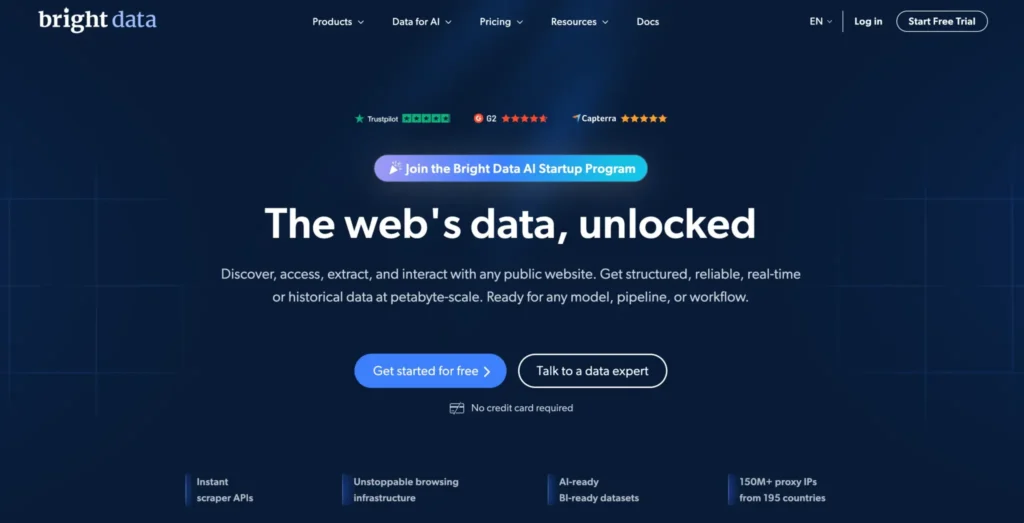
Bright Data is one of the strongest choices for serious Google scraping because it gives you both raw proxy infrastructure and purpose-built SERP data products. That matters. If you are building a rank tracking platform, an SEO intelligence dashboard, or a large keyword monitoring system, managing proxies manually can become expensive in engineering time.
Bright Data’s residential proxy page lists 400M+ monthly ethical residential IPs from 195 countries, along with rotating and sticky sessions, geo targeting, and reported high success metrics. Its SERP API is built specifically for search engine scraping, with real-time output, JSON/HTML/Markdown delivery, geo targeting, and pay-only-for-success pricing. The pricing page shows pay-as-you-go SERP API access from $1.5 per 1,000 results.
For Google scraping, Bright Data works best when accuracy is more important than the lowest possible price. You get strong location controls, mature dashboards, compliance checks, and multiple products under one roof. That is useful for teams that need to track rankings across countries, cities, devices, and languages.
The downside is cost and complexity. Bright Data is not always the easiest option for a beginner who only wants to test 500 keywords. It is built for teams that care about scale, reliability, and data quality.
Bright Data Key Features
| Feature | Details |
|---|---|
| Best proxy type for Google | Residential proxies and SERP API |
| SERP API | Yes |
| Geo targeting | Country, city, and advanced targeting options |
| Output formats | JSON, HTML, Markdown via SERP API |
| Best for | Enterprise SEO platforms, SERP analytics, ad intelligence |
| Main drawback | Premium pricing and more advanced setup |
Pro Tip: Use Bright Data SERP API when you need clean structured SERP data. Use its residential proxy pool when you need more control over your own scraping logic.
2. Oxylabs: Best for High-Volume Search Data Operations
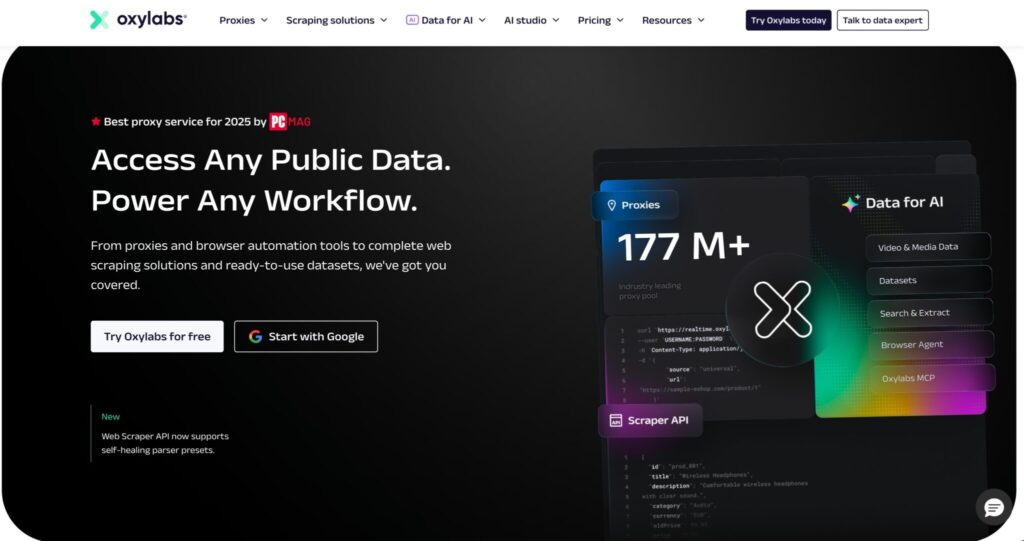
Oxylabs is another top-tier provider for Google scraping, especially for teams that need both large proxy pools and dedicated scraping APIs. Its official site lists 175M+ residential IPs and 2M datacenter IPs, along with scraping products such as Web Scraper API, Web Unblocker, and Fast Search API. Oxylabs’ residential proxy page also highlights 175M+ IPs, city-level targeting, sticky sessions up to 24 hours, and SOCKS5 support.
For Google scraping, Oxylabs is a strong pick because it gives you options. You can use raw residential proxies if you have an internal scraper. You can use its SERP Scraper API if your team wants managed search engine extraction. Its SERP Scraper API is designed for public search engine data, including SEO analysis, market research, competitor tracking, and rank monitoring.
The biggest reason to choose Oxylabs is infrastructure maturity. It is built for businesses that cannot afford unstable results. If you are collecting millions of SERP rows per month, a cheap proxy pool can become more expensive than an enterprise provider because failed requests, bad IPs, and parsing issues waste time.
Oxylabs is not the cheapest provider. Smaller site owners may feel the platform is more powerful than they need. But for serious Google data collection, it is one of the safest names to shortlist.
Oxylabs Key Features
| Feature | Details |
|---|---|
| Best proxy type for Google | Residential proxies, SERP Scraper API |
| IP pool | 175M+ residential IPs |
| Geo targeting | Country and city-level targeting |
| Sticky sessions | Up to 24 hours on residential proxies |
| Protocols | HTTP(S), SOCKS5 support |
| Best for | Enterprise scraping, large SEO datasets, rank monitoring |
| Main drawback | Higher cost for small teams |
Pro Tip: Oxylabs is a good choice when your Google scraping project has moved beyond testing and needs predictable success rates, support, and cleaner operational controls.
3. Decodo: Best Balance of Scale, Price, and Usability
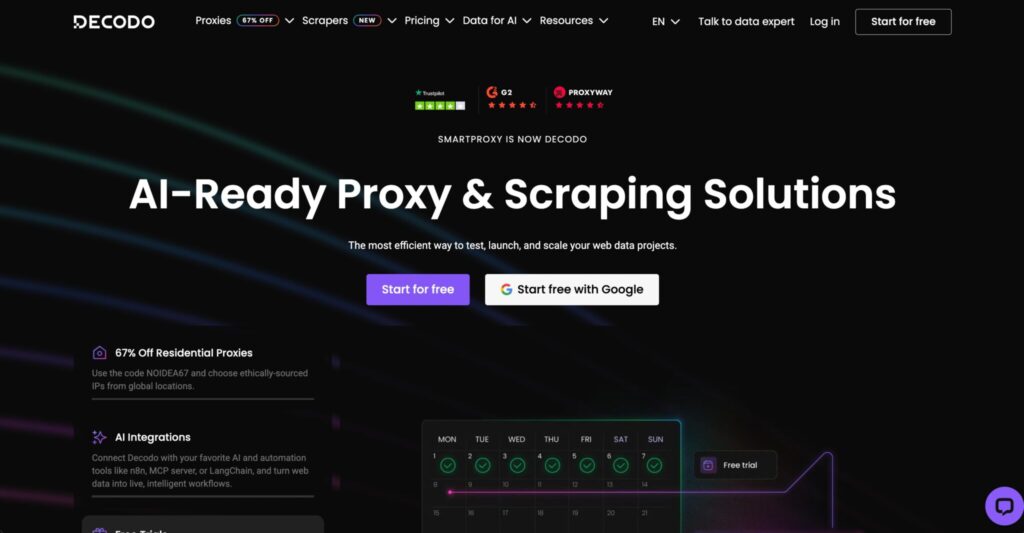
Decodo, formerly Smartproxy, is one of the most practical options for agencies and mid-sized teams. Its official site says Smartproxy has rebranded to Decodo and promotes access to 125M+ IPs. That makes it a strong middle-ground option between enterprise-heavy platforms and budget proxy sellers.
For Google scraping, Decodo’s biggest strength is ease of use. The dashboard is cleaner than many older proxy platforms, the setup is beginner-friendly, and the network is large enough for serious SEO workflows. It supports residential, mobile, datacenter, and ISP-style proxy use cases, which gives you flexibility when testing different Google scraping setups.
Decodo is especially useful for SEO agencies that need to check rankings across multiple countries or run smaller SERP collection jobs without committing to a heavy enterprise contract. It also offers scraping tools, which makes it more than just a raw proxy seller.
The trade-off is that enterprise teams may still prefer Bright Data or Oxylabs for complex compliance workflows, account management, and very large data pipelines. But for many users, Decodo hits the sweet spot: strong enough for production, simple enough for daily use, and usually more approachable than the biggest enterprise vendors.
Decodo Key Features
| Feature | Details |
|---|---|
| Best proxy type for Google | Residential proxies and scraping tools |
| IP pool | 125M+ IPs listed on official site |
| Former brand | Smartproxy |
| Best for | SEO agencies, mid-scale scraping, rank tracking tests |
| Strength | Clean dashboard and strong usability |
| Main drawback | Less enterprise-heavy than Bright Data or Oxylabs |
Pro Tip: Decodo works well when you are testing keyword tracking across many locations but do not want to build a complex proxy management system from scratch.
4. SOAX: Best for Geo Targeting and Clean Residential Sessions
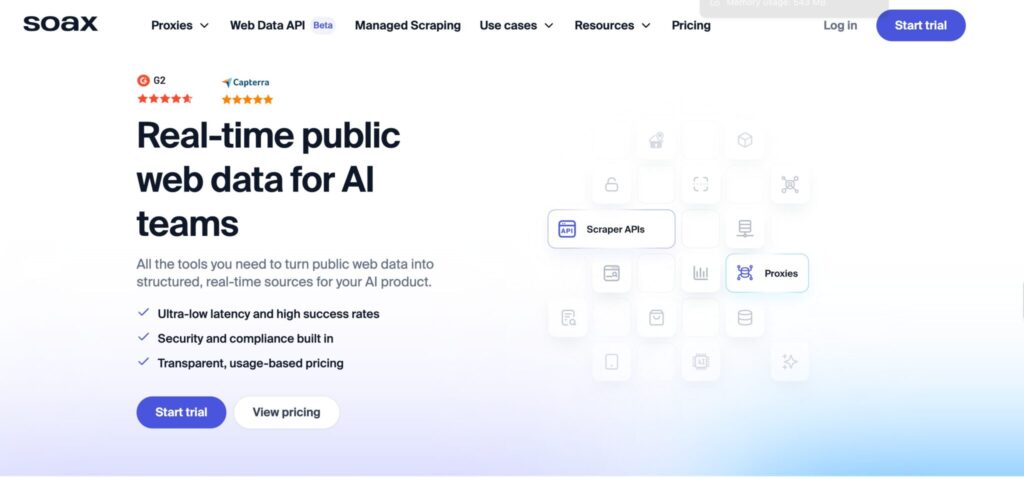
SOAX is a strong residential proxy provider for Google scraping when local accuracy matters. Its residential proxy page lists 155M+ IPs in 195+ locations, unlimited concurrent sessions, automatic rotation, sticky sessions, and 99.9% uptime. Another SOAX proxy page highlights 99.95% uptime, HTTP, HTTPS, and SOCKS5 support, sticky sessions, and automatic proxy rotation.
For Google scraping, SOAX makes sense when you care about local SERP variation. Google results can shift based on country, city, language, device, and sometimes even neighborhood-level signals. If your SEO project depends on tracking location-specific SERPs, you need more than a generic proxy list. You need clean targeting controls and stable sessions.
SOAX is also useful for workflows where you need to keep a session long enough to complete a multi-step check. Its help center explains that sticky sessions let users keep the same IP address for a specified session length, which can help make sessions more stable.
SOAX is not the first provider I would choose if you only want a fully managed Google SERP API. It is stronger as a proxy layer than as a pure SERP data platform. But if your internal team already has scraping logic and needs quality residential routing, SOAX deserves attention.
SOAX Key Features
| Feature | Details |
|---|---|
| Best proxy type for Google | Residential proxies |
| IP pool | 155M+ residential IPs |
| Coverage | 195+ locations |
| Rotation | Automatic rotation and sticky sessions |
| Protocols | HTTP, HTTPS, SOCKS5 |
| Best for | Local SERP tracking, regional SEO checks |
| Main drawback | Less API-first than dedicated SERP platforms |
Pro Tip: Use SOAX for location-sensitive SEO projects where city-level accuracy matters more than simply collecting the cheapest possible SERP data.
5. NetNut: Best for Stable SEO Monitoring and Large Proxy Access
NetNut is a good fit for teams that need reliable residential access for SEO monitoring, ad verification, and public web data collection. Its official site lists 85M+ residential proxies and 5M mobile proxies, with coverage across 195+ countries. NetNut’s residential proxy page also states that its residential proxy servers provide access to over 85M residential IP addresses worldwide.
For Google scraping, NetNut’s value comes from stable infrastructure and business-focused positioning. It is not only for hobby scrapers. It is built for companies that want predictable data collection, support, and scalable proxy access.
NetNut also has a SERP Scraper API page focused on SEO monitoring and search engine data. Its SEO monitoring use case page says its proxies help monitor search engine optimization data and track SERP results with location-specific insights.
The provider can be a solid choice if you want a proxy network that sits between budget tools and very premium enterprise platforms. It is usually not the cheapest option, but it offers the kind of scale that serious SEO operations need.
NetNut Key Features
| Feature | Details |
|---|---|
| Best proxy type for Google | Residential proxies and SERP-related tools |
| IP pool | 85M+ residential IPs, 5M mobile proxies |
| Coverage | 195+ countries |
| Best for | SEO monitoring, SERP tracking, ad verification |
| Strength | Stable infrastructure and business support |
| Main drawback | Pricing can feel high for smaller users |
Pro Tip: NetNut is worth testing if you need residential scale but want a provider that feels more business-oriented than low-cost proxy marketplaces.
6. IPRoyal: Best Budget Residential Proxy Option for Smaller Google Scraping Projects
IPRoyal is a practical choice if you want residential proxies for Google scraping without jumping straight into enterprise pricing. It lists 32M+ residential IPs in 195+ countries, with residential pricing starting at $7 per GB for the 1GB plan on its official pricing page.
For Google scraping, IPRoyal fits smaller SEO teams, freelancers, affiliate site owners, and agencies that need controlled keyword checks rather than massive SERP pipelines. It is useful when you want to test local SERPs, verify ranking movement, check ads visibility, or run limited market research.
The big advantage is affordability. You can start small, test your workflow, and increase usage as needed. The downside is that IPRoyal does not feel as API-first as Bright Data, Oxylabs, or DataForSEO for full SERP extraction. You will need your own scraping logic, request pacing, parsing, and error handling.
IPRoyal Key Features
| Feature | Details |
|---|---|
| Best proxy type for Google | Residential proxies |
| IP pool | 32M+ residential IPs |
| Coverage | 195+ countries |
| Starting price | $7 per GB on the 1GB residential plan |
| Best for | Small SEO projects, rank checks, lightweight scraping |
| Main drawback | Not a full managed SERP data platform |
Pro Tip: IPRoyal makes sense when you are validating a Google scraping workflow before moving to a more expensive SERP API or enterprise proxy setup.
7. Webshare: Best Affordable Proxy Provider for Basic Scraping and Testing
Webshare is one of the most budget-friendly names in the proxy market. Its official site lists 400K+ datacenter proxy servers, static residential proxies, and rotating residential proxies. Webshare’s pricing page also lists rotating residential proxies starting at $1.40 per GB, datacenter proxies from $0.05 per IP, and static residential proxies from $0.23 per IP.
For Google scraping, Webshare is best for testing, small scraping tasks, and budget-conscious users who need simple proxy access. It is not the first provider I would choose for serious Google SERP scraping at scale because Google can detect low-quality datacenter activity quickly. Still, Webshare can be useful for non-sensitive research, light checks, and workflows where cost matters more than enterprise-grade success rates.
The dashboard is clean, the pricing is accessible, and the proxy list model is easy to understand. That makes it beginner-friendly. The limitation is that you do not get the same managed SERP scraping features, compliance layers, or advanced data extraction tooling that you get with enterprise platforms.
Webshare Key Features
| Feature | Details |
|---|---|
| Best proxy type for Google | Rotating residential or static residential |
| Datacenter pool | 400K+ proxy servers |
| Pricing signal | Residential from $1.40 per GB, datacenter from $0.05 per IP |
| Best for | Budget testing, simple proxy lists, lightweight workflows |
| Strength | Low entry cost |
| Main drawback | Not ideal for high-volume Google scraping |
Pro Tip: Avoid relying only on cheap datacenter proxies for Google scraping. They are fast and affordable, but they are also easier to detect under repeated search activity.
8. Rayobyte: Best for Ethical Proxy Sourcing and Flexible Proxy Types
Rayobyte is a strong option for users who care about transparent proxy sourcing and flexible pricing. Its residential proxy page promotes pay-as-you-go pricing, concurrent sessions, geo targeting, and 24/7 support, with residential plans starting at $3.50 per GB for smaller traffic volumes. Its pricing page also lists ISP proxies and other proxy products for users who need more stable IP access.
For Google scraping, Rayobyte is a good fit when you want residential proxies for public data collection but still want a provider with a more compliance-conscious brand image. It is especially useful for agencies that need a mix of datacenter, ISP, and residential proxies for different projects.
Rayobyte may not be as instantly recognizable as Bright Data or Oxylabs in enterprise scraping circles, but it has a solid product range. Its ISP proxies can be useful for workflows that need stable sessions, while residential proxies are better for location diversity.
Rayobyte Key Features
| Feature | Details |
|---|---|
| Best proxy type for Google | Residential and ISP proxies |
| Pricing signal | Residential from $3.50 per GB on smaller plans |
| ISP proxies | Available |
| Best for | Ethical proxy buyers, agencies, public data workflows |
| Strength | Multiple proxy types under one provider |
| Main drawback | Less dominant in SERP API tooling than top enterprise providers |
Pro Tip: Rayobyte is worth testing when you want more control than an API gives you, but you still want a provider that talks seriously about sourcing and responsible data collection.
9. DataForSEO: Best API First Choice for Rank Tracking and SERP Data
DataForSEO is different from a traditional proxy provider. You do not buy proxies and build everything yourself. Instead, you access structured SERP data through an API. That makes it one of the best options for SEO software companies, rank trackers, keyword tools, and agencies that want Google SERP data without managing IP rotation directly.
DataForSEO’s SERP API pricing page lists three modes: Standard Queue at $0.0006 per SERP, Priority Queue at $0.0012 per SERP, and Live Mode at $0.002 per SERP for one SERP with 10 search results. This pricing model is attractive if you are building a tool that needs predictable SERP data costs.
The biggest benefit is simplicity. You can request Google organic results, local packs, maps-style data, or other SERP features depending on your setup, then work with structured output instead of raw HTML. That saves developer time.
The downside is flexibility. If you need full control over every browser-level interaction, custom header behavior, or unusual search flow, raw proxies may still be better. But for rank tracking, keyword monitoring, and SEO reporting, DataForSEO is one of the cleanest choices.
DataForSEO Key Features
| Feature | Details |
|---|---|
| Type | SERP API, not a raw proxy seller |
| Pricing signal | Standard Queue from $0.0006 per SERP |
| Best for | Rank tracking tools, SEO platforms, keyword datasets |
| Strength | Predictable API pricing and structured data |
| Main drawback | Less control than building your own scraper |
Pro Tip: Choose DataForSEO if your goal is clean SERP data, not proxy engineering. It is usually easier to scale an SEO tool with an API than with a pile of proxy credentials and custom parsers.
10. SerpApi: Best Developer Friendly Google Search API With Legal Caveat
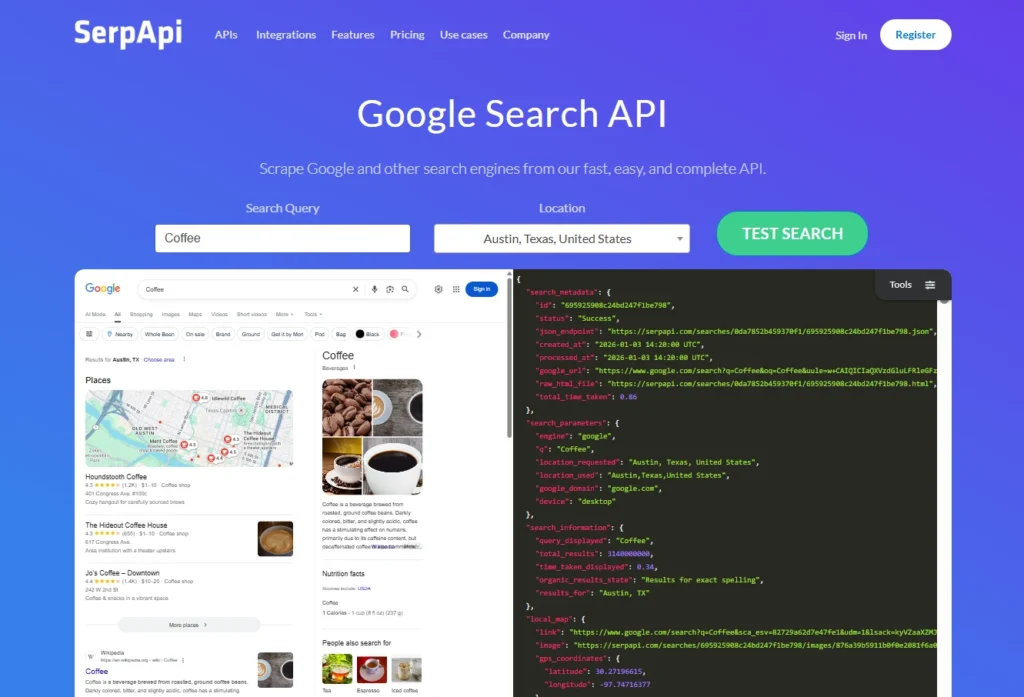
SerpApi is a developer-focused Google Search API that returns structured SERP data. Its site lists Google Search API, Google AI Overview API, Google Ads Transparency API, Google Images API, Google Shopping-style data, and other search-related endpoints. Pricing shown on the official page includes a free tier with 250 searches per month, a Starter plan at $25 per month for 1,000 searches, and higher plans for larger usage.
For developers, SerpApi is attractive because it is easy to integrate. It supports multiple programming languages and returns structured data for organic results, maps, shopping, direct answers, knowledge graph elements, and other SERP features.
There is one important caveat. Reuters reported in December 2025 that Google sued SerpApi, alleging large-scale scraping of Google search results, while SerpApi said it would defend itself and argued that the information it provides is publicly accessible. That does not automatically mean users cannot evaluate the service, but it does mean businesses should involve legal or compliance review before relying on it heavily.
SerpApi Key Features
| Feature | Details |
|---|---|
| Type | Google Search API |
| Starting plan | Free tier available, Starter at $25/month |
| Best for | Developers, SaaS tools, structured SERP data |
| Strength | Easy integration and rich SERP output |
| Main drawback | Active legal scrutiny around Google scraping |
Pro Tip: SerpApi is useful for fast development, but for commercial projects, review the legal context carefully before making it a core data supplier.
How to Choose the Best Proxies for Google Scraping
1. Decide Whether You Need Proxies or a SERP API
This is the first decision. If you only need Google ranking data, maps data, featured snippets, ads positions, or organic result pages, a SERP API is often the cleaner choice. DataForSEO, Bright Data SERP API, Oxylabs SERP Scraper API, and SerpApi handle much of the infrastructure for you.
If you need a custom workflow, raw HTML collection, your own browser automation stack, or non-standard search behavior, then raw residential proxies or ISP proxies give you more control.
For most SEO teams:
| Use Case | Better Option |
|---|---|
| Daily rank tracking | SERP API |
| Local SEO monitoring | SERP API or residential proxies |
| Custom scraping experiments | Residential proxies |
| Fast repeatable sessions | ISP proxies |
| Low-cost testing | Webshare or IPRoyal |
| Enterprise data pipelines | Bright Data or Oxylabs |
2. Focus on IP Pool Quality, Not Only IP Pool Size
A huge proxy pool sounds impressive, but quality matters more. For Google scraping, you want clean IPs, stable routing, accurate geo targeting, and low failure rates.
Look for:
| Factor | Why It Matters |
|---|---|
| Residential IP freshness | Reduces repeated use of overworked IPs |
| Country and city targeting | Helps collect local SERP data |
| Sticky sessions | Useful for controlled multi-step workflows |
| Rotation controls | Prevents overusing the same IP |
| ASN diversity | Helps avoid unnatural traffic patterns |
| Provider compliance | Reduces business risk |
3. Choose the Right Proxy Type
Residential proxies are usually the safest option for Google scraping because they look closer to normal consumer traffic. ISP proxies are useful when you need speed and session stability. Datacenter proxies are cheap and fast, but weaker for repeated Google search collection. Mobile proxies can help with mobile SERP testing, but they are usually expensive.
| Proxy Type | Best For | Weakness |
|---|---|---|
| Residential | Local SERPs, SEO research, broad location coverage | Higher cost than datacenter |
| ISP | Stable sessions, faster scraping, controlled workflows | Less natural rotation than residential |
| Datacenter | Low-cost tests, non-sensitive scraping | Easier to detect at scale |
| Mobile | Mobile SERP and app-style testing | Expensive and slower |
4. Check Rotation Controls Carefully
Rotation is one of the biggest differences between average and strong proxy providers. For Google scraping, you usually need a mix of automatic rotation and sticky sessions.
Automatic rotation helps distribute requests across IPs. Sticky sessions help keep the same IP long enough to complete a controlled workflow. The right balance depends on your use case.
For keyword rank tracking, frequent rotation is usually better. For local SERP testing with consistent parameters, short sticky sessions may help. For login-based or personalized scraping, do not use proxies unless you have proper permission and a clear legal basis.
5. Prioritize Location Accuracy
Google results vary heavily by location. A keyword like “best dentist near me” or “LLC filing service” can show different results depending on city, state, device, language, and search settings.
A strong provider should let you target:
| Targeting Option | Why It Helps |
|---|---|
| Country | International SERP checks |
| State or region | Regional SEO campaigns |
| City | Local SEO monitoring |
| Language | Multilingual search visibility |
| Device type | Desktop vs mobile SERP differences |
6. Watch Pricing by Real Cost, Not Sticker Price
Cheap proxies can become expensive if half your requests fail. SERP APIs may look pricier per request, but they can save money if they reduce retries, parsing errors, and developer time.
Compare providers using this formula:
Real Cost = Proxy/API Cost + Failed Requests + Developer Time + Parsing Time + Compliance Risk
That last part matters. Google’s current Terms of Service define the rules for using Google services, and businesses should review the applicable terms before building automated collection workflows.
Best Proxy Setup for Different Google Scraping Use Cases
| Use Case | Recommended Setup |
|---|---|
| Small SEO keyword checks | IPRoyal or Webshare residential proxies |
| Serious rank tracking | DataForSEO or Bright Data SERP API |
| Enterprise SERP intelligence | Bright Data or Oxylabs |
| Local SEO across many cities | SOAX, Bright Data, Oxylabs, or DataForSEO |
| Developer testing | SerpApi or DataForSEO |
| Budget experiments | Webshare or IPRoyal |
| Stable custom scraping | ISP proxies from Rayobyte, Oxylabs, or Bright Data |
| Large search monitoring | NetNut, Oxylabs, or Bright Data |
Final Verdict: Which Proxy Provider Is Best for Google Scraping?
The best overall proxy provider for Google scraping is Bright Data because it gives you both premium proxy infrastructure and a mature SERP API. It is expensive, but it is built for serious search data collection.
Oxylabs is the closest alternative for high-volume teams that want enterprise-grade residential proxies and dedicated search scraping tools. Decodo is the best middle-ground choice for agencies that want strong proxy access without enterprise complexity. SOAX is excellent for local and regional SERP checks. NetNut fits SEO monitoring and business-grade residential access.
For smaller budgets, IPRoyal and Webshare are good starting points. For API-first rank tracking, DataForSEO is one of the most practical choices because it removes the need to manage proxies directly. SerpApi is developer-friendly, but the current legal scrutiny around Google scraping makes compliance review especially important before heavy commercial use.
FAQs About Google Scraping Proxies
1. What are the best proxies for Google scraping?
Residential proxies are usually the best raw proxy type for Google scraping because they offer real-user IP coverage and better location flexibility. For most SEO teams, a dedicated SERP API from providers like Bright Data, Oxylabs, DataForSEO, or SerpApi is often more reliable than managing proxies manually.
2. Are datacenter proxies good for scraping Google?
Datacenter proxies can work for light testing, but they are not ideal for serious Google scraping. They are fast and cheap, but they are easier to detect when used repeatedly. Residential or ISP proxies are usually better for search result collection.
3. Is a SERP API better than using proxies?
Yes, if your main goal is structured Google SERP data. A SERP API handles proxy rotation, request management, parsing, and output formatting. Raw proxies are better when you need custom control over your own scraping system.
4. Which proxy type is best for local SEO tracking?
Residential proxies and SERP APIs with accurate location targeting are best for local SEO tracking. Local search results can change by country, state, city, language, and device, so location accuracy matters more than just proxy speed.
5. How many proxies do I need for Google scraping?
It depends on keyword volume, request frequency, location count, and whether you use raw proxies or a SERP API. A small SEO agency may only need a small residential plan or API package. A rank tracking platform may need millions of requests per month through a managed SERP API.
6. Can free proxies be used for Google scraping?
Free proxies are not recommended. They are slow, unstable, overused, and risky from a privacy and security perspective. They also tend to fail quickly on protected sites. Use a reputable paid provider instead.
7. Are Google scraping proxies legal?
Legality depends on your jurisdiction, data type, method, scale, and use case. Google’s terms govern use of its services, and large-scale scraping has attracted legal action, including Google’s 2025 lawsuit against SerpApi reported by Reuters. Businesses should get legal guidance before running commercial Google scraping projects.
8. What is the safest way to collect Google ranking data?
The safest practical route is to use official Google tools where they fit, such as Search Console for your own verified properties, and use reputable SERP data providers only after reviewing their terms, methods, and compliance posture. For SEO reporting, a managed SERP API is usually cleaner than building a raw scraping system from scratch.
9. Which provider is best for beginners?
For beginners, Webshare and IPRoyal are easier entry points for raw proxies, while DataForSEO is better if you want structured SERP data without managing proxy rotation manually.
10. Which provider is best for enterprise teams?
Bright Data and Oxylabs are the strongest enterprise options. Both offer large proxy networks, scraping tools, support, and infrastructure designed for high-volume public data collection.