
Market research used to mean surveys, focus groups, competitor spreadsheets, and a lot of manual checking. That still has its place, but the serious teams now work with live public data.
They monitor product pricing across regions. They track competitor landing pages. They study local SERPs. They test ads from different cities. They collect marketplace data, reviews, availability, sentiment, and category movement before the trend becomes obvious.
That kind of research breaks quickly without the right proxy setup.
Search engines throttle repeated queries. E-commerce sites show different prices by country or city. Travel platforms change inventory based on location. Social platforms limit repeated access. Some websites quietly serve incomplete data when traffic looks automated.
This is where proxies become a core research tool, not just a technical add-on.
A good market research proxy lets your team collect public web data from different regions, reduce blocks, rotate IPs cleanly, and separate research traffic from your internal network. The best providers also give you session controls, city-level targeting, residential IPs, ISP proxies, datacenter options, and APIs that make large-scale collection easier.
For this guide, I reviewed the most useful proxy providers for market research teams in 2026 based on IP pool size, geo-targeting depth, proxy types, rotation control, pricing, reliability, dashboard usability, and fit for real research workflows.
Why Market Research Teams Need Proxies?
Market research is no longer limited to what users voluntarily tell you. A big part of modern research comes from observing public market signals.
That includes competitor pricing, ad placements, product stock, customer reviews, search visibility, category demand, local availability, marketplace rankings, and regional messaging.
The problem is that websites do not always show the same data to everyone.
A user in New York may see different prices than a user in Berlin. A mobile user may see different offers than a desktop visitor. A logged-out visitor may see different inventory than someone with browsing history. Search results also change by location, device, language, and behavior.
Proxies help researchers see these variations more clearly.
Instead of sending every request from one office IP, your research tools can route traffic through residential, mobile, ISP, or datacenter IPs across many countries and cities. This makes the collected data closer to what real users see in each market.
For example, a retail intelligence team may use proxies to compare the same product price across the US, UK, Germany, and Australia. A travel research team may check hotel rates from multiple origin countries. A SaaS company may test competitor landing pages in different regions. An SEO team may collect localized SERP data without relying on one fixed IP address.
The right proxy setup also protects your research pipeline from unnecessary interruptions. Rotating residential proxies can reduce blocks during larger data collection runs. ISP proxies can help when you need longer, stable sessions. Datacenter proxies can work well for faster, lower-risk research tasks. Mobile proxies are useful when market data depends heavily on carrier or mobile-first behavior.
The key is matching the proxy type to the research job.
Use residential proxies when you need realistic user-like access. Use ISP proxies when session stability matters. Use datacenter proxies when speed and low cost matter more than stealth. Use mobile proxies when testing mobile-heavy platforms, app flows, or carrier-influenced experiences.
9 Best Proxies for Market Research in 2026
| Rank | Provider | Best For | Proxy Types | Starting Price Snapshot | Key Strength |
|---|---|---|---|---|---|
| #1 | Oxylabs | Enterprise-grade market intelligence | Residential, ISP, datacenter, mobile, SOCKS5, Web Unblocker | Residential plans listed with large global pool options | Large residential pool, strong geo-targeting, enterprise tooling |
| #2 | Decodo | Best value for research teams | Residential, mobile, ISP, datacenter, scraping APIs | Residential pricing starts from around $2/GB on official pricing pages | Good balance of price, usability, and IP scale |
| #3 | Webshare | Independent researchers and small teams | Datacenter, static residential, rotating residential | Residential from around $1.40/GB; datacenter from low per-IP pricing | Affordable, simple dashboard, free starter option |
| #4 | Bright Data | Enterprise intelligence operations | Residential, ISP, mobile, datacenter, datasets, Web Unlocker | Residential pricing starts from $5.88/GB | Advanced data platform, huge network, strong compliance controls |
| #5 | SOAX | Consumer behavior and geo testing | Residential, mobile, ISP, datacenter, Web Data API | Starter plan listed at $3.60/GB with 25GB included | Flexible proxy credits across proxy types |
| #6 | IPRoyal | Long-term studies and stable access | Residential, ISP, datacenter, mobile | Residential from $1.75/GB | Flexible pay-as-you-go model and sticky session options |
| #7 | Proxy-Cheap | Budget-conscious research | Residential, datacenter, static residential, mobile | Rotating residential plans listed from $4.99/GB | Low entry pricing and simple proxy products |
| #8 | ProxyEmpire | Mixed research data collection | Residential, static residential, mobile, datacenter | Residential and static residential listed from $0.75 | Good variety of proxy types and targeting options |
| #9 | DataImpulse | Budget market research scraping | Residential, mobile, datacenter | Residential from $1/GB | Low-cost PAYG residential traffic |
#1 — Oxylabs: Best Market Research Proxy for Comprehensive Intelligence
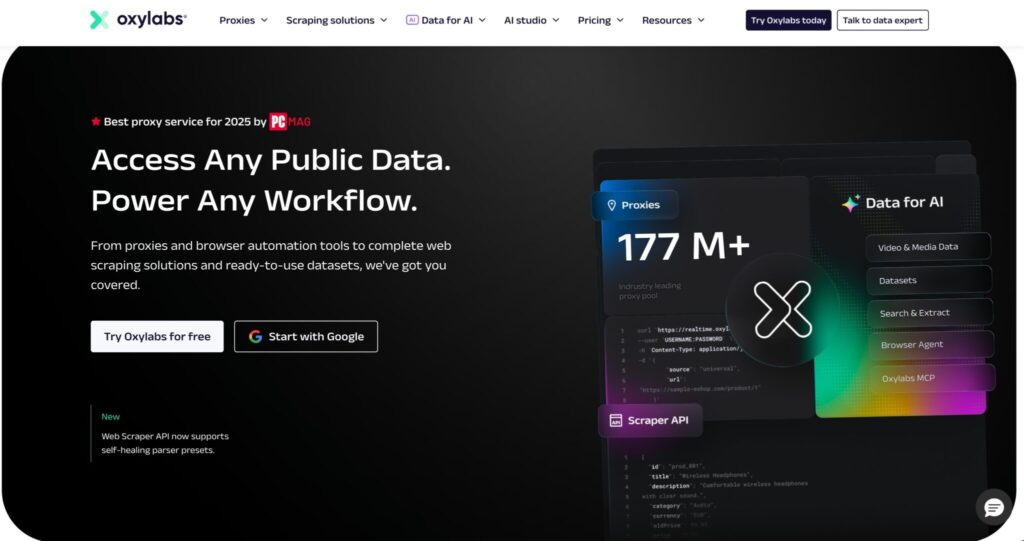
Oxylabs is the provider I would place at the top for serious market research operations where data quality, location targeting, scale, and stability matter more than chasing the lowest price.
Its residential proxy network is built for large-scale public data collection, with Oxylabs listing 175M+ residential IPs and coverage across 195 locations. The platform also supports city, state, and ZIP-level targeting, which is exactly what market research teams need when they want to compare localized results instead of broad country-level snapshots.
That matters because market research often lives in the small differences.
A national price average may look stable, but a city-level check may reveal where a competitor is discounting aggressively. A product page may show the same headline across a country, but the local shipping promise may change by ZIP code. A search result may look clean at the national level, while local SERPs show different competitors winning.
Oxylabs is especially strong for:
- Pricing intelligence
- SERP monitoring
- Travel fare and hotel rate research
- Marketplace tracking
- Ad verification
- Brand protection research
- Competitor page monitoring
- Large-scale public web scraping
The provider also offers more than basic proxies. Oxylabs has residential proxies, mobile proxies, ISP proxies, datacenter proxies, SOCKS5 proxies, and a Web Unblocker product for more complex scraping pipelines. Its residential proxies support session control and unlimited concurrent sessions, which gives research teams more flexibility when running larger crawling jobs.
For market research, the biggest advantage is control. You can build stable collection workflows around location, rotation, session length, and proxy type instead of constantly fighting random block rates.
The drawback is that Oxylabs may be too much for very small teams. If you are collecting a few hundred pages per month, Webshare, IPRoyal, or DataImpulse may be easier to justify. Oxylabs makes more sense when data collection is part of your operating rhythm, not an occasional task.
Pro-Tip: Use Oxylabs residential proxies for consumer-facing targets where accuracy matters, then use datacenter or ISP proxies for lighter monitoring tasks. This keeps data quality high without wasting premium residential bandwidth on simple checks.
#2 — Decodo: Best Value Market Research Proxy
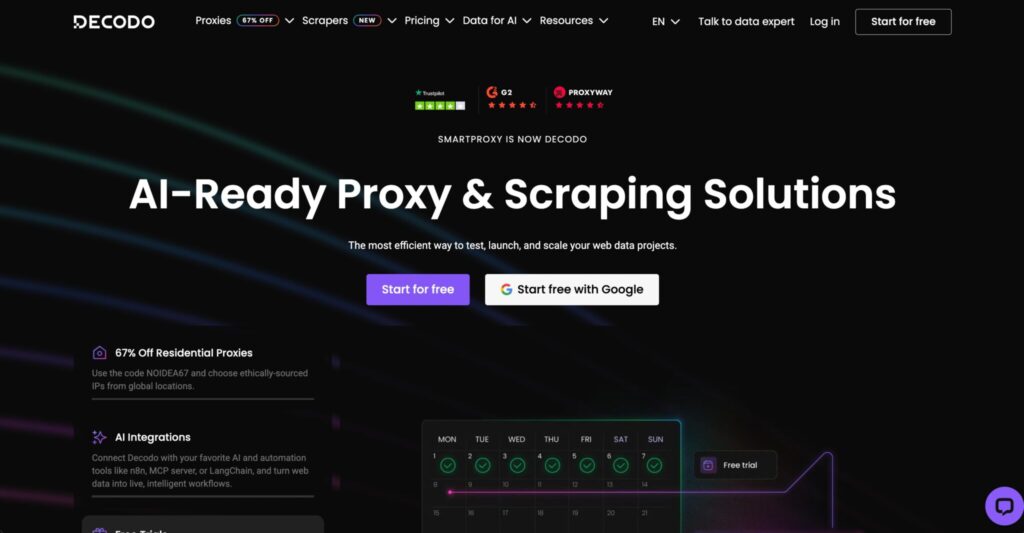
Decodo, formerly Smartproxy, is one of the strongest choices for research teams that want enterprise-like proxy coverage without the heavier feel of a fully enterprise platform.
The provider’s official site states that Smartproxy has rebranded to Decodo and lists 125M+ IPs, 195+ locations, 99.99% uptime, and sub-second average speed claims. Its residential proxy pricing page shows plans starting from around $2/GB, with smaller monthly packages also available for teams that want to test before committing to larger volumes.
That balance makes Decodo very attractive for market research.
You get a large enough IP pool for global research, decent location coverage, scraping-friendly tooling, and a dashboard that does not feel built only for infrastructure engineers. If your team includes marketers, SEO analysts, data analysts, and non-technical researchers, usability matters.
Decodo works well for:
- Local SERP tracking
- Competitor pricing checks
- Review monitoring
- Retail availability research
- Ad verification
- Marketplace research
- Product assortment monitoring
- Social listening support workflows
One reason Decodo fits market research so well is its middle-ground positioning. It is not the cheapest provider in every scenario, and it is not the most advanced enterprise data platform either. Instead, it hits the practical zone where many teams operate.
You can run residential proxy campaigns for country-level or city-level research, use mobile proxies for mobile-specific checks, and lean on scraping APIs when you do not want to build everything from scratch.
For growing teams, that matters. You may start by checking prices in three countries. Six months later, you may need 20 markets, multiple product categories, and weekly monitoring. Decodo gives you room to scale without forcing you into a complex setup on day one.
The main limitation is that very high-compliance enterprise teams may still prefer Oxylabs or Bright Data because of deeper governance and larger data product ecosystems. But for most market research teams, Decodo offers a strong mix of coverage, cost, and ease of use.
Pro-Tip: Start with residential proxies for research targets that block aggressively. If a site behaves well, test datacenter or ISP proxies for the same workflow to lower long-term data collection costs.
#3 — Webshare: Best Market Research Proxy for Independent Researchers
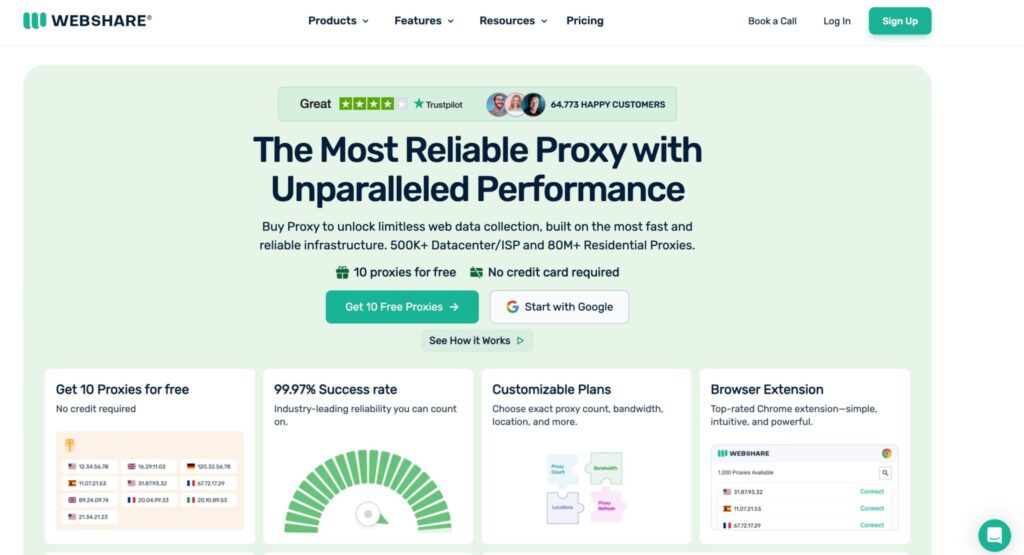
Webshare is a strong pick for independent researchers, small agencies, startup analysts, and SEO teams that want affordable proxies without a complicated procurement process.
Its pricing is one of the clearest reasons to consider it. Webshare lists residential proxy pricing from around $1.40/GB and datacenter proxy server pricing from low per-IP rates. The platform also offers datacenter, static residential, and rotating residential proxy products, which gives smaller teams enough flexibility for different research jobs.
Webshare is not trying to be the most advanced enterprise intelligence suite. That is actually part of its appeal.
The dashboard is simple. The pricing is easier to understand than many competitors. The product range covers common use cases. For a solo researcher or lean team, that can be more valuable than dozens of advanced options you will never touch.
Webshare is useful for:
- Small-scale competitor monitoring
- SERP checks
- Product availability research
- Lightweight price tracking
- Regional page checks
- Basic web scraping
- Agency research tasks
- Testing proxy-based workflows before scaling
The platform also highlights 80M+ residential IPs and rotating residential proxy plans, which gives smaller teams access to a meaningful residential pool without needing enterprise-level volume commitments.
Where Webshare shines is budget control. You can use datacenter proxies for less sensitive targets, static residential proxies for repeat checks, and rotating residential proxies when you need more natural access patterns.
The trade-off is that Webshare may not give you the same advanced unblocking ecosystem, managed support, or compliance tooling as larger enterprise providers. If your research pipeline feeds executive dashboards or investment decisions, you may eventually want a more robust setup. But for early-stage data collection, Webshare is a very practical starting point.
Pro-Tip: For market research pilots, use Webshare to test your target sites, estimate bandwidth needs, and identify which proxy type works best. Once you know your block rates and data volume, you can decide whether to stay lean or move to a larger provider.
#4 — Bright Data: Best Market Research Proxy for Enterprise Intelligence Operations
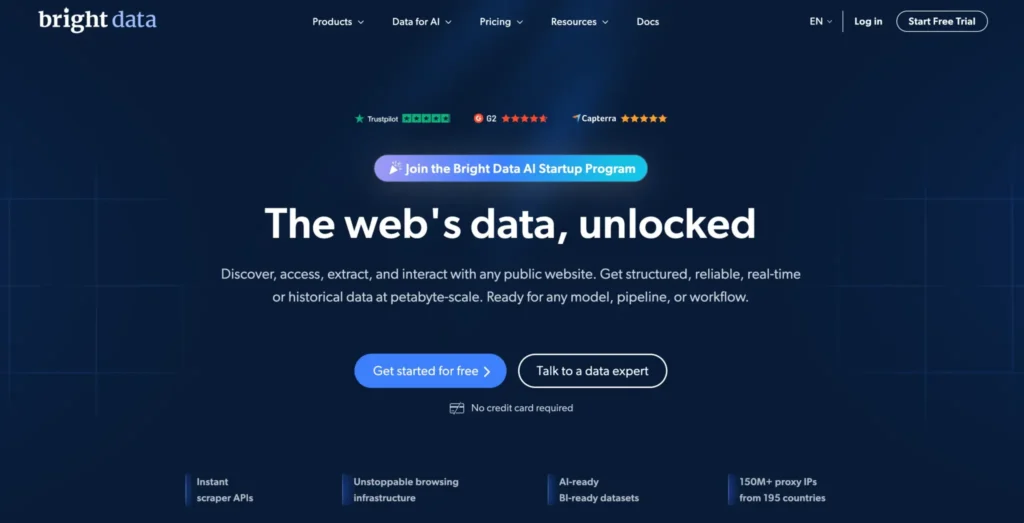
Bright Data is built for teams that treat public web data as a serious business asset.
It is not just a proxy provider. It is a broader web data platform with proxy networks, Web Unlocker, scraping tools, datasets, and enterprise controls. That makes it especially useful for market research teams inside larger companies, consultancies, investment firms, pricing intelligence platforms, and data-heavy SaaS businesses.
Bright Data’s pricing page lists residential proxies starting from $5.88/GB, while its broader pricing page highlights proxy networks, large geographic coverage, stability, speed, and 400M+ monthly residential IPs.
That scale is valuable when your research needs are complex.
A small team may need to compare prices on 200 product pages. An enterprise intelligence team may need to monitor 20 retailers, 15 markets, dozens of product categories, daily SERP positions, competitor landing pages, and public marketplace listings. At that level, the proxy is only one part of the system. You also need reliability, data collection tooling, monitoring, compliance, and support.
Bright Data works well for:
- Enterprise price intelligence
- Competitive intelligence dashboards
- Large-scale public data extraction
- Search intelligence
- Review and sentiment monitoring
- Travel and hospitality research
- Marketplace data collection
- Ad verification and brand monitoring
The provider’s biggest strength is depth. You can use residential proxies for realistic access, ISP proxies for stable identity, mobile proxies for mobile-first experiences, and datacenter proxies for fast, cheaper collection where suitable. You can also work with web scraping APIs and datasets if you want to reduce in-house engineering work.
The downside is price and complexity. Bright Data can feel heavy for a small research team that only needs basic proxies. It is better suited to organizations that already know the value of the data they are collecting and need a platform that can support bigger workflows.
Pro-Tip: Bright Data makes the most sense when the value of the research output is high. If the data supports pricing strategy, market entry, investment analysis, or revenue operations, the higher proxy cost can be easier to justify.
#5 — SOAX: Best Market Research Proxy for Consumer Behavior Analysis
SOAX is a strong option for teams that need flexible access across proxy types and markets, especially when consumer behavior changes by location, device, or network type.
The provider lists residential proxies with a large global network and coverage across 195+ locations. Its pricing page also uses a flexible credit model, where credits can be applied across residential, mobile, ISP, datacenter proxies, and Web Data API. The listed Starter plan begins at $3.60/GB with 25GB included.
That flexibility is useful in market research because not every research task needs the same proxy type.
Suppose you are studying how users experience a retail site. Residential proxies may be enough for country-level pricing checks. But if you are testing app install flows, mobile ad placements, or carrier-based experiences, mobile proxies may give you more accurate results. If you are monitoring the same competitor pages every day, ISP proxies may provide better session stability.
SOAX fits teams that want to test different data collection paths without managing separate providers for every proxy category.
It is especially useful for:
- Consumer journey research
- App and mobile market research
- Geo-specific website testing
- Localized pricing checks
- Competitor monitoring
- Ad verification
- Search result tracking
- Product availability checks
The platform’s value is not only the IP pool. It is the ability to move between proxy types depending on the target website and the research question.
For example, a consumer behavior analyst may want to know how a travel booking site behaves from London, Dubai, Mumbai, and Singapore. A pricing analyst may want to compare retail discounts across cities. A mobile growth team may want to test whether a landing page or ad flow changes for mobile users. SOAX can support those workflows without making the team rebuild everything each time.
The main limitation is that SOAX can become more expensive than budget providers if you only need basic scraping. It is better for teams that care about location flexibility, proxy diversity, and controlled research conditions.
#6 – IPRoyal: Best Market Research Proxy for Long-Term Studies
IPRoyal is a good fit for market researchers who need flexible residential traffic, sticky sessions, and affordable entry pricing without being forced into large enterprise contracts.
The provider lists residential proxies from $1.75/GB, with a 32M+ proxy pool and support for geo-targeted research, SEO monitoring, web scraping, and ad verification. It also highlights sticky residential sessions that can last up to 7 days, which is useful when your research workflow depends on repeat access from the same IP rather than constant rotation.
That sticky-session feature matters more than many beginners realize.
In market research, not every task should rotate IPs on every request. If you are checking a logged-out product flow, monitoring how a website behaves over time, or comparing localized pricing across multiple steps, a stable identity can produce cleaner data. Random rotation may create noise. Sticky sessions help you hold the same IP long enough to complete the journey.
IPRoyal works well for:
- Long-term price monitoring
- Geo-targeted research
- Competitor tracking
- Local SERP checks
- Ad verification
- E-commerce monitoring
- Repeat research workflows
- Budget-conscious scraping projects
Its residential proxies support unlimited concurrent sessions, which makes it easier to scale research jobs without worrying about artificial session caps. The provider also offers ISP, datacenter, and mobile proxies, so researchers can choose based on the target site and data collection style.
The biggest reason to consider IPRoyal is value. It is not as enterprise-heavy as Bright Data or Oxylabs, but it gives smaller teams access to useful proxy controls at a lower starting cost. That makes it a practical option for agencies, affiliate marketers, pricing analysts, and small data teams that need reliable access without locking themselves into a huge monthly budget.
The downside is that IPRoyal may require more hands-on testing. For some targets, it may work beautifully. For stricter websites, you may need to experiment with session duration, country selection, and request pacing. That is normal with budget-friendly residential proxy setups.
Pro-Tip: Use IPRoyal’s sticky sessions for multi-step research flows, such as checking a product page, cart page, shipping estimate, and checkout preview from the same location. This gives you a more realistic view of how a real user would experience the site.
#7 – Proxy-Cheap: Best Budget Market Research Proxy

Proxy-Cheap is designed for users who want affordable proxy access without a complicated buying process. It is not the most advanced provider on this list, but it can be a smart option when your priority is low-cost research traffic.
The provider lists rotating residential proxies from $4.99/GB, with HTTP and SOCKS5 support and coverage across 195+ locations. It also offers datacenter IPv4, datacenter IPv6, static residential, and static mobile proxy products.
For market research, Proxy-Cheap makes sense when you are doing lighter tasks such as:
- Basic competitor checks
- Regional page testing
- Simple price monitoring
- Ad preview checks
- SERP sampling
- Localized content verification
- Small scraping projects
- Proxy testing before scaling
Its value is simplicity. You can choose a proxy type, buy traffic, and start testing. That works well for small teams that do not need enterprise APIs, managed onboarding, or advanced compliance dashboards.
Proxy-Cheap also offers datacenter proxies at lower monthly rates, which can help when you need speed more than residential realism. For example, if you are checking non-sensitive public pages or collecting basic metadata, datacenter proxies may be enough. For stricter e-commerce, travel, and search targets, rotating residential proxies will usually perform better.
The provider is best viewed as a budget tool rather than a full market intelligence platform. If your research feeds high-value business decisions, you may want stronger infrastructure, better analytics, or more advanced targeting from providers like Oxylabs, Bright Data, Decodo, or SOAX. But if you are testing workflows, collecting smaller datasets, or running cost-sensitive research campaigns, Proxy-Cheap can do the job.
Pro-Tip: Do not use the cheapest proxy type for every research task. Start with datacenter proxies for easy targets, then move to rotating residential proxies only when you see blocks, inaccurate location results, or incomplete pages.
#8 – ProxyEmpire: Best Market Research Proxy for Diverse Data Types
ProxyEmpire is useful for market research teams that collect different types of data and want access to several proxy categories under one roof.
The provider offers rotating residential, static residential, rotating mobile, dedicated mobile, and rotating datacenter proxies. Its public pricing page lists proxy options from $0.35/GB for datacenter traffic, residential options from $0.75/GB at higher-volume tiers, and a low-cost trial offer.
That range gives ProxyEmpire a flexible place in the market.
If you are checking fast, low-risk targets, rotating datacenter proxies may keep costs low. If you need stable identity, static residential proxies can help. If you are researching mobile-first experiences, rotating mobile proxies can give you traffic patterns closer to real carrier users.
ProxyEmpire is a good fit for:
- Multi-source market research
- Product pricing studies
- Mobile ad verification
- Competitor monitoring
- Marketplace tracking
- Regional page testing
- Retail data collection
- Mixed proxy workflows
Its biggest advantage is variety. Market research rarely fits into one neat category. One day you may need residential IPs for e-commerce data. The next day you may need mobile proxies for app funnel testing. Later, you may need cheap datacenter bandwidth for a public page scan. ProxyEmpire gives you room to mix those workflows.
The provider is also interesting for teams that want to compare proxy types on the same target. This is a smart habit. Instead of assuming residential proxies are always required, test datacenter, ISP, residential, and mobile where relevant. You may find that some sources are easy to collect from, while others need a more realistic IP profile.
The main limitation is that ProxyEmpire can feel less polished than the most established enterprise platforms. If your team needs advanced governance, custom contracts, managed scraping, or board-level reporting, you may prefer Bright Data or Oxylabs. But for flexible research operations, ProxyEmpire is worth shortlisting.
Pro-Tip: Build a proxy testing matrix before running a large project. Test each target with datacenter, residential, and mobile proxies, then compare success rate, response quality, speed, and cost per 1,000 successful pages.
#9 – DataImpulse: Best Budget Market Research Proxy
DataImpulse is one of the most budget-friendly options on this list. It is especially attractive for researchers who want simple pay-as-you-go residential proxy traffic without high monthly commitments.
The provider lists residential proxies from $1 per GB, a 90M+ residential IP pool, coverage across 195 countries, and use cases such as web scraping, SERP tracking, ad verification, and price intelligence. It also says traffic does not expire, which can be useful for smaller teams with inconsistent research volume.
That makes DataImpulse a practical choice for:
- Budget price monitoring
- SERP research
- Competitor checks
- Public web scraping
- Ad verification
- Occasional market research projects
- Small agency workflows
- Early-stage research testing
The main appeal is cost control. If you only run research campaigns occasionally, monthly commitments can feel wasteful. DataImpulse’s pay-per-GB model is better suited to users who want to top up, run a project, pause, and come back later.
For example, a small SEO team might use DataImpulse to collect search results from multiple countries. A retail analyst may run a short pricing study before a campaign launch. An affiliate marketer may check how competitor landing pages appear across different regions. In these cases, paying for traffic as needed can be more practical than subscribing to a larger plan.
The trade-off is that budget providers usually require more testing and tuning. You may need to adjust rotation rules, request speed, location targeting, and retries to get stable results. For high-stakes research, always validate a sample manually before trusting the full dataset.
Pro-Tip: DataImpulse is best for controlled research batches. Run a small sample first, check data accuracy, review blocked or incomplete responses, then scale only after the success rate looks stable.
How to Choose the Best Proxy for Market Research?
Choosing a proxy for market research is not just about buying the biggest IP pool. A large pool helps, but it does not automatically mean better data.
The best choice depends on your research target, data volume, locations, session needs, and tolerance for failed requests.
1. Match the Proxy Type to the Research Job
Residential proxies are usually the safest choice for public market research because they route traffic through real consumer-style IPs. They work well for e-commerce, travel, search engines, review sites, and localized content checks.
ISP proxies are useful when you need stability. They combine datacenter-like speed with residential-looking IP ownership, making them good for longer sessions and repeat checks.
Datacenter proxies are faster and cheaper, but easier to detect. Use them for low-risk websites, basic monitoring, and public pages that do not apply strict anti-bot systems.
Mobile proxies are best for mobile-specific research, app testing, mobile ad verification, and platforms where carrier-level signals matter.
2. Look Beyond Country Targeting
Country-level targeting is useful, but many market research tasks need more precision.
For pricing, local SERPs, delivery availability, retail stock, and ad previews, city-level targeting can be much more accurate. In some industries, ZIP-level targeting is even better.
A national view may hide local differences. A city-level view often reveals the real competitive story.
3. Understand IP Pool Quality
Do not judge a proxy provider only by the size of its IP pool. A provider with 100M+ IPs is not automatically better than one with 30M+ IPs if the smaller provider has cleaner IPs, better targeting, and more stable sessions.
Look for:
- Real residential or ISP-sourced IPs
- Strong location coverage
- Low duplicate IP reuse
- Good success rates on your target sites
- Clear proxy replacement or rotation controls
- Transparent acceptable-use policies
For market research, data accuracy matters more than raw IP count.
4. Choose the Right Rotation Protocol
Rotation controls can make or break a research workflow.
Rotating on every request is useful when you are collecting many independent pages. It reduces the chance of one IP getting rate-limited.
Sticky sessions are better when you need continuity. Use sticky sessions for multi-step flows, cart checks, quote forms, travel searches, or anything where the website expects one user to stay on the same IP.
Session-based rotation is often the sweet spot. You can hold an IP for 5, 10, 30, or 60 minutes, then rotate after the task is complete.
5. Check Bandwidth Costs Carefully
Market research scraping can use more bandwidth than expected.
HTML pages are usually light. But modern websites often load scripts, images, tracking files, APIs, and dynamic content. If your scraper renders full pages in a browser, bandwidth usage can climb fast.
To control cost:
- Block images when not needed
- Avoid loading unnecessary scripts
- Cache repeated assets
- Use APIs where possible
- Compress responses
- Test bandwidth before scaling
- Track cost per successful page, not just cost per GB
A cheap proxy can become expensive if it has poor success rates.
6. Test With Real Targets Before Buying Big
Never choose a proxy provider only from a feature table.
Pick your top 5 to 10 target websites. Run small tests. Compare success rate, speed, block rate, data completeness, and location accuracy.
A good test should answer:
- Did the page load correctly?
- Did the site show the right location?
- Was pricing visible?
- Were search results complete?
- Did the IP get blocked quickly?
- Did sticky sessions behave properly?
- Was the cost reasonable per successful result?
This small test can save you from choosing the wrong provider for a long-term project.
FAQs: Best Proxies for Market Research 2026
What types of market research benefit most from proxies?
Proxies are most useful for research that depends on location, scale, or repeated access. This includes pricing intelligence, SERP tracking, ad verification, competitor monitoring, product availability checks, travel fare research, review monitoring, marketplace analysis, and regional content testing.
Can proxies access geo-specific market data?
Yes. Proxies can help researchers view public websites from different countries, states, cities, or even ZIP-level locations depending on the provider. This is useful for checking localized pricing, delivery options, search results, ads, inventory, and region-specific landing pages.
Is proxy-based market research ethical?
Proxy-based market research can be ethical when it focuses on publicly available data, respects website terms where applicable, avoids personal data misuse, follows privacy laws, and uses reasonable request rates. The goal should be market intelligence, not intrusion, account abuse, or bypassing private access controls.
How much bandwidth does typical market research scraping use?
It depends on the target website and scraping method. Simple HTML scraping may use very little bandwidth. Browser-based scraping with JavaScript rendering, images, and dynamic content can use much more. Always run a sample test first and calculate bandwidth per successful page before scaling.
Are residential proxies better than datacenter proxies for market research?
Residential proxies are usually better for websites with stricter anti-bot systems or location-sensitive content. Datacenter proxies are cheaper and faster, but they are easier to detect. A practical setup often uses both: residential proxies for difficult targets and datacenter proxies for simpler public pages.
What is the best proxy rotation setting for market research?
For large page collection, rotating on every request can work well. For multi-step research, sticky sessions are better because they keep the same IP during the full journey. For many research teams, session-based rotation between 10 and 60 minutes offers a good balance.
Do proxies guarantee accurate market research data?
No. Proxies improve access and location testing, but they do not guarantee perfect data. Websites may personalize results based on cookies, device type, language, user agent, time of day, or browsing behavior. For better accuracy, combine proxies with clean browser profiles, consistent settings, and manual sample validation.
Which proxy provider is best for small market research teams?
Webshare, IPRoyal, Proxy-Cheap, and DataImpulse are strong options for smaller teams because they offer lower entry pricing and simpler setups. Decodo is a good step up when you need better scale and usability without moving straight into enterprise-level pricing.
Which proxy provider is best for enterprise market intelligence?
Oxylabs and Bright Data are the strongest choices for enterprise market intelligence because they offer large proxy networks, advanced targeting, multiple proxy types, scraping tools, and stronger infrastructure for high-volume public data collection.
Conclusion: Best Proxies for Market Research 2026
The best market research proxy depends on how serious your data operation is.
If you need enterprise-grade scale, precise targeting, and strong infrastructure, Oxylabs is the best overall choice. It is built for serious intelligence teams that cannot afford weak data pipelines.
If you want a strong balance of price, coverage, and usability, Decodo is the best value pick. It gives growing research teams enough power without making the setup feel too heavy.
If you are an independent researcher, small agency, or solo operator, Webshare is one of the easiest places to start. It is affordable, simple, and good for testing proxy-based workflows.
If your company treats public web data as a strategic asset, Bright Data deserves a close look. It is expensive compared to budget providers, but its platform depth makes sense for larger intelligence operations.
For flexible consumer behavior research, SOAX is strong because it lets you work across residential, mobile, ISP, and datacenter proxy types with a credit-based model.
For long-term studies and sticky-session workflows, IPRoyal is a practical choice. For cheaper testing, Proxy-Cheap, ProxyEmpire, and DataImpulse can all work well depending on your target sites and budget.
My practical recommendation is simple: do not pick a provider only because the pricing looks good on paper. Test it against your real research targets. Measure success rate, location accuracy, bandwidth use, session stability, and cost per successful result.
That is the number that matters.
A proxy is not just a way to access data. For market research, it is part of the data quality system. Choose the wrong one, and your reports become noisy. Choose the right one, and you get cleaner signals, sharper insights, and better decisions before your competitors even notice the pattern.