
Best Proxies For Security Intelligence.
Security intelligence work is messy because the internet does not show the same surface to everyone. A phishing kit may appear in one country and vanish in another.
A fake login page may block corporate IP ranges. A scam ad may only load from mobile networks. A stolen brand mention may sit on a forum that throttles repeated checks.
That is where proxies become part of the collection stack. Not as a magic cloak, and not as a shortcut for breaking rules, but as controlled network infrastructure for gathering public, authorized, and legally reviewable intelligence from multiple locations and network types.
For security teams, the best proxy is not simply the biggest pool. You need clean sourcing, predictable rotation, strong geo-targeting, session control, uptime, audit-friendly logs, and support that understands enterprise data collection.
Quick Picks: Best Proxies For Security Intelligence
| Provider | Best For | Proxy Types | Pool Positioning | Rotation Strength | Watch-Out |
|---|---|---|---|---|---|
| Bright Data | Enterprise intelligence teams | Residential, ISP, mobile, datacenter | Huge global pool | Advanced rotation and targeting | Premium pricing |
| Oxylabs | Large-scale public web intelligence | Residential, ISP, mobile, datacenter | Enterprise-scale pool | Strong sticky and rotating sessions | Better for bigger budgets |
| Decodo | Balanced speed and usability | Residential, ISP, mobile, datacenter | Large global pool | Simple session controls | Fewer deep enterprise extras |
| SOAX | Geo-specific monitoring | Residential, mobile, ISP, datacenter | Strong city and country coverage | Flexible sticky and rotating options | Cost rises with volume |
| NetNut | Stable long-running collection | Residential, static residential, mobile, datacenter | Strong residential and mobile footprint | Good for steady sessions | Not the cheapest |
| IPRoyal | Budget-conscious teams | Residential, ISP, mobile, datacenter | Flexible, smaller pool | Easy rotation and TTL controls | Fewer advanced tools |
| Webshare | Testing and high-speed collection | Datacenter, static residential, rotating residential | Broad low-cost coverage | Simple rotation options | Basic support and tooling |
What Makes a Proxy Good for Security Intelligence?
A security intelligence proxy stack should do four jobs well. It should let your team see public web data from different network viewpoints, reduce collection bias from corporate IP ranges, support repeatable monitoring without hammering sites, and give compliance teams enough control to explain what was collected, where, and why.
For most teams, that means using a mix of residential, ISP, mobile, and datacenter proxies. Residential IPs help with geo-sensitive pages. ISP proxies work well when you need stable sessions with cleaner reputational signals. Mobile proxies help when content changes by carrier or mobile network. Datacenter proxies still matter for fast, lower-cost collection from sources that do not require residential context.
Pro-Tip: Build your proxy plan around intelligence questions, not proxy types. “Do we need to see this from a real mobile carrier in Germany?” is a better buying question than “Should we buy mobile proxies?”
1. Bright Data: Best Overall for Enterprise Security Intelligence
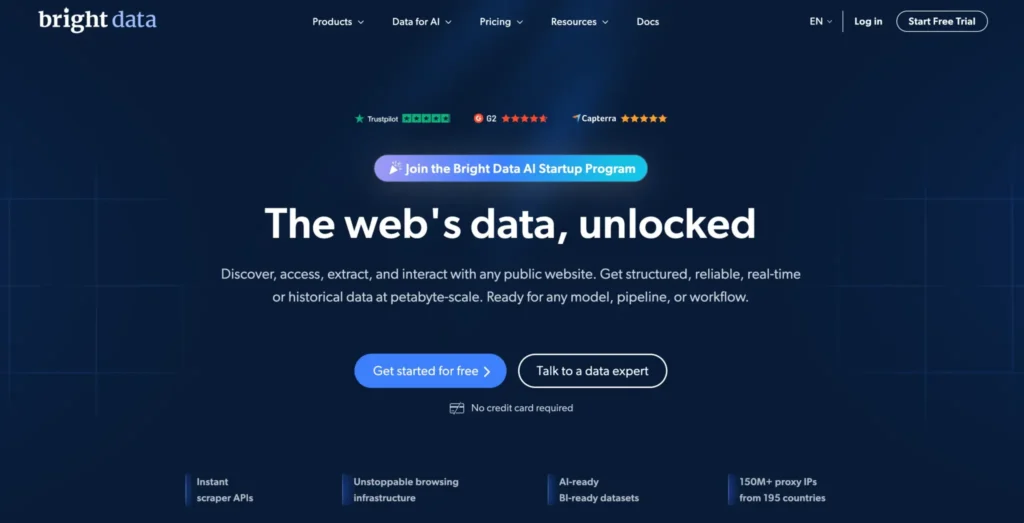
Bright Data is the heavyweight option for teams that need scale, control, and compliance support. Its stack covers residential, ISP, mobile, and datacenter networks, with strong targeting by country, city, carrier, and ASN. For security intelligence, that matters because the same scam page can behave differently across regions, devices, and networks.
The platform fits mature teams collecting public intelligence across fake storefronts, phishing pages, impersonation domains, ad fraud trails, marketplace abuse, and regional threat campaigns. It also works well when you need structured data tools alongside proxies instead of building every pipeline from scratch.
Bright Data’s biggest advantage is control. You can tune sessions, rotate IPs, choose locations, and build collection workflows with precision. The downside is complexity. Smaller teams may find the dashboard and pricing more than they need.
Best fit: Enterprise security teams, brand protection vendors, fraud intelligence platforms, and OSINT teams with formal workflows.
2. Oxylabs: Best for Large-Scale Public Web Intelligence
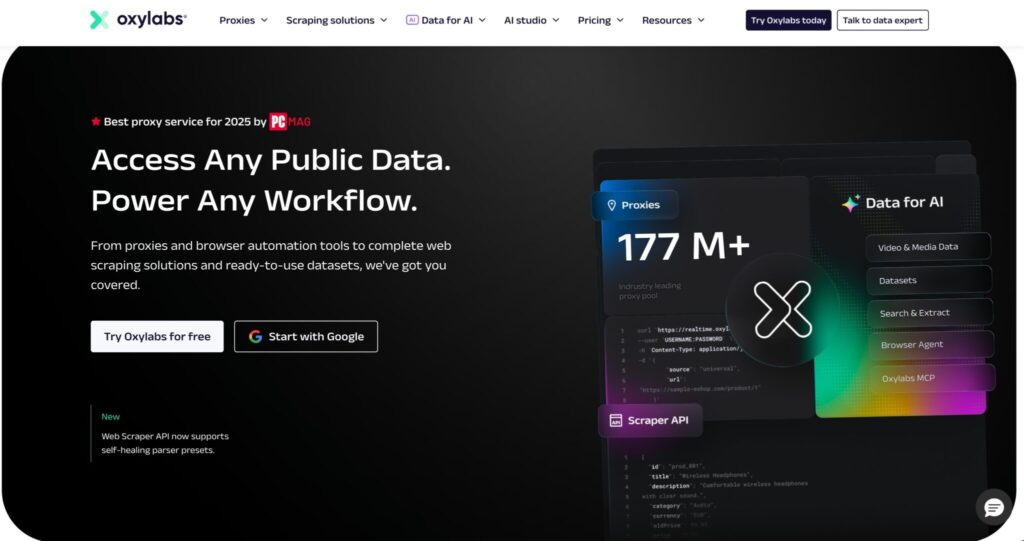
Oxylabs is another premium provider built for serious data operations. Its residential proxy pool, datacenter infrastructure, ISP proxies, and scraping tools make it a strong match for teams monitoring public sources at scale, including leaked credential chatter, copycat domains, suspicious search results, fake reviews, ad abuse, and emerging scam pages.
Its rotation options are practical. You can use rotating sessions for broad discovery and sticky sessions when a workflow needs continuity, such as checking a multi-step public page or tracking a regional variant. Oxylabs also has the documentation and account support larger organizations expect.
Where it shines is reliability at scale. Where it may feel heavy is cost. If you only need a small amount of monitoring traffic, Oxylabs may be more platform than you need.
Best fit: Enterprise threat intelligence, search intelligence, large-scale brand monitoring, and fraud research teams.
3. Decodo: Best Balanced Proxy Provider for Growing Teams
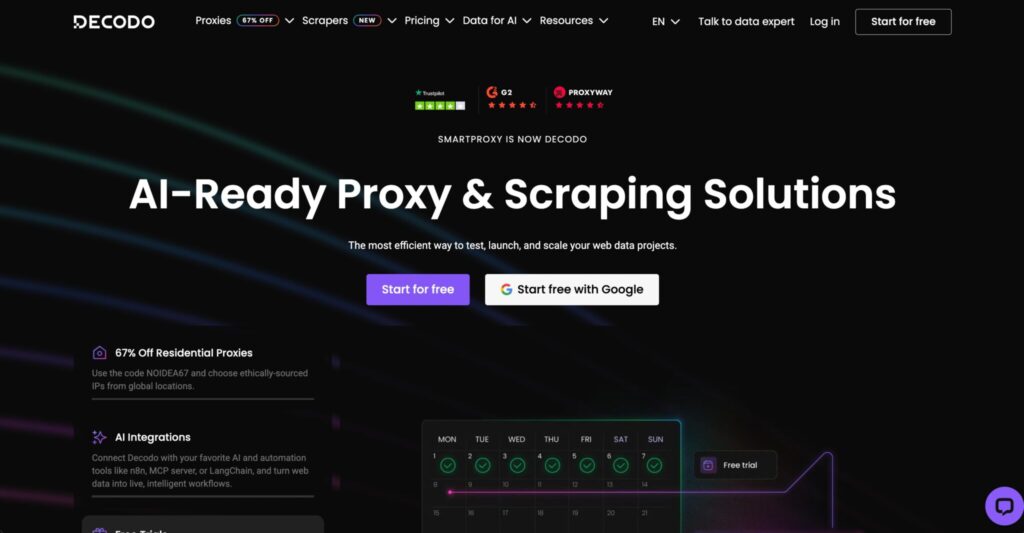
Decodo, formerly Smartproxy, is one of the easiest providers to recommend when a team wants strong coverage without enterprise-level friction. It offers residential, mobile, ISP, and datacenter proxies, plus tools that help teams start quickly.
For security intelligence, Decodo is useful when you need a clean balance between performance, price, and usability. A mid-sized team can monitor phishing pages, fake coupon pages, social impersonation, suspicious listings, or regional scam campaigns without spending weeks configuring infrastructure.
The dashboard is approachable, and the proxy controls are clear enough for analysts who are not full-time scraping engineers. That matters because most security teams do not have unlimited engineering time.
Pro-Tip: Use Decodo for discovery pipelines first. If a source proves high-value and high-volume, then decide whether to move that workload to a deeper enterprise setup.
Best fit: Mid-market security teams, managed security providers, affiliate fraud monitoring, brand abuse monitoring, and OSINT analysts.
4. SOAX: Best for Geo-Targeted Security Monitoring
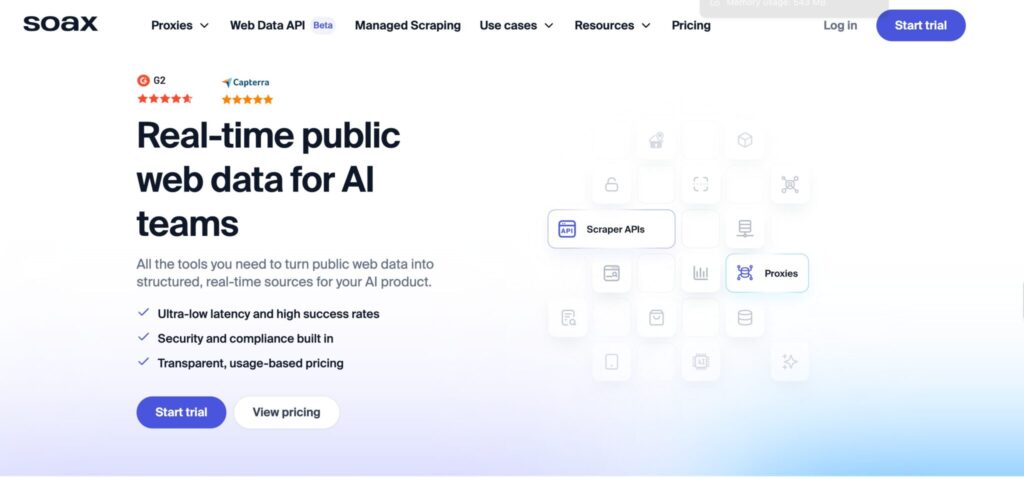
SOAX stands out for granular targeting and flexible residential or mobile access. If your security intelligence work depends on location-specific views, SOAX deserves attention. It is especially useful when investigating region-locked scam pages, local fake ads, location-based pricing fraud, or mobile-only abuse patterns.
The provider supports rotating and sticky sessions, which gives teams room to test different collection styles. Use rotating residential proxies for wide discovery. Use sticky sessions when a page requires continuity. Use mobile proxies when target behavior changes by mobile network.
SOAX also emphasizes ethically sourced IPs, which should matter to any serious security team. Dirty or questionable proxy supply can create reputational and legal headaches.
Best fit: Geo-sensitive monitoring, mobile threat research, localized brand abuse checks, and regional fraud intelligence.
5. NetNut: Best for Stable Long-Running Collection
NetNut is a strong option when stability matters more than chasing the lowest cost per gigabyte. Its residential, static residential, mobile, and datacenter products make it suitable for long-running monitoring tasks where you want fewer session failures.
Security intelligence pipelines often run on schedules: check these domains every four hours, monitor these public marketplaces daily, review these regional SERPs every morning, scan public pages for brand misuse weekly. NetNut fits that rhythm because it is built around reliable proxy access and business-focused support.
The trade-off is pricing. It may not be ideal for hobby projects or very small campaigns, but for production-grade collection, reliability can justify the spend.
Best fit: Scheduled intelligence collection, enterprise OSINT operations, marketplace abuse tracking, and steady monitoring pipelines.
6. IPRoyal: Best Budget-Friendly Option for Lean Security Teams
IPRoyal gives smaller teams access to residential, ISP, mobile, and datacenter proxies without the heavy buying process of larger enterprise vendors. Its dashboard is simple, and the pricing model is friendly for teams testing proxy-backed intelligence collection for the first time.
For security intelligence, IPRoyal works well for lighter monitoring tasks: checking suspicious landing pages, reviewing public search results from different regions, validating ad placement, or tracking low-volume brand abuse. It also gives you enough rotation control to handle basic discovery and session-based checks.
It is not the most advanced provider here, but that is not always a problem. Many teams need a dependable starting point before they invest in a larger platform.
Best fit: Startups, solo analysts, small security teams, and low-to-mid volume monitoring.
7. Webshare: Best for Affordable Testing and Datacenter Workloads
Webshare is attractive because it keeps proxy buying simple and affordable. It offers datacenter, static residential, and rotating residential proxies, making it useful for teams that want to test collection logic before moving to premium pools.
For security intelligence, Webshare is best used in controlled workloads: uptime checks, public page collection, test environments, and sources that do not require advanced residential coverage. Its datacenter proxies can be fast and cost-efficient, while static residential proxies help when you need a more stable network identity.
The limitation is tooling depth. You do not get the same enterprise features, managed help, or advanced scraping ecosystem as Bright Data or Oxylabs.
Best fit: Budget testing, prototype pipelines, datacenter-friendly sources, and small intelligence projects.
How to Choose Proxies for Security Intelligence
1. Match Proxy Type to the Intelligence Job
Use residential proxies when you need a realistic public web viewpoint across regions. Use mobile proxies when the source changes by carrier, app flow, or mobile network. Use ISP proxies when you need stable, trusted-looking sessions. Use datacenter proxies when you need speed, lower cost, and the target source is not sensitive to cloud IP ranges.
Do not use one proxy type for everything. That usually wastes budget and reduces accuracy.
2. Judge IP Pools by Quality, Not Just Size
A giant pool sounds impressive, but pool quality matters more. Look for ethically sourced IPs, ASN diversity, city-level targeting, clean reputation, low failure rates, and enough subnet spread. For security intelligence, a smaller clean pool can beat a larger noisy pool.
Ask providers about consent-based sourcing, abuse controls, blocked use cases, and compliance documentation. If the answers are vague, walk away.
3. Understand Rotation Protocols
Per-request rotation gives every request a fresh IP. It is useful for broad discovery, search monitoring, and checking many public pages. Sticky sessions keep the same IP for a set time, which helps when a workflow needs continuity. Static ISP proxies keep a stable IP for longer tasks.
A strong setup often uses all three. Discovery runs on rotation. Verification uses sticky sessions. Recurring monitoring uses ISP or static residential proxies.
Pro-Tip: Avoid aggressive rotation for multi-step workflows. Too many IP changes can break session logic and create bad data.
4. Check Protocol Support
Most teams will need HTTP and HTTPS. SOCKS5 is useful for more flexible traffic routing and certain research tools. Mobile-heavy workflows may need more specialized support, but keep everything inside approved, lawful use cases.
5. Build Governance Into the Stack
Security intelligence should be defensible. Keep internal logs, define allowed sources, respect legal restrictions, rate-limit requests, avoid collecting unnecessary personal data, and review terms where needed. A proxy does not make a risky collection practice safe.
FAQs: Best Proxies For Security Intelligence
1. What are the best proxies for security intelligence?
Bright Data and Oxylabs are best for enterprise teams. Decodo and SOAX are strong for growing teams that need usability and geo-targeting. IPRoyal and Webshare are better for lean budgets and testing.
2. Are residential proxies better than datacenter proxies?
Residential proxies are better for geo-sensitive and consumer-view monitoring. Datacenter proxies are faster and cheaper for sources that allow high-volume public collection. Most teams need both.
3. Should security teams use mobile proxies?
Use mobile proxies when the content changes on mobile networks, carrier IPs, or app-like flows. They are usually more expensive, so reserve them for cases where mobile context matters.
4. What is the difference between rotating and sticky proxies?
Rotating proxies change IPs frequently, often per request. Sticky proxies keep the same IP for a set period. Rotating is better for discovery. Sticky is better for workflows that need session continuity.
5. Are free proxies safe for threat research?
No. Free proxies are risky, unstable, and often poorly controlled. For security intelligence, free proxies can contaminate results, leak traffic, or expose your research environment.
6. How many proxies do I need?
Start with the workload. Count target regions, request volume, session length, and refresh frequency. A daily regional monitoring job may need far less capacity than a real-time fraud intelligence system.
7. What is the best proxy setup for phishing monitoring?
Use residential proxies for regional checks, ISP proxies for stable verification, and datacenter proxies for high-speed enrichment on sources that tolerate them. Keep clear rules for allowed collection and evidence handling.
Final Buying Verdict
If you want the safest enterprise shortlist, start with Bright Data and Oxylabs. If you want strong performance without heavy enterprise overhead, look at Decodo and SOAX.
If your team values stability for scheduled monitoring, NetNut is worth testing. If budget matters, IPRoyal and Webshare are practical starting points.
The best security intelligence proxy stack is usually a mix, not a single vendor. Use premium residential or mobile proxies only where they improve visibility. Use ISP proxies where session trust matters.
Use datacenter proxies where speed and cost matter. The teams that win are not the ones buying the biggest pool. They are the ones matching the right network identity to the right intelligence question.