
SEO used to be cleaner. You checked rankings, audited competitors, scraped SERPs, monitored keywords, pulled metadata, and ran reports without hitting walls every few minutes.
That version of SEO is gone.
Search engines, ecommerce platforms, review sites, and local directories now treat heavy automated access with suspicion. If your agency tracks 5,000 keywords across 20 cities every morning, you are not browsing like a normal user. If your crawler checks hundreds of competitor pages in a short window, it creates a pattern. If your rank tracker keeps requesting Google results from the same IP address, that IP will eventually get throttled, blocked, served CAPTCHA pages, or shown inconsistent data.
That is where SEO proxies become useful.
A good proxy setup lets you collect public SEO data at scale without overloading one IP address. It helps you run local SERP checks, monitor competitors, verify ads, scrape metadata, test international rankings, and keep your tools working with fewer interruptions. The key is choosing the right proxy type for the job. Residential proxies, ISP proxies, mobile proxies, and datacenter proxies all behave differently.
For SEO, clean IP quality matters more than cheap bandwidth. Rotation settings matter. Location accuracy matters. Sticky sessions matter. And yes, pricing matters too, because rank tracking can quietly burn through data if you are not careful.
Below is a practical buyer’s guide to the 9 best proxies for SEO in 2026, written for agencies, affiliate SEOs, technical SEOs, SaaS teams, and anyone running serious SERP data operations.
Why SEO Professionals Need Proxies
SEO proxies are not just for scraping. They solve several everyday problems that show up once your SEO workflow grows beyond manual checks.
The first problem is rank tracking accuracy. Search results change based on country, city, device, language, personalization signals, and IP location. Checking “best VPN,” “LLC services,” or “camping in Rishikesh” from one random server does not show what real users see in different locations. Proxies let you check rankings from specific countries, regions, and sometimes cities.
The second problem is request limits. SEO tools, custom crawlers, SERP scrapers, and Python scripts can generate hundreds or thousands of requests. Sending those requests through one IP address is like shouting into a security camera. Rotation spreads the activity across a pool of IPs so your collection workflow looks less repetitive.
The third problem is competitive research. If you are monitoring pricing pages, title tags, schema changes, product listings, or backlink footprints, you need stable access. A poor proxy pool gives you noisy data, connection failures, and half-loaded pages. That wastes more time than it saves.
The fourth problem is local SEO testing. A business ranking in New York may not rank the same in Chicago. A hotel keyword in Bangkok can show different results for a user in India, Singapore, or the United States. Residential and mobile proxies are especially useful when you need location-sensitive results.
The final problem is tool reliability. Many SEO platforms, scrapers, and browser automation setups can integrate proxies. The better the proxy, the fewer failed jobs, retry loops, and messy reports you deal with.
A strong SEO proxy setup usually needs:
| SEO Task | Best Proxy Type | Why It Works |
|---|---|---|
| Daily rank tracking | Residential or ISP proxies | Cleaner IP reputation and better location accuracy |
| Large SERP scraping | Residential proxies or SERP APIs | Handles rotation and reduces blocks |
| Technical audits | Datacenter or ISP proxies | Faster and cheaper for crawling your own or low-risk sites |
| Local SEO checks | Residential or mobile proxies | More realistic local signals |
| Competitor monitoring | Residential or ISP proxies | Better consistency across protected sites |
| Ad verification | Residential, mobile, or ISP proxies | Shows ads from different markets and devices |
The wrong proxy can make your SEO data worse. A blocked IP does not just fail. It can return distorted SERPs, CAPTCHA pages, soft blocks, empty HTML, or location-mismatched results. That is why this list focuses on practical SEO use, not just who has the biggest pool.
9 Best Proxies For SEO in 2026
| Rank | Proxy Provider | Best For | Proxy Types Useful for SEO | Starting Residential Price | IP Pool / Coverage | Best SEO Use Case |
|---|---|---|---|---|---|---|
| 1 | Oxylabs | Premium SEO operations | Residential, datacenter, ISP, mobile, Web Unblocker | Residential plans listed from $6/GB on starter monthly pricing | 175M+ residential and 2M datacenter IPs listed on its site | Enterprise SERP scraping, rank tracking, large-scale public data collection |
| 2 | Decodo | Best value SEO proxy | Residential, static residential, datacenter, mobile, scraping APIs | Residential plans shown from $3.75/GB on small monthly packages, with lower rates at higher volume | 115M+ residential IPs listed on its residential page | Agencies needing balance between price, scale, and ease of use |
| 3 | Webshare | Individual SEOs and small agencies | Residential, static residential, datacenter | Residential listed from $1.40/GB at scale, with datacenter pricing from $0.05/IP | 80M+ residential IPs listed on pricing page | Budget rank tracking, light scraping, small agency workflows |
| 4 | Bright Data | Global multi-market tracking | Residential, ISP, datacenter, mobile, SERP API, Web Unlocker | Residential pricing page lists plans from $5.88/GB | 400M+ monthly residential IPs listed across 195 countries | Global SERP intelligence, enterprise scraping, location-heavy tracking |
| 5 | SOAX | Accurate local SERP data | Residential, mobile, US datacenter, Web Data API | Residential bundled plans listed from $3.60/GB with 25GB included | 155M+ residential IPs in 195+ locations listed on its residential page | City-level SERP checks, local SEO, geo-targeted data collection |
| 6 | IPRoyal | Long-term rank monitoring | Residential, ISP, datacenter, mobile | Residential pricing page lists 1GB at $7/GB and lower rates at higher tiers | 32M+ residential IP pool listed on pricing pages | Consistent SEO monitoring, flexible smaller purchases |
| 7 | Proxy-Cheap | Daily budget rank checks | Rotating residential, static residential, datacenter, mobile | Rotating residential listed from $4.99/GB | Offers static residential, rotating residential, datacenter, and mobile options | Cost-conscious rank checks and lightweight SEO tasks |
| 8 | NodeMaven | Clean SERP data collection | Residential, mobile, ISP | Residential pricing starts from $2.20/GB on monthly plans | Residential and mobile access included in plans | Cleaner IP filtering, SEO monitoring, ad verification |
| 9 | DataImpulse | Budget SEO proxy | Residential, mobile, datacenter | Residential pricing starts from $1/GB | 90M+ residential IPs and 195-country coverage listed on its site | Low-cost SERP tracking, testing, and entry-level scraping |
Pricing and pool sizes change often in the proxy market. The numbers above are based on current provider pages and recent public pricing pages checked for this draft. Oxylabs lists residential starter pricing at $6/GB and also states a 175M+ residential IP pool on its website.
Decodo lists 115M+ residential IPs and small monthly residential packages starting from $3.75/GB. Webshare lists residential pricing from $1.40/GB at higher volume and datacenter proxies from $0.05/IP.
Bright Data lists residential pricing from $5.88/GB and states 400M+ monthly residential IPs from 195 countries. SOAX lists residential access from $3.60/GB with 25GB included and promotes 155M+ IPs in 195+ locations.
IPRoyal lists a 32M+ residential pool and residential prices starting at $7/GB for 1GB packages. DataImpulse lists $1/GB residential pricing and 90M+ residential IPs.
#1 — Oxylabs: Best Premium SEO Proxy Provider
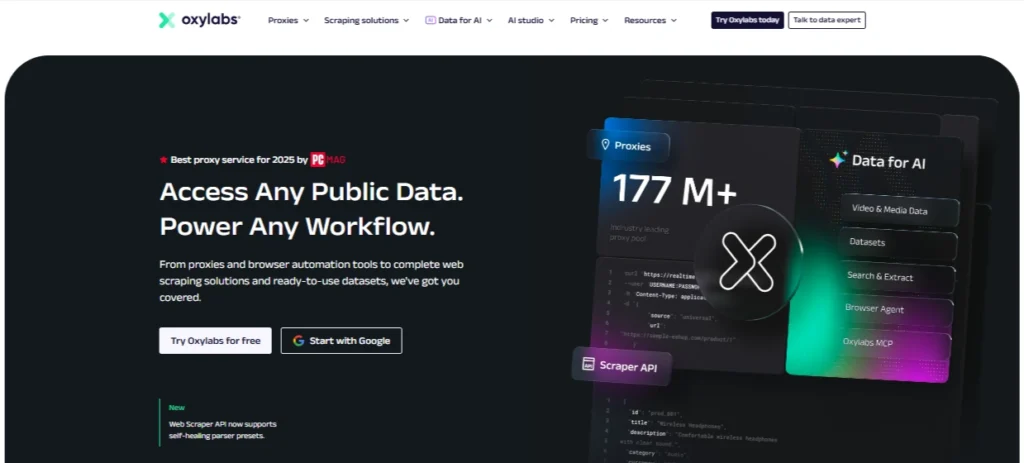
Oxylabs is the provider I would put in the “serious infrastructure” category. It is not the cheapest option, and that is not really the point. Oxylabs is built for teams that care about reliability, scale, support, and data collection workflows that cannot keep breaking at 2 a.m.
For SEO, Oxylabs works best when you are running large SERP scraping operations, monitoring rankings across multiple countries, collecting competitor data, or powering internal SEO dashboards. Its residential proxy pool is large, and the company also offers datacenter proxies and scraping-focused products. That gives technical SEO teams more room to build around the proxy layer instead of duct-taping random providers together.
The biggest benefit is stability. When you run high-volume SEO data collection, cheap proxies can become expensive fast because failed requests still cost time. Your crawler retries. Your script slows down. Your data pipeline gets holes. Reports go out late. Oxylabs helps reduce that operational drag.
Oxylabs lists residential proxy plans starting at $6/GB on its pricing page, with larger plans reducing the per-GB cost. Its main site also states a 175M+ residential IP pool and 2M datacenter IP proxies.
Best for: Enterprise SEO teams, SaaS SEO tools, large agencies, and data-heavy SEO operations.
Pros
| Strength | Why It Matters for SEO |
|---|---|
| Large residential pool | Better for global SERP checks and high-volume scraping |
| Enterprise-grade reliability | Useful when SEO data feeds power reporting dashboards |
| Strong scraping ecosystem | Helpful for teams collecting public data beyond simple rank tracking |
| Good for scaled workflows | Handles larger workloads better than bargain providers |
Cons
| Limitation | What to Know |
|---|---|
| More expensive than budget options | Overkill for small blogs or casual checks |
| Can feel technical for beginners | Best value appears when you have serious data needs |
| Trial or onboarding may require sales interaction | Less plug-and-play than low-cost dashboards |
Pro-Tip: Use Oxylabs when your proxy setup is tied to revenue-critical reporting. If you only check 50 keywords per week, it may be too much. If you track 50,000 keywords across markets, premium infrastructure starts making sense.
#2 — Decodo: Best Value SEO Proxy
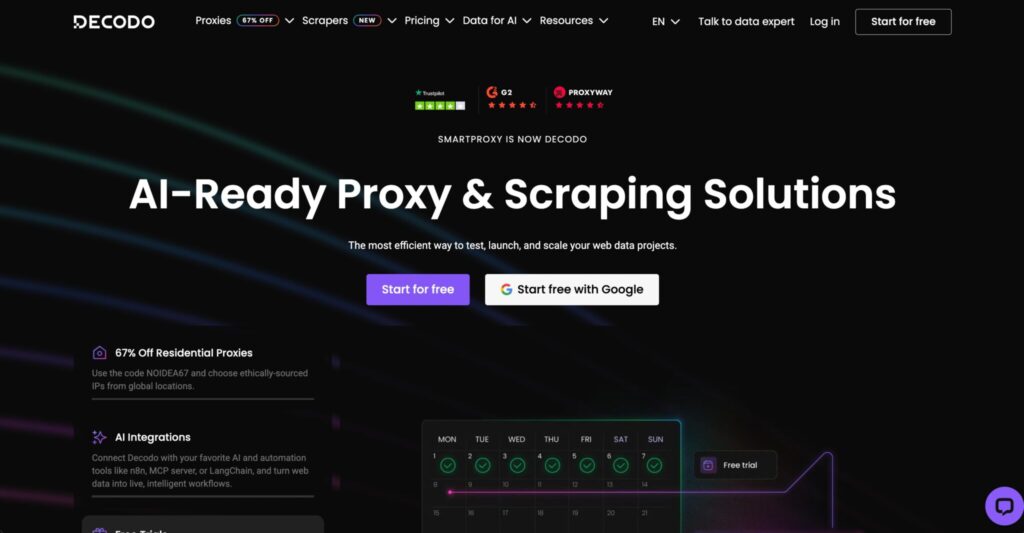
Decodo, formerly Smartproxy, sits in a sweet spot for SEO professionals. It offers a strong mix of scale, pricing, usability, and scraping-friendly features. For many agencies, it may be the most balanced option on this list.
The provider lists 115M+ residential IPs, country, state, city, and ZIP-level targeting, and unlimited concurrent sessions on residential plans. For SEO, that combination matters. You can run rank tracking in multiple locations, test local SERPs, scrape search pages, and keep campaigns organized without immediately stepping into enterprise-only pricing.
Decodo’s residential pricing page shows smaller packages starting at $3.75/GB for 3GB, with lower per-GB pricing on larger plans and pay-as-you-go at $4/GB. It also offers a 3-day free trial on the residential page.
Where Decodo stands out is usability. The dashboard is easier for non-engineers than some enterprise platforms. That makes it attractive for SEO teams that need proxies but do not want to spend days configuring everything.
Best for: SEO agencies, affiliate marketers, rank tracking teams, and growing data teams.
Pros
| Strength | Why It Matters for SEO |
|---|---|
| Strong price-to-performance balance | Good for agencies watching margins |
| 115M+ residential pool | Enough scale for most SEO workflows |
| City and ZIP targeting | Useful for local SEO rank checks |
| Unlimited concurrent sessions | Helpful for parallel rank tracking jobs |
Cons
| Limitation | What to Know |
|---|---|
| Not always the cheapest per GB | DataImpulse and Webshare can be cheaper |
| Heavy enterprise scraping may need higher plans | Large jobs can still become expensive |
| Rebrand may confuse old Smartproxy users | Decodo is the new brand home |
Pro-Tip: For daily rank tracking, start with residential proxies and test sticky session settings. Rotating too aggressively can create inconsistent results, while rotating too slowly can increase blocks.
#3 — Webshare: Best SEO Proxy for Individual SEOs and Small Agencies
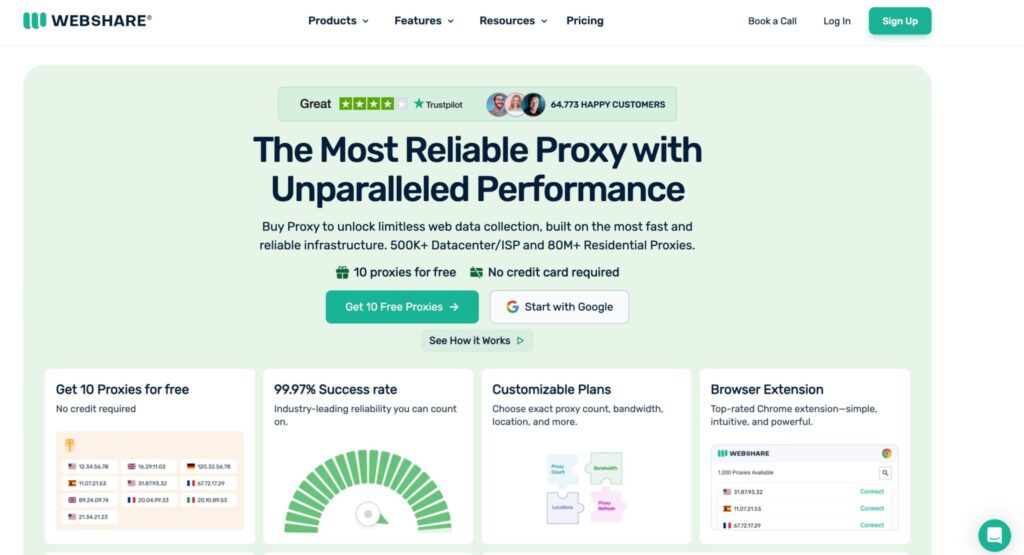
Webshare is a strong pick when budget matters but you still want a real provider instead of random free proxy lists. It is especially useful for individual SEOs, small agencies, niche site owners, and teams testing proxy workflows for the first time.
Its pricing is one of the main attractions. Webshare lists rotating residential proxies from $1.40/GB at scale, static residential proxies from $0.23/IP, and datacenter proxy servers starting at $0.05/IP. It also promotes 80M+ residential IPs on its pricing page.
For SEO work, Webshare is best for lighter rank tracking, competitor checks, and basic scraping. It is not the most advanced scraping ecosystem, but many users do not need that. If your main requirement is “give me clean enough proxies at a reasonable price,” Webshare deserves a close look.
The dashboard is simple, and its datacenter proxies are useful for tasks where residential IPs are unnecessary. For example, crawling your own websites, testing uptime, checking redirects, or running basic technical audits can often be done with datacenter proxies.
Best for: Freelancers, bloggers, small SEO agencies, and budget-conscious rank tracking.
Pros
| Strength | Why It Matters for SEO |
|---|---|
| Affordable pricing | Good for small teams and testing |
| Residential and datacenter options | Lets you match cost to task |
| Simple dashboard | Easy for non-technical users |
| Static residential options | Useful for stable logins and repeat checks |
Cons
| Limitation | What to Know |
|---|---|
| Fewer advanced scraping tools | Not as complete as Bright Data or Oxylabs |
| Support depth may be lighter | Larger teams may want more hands-on support |
| Cheap plans require careful testing | Lowest-cost options may not fit sensitive SERP scraping |
Pro-Tip: Do not use residential bandwidth for every SEO task. Use datacenter proxies for simple crawling and save residential traffic for SERP checks, local rankings, and tougher targets.
#4 — Bright Data: Best SEO Proxy for Global Multi-Market Tracking
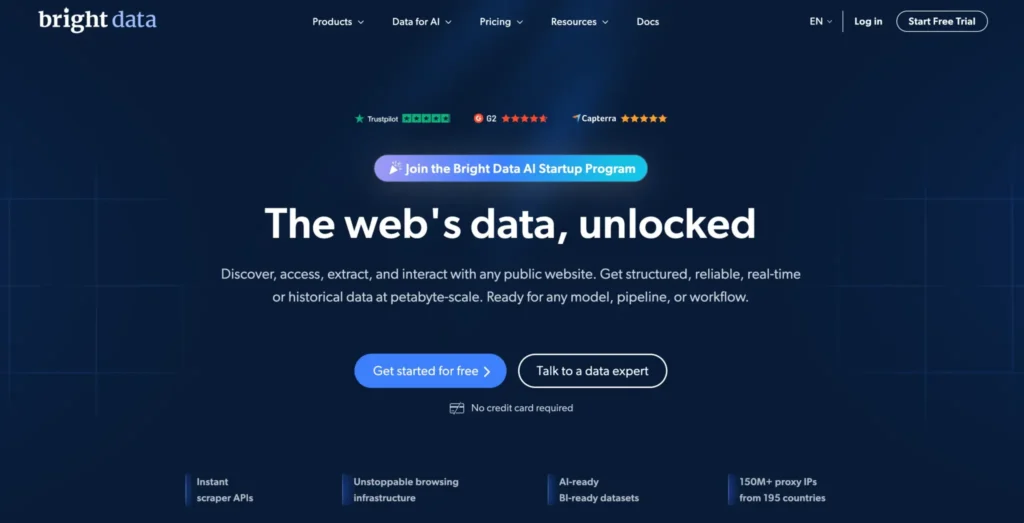
Bright Data is one of the most advanced proxy and web data platforms in the market. It is built for teams that need scale, location accuracy, compliance controls, and multiple ways to collect data.
For SEO, Bright Data is particularly strong when you need global rank intelligence. If you track keywords in the United States, United Kingdom, India, Australia, Canada, Germany, and local city-level markets, you need both coverage and control. Bright Data’s residential proxy page states 400M+ monthly ethical residential IPs from 195 countries. It also lists sticky and rotating sessions, free geo-location targeting, and performance-related metrics on its residential proxy page.
Bright Data’s residential pricing page lists residential proxies from $5.88/GB. It also offers products beyond raw proxies, including SERP-focused and web unlocking tools, which can be useful if your team wants to avoid maintaining its own scraper logic.
The trade-off is complexity. Bright Data has a lot of power, but you need to know what you are buying. A small SEO team may find it more platform than they need. A serious data team may love the flexibility.
Best for: Global SEO teams, enterprise agencies, market intelligence platforms, and multi-country rank tracking.
Pros
| Strength | Why It Matters for SEO |
|---|---|
| Huge global proxy network | Strong fit for international SERP tracking |
| Residential, ISP, datacenter, and mobile options | Lets teams choose the right IP type |
| SERP and web data tools | Reduces scraper maintenance |
| Strong location targeting | Useful for local and international SEO |
Cons
| Limitation | What to Know |
|---|---|
| Can become expensive | Not ideal for casual SEO users |
| More complex than budget providers | Requires careful setup |
| Best value appears at scale | Small workloads may not justify the platform |
Pro-Tip: If you are scraping SERPs at scale, compare raw proxy costs against Bright Data’s SERP or unlocking products. Sometimes paying per successful result is cheaper than paying for failed requests, retries, and developer time.
#5 — SOAX: Best SEO Proxy for Accurate Local SERP Data
SOAX is a strong choice for local SEO and geo-sensitive data collection. It offers residential proxies, mobile proxies, US datacenter proxies, and Web Data API access through bundled plans. Its residential page promotes 155M+ IPs in 195+ locations, and its pricing shows starter bundled plans at $3.60/GB with 25GB included.
The reason SOAX makes sense for SEO is targeting. Local search is messy. A query like “best dentist near me,” “LLC filing service,” or “river rafting in Rishikesh” can vary dramatically by location. If your SEO work depends on local rankings, you need proxies that can give cleaner location signals.
SOAX is also useful for agencies handling multiple local clients. You can test results from different regions, monitor map pack visibility, check localized landing pages, and verify if your client’s page appears consistently in target locations.
It is not the cheapest provider on this list, but it gives a good mix of control and data quality.
Best for: Local SEO agencies, geo-targeted rank tracking, map pack monitoring, and regional SERP scraping.
Pros
| Strength | Why It Matters for SEO |
|---|---|
| Strong geo-targeting | Helpful for city and region-level ranking checks |
| Residential and mobile options | Useful for realistic local SERP testing |
| Bundled Web Data API access | Good for teams that need more than raw proxies |
| Large stated IP pool | Helps with distributed SEO data collection |
Cons
| Limitation | What to Know |
|---|---|
| Minimum monthly spend may be higher than budget tools | Not ideal for very small users |
| Bundled pricing may not suit everyone | Some users only want raw proxies |
| Needs testing by target market | Local accuracy varies by location and availability |
Pro-Tip: When tracking local rankings, keep your language, device, and location settings consistent. A proxy alone will not fix messy methodology.
#6 — IPRoyal: Best SEO Proxy for Long-Term Rank Monitoring
IPRoyal is a practical pick for SEOs who want flexible access without jumping into enterprise complexity. It offers residential, ISP, datacenter, and mobile proxies, which gives you enough variety for most SEO workflows.
Its residential pricing page lists 1GB at $7/GB, 2GB at $5.95/GB, 10GB at $5.25/GB, and 50GB at $4.90/GB. The same page mentions access to 32M+ IPs in 195+ countries. Its main pricing pages also show residential pricing from $1.75/GB at larger volumes.
For long-term rank monitoring, IPRoyal’s appeal is simple: it is approachable. You can buy smaller packages, test campaigns, use residential proxies for location-sensitive rank checks, and use datacenter or ISP proxies where speed and stability matter more.
It may not have the same enterprise tooling as Bright Data or Oxylabs, but not every SEO team needs that. Many teams need stable, affordable proxies that work inside existing tools.
Best for: Small to mid-sized SEO teams, rank trackers, affiliate SEOs, and flexible proxy buyers.
Pros
| Strength | Why It Matters for SEO |
|---|---|
| Flexible pricing tiers | Good for smaller SEO teams |
| Residential, ISP, datacenter, and mobile proxies | Covers different SEO workflows |
| 32M+ residential IP pool | Enough for many tracking use cases |
| Simple buying experience | Easier than enterprise-first providers |
Cons
| Limitation | What to Know |
|---|---|
| Smaller pool than top enterprise providers | May matter for huge scraping jobs |
| Per-GB pricing can be higher at small volumes | Entry-level residential traffic is not the cheapest |
| Less advanced scraping infrastructure | Better as proxy infrastructure than full data platform |
Pro-Tip: For daily keyword checks, calculate monthly usage before buying. A 1GB plan sounds fine until your rank tracker checks thousands of keyword-location combinations.
#7 — Proxy-Cheap: Best Budget SEO Proxy for Daily Rank Checks

Proxy-Cheap is positioned around affordability. It offers rotating residential, static residential, datacenter, and mobile proxies, which makes it useful for SEOs who want multiple proxy types without premium pricing.
Its homepage lists rotating residential proxies starting at $4.99/GB, static residential from $2.12/month during the shown discount, datacenter IPv4 from $1.49/month during the shown discount, and rotating mobile from $5.99/GB.
For SEO, Proxy-Cheap is best used carefully. It can work well for daily rank checks, lightweight SERP monitoring, and small automation jobs. But with budget providers, you should always test block rates, speed, and location accuracy before committing to a bigger workflow.
The good news is that daily rank tracking does not always need the most expensive proxy setup. If your tool sends moderate requests and you rotate sensibly, Proxy-Cheap can be cost-efficient.
Best for: Budget rank monitoring, solo SEOs, small agencies, and lightweight scraping.
Pros
| Strength | Why It Matters for SEO |
|---|---|
| Affordable entry pricing | Useful for low-margin projects |
| Multiple proxy types | Lets you choose between residential, mobile, and datacenter |
| Good for small recurring jobs | Suitable for daily checks if tested properly |
| Simple positioning | Easy to understand for beginners |
Cons
| Limitation | What to Know |
|---|---|
| Not as enterprise-grade as premium providers | Heavy scraping may require stronger infrastructure |
| Quality can vary by location | Always test target countries first |
| Fewer advanced SEO-specific tools | You may need your own rank tracker or scraper logic |
Pro-Tip: Run a 48-hour test before moving all rank tracking to any budget proxy provider. Check failed requests, CAPTCHA rates, average response time, and location match accuracy.
#8 — NodeMaven: Best SEO Proxy for Clean SERP Data Collection
NodeMaven has become interesting because it focuses heavily on IP quality and filtering. Its residential proxy page positions the product for market research, ad verification, SEO monitoring, and AI dataset collection. Its pricing page says residential proxies start at $2.20/GB on monthly plans, with access to both residential and mobile proxy pools, traffic rollover, and cashback on used bandwidth.
For SEO, clean IPs can matter more than huge pool size. If your proxies are overused, abused, or constantly blocked, the headline pool number means very little. NodeMaven’s pitch is that it filters for quality, which can help with SERP collection and monitoring jobs where consistency matters.
The inclusion of residential and mobile access in the same plan can also be attractive. Mobile proxies are useful when you need to test mobile SERPs, mobile ads, app visibility, or location-specific mobile experiences.
Best for: SEO teams that care about IP quality, mobile SERP checks, and cleaner data collection.
Pros
| Strength | Why It Matters for SEO |
|---|---|
| Focus on filtered IP quality | Helps reduce noisy SERP collection |
| Residential and mobile access | Useful for mobile SEO checks |
| Traffic rollover | Better for uneven monthly usage |
| Competitive starting price | Good balance of quality and cost |
Cons
| Limitation | What to Know |
|---|---|
| Less established than legacy giants | Enterprise buyers may prefer older providers |
| May require testing in your specific markets | Quality varies by location and target |
| Smaller brand footprint | Fewer third-party benchmarks than major providers |
Pro-Tip: Use NodeMaven for SEO workflows where “clean data” matters more than raw volume. For example, local SERP snapshots, ad verification, and smaller but sensitive rank checks.
#9 — DataImpulse: Best Budget SEO Proxy
DataImpulse is the budget pick for SEO teams that want residential proxies without high monthly commitments. Its site lists residential proxies at $1/GB, 90M+ residential IPs, pay-as-you-go pricing, 24/7 support, and coverage across 195 countries.
That pricing is hard to ignore. If you are testing SERP scraping, building a small rank tracker, or experimenting with proxy-powered SEO workflows, DataImpulse gives you a low-cost entry point.
The trade-off is that ultra-low-cost residential traffic should always be tested against your targets. Cheap bandwidth is great only if the requests succeed and the location data is usable. If your project burns 20GB because half the requests fail, it is no longer cheap.
Still, DataImpulse deserves a place in this guide because many SEO teams need a low-risk starting point. It is especially useful for testing ideas before moving to a more expensive provider.
Best for: Budget SEO experiments, low-cost SERP tracking, testing, and smaller scraping projects.
Pros
| Strength | Why It Matters for SEO |
|---|---|
| $1/GB residential pricing | Very attractive for budget-conscious SEOs |
| Pay-as-you-go model | Good for testing and irregular usage |
| 90M+ residential IPs | Strong stated pool size for the price |
| 195-country coverage | Useful for international checks |
Cons
| Limitation | What to Know |
|---|---|
| Needs careful quality testing | Low price does not guarantee perfect SERP access |
| May not replace enterprise providers | Large teams may need stronger support and tools |
| Best for controlled workloads | Heavy scraping should be benchmarked first |
Pro-Tip: Use DataImpulse to test keyword-location workflows, but measure actual cost per successful SERP result. That number matters more than cost per GB.
How to Choose the Best Proxies For SEO
Choosing SEO proxies is not about picking the biggest IP pool or the lowest price. It is about matching the proxy to the job.
1. Start With Your SEO Use Case
A rank tracker, a SERP scraper, a backlink crawler, and an ad verification workflow do not need the same proxy setup.
| Use Case | Recommended Proxy Type | Reason |
|---|---|---|
| Local rank tracking | Residential or mobile | More realistic location-based SERPs |
| High-volume SERP scraping | Residential or SERP API | Better unblock rates |
| Technical site crawling | Datacenter or ISP | Faster and cheaper |
| Competitor page monitoring | Residential or ISP | Better stability and lower block risk |
| Ad verification | Residential, mobile, or ISP | Shows market-specific ads |
| International SEO checks | Residential | Better global coverage |
For most SEO teams, residential proxies are the safest default. They cost more than datacenter proxies, but they are better for search results, local checks, and platforms that dislike obvious server traffic.
2. Look Beyond IP Pool Size
A provider can advertise 100M+ IPs, but that does not mean all IPs are available for your target country, city, or workflow. What matters is usable pool quality.
Check these points:
| Factor | Why It Matters |
|---|---|
| Active IPs in your target locations | Your campaign may need US, UK, India, Canada, or city-level availability |
| IP reputation | Overused proxies trigger more blocks |
| Rotation control | Poor rotation creates inconsistent data |
| Sticky sessions | Useful for multi-step checks and stable workflows |
| Protocol support | HTTP, HTTPS, and SOCKS5 support can affect tool compatibility |
| Concurrency limits | Important for parallel rank tracking |
A smaller clean pool can beat a giant dirty pool.
3. Understand Rotation Protocols
Rotation controls how often your proxy IP changes. This is one of the most important proxy settings for SEO.
| Rotation Type | Best For | SEO Notes |
|---|---|---|
| Per-request rotation | Large scraping jobs | Good for scale, but can create inconsistent sessions |
| Timed rotation | Rank tracking and monitoring | Stable enough for repeat checks |
| Sticky sessions | Login-based tools, multi-step workflows | Keeps one IP for a set time |
| Manual rotation | Controlled testing | Useful for debugging and QA |
For SERP scraping, timed or per-request rotation often works well. For local rank tracking, you may want more consistency. For logging into tools or checking dashboards, sticky sessions are usually safer.
4. Match Location Targeting to Your SEO Strategy
Country targeting is enough for broad international SEO. City targeting is better for local SEO. ZIP targeting can be useful, but only if the provider has enough real IP availability in those locations.
For example:
| SEO Scenario | Location Requirement |
|---|---|
| Tracking “best LLC services” in the US | Country-level US may be enough |
| Tracking “dentist near me” in Dallas | City-level targeting is better |
| Tracking map pack visibility | City or ZIP-level targeting helps |
| Checking international SERPs | Country plus language settings |
| Testing travel keywords | Country and device context matter |
Do not rely only on the proxy location. Search settings, language, browser parameters, device type, and personalization controls can also affect SERPs.
5. Calculate Real Monthly Usage
Proxy pricing can be deceptive. A low per-GB rate looks great until you estimate your actual usage.
A simple rank tracking formula:
Keywords × Locations × Devices × Checks per month = SERP requests
If you track 1,000 keywords in 5 locations across desktop and mobile every day:
1,000 × 5 × 2 × 30 = 300,000 SERP checks per month
That is not a small workload. You may need to compare raw residential proxies against a SERP API because failed requests, retries, and bandwidth waste can change the real cost.
6. Test Before Scaling
Before buying a large plan, test these metrics:
| Metric | What to Measure |
|---|---|
| Success rate | How many requests return valid pages |
| CAPTCHA rate | How often you hit verification pages |
| Average response time | How fast requests complete |
| Location accuracy | Whether results match the intended market |
| SERP consistency | Whether rankings look stable across repeated checks |
| Cost per valid result | The real number that affects ROI |
A proxy provider can look perfect on paper and still perform poorly for your exact target.
FAQs: Best Proxies For SEO in 2026
Why do I need proxies for SEO rank tracking?
You need proxies for rank tracking because search results vary by location, device, and IP. If all ranking checks come from one server, you may get blocked or receive data that does not match what real users see. Proxies help distribute requests and collect more location-relevant SERP data.
Can I use free proxies for SEO rank tracking?
Free proxies are a bad idea for serious SEO work. They are usually slow, unstable, overused, and risky. Many are already blocked by search engines or data platforms. They can also distort your reports because failed requests may look like ranking drops or missing pages.
For testing, a free proxy might be harmless. For client reporting, revenue tracking, or campaign decisions, use a paid provider.
What’s the difference between residential and datacenter proxies for SEO?
Residential proxies use IP addresses associated with real internet service providers and household users. They usually look more natural to search engines and location-sensitive websites. Datacenter proxies come from cloud servers or data centers. They are faster and cheaper, but easier to identify as automated traffic.
For SERP scraping and local rank tracking, residential proxies are usually better. For technical crawling and low-risk tasks, datacenter proxies can be enough.
How many proxy requests does daily rank tracking use?
It depends on your keyword count, locations, devices, and frequency. A small site tracking 100 keywords in one country once per day may use a manageable number of requests. An agency tracking 5,000 keywords across 20 cities on desktop and mobile can generate hundreds of thousands of monthly checks.
Always calculate usage before buying. Proxy costs can rise quickly when you add locations and mobile tracking.
Do SEO proxies work for Ahrefs, SEMrush, and other SEO tools?
Most mainstream SEO tools like Ahrefs and Semrush already collect their own data, so you usually do not need proxies for their normal web apps. Proxies are more relevant when you run custom scrapers, rank trackers, browser automation, local SERP checks, or internal SEO data pipelines.
If a third-party SEO tool supports proxy settings, check its documentation before connecting any provider.
Are residential proxies better than mobile proxies for SEO?
Residential proxies are better for most SEO workflows because they offer a good balance of price, scale, and location coverage. Mobile proxies can be useful for mobile SERP testing, app-based checks, ad verification, and cases where mobile carrier IPs matter.
Mobile proxies are usually more expensive, so use them only when mobile-specific accuracy is important.
Which proxy type is best for local SEO?
Residential proxies are usually the best starting point for local SEO. If you need mobile map pack checks or mobile SERP testing, mobile proxies can help. The key is accurate location targeting. City-level or ZIP-level targeting is useful, but only when the provider has enough real availability in that location.
What is the best budget proxy for SEO?
For budget SEO work, Webshare and DataImpulse are strong options. Webshare is useful for individual SEOs and small agencies that want affordable residential and datacenter choices. DataImpulse is attractive for low-cost residential traffic because it lists residential proxies from $1/GB.
For better balance between price and reliability, Decodo is often a stronger middle-ground option.
What is the best premium proxy for SEO?
Oxylabs and Bright Data are the strongest premium picks. Oxylabs is excellent for enterprise-grade proxy infrastructure and large-scale data collection. Bright Data is better when you need global coverage, advanced data products, SERP tools, and strong location control.
For agencies and growth-stage SEO teams that want premium-like performance without full enterprise complexity, Decodo is a practical choice.
Conclusion: Best Proxies For SEO in 2026
The best SEO proxy depends on your workload.
- If you want premium infrastructure for high-volume SEO data collection, Oxylabs is the strongest overall pick.
- If you want the best value for agency-level SEO work, Decodo is the safest recommendation.
- If you are a freelancer or small agency watching every dollar, Webshare gives you a friendly entry point.
- If your SEO work spans many countries and requires advanced data tooling, Bright Data is built for that level of operation.
For local SEO, SOAX deserves attention because location accuracy matters. For steady rank monitoring with flexible plans, IPRoyal is practical. For budget daily checks, Proxy-Cheap can work if you test it properly. For cleaner SERP data collection with a quality-focused angle, NodeMaven is worth testing. And for low-cost experimentation, DataImpulse is hard to ignore.
The real winner is not always the provider with the biggest pool or the lowest price. It is the provider that gives you the highest number of accurate, usable, location-matched SEO results at the lowest operational cost.
That is the number serious SEOs should track. Not cost per GB. Not pool size. Not marketing claims.
Cost per clean SEO result.