
10. Best Residential IP Rotation Services: A Practical Buyer’s Guide for 2026
If you have ever run a serious scraping job, ad verification check, price monitoring system, SEO rank tracker, or fraud research workflow, you already know one thing: the proxy layer is not just a technical add-on. It is the engine room.
A weak residential proxy setup can burn through bandwidth, trigger blocks, return messy data, break login flows, and waste hours of debugging time. A strong residential IP rotation service, on the other hand, gives you cleaner access, better geographic coverage, more stable sessions, and fewer failed requests.
That does not mean “bigger IP pool equals better provider.” That is one of the first mistakes buyers make.
A provider with 100 million IPs can still perform poorly on your target if the rotation logic is weak, if certain locations are thin, if IPs are overused, or if sticky sessions keep breaking mid-task. Likewise, a smaller provider can perform well if its IP quality, session controls, and routing are tuned for your exact use case.
Residential IP rotation is about balance. You need enough fresh IPs, enough control over when those IPs change, and enough targeting precision to avoid looking random in a way that hurts your workflow.
This guide breaks down the best residential IP rotation services for professionals who care about real-world performance, not just marketing claims.
Quick Answer: Best Residential IP Rotation Services
Here is the short version before we go deeper:
| Rank | Provider | Best For | Residential Pool | Rotation Style | Starting Price Signal | Best Use Case |
|---|---|---|---|---|---|---|
| 1 | Bright Data | Enterprise-grade control | 400M+ residential IPs | Random, country-targeted, sticky, advanced rules | From $5.88/GB on residential pricing page | Large-scale data collection and complex geo-targeting |
| 2 | Oxylabs | High-volume scraping teams | 175M+ residential IPs | Rotating and sticky sessions up to 24 hours | From $6/GB starter residential plan | Enterprise scraping, price intelligence, SEO data |
| 3 | Decodo | Best value for speed and usability | 115M+ residential IPs | Rotating per request or sticky sessions | From $2/GB at higher volume | Agencies, SaaS teams, mid-size data operations |
| 4 | SOAX | Precise geo-targeting | 155M+ residential IPs | Automatic rotation and sticky sessions | Starter around $3.60/GB | Geo-specific monitoring, ad verification, localized testing |
| 5 | NetNut | Stable business use cases | 85M+ residential IPs | Rotating residential pool | Custom and plan-based pricing | Data collection teams needing stable routing |
| 6 | IPRoyal | Budget-friendly rotating residential proxies | 32M+ rotating residential proxies | Custom rotation settings | Often positioned as low-cost PAYG | Small teams, testing, flexible usage |
| 7 | Webshare | Affordable rotation controls | Large global residential pool | Rotation from 5 minutes to monthly | Plan-based pricing | Budget-conscious teams needing easy setup |
| 8 | ProxyEmpire | Rollover-style and flexible proxy buying | Residential proxies from local home networks | Rotating residential sessions | Residential proxies from $0.75 signal | Buyers who want flexibility and smaller testing options |
| 9 | DataImpulse | Low-cost pay-as-you-go | 90M+ residential IPs | Rotating and sticky options | $1/GB | Cost-sensitive scraping and SERP tracking |
| 10 | Rayobyte | Ethical proxy operations and mixed proxy stack | 36M+ residential IPs | Residential and rotating ISP options | Residential as low as $0.50/GB signal | Teams that value support and proxy variety |
Bright Data lists 400M+ residential IPs across 195 countries, with targeting options including country, city, state, ZIP, and ASN level. Oxylabs lists 175M+ residential IPs, city-level targeting, sticky sessions up to 24 hours, and SOCKS5 support. Decodo lists 115M+ residential IPs, rotating and sticky session options, and published residential pricing starting from $2/GB at larger volume tiers. SOAX lists 155M+ residential IPs, automatic IP rotation, sticky sessions, and 99.9% network uptime.
What Is a Residential IP Rotation Service?
A residential IP rotation service routes your traffic through real residential IP addresses and changes those IPs based on a selected rule.
That rule can be simple:
You send one request, the provider assigns one IP.
You send the next request, the provider assigns a different IP.
Or it can be more controlled:
You keep the same IP for 5 minutes, 30 minutes, 1 hour, or even longer. This is called a sticky session.
Rotating proxies are useful when you need distributed request patterns across many IPs. Sticky sessions are useful when you need continuity, such as account-based workflows, multi-step forms, shopping carts, local SERP checks, app testing, and workflows where changing IP mid-session can break the process.
Decodo explains the difference clearly: rotating sessions switch IPs per request or timer, while sticky sessions keep the same IP for minutes to days depending on the setup. Bright Data’s documentation also notes that shared pool rotating proxies can assign random proxies based on your configuration, such as a specific country parameter.
Best Residential IP Rotation Services Reviewed
1. Bright Data: Best Overall for Enterprise-Level Rotation Control
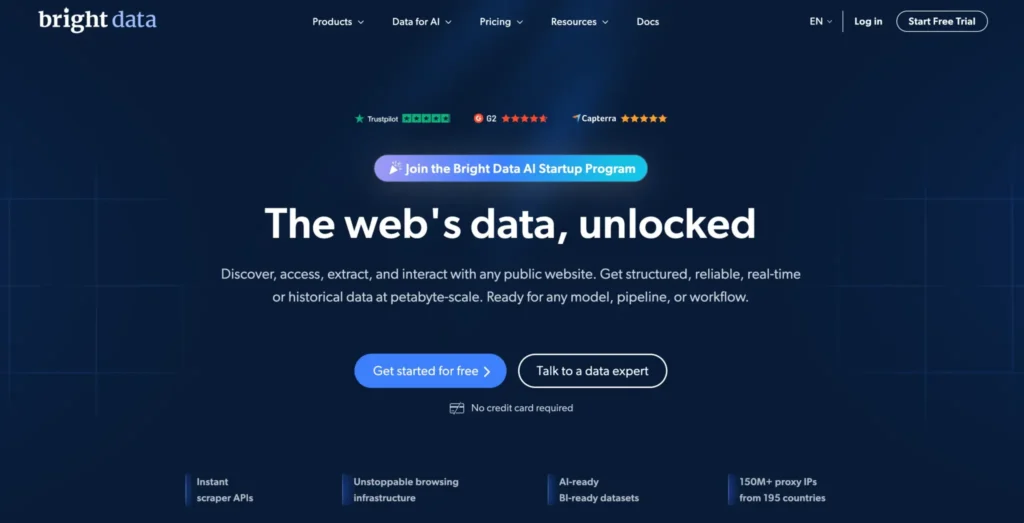
Bright Data is one of the strongest options for teams that need serious proxy infrastructure, not just a basic proxy list. Its residential network is huge, its targeting controls are deep, and its ecosystem includes proxy networks, scraping APIs, datasets, and tools for large-scale data operations.
The biggest strength is control. You can target by country, city, state, ZIP, and ASN. For teams doing ad verification, competitive pricing, travel data, local SERP analysis, or marketplace monitoring, this matters. Broad country targeting is fine for simple use cases, but city or ASN-level control becomes valuable when results change by region or carrier.
Bright Data also has mature rotation logic. You can rotate IPs, configure zones, and tune how traffic is routed through its infrastructure. That makes it better suited to technical teams that want configuration depth.
The tradeoff is cost and complexity. Bright Data is not always the easiest starting point for beginners. The dashboard and documentation are powerful, but the platform is built for serious users. If you only need 5GB of casual testing bandwidth, cheaper providers may feel easier.
Best for: Enterprise scraping, SERP intelligence, ad verification, marketplace monitoring, and complex geo-targeting.
Pro Tip: Use Bright Data when location precision matters more than the cheapest cost per GB. If your data accuracy depends on ZIP, ASN, or city-level targeting, the higher price can be justified.
2. Oxylabs: Best for High-Volume Web Data Teams
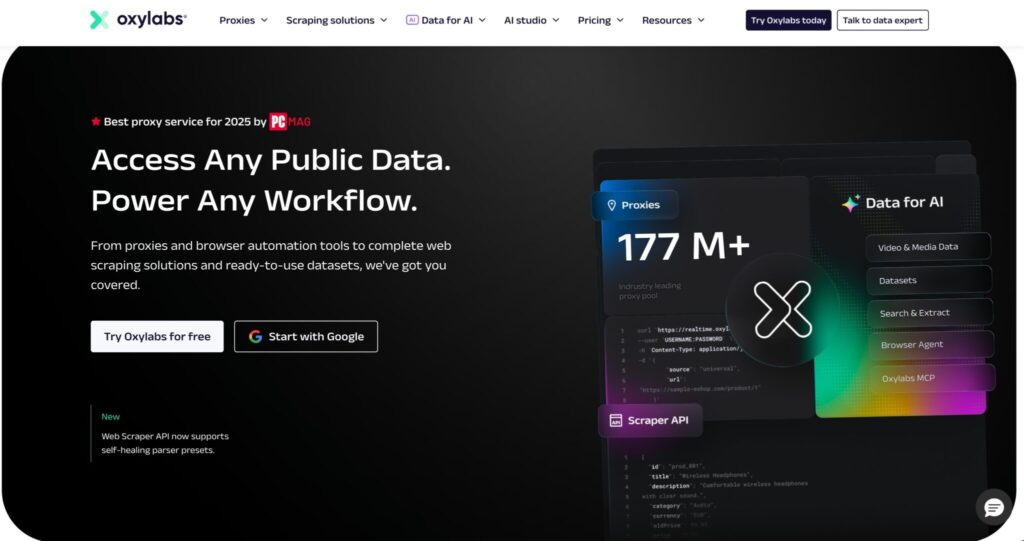
Oxylabs is a premium residential proxy provider built for scale. Its residential proxy pool includes 175M+ IPs, and its product pages highlight city-level targeting, sticky residential sessions up to 24 hours, and support for SOCKS5.
The strength of Oxylabs is reliability for larger operations. If you are running structured data collection across e-commerce sites, search engines, travel platforms, real estate portals, or public directories, Oxylabs gives you the kind of infrastructure that teams can build around.
Its sticky session support is especially useful. For simple scraping, rotating per request often works. For workflows that need continuity, such as keeping the same location identity during a multi-page journey, sticky sessions are safer.
Pricing is not bargain-bin. Oxylabs’ residential pricing page shows a starter plan at $6/GB and lower per-GB costs on larger plans. That places it in the premium category, but the value is stronger when you need consistency at scale.
Best for: Enterprise scraping, price monitoring, market intelligence, brand protection, and large data pipelines.
Pro Tip: If you use Oxylabs for scraping, test both rotating and sticky modes on the same target. Some sites respond better to short sticky windows than aggressive per-request rotation.
3. Decodo: Best Balance of Speed, Price, and Usability
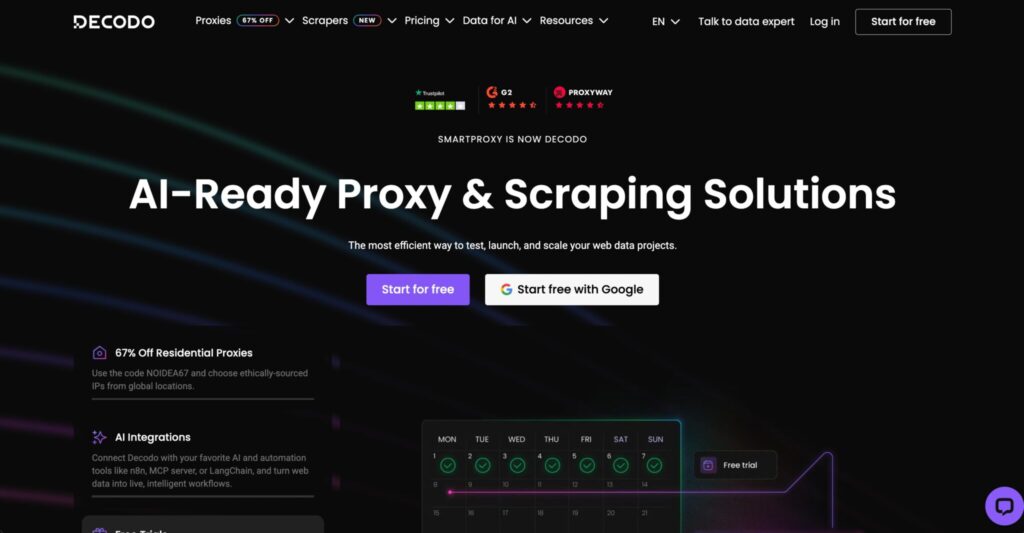
Decodo is the new name for Smartproxy, and that matters because many older proxy comparisons still use the old brand name. Decodo says Smartproxy officially rebranded to Decodo, and its current site positions the platform around 125M+ IPs overall. Its residential proxy page lists 115M+ IPs from 195+ locations, rotating and sticky session options, 99.86% success rate, and 99.99% uptime.
This is one of the most practical choices for agencies, SEO teams, SaaS companies, and mid-size data teams. The setup is easier than some enterprise-heavy providers, but the infrastructure is still strong enough for serious work.
Decodo also has attractive pricing. Its residential pricing page shows regular plans such as 3GB at $3.75/GB, 10GB at $3.50/GB, and larger tiers going lower, with residential proxies starting at $2/GB at higher volume.
The rotation controls are flexible enough for most workflows. You can use rotating sessions when you need fresh IPs and sticky sessions when you need continuity.
Best for: SEO tracking, e-commerce monitoring, app testing, agency workflows, and mid-scale scraping.
Pro Tip: Decodo is a strong first serious proxy provider because it gives you a good mix of usability and control. Test it before jumping straight into a more complex enterprise stack.
4. SOAX: Best for Geo-Targeted Rotation
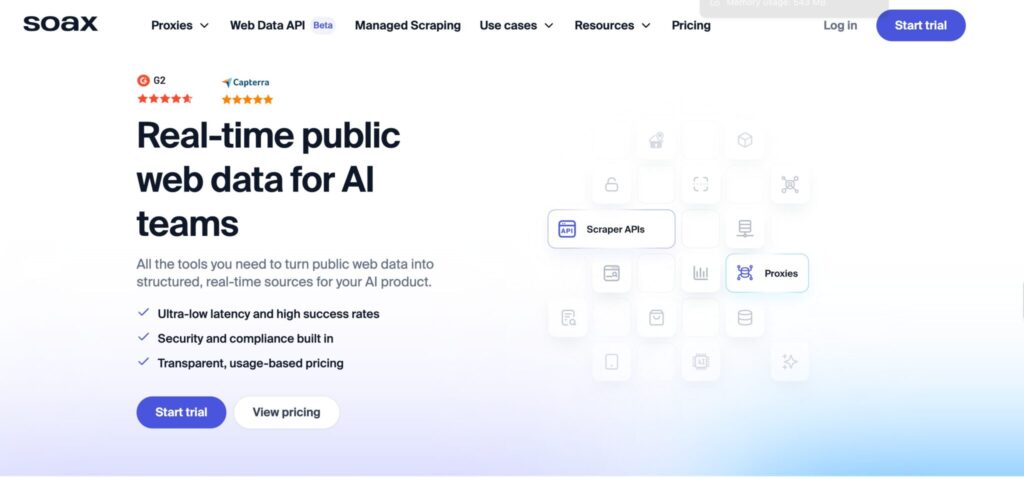
SOAX is a strong pick when location accuracy is central to your project. Its residential proxy page lists 155M+ IPs in 195+ locations, unlimited concurrent sessions, ethically sourced proxies, 99.9% uptime, automatic IP rotation, and sticky sessions.
The biggest reason to consider SOAX is its targeting model. If you need region-specific data, ad previews, local search behavior, price checks, or localized user journeys, SOAX gives you the controls needed to narrow the proxy pool.
Its pricing has also become more flexible. SOAX’s pricing page shows plans where credits can be used across proxy types and Web Data API, with a Starter plan listed at $3.60/GB and 25GB included.
SOAX is not always the cheapest for very small casual use, but it performs well when you need clean routing and accurate targeting.
Best for: Ad verification, local SEO, localized market research, travel fare checks, and country or city-specific testing.
Pro Tip: Use SOAX when the target result changes by location. Paying a little more for accurate geo-targeting is better than collecting bad data from the wrong region.
5. NetNut: Best for Stable Business Data Collection
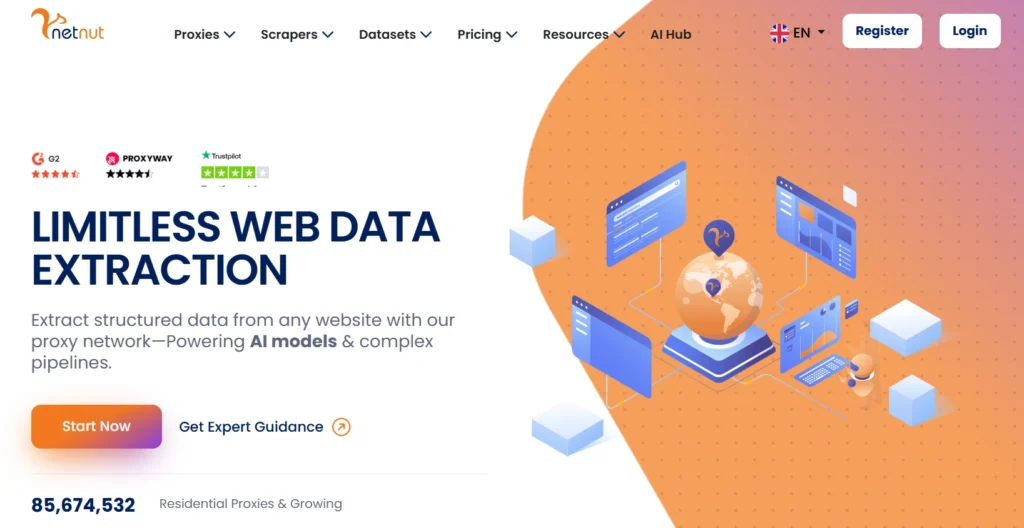
NetNut is a business-focused proxy provider with a large residential network. Its site lists over 85M residential IPs and rotating residential proxies across 195+ countries.
NetNut has historically leaned into stable connectivity and ISP-sourced infrastructure. For businesses that want less fiddling and more predictable routing, it can be a good choice. It is often considered by teams working on web data collection, ad verification, SEO monitoring, and brand protection.
The platform may not always feel as beginner-friendly as Decodo or as broad as Bright Data, but it fits well for teams that need reliable residential traffic and account support.
Best for: Business intelligence teams, brand monitoring, SEO tools, and public web data collection.
Pro Tip: NetNut is worth testing if your current provider has too many unstable peers in specific regions. Stability can matter more than raw IP count.
6. IPRoyal: Best Budget-Friendly Residential Rotation Option
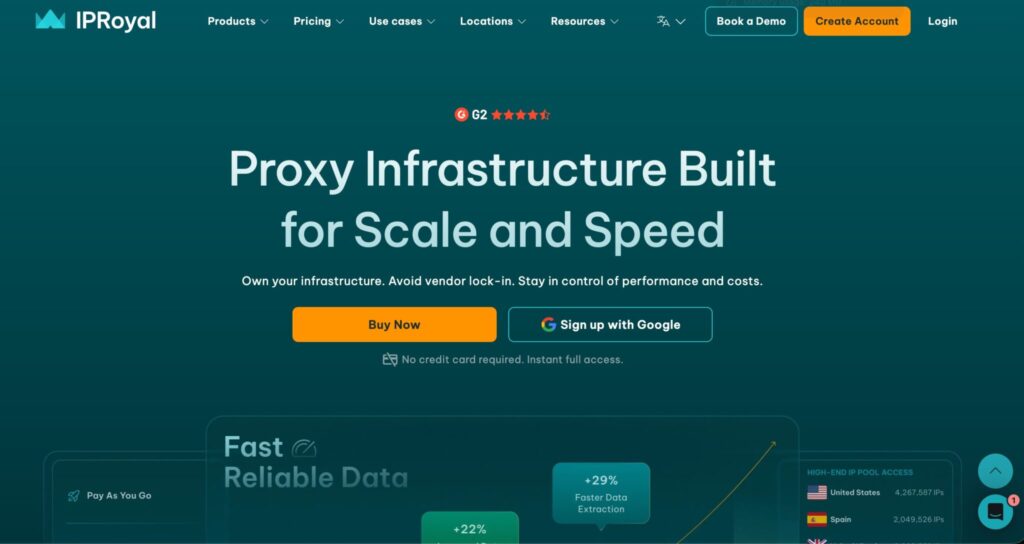
IPRoyal is popular among smaller teams because it keeps the buying process simple and cost-conscious. Its rotating proxy page lists 32M rotating residential proxies, 195+ locations, 99.9% uptime, HTTP and HTTPS support, and country, state, and city-level targeting.
The appeal is flexibility. You do not always need an enterprise account, a sales call, or a huge monthly commitment. For small scraping jobs, market checks, localized research, and proxy testing, that can be a major advantage.
IPRoyal may not be the first choice for very large enterprise workloads, but it is a practical choice when you need residential rotation without overbuilding the stack.
Best for: Small businesses, freelancers, lightweight scraping, SEO checks, and flexible testing.
Pro Tip: Use IPRoyal for early-stage testing before committing to a high-volume provider. If your target works with a budget pool, you can save a lot of money.
7. Webshare: Best for Affordable Rotation Customization
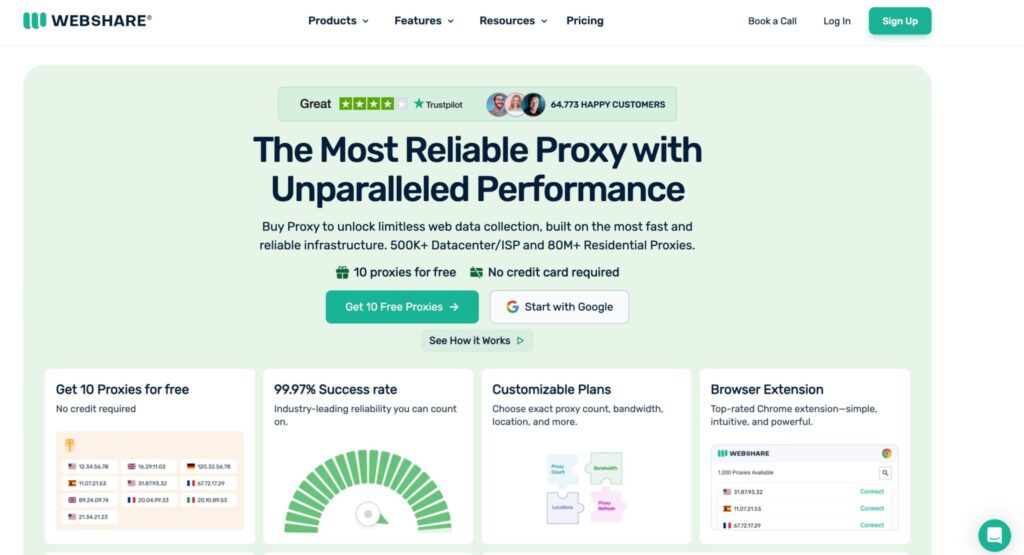
Webshare is a clean option for buyers who want a simple dashboard, clear plans, and practical rotation controls. Its rotating proxy page says users can customize rotation between every 5 minutes and every month. Its residential proxy page highlights global coverage, 99.97% uptime, easy rotating proxy setup, and ethically sourced residential proxies.
That rotation window is useful. Not every workflow needs a new IP every request. Some tools work better with 5-minute sessions, 15-minute sessions, or longer windows. Webshare makes that kind of setup approachable.
Webshare may not offer the same advanced scraping ecosystem as Bright Data or Oxylabs, but it is strong for teams that want simple proxy infrastructure without a steep learning curve.
Best for: Budget-friendly scraping, browser automation, testing, and teams that want simple rotation controls.
Pro Tip: Start with a moderate rotation interval before using per-request rotation. Over-rotation can look unnatural and may create more failed sessions than it solves.
8. ProxyEmpire: Best for Flexible Residential Proxy Buying
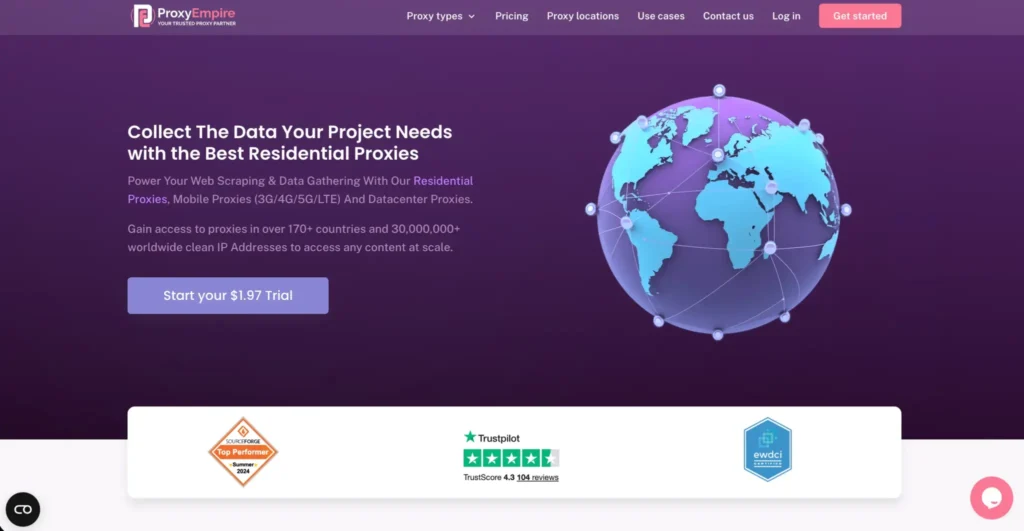
ProxyEmpire focuses on flexible residential and mobile proxy options. Its homepage describes residential proxies from local home networks and shows residential proxies “from $0.75” as a pricing signal. It also promotes a low-cost trial on its pricing page.
One reason ProxyEmpire gets attention is its buyer-friendly structure. Users who do not want a large monthly plan can test smaller amounts first. That is helpful when you are unsure whether a provider’s IP pool works well with your target sites.
It is not always the first name that enterprise teams shortlist, but it is useful for buyers who value flexibility, rollover-style thinking, and smaller starting commitments.
Best for: Smaller campaigns, testing, niche geo workflows, and buyers who want flexible plans.
Pro Tip: Use the trial to test exact locations and target domains, not just generic speed. A proxy that loads Google quickly may still perform poorly on your actual target.
9. DataImpulse: Best Low-Cost Pay-As-You-Go Residential Proxy Service
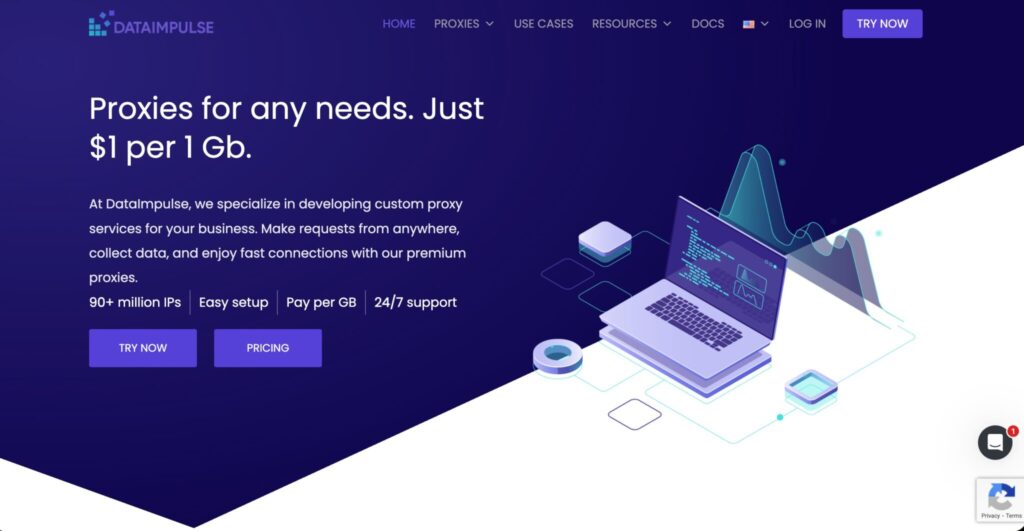
DataImpulse is one of the most interesting low-cost options right now. Its residential proxy page lists 90M+ ethical residential IPs, coverage across 195 countries, and pricing starting at $1/GB. Its homepage also emphasizes pay-per-GB pricing, 24/7 support, and easy setup.
This makes it attractive for cost-sensitive users. If you are running SERP tracking, price comparison, small scraping tasks, or testing multiple providers, $1/GB pricing can reduce your risk.
The key question is performance on your targets. Cheaper residential proxies can be great, but you need to test success rate, latency, and IP freshness. Do not judge only by the price.
Best for: Budget scraping, SERP monitoring, testing, and lower-volume public data collection.
Pro Tip: DataImpulse can be a good secondary provider. Use it for lower-risk targets and keep a premium provider for tougher websites.
10. Rayobyte: Best for Ethical Proxy Operations and Mixed Proxy Needs
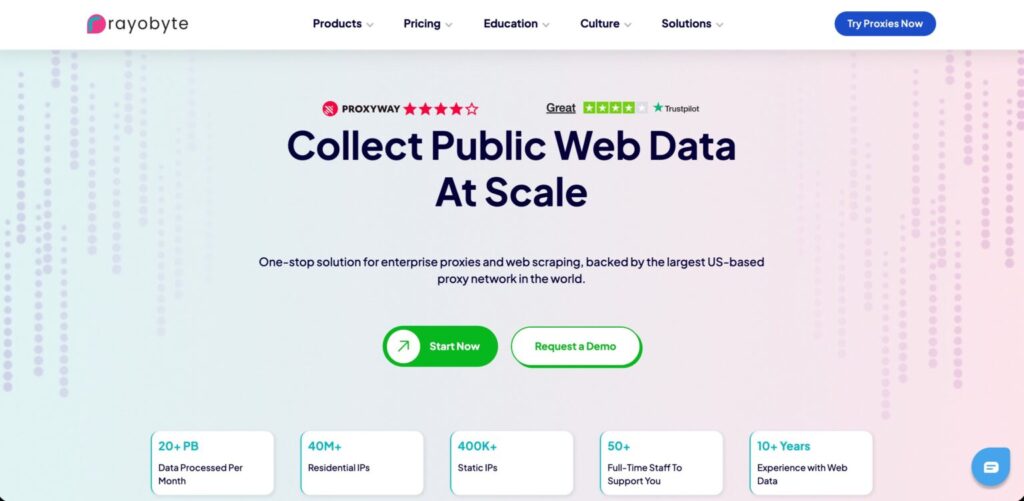
Rayobyte offers residential proxies, ISP proxies, datacenter proxies, rotating ISP proxies, and scraping solutions. Its site lists 36M+ residential IPs and residential pricing “as low as $0.50/GB.”
Rayobyte is a strong fit for teams that want a provider with multiple proxy types under one roof. Residential proxies are not always the right answer. Some tasks work better with ISP proxies, some with datacenter proxies, and some with residential rotation. Having multiple options helps you avoid overspending.
Rayobyte also has a long-standing focus on ethical sourcing and support, which matters for brands that care about compliance.
Best for: Teams needing residential, ISP, and datacenter options together.
Pro Tip: Do not force residential proxies on every job. If a target accepts ISP or datacenter IPs, you can cut costs and improve speed.
How to Choose the Best Residential IP Rotation Service
1. Start With the Job, Not the Provider
Before comparing providers, define the job.
- Are you collecting public pricing data?
- Checking local ads?
- Monitoring SERPs?
- Testing an app from different countries?
- Running browser automation?
- Managing long multi-step sessions?
Each use case needs different rotation behavior. For example, SERP tracking often benefits from location-specific residential IPs and moderate rotation. E-commerce price monitoring may need larger pools and stable retries. Multi-step workflows usually need sticky sessions.
2. Check IP Pool Size, but Do Not Worship It
A large IP pool helps, but it does not guarantee performance.
What matters more is usable pool depth in your target region. A provider may advertise 100M+ IPs globally, but if you need clean IPs in a specific city, country, ASN, or mobile carrier, the real pool may be much smaller.
Ask these questions:
| Question | Why It Matters |
|---|---|
| How many IPs are available in my target country? | Global pool size can hide weak local coverage |
| Can I target city, state, ZIP, or ASN? | Useful for local SEO, ads, and price checks |
| Are IPs shared or dedicated? | Shared IPs may carry more reputation risk |
| How often are peers refreshed? | Stale pools can trigger more failures |
| Is there usage reporting by location? | Helps diagnose weak regions |
3. Understand Rotation Protocols
Residential proxy rotation usually works in three common ways:
| Rotation Type | How It Works | Best For | Risk |
|---|---|---|---|
| Per-request rotation | New IP on every request | Large-scale public data collection | Can break sessions |
| Time-based rotation | IP changes every few minutes | SERP tracking, price checks, browsing flows | Bad interval can reduce accuracy |
| Sticky session | Same IP held for a set period | Logins, carts, forms, app testing | IP may expire during long tasks |
The best provider gives you control over all three.
4. Match Sticky Session Length to the Workflow
Sticky sessions are not automatically better. They are just different.
- Use short sticky sessions for quick multi-page tasks.
- Use longer sticky sessions for account-based workflows or app testing.
- Use per-request rotation for simple stateless collection.
A 10-minute sticky session may be perfect for checking product pages across a marketplace. A 24-hour sticky session may be useful for long account workflows, but it can also increase exposure if the same IP gets flagged.
5. Look at Protocol Support
Most residential proxy services support HTTP and HTTPS. Some also support SOCKS5.
SOCKS5 can be useful for broader app-level traffic and certain tools. Oxylabs, for example, says its residential proxies support SOCKS5.
For most SEO tools, scraping scripts, and browser automation setups, HTTP or HTTPS is enough. For more advanced use cases, SOCKS5 support can matter.
6. Test Success Rate on Your Own Targets
Provider success-rate claims are useful, but your target decides the truth.
Run a small test:
| Test Area | What to Measure |
|---|---|
| Success rate | How many requests return valid responses |
| Latency | How long each request takes |
| Block rate | How many requests get denied or challenged |
| Geo accuracy | Whether the result matches the target location |
| Session stability | Whether sticky sessions hold long enough |
| Cost per valid result | Real cost after failed requests |
Cost per GB is not the real metric. Cost per successful result is.
7. Choose Ethical and Compliant Providers
Residential proxies should be sourced with user consent and used for legitimate purposes. Use them for lawful research, public web data, ad verification, security testing with permission, price intelligence, and quality assurance.
Avoid using proxies for credential attacks, spam, fraud, account abuse, bypassing paywalls, or accessing private data. Besides being unethical, these workflows can create legal and account-level risk.
Final Verdict: Which Residential IP Rotation Service Should You Choose?
- If you want the best enterprise-grade residential rotation platform, choose Bright Data.
- If you want premium infrastructure for high-volume scraping, choose Oxylabs.
- If you want the best mix of usability, price, and performance, choose Decodo.
- If location precision is your main concern, choose SOAX.
- If you want stable business-focused residential routing, test NetNut.
- If you need a budget-friendly starting point, shortlist IPRoyal, Webshare, or DataImpulse.
- If you want flexible trial-friendly buying, look at ProxyEmpire.
- If you need a broader proxy stack with residential, ISP, and datacenter options, consider Rayobyte.
The smartest buying move is simple: shortlist two premium providers and one budget provider. Run the same target test across all three. Track success rate, response time, block rate, geo accuracy, and cost per valid result. The winner will become obvious fast.
FAQs: Best Residential IP Rotation Services
1. What is the best residential IP rotation service overall?
Bright Data is the strongest overall choice for enterprise users because of its huge residential pool, advanced targeting, and mature proxy infrastructure. For mid-size teams, Decodo is often easier and more cost-effective. For high-volume scraping, Oxylabs is one of the safest premium picks.
2. Are rotating residential proxies better than datacenter proxies?
Residential proxies are better when the target is sensitive to datacenter traffic or when location authenticity matters. Datacenter proxies are faster and cheaper, but they are easier to identify. Use residential proxies for tougher targets and datacenter proxies for simple, low-risk jobs.
3. What is the difference between rotating and sticky residential proxies?
Rotating proxies change IPs per request or after a set time. Sticky residential proxies keep the same IP for a specific session window. Use rotating proxies for broad data collection. Use sticky sessions for multi-step workflows, logins, forms, and app testing.
4. How often should I rotate residential IPs?
It depends on the workflow. Stateless scraping can use per-request rotation. SERP tracking may work better with timed rotation. Multi-step sessions usually need sticky IPs for 5 to 30 minutes or longer. Avoid rotating too aggressively when the workflow needs continuity.
5. Which provider has the largest residential IP pool?
Bright Data currently advertises 400M+ residential IPs, which is one of the largest published residential pools. Oxylabs lists 175M+ residential IPs, while SOAX lists 155M+ residential IPs.
6. What is the cheapest residential IP rotation service?
DataImpulse is one of the cheapest options, with residential proxy pricing starting at $1/GB and 90M+ residential IPs listed on its official residential proxy page. IPRoyal and ProxyEmpire are also worth checking for flexible lower-cost plans.
7. Do residential proxies support SOCKS5?
Some providers support SOCKS5, but not all residential plans include it by default. Oxylabs says its residential proxies support SOCKS5. Always confirm protocol support before buying if your tool requires SOCKS5.
8. Can residential IP rotation reduce blocks?
It can reduce block rates when used correctly, but it is not magic. Success depends on IP quality, request behavior, headers, session design, target rules, and compliance with website terms. Poorly configured rotation can actually increase failures.
9. Is a bigger residential proxy pool always better?
No. Bigger pools help, but usable IP quality matters more. A smaller provider with clean IPs in your target country can outperform a larger provider with weak regional coverage.
10. What should I test before buying a residential proxy plan?
Test success rate, location accuracy, latency, sticky session stability, protocol support, dashboard usability, and cost per valid result. Do not buy a large plan based only on advertised IP count or pricing.