
Residential proxies used to be a niche tool for sneaker bots, SEO rank tracking, and a few aggressive data teams. That is no longer the case.
In 2026, residential proxy networks sit quietly behind some of the most important workflows in SaaS: market intelligence, AI dataset collection, ad verification, localized QA testing, travel fare monitoring, pricing research, search result tracking, and fraud-prevention testing.
The reason is simple. Websites behave differently depending on who is visiting, where they are visiting from, how often they connect, and whether the traffic looks like a real residential user or a data center script. A residential proxy routes your traffic through real ISP-assigned IP addresses, which makes requests appear closer to normal user traffic than traditional datacenter proxies.
That does not mean every residential proxy provider is equal. Some are built for enterprise scraping pipelines with strict success-rate requirements. Some are better for startup teams that need affordable traffic without a long contract. Others focus on rotating sessions, sticky IPs, geo-targeting, or low-cost pay-as-you-go data.
This guide breaks down the 9 best residential proxy providers in 2026, with a practical look at IP pools, rotation controls, pricing structure, targeting options, and the type of SaaS team each one fits best.
Why SaaS Businesses Need Residential Proxies
SaaS businesses rely on residential proxies because the modern web is no longer uniform. A pricing page in New York may not look the same as the same page in Berlin. Search results change by device, language, country, city, and even browsing behavior. Ads appear differently across regions. Product availability, reviews, travel prices, competitor offers, and marketplace listings can all shift based on location.
For a SaaS team, that creates a data problem.
If your infrastructure sends requests from the same cloud server range again and again, many websites will throttle, block, distort, or challenge your traffic. Residential proxies help reduce that friction by giving your systems access to ISP-based IPs across many locations.
The best use cases include:
Public web data collection: SaaS teams collecting public product pages, pricing pages, SERP data, reviews, travel listings, real estate listings, and marketplace information.
Ad verification: Brands and agencies checking whether ads appear correctly in specific regions and whether competitors or affiliates are violating policy.
Localization testing: Product teams checking how an app, checkout flow, landing page, or search result behaves from different locations.
AI data pipelines: Teams collecting public web data for model evaluation, retrieval systems, enrichment, and competitive intelligence.
Fraud and risk testing: Security teams simulating residential traffic from multiple locations to test risk systems, login flows, bot defenses, and regional user experiences.
The key is responsible usage. Residential proxies should be used for lawful, permission-aware, privacy-conscious workflows. Good teams respect robots.txt where relevant, avoid collecting sensitive personal data, follow platform terms, and rate-limit requests properly.
9 Best Residential Proxy Providers in 2026
#1: Oxylabs: Best for Enterprise SaaS and AI Data Pipelines
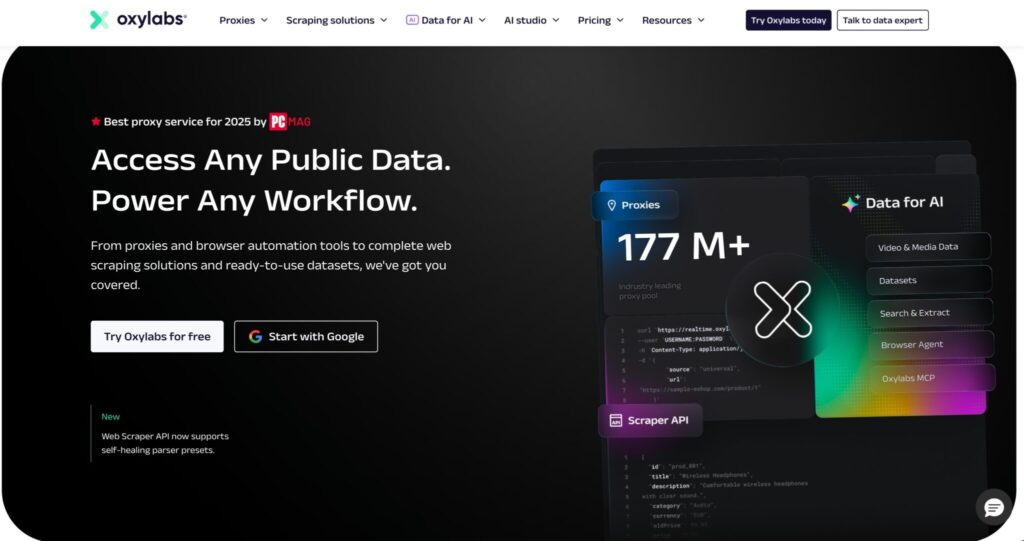
Oxylabs is one of the strongest choices for enterprise SaaS teams that need scale, stability, and precise targeting. Its residential proxy network is positioned around a large pool, broad geographic coverage, and advanced controls for high-volume data operations.
Oxylabs lists 175M+ residential IPs, coverage across 195 locations, and targeting options that include continent, country, city, state, and ZIP code. It also supports SOCKS5, and its sticky sessions can hold the same IP for up to 24 hours, which is useful for multi-step workflows where a session needs continuity.
For SaaS teams, Oxylabs makes the most sense when proxy infrastructure is not just a side tool. If your business depends on stable public data collection, large-scale monitoring, or AI-oriented data pipelines, Oxylabs gives you the type of enterprise-grade foundation that can support serious volume.
The dashboard and documentation are developer-friendly, but this is not the cheapest option on the market. Smaller teams may find Oxylabs more than they need if they only run occasional scraping or basic regional testing.
Best for: Enterprise SaaS companies, AI data teams, market intelligence platforms, pricing intelligence tools, and compliance-heavy scraping workflows.
Pro tip: Use Oxylabs when success rate and location accuracy matter more than squeezing the lowest possible cost per GB. For lightweight jobs, it may be overpowered. For mission-critical pipelines, that extra infrastructure depth can save hours of debugging.
#2: Decodo (formerly Smartproxy): Best for Mid-Size SaaS Teams
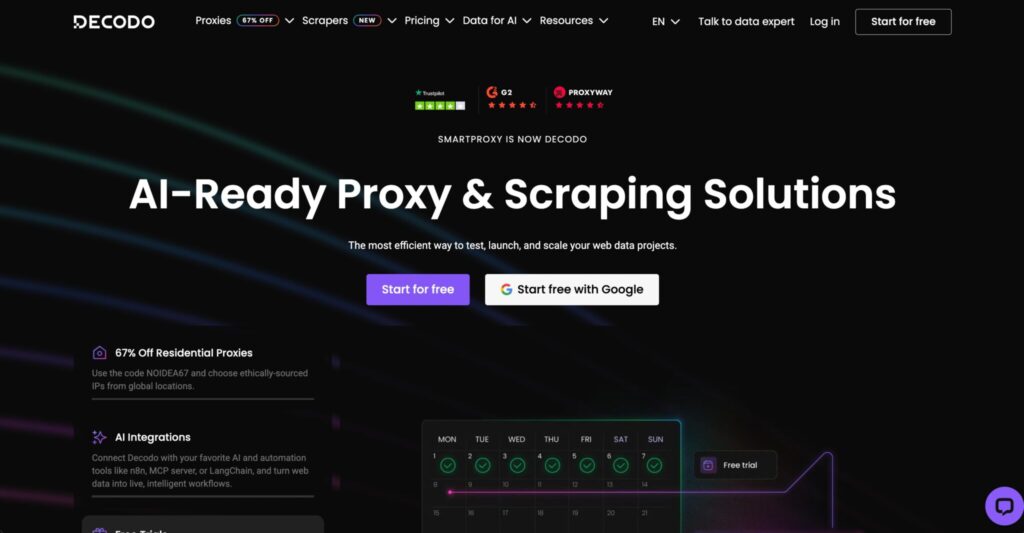
Decodo, formerly Smartproxy, is one of the easiest providers to recommend to mid-size SaaS teams because it sits in a useful middle ground. It is more approachable than some enterprise-first platforms, but still offers enough scale and tooling for serious data operations.
The company’s official site confirms the Smartproxy-to-Decodo rebrand and highlights a network of 125M+ IPs overall. Its residential proxy product lists 115M+ residential IPs, advanced geo-targeting at country, continent, state, city, and ZIP code level, unlimited concurrent sessions, and pricing starting from around $2/GB on larger plans.
That combination makes Decodo a strong choice for teams that need reliable residential proxies but do not want a heavy enterprise sales cycle. It works well for SERP tracking, price monitoring, social listening, competitor research, and product testing.
Decodo also appeals to teams that want scraping tools and proxy products in one ecosystem. If your team wants to move from simple proxy rotation into managed scraping APIs later, Decodo gives you room to grow.
Best for: Mid-size SaaS teams, SEO tools, scraping startups, price intelligence platforms, and teams that need strong features without enterprise complexity.
Pro tip: Decodo is a smart first serious residential proxy provider if you have outgrown cheap proxy tools but are not ready for heavy enterprise pricing.
#3: Webshare: Best for Developer-First SaaS and Startups
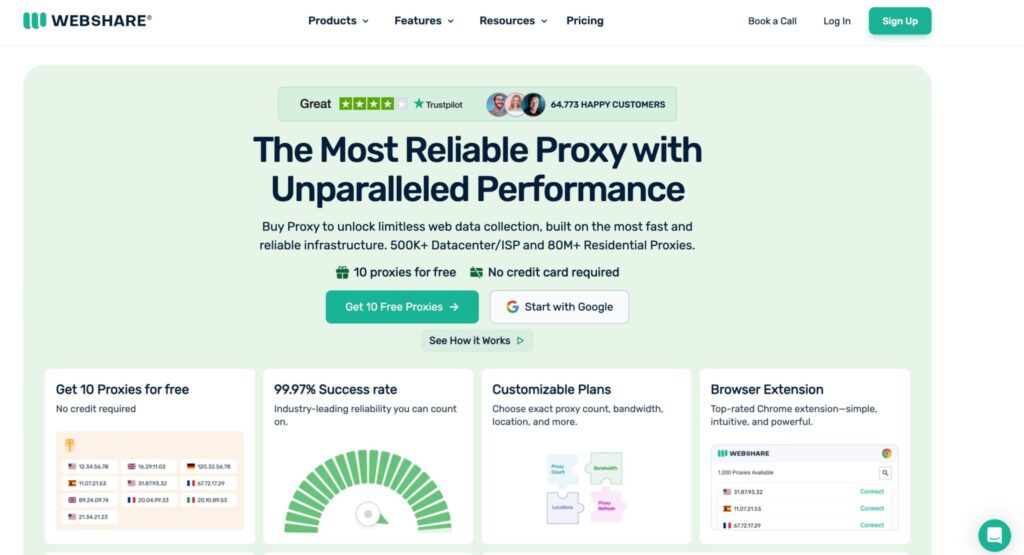
Webshare is a strong fit for developers and startups that want simple proxy access, clean pricing, and a dashboard that does not feel bloated. It is especially attractive for teams that care about affordability and fast setup more than advanced managed scraping tools.
Webshare’s pricing page lists rotating residential proxies starting at $1.40/GB, with 80M+ residential IPs. Its product pages also mention static residential options and proxy server products, making it useful for teams that want to test different proxy types without juggling multiple vendors.
The big appeal is developer usability. Webshare is easy to plug into scripts, QA flows, scraping jobs, and lightweight automation systems. You can start small, test quickly, and scale when the economics make sense.
The tradeoff is that Webshare is not as deep as Bright Data, Oxylabs, or Decodo when it comes to advanced scraping infrastructure, enterprise support, and complex data collection tooling. That is not always a weakness. For many startup teams, fewer moving parts are a benefit.
Best for: Startups, solo developers, small SaaS teams, QA testing, lightweight scraping, and teams that want lower-cost residential traffic.
Pro tip: Webshare is a good place to validate your proxy workflow before committing to a premium provider. If your success rates are strong at this price point, you may not need a larger vendor yet.
#4: Bright Data: Best for AI-Ready Data and Petabyte-Scale Operations
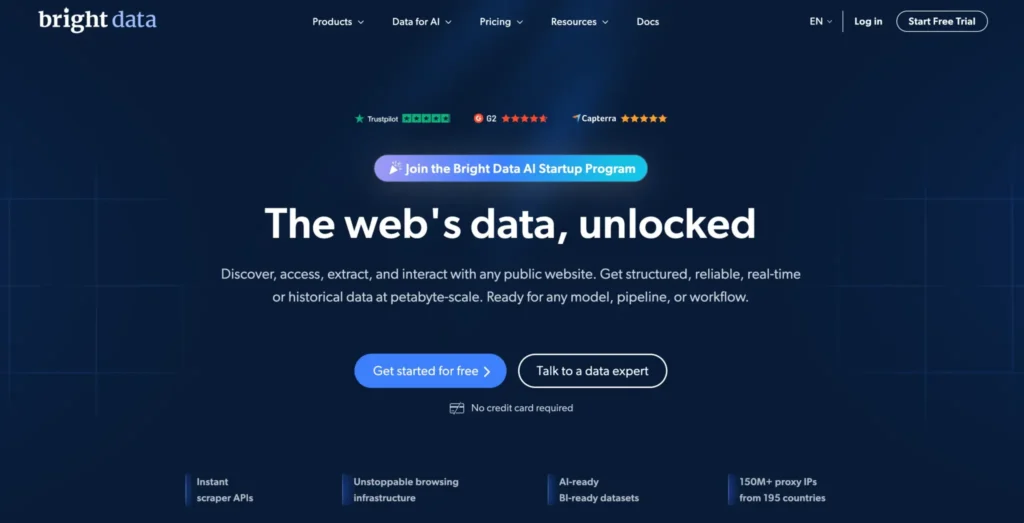
Bright Data is built for teams that want more than just raw proxies. It offers residential proxies, scraping APIs, datasets, proxy management tools, and data infrastructure aimed at large-scale collection workflows.
Bright Data says its residential network includes 400M+ monthly residential IPs and supports targeting by country, city, ZIP code, carrier, and ASN. Its residential proxy pricing page lists plans starting from $5.88/GB, though pricing can vary by usage, plan type, and commitment.
For AI and data-heavy SaaS companies, Bright Data stands out because of the broader ecosystem. If your team needs public datasets, SERP APIs, web unlocker tools, proxy management, and compliance-oriented workflows, Bright Data has a mature stack.
It is not the cheapest provider, and beginners may find it more complex than needed. But for teams collecting large volumes of public web data across regions, Bright Data is one of the most complete platforms in the market.
Best for: AI companies, enterprise data teams, large scraping operations, SERP intelligence tools, and businesses that need proxies plus managed data tools.
Pro tip: Choose Bright Data if your team wants to reduce engineering burden around unblocking, parsing, and scaling. Choose a simpler provider if you only need raw proxy bandwidth.
#5: IPRoyal: Best for Non-Expiring Traffic and Budget Flexibility
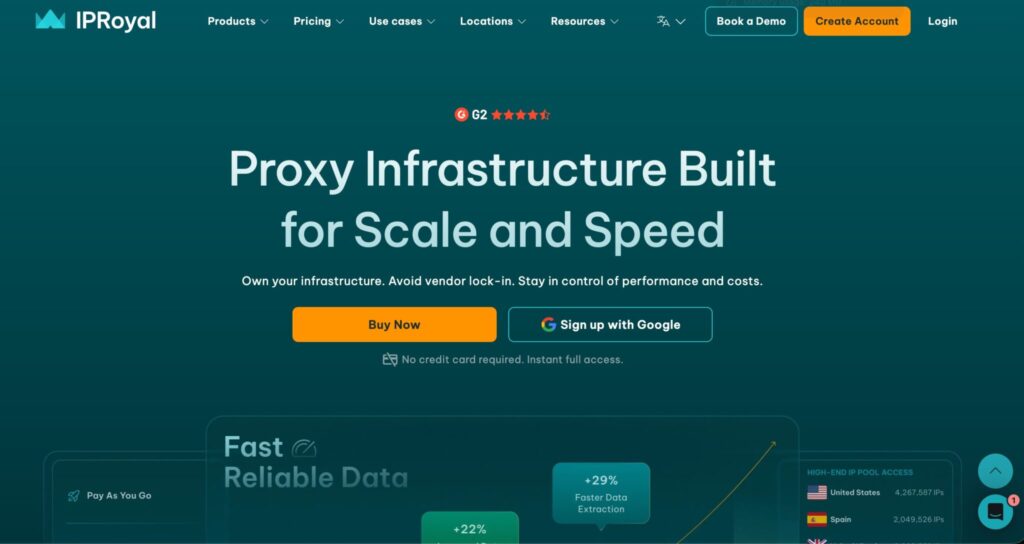
IPRoyal is attractive for teams that hate losing unused bandwidth. Its biggest advantage is simple: residential proxy traffic does not expire. That makes budgeting easier for SaaS teams with uneven usage patterns.
IPRoyal’s official residential proxy page says plans start at $7/GB, with bulk pricing dropping as low as $1.75/GB, and traffic never expires. Its pricing page also highlights non-expiring traffic and a self-service dashboard.
This model works especially well for teams that do not scrape at the same intensity every month. Maybe your team runs heavy data pulls during product launches, audits, quarterly competitor reviews, or campaign monitoring windows. With expiring monthly bandwidth, you may overpay. With IPRoyal, unused traffic remains available.
The downside is that IPRoyal is not as enterprise-heavy as Oxylabs or Bright Data. If you need the largest pool, advanced managed scraping tools, or the deepest compliance support, you may want a higher-end provider.
Best for: Budget-conscious SaaS teams, agencies, small data teams, ad verification, regional checks, and irregular scraping workloads.
Pro tip: IPRoyal is a good fit when your proxy usage is unpredictable. Buy traffic in bulk when the rate makes sense, then use it across multiple campaigns without worrying about monthly waste.
#6: SOAX: Best for AI Teams Needing Clean, Whitelisted IPs
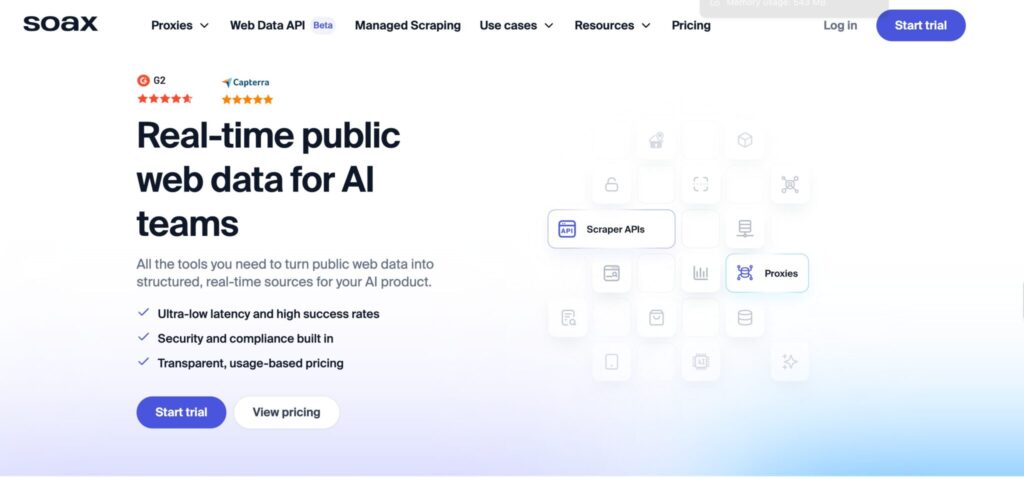
SOAX has become a strong name for teams that care about clean IP access, flexible rotation, and controlled targeting. It is particularly useful for AI and data teams that want structured residential traffic without messy setup.
SOAX lists 155M+ residential proxies and gives users access to its full IP pool across plan tiers. It also supports flexible rotation, including rotation on each new request or at selected intervals. SOAX states that residential and mobile proxies can refresh up to a maximum interval of one hour, while ISP and datacenter proxies can go up to 24 hours. Pricing pages show bundled plans starting around $3.60/GB on the Starter plan.
SOAX is useful when you need control over how sessions behave. Some scraping jobs need fresh IPs on every request. Others need sticky sessions to complete a login, checkout, form flow, or multi-page crawl. SOAX gives you enough session flexibility to adapt.
It is not always the lowest-cost option, but it gives strong value for teams that want clean traffic, detailed targeting, and a balanced dashboard.
Best for: AI data teams, QA testing, localized research, ad verification, SERP tracking, and teams that care about session control.
Pro tip: Use per-request rotation for broad data collection, but use sticky sessions for login flows, account-based testing, and multi-step pages. Using the wrong rotation mode can break a workflow that otherwise looks technically correct.
#7: Proxy-Cheap: Best for Cost-Conscious SaaS Teams

Proxy-Cheap is aimed at teams that want affordable proxies without a heavy platform commitment. It offers rotating residential, static residential, datacenter, mobile, and IPv6 products, which makes it flexible for teams testing several proxy types.
Its residential proxy page lists 50M+ residential IPs across 195+ countries, SOCKS5 and HTTPS support, rotating IPs, and uptime claims around 99.9%. Its main site shows rotating residential pricing starting at $4.99/GB, while other proxy categories have lower entry prices.
Proxy-Cheap is not the first provider I would pick for a large enterprise data operation. But for cost-conscious SaaS teams, affiliate tools, SEO monitoring, and lighter automation workflows, it can be a practical option.
The biggest thing to test is success rate on your exact targets. Cheap residential proxy traffic can be perfectly fine for some workflows and frustrating for others. The target site matters.
Best for: Budget SaaS teams, SEO testing, small scraping workflows, affiliate research, and teams that want simple residential access.
Pro tip: Do not judge Proxy-Cheap only by the advertised price. Run a small test against your actual target websites. A cheaper provider with poor success rates can become more expensive than a premium provider that completes the job cleanly.
#8: ProxyEmpire: Best Residential Proxy with Unlimited Data Rollover
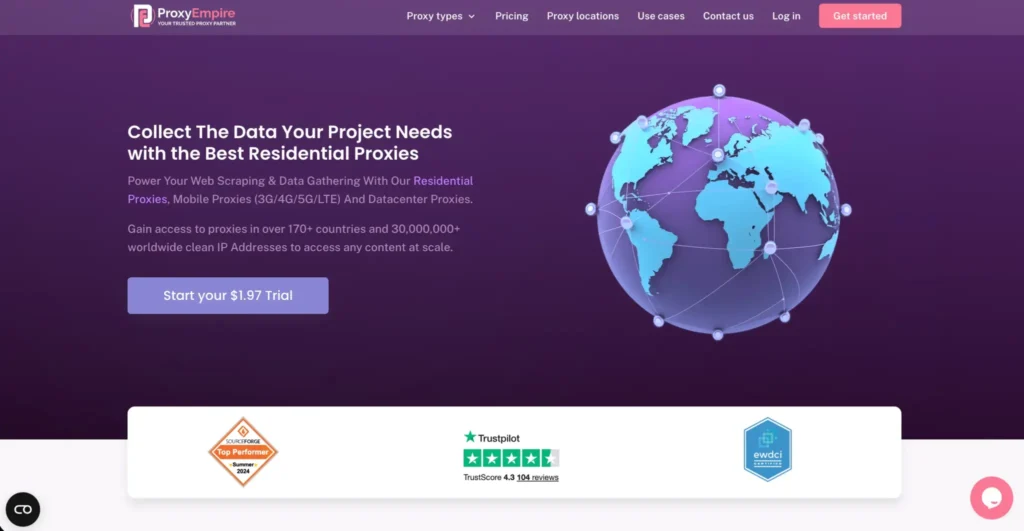
ProxyEmpire is one of the more interesting residential proxy providers because of its rollover model. For teams with unpredictable usage, that can be a real advantage.
ProxyEmpire promotes residential proxies from $0.75, static residential proxies, mobile proxies, and datacenter proxies. Its site also highlights rollover data, unlimited concurrent connections, SOCKS5 and HTTP support, advanced targeting, and coverage across 170+ countries. Some ProxyEmpire pages describe unused bandwidth as carrying over instead of expiring, which is the main reason it stands out in this list.
The provider fits teams that do not want to lose paid traffic at the end of the month. That can help agencies, SaaS teams with seasonal data pulls, and businesses that run heavy research projects in bursts.
ProxyEmpire also supports practical targeting options like country, region, city, ISP, and ASN, making it useful for localized data workflows.
Best for: Agencies, SaaS teams with uneven usage, long-term data projects, localized research, and teams that want rollover bandwidth.
Pro tip: ProxyEmpire is worth testing if your usage pattern is spiky. If you scrape heavily one month and lightly the next, rollover bandwidth can make your proxy budget easier to manage.
#9: DataImpulse: Best Budget Residential Proxy Provider
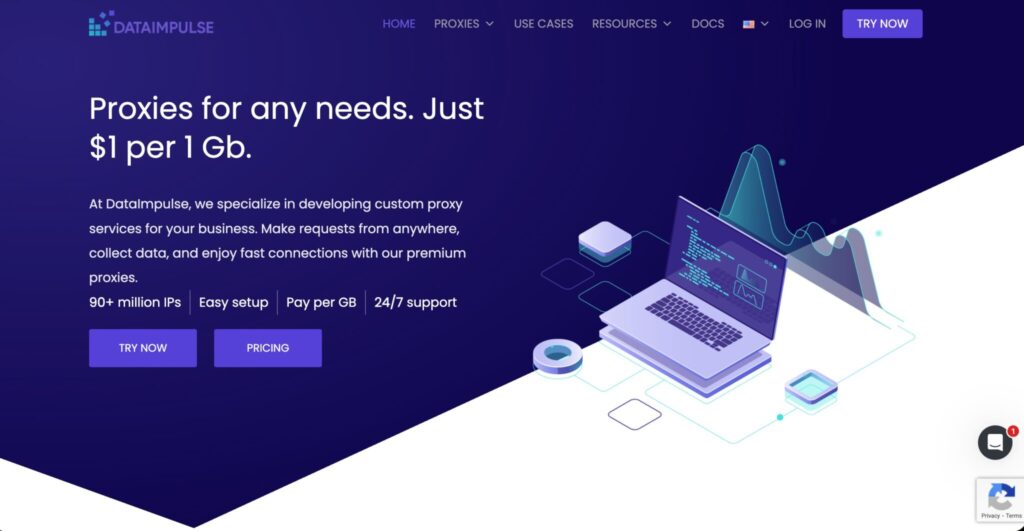
DataImpulse has become a serious budget option because of its simple pricing and strong entry-level value. It is not trying to look like the most complex enterprise data platform. Its pitch is simple: low-cost residential traffic with no unnecessary friction.
DataImpulse lists 90M+ residential IPs, coverage across 195 countries, pay-as-you-go pricing from $1/GB, non-expiring traffic, HTTP(S)/SOCKS5 support, rotating sessions, sticky sessions, API access, and free country targeting.
That makes it one of the most affordable residential proxy providers in 2026. For small SaaS teams, founders, developers, and budget-conscious data projects, DataImpulse is easy to test because the entry cost is low.
The tradeoff is that teams running large, mission-critical, high-success-rate scraping pipelines may still prefer Oxylabs, Bright Data, Decodo, or SOAX. Budget providers can be excellent, but you need to validate IP quality, stability, and success rate against your targets.
Best for: Budget residential proxies, startup testing, small scraping jobs, price tracking, SERP checks, and developers who want low-cost bandwidth.
Pro tip: DataImpulse is a strong first test provider if your main question is, “Can this workflow work at all?” Once the workflow is proven, compare its success rate against a premium provider before scaling.
Best Residential Proxy Providers 2026: Quick Comparison at a Glance
| Provider | Best For | Residential IP Pool | Starting Price | Rotation / Session Control | Targeting Strength | Main Advantage |
|---|---|---|---|---|---|---|
| Oxylabs | Enterprise SaaS and AI pipelines | 175M+ IPs | Usage-based plans | Rotation plus sticky sessions up to 24 hours | Country, city, state, ZIP, ASN-style controls | Enterprise-grade scale and reliability |
| Decodo | Mid-size SaaS teams | 115M+ residential IPs | From around $2/GB on larger plans | Unlimited concurrent sessions, rotating residential setup | Country, state, city, ZIP | Strong balance of price, usability, and scale |
| Webshare | Developers and startups | 80M+ residential IPs | From $1.40/GB | Rotating residential and static residential options | Broad global coverage | Low-cost, developer-friendly setup |
| Bright Data | AI-ready data operations | 400M+ monthly residential IPs | From $5.88/GB | Advanced proxy and data tools | Country, city, ZIP, carrier, ASN | Full data collection ecosystem |
| IPRoyal | Flexible budget usage | Not positioned as largest pool | From $7/GB, lower with bulk | Rotating and sticky-style usage | Location customization | Non-expiring traffic |
| SOAX | Clean IPs and session control | 155M+ residential IPs | Around $3.60/GB starter bundle | Per-request or interval rotation | Strong location targeting | Clean pool and flexible rotation |
| Proxy-Cheap | Low-cost proxy access | 50M+ residential IPs | From $4.99/GB | Rotating IPs | 195+ countries | Affordable multi-proxy catalog |
| ProxyEmpire | Rollover bandwidth | 30M+ claimed on some product pages | From $0.75 on select plans | Unlimited concurrent sessions on promoted plans | 170+ countries, city, ISP, ASN | Data rollover model |
| DataImpulse | Cheapest residential proxy testing | 90M+ residential IPs | From $1/GB | Rotating and sticky sessions | 195 countries, country targeting included | Low-cost pay-as-you-go traffic |
How to Choose the Best Residential Proxy Provider
Choosing a residential proxy provider is not just about picking the biggest IP pool. A large pool helps, but quality, rotation behavior, targeting accuracy, and pricing model usually matter more.
1. Look at IP Pool Quality, Not Just IP Pool Size
A provider may advertise millions of IPs, but the real question is: how many of those IPs work reliably for your target websites?
For SaaS use cases, test these points:
- Success rate on your actual target domains
- Error rate during peak hours
- CAPTCHA frequency
- IP freshness
- Geo-location accuracy
- ASN and ISP diversity
- Session stability
A smaller but cleaner pool can beat a massive low-quality pool. That is especially true for sensitive targets like search engines, marketplaces, travel sites, and social platforms.
2. Match Rotation Protocol to the Workflow
Rotation is where many proxy setups fail.
Per-request rotation is useful when you want every request to come from a different IP. This works well for broad public data scraping, SERP checks, and high-volume crawling.
Sticky sessions are better when your workflow needs continuity. Examples include adding items to a cart, testing a checkout flow, logging into a dashboard, completing a multi-page form, or browsing a localized site like a normal user.
Static residential or ISP proxies are better when you need a long-lasting identity, lower latency, and fewer session breaks.
The wrong rotation setting can make a good provider look bad. If your session keeps changing during a multi-step workflow, the site may treat your behavior as suspicious.
3. Check Geo-Targeting Depth
Basic country targeting is enough for simple use cases. But SaaS teams often need more.
For serious localization, look for:
- Country targeting
- State or region targeting
- City targeting
- ZIP code targeting
- ASN targeting
- ISP targeting
- Carrier targeting for mobile workflows
Bright Data, Oxylabs, Decodo, SOAX, and ProxyEmpire are stronger when location precision matters. Budget providers can still work, but you should test accuracy before relying on them for client reports or production dashboards.
4. Review Protocol Support
Most teams need HTTP(S), but SOCKS5 support is useful for broader compatibility. SOCKS5 works well with browsers, automation tools, scraping frameworks, app testing workflows, and certain non-HTTP traffic patterns.
If your engineering team uses Puppeteer, Playwright, Selenium, Scrapy, custom Python scripts, browser profiles, or anti-detect browsers, confirm setup guides before buying.
5. Understand the Pricing Model
Residential proxy pricing usually follows one of these models:
Per GB billing: You pay for bandwidth. This is common and simple.
Subscription bundles: You get a set amount of traffic each month.
Pay-as-you-go: You top up and use traffic when needed.
Non-expiring bandwidth: Unused traffic stays in your account.
For predictable high-volume use, monthly plans can be cheaper. For irregular use, non-expiring traffic from providers like IPRoyal, ProxyEmpire, or DataImpulse can be more budget-friendly.
6. Test Before Scaling
Never pick a residential proxy provider only from a comparison table. Your target sites, request patterns, headers, browser behavior, and rate limits all affect success.
A proper test should include:
- At least 3 to 5 target domains
- Multiple locations
- Peak and off-peak testing
- Per-request and sticky sessions
- Realistic concurrency
- CAPTCHA and block tracking
- Cost per successful request
The best proxy provider is not always the one with the cheapest GB price. It is the one with the best cost per completed task.
FAQs: Best Residential Proxy Providers 2026
What is a residential proxy and why does it matter for SaaS?
A residential proxy routes internet traffic through a real ISP-assigned residential IP address. For SaaS teams, this matters because many websites treat residential traffic differently from datacenter traffic. Residential proxies help with public web data collection, price monitoring, localized testing, SERP tracking, ad verification, and AI data workflows.
They are especially useful when your SaaS product depends on seeing the web as real users see it in different regions.
What’s the difference between rotating and static residential proxies?
A rotating residential proxy changes the IP address at set intervals or per request. This is useful for scraping, SERP tracking, and high-volume public data collection.
A static residential proxy, often called an ISP proxy, keeps the same residential-style IP for longer. This is better for account-based workflows, browser profiles, checkout testing, and sessions that should not change mid-task.
Use rotating proxies for scale. Use static or sticky sessions for continuity.
How do I choose the right provider for my SaaS business?
Start with your use case.
If you need enterprise-grade public data collection, look at Oxylabs, Bright Data, or Decodo. If you want developer-friendly pricing, Webshare is strong. If your traffic pattern is irregular, IPRoyal, ProxyEmpire, or DataImpulse can help reduce wasted bandwidth. If clean IPs and session controls matter, SOAX is a practical choice.
The best decision comes from testing success rate, not just comparing advertised IP pools.
Are residential proxies legal?
Residential proxies are legal tools in many jurisdictions, but legality depends on how you use them. Using proxies for privacy, QA testing, ad verification, public data collection, or localization research can be legitimate. Using them for fraud, credential attacks, spam, account abuse, or unauthorized access is not acceptable.
Always respect applicable laws, website terms, data protection rules, and privacy standards.
Do residential proxies work for AI training data collection?
Yes, residential proxies can support AI-related public data collection, but they are not a magic permission slip. Teams still need to follow legal, ethical, and contractual limits.
For AI workflows, residential proxies are useful for collecting public pages, testing retrieval systems, monitoring knowledge freshness, checking search visibility, and gathering region-specific web data. Enterprise teams often prefer providers like Oxylabs, Bright Data, Decodo, and SOAX because they offer stronger scale, targeting, and infrastructure controls.
What is the cheapest residential proxy option right now?
Among the providers covered here, DataImpulse is one of the cheapest options, with residential proxy pricing from $1/GB and non-expiring traffic. Webshare is also very competitive, listing rotating residential proxies from $1.40/GB. IPRoyal can drop to $1.75/GB on bulk residential traffic, with the added benefit of non-expiring bandwidth.
Pricing changes often, so always confirm the current rate before buying.
Can I use residential proxies for SaaS product testing?
Yes. Residential proxies are useful for SaaS QA testing when you need to see how your product behaves across regions, ISPs, languages, or user environments.
Common testing examples include:
- Checking localized landing pages
- Testing geo-specific pricing
- Verifying checkout flows
- Reviewing ad placements
- Monitoring search visibility
- Testing regional content restrictions
- Checking fraud rules and risk scoring
For multi-step testing, use sticky sessions rather than per-request rotation.
Conclusion: Best Residential Proxy Providers 2026
The best residential proxy provider in 2026 depends on your workload.
Choose Oxylabs if you need enterprise-grade scale, precise targeting, and strong infrastructure for SaaS or AI data pipelines. Pick Decodo if you want a balanced provider with strong residential coverage, fair pricing, and room to grow. Go with Webshare if you need affordable, developer-friendly residential proxies for startup workflows.
Choose Bright Data when your team needs proxies plus a serious data collection ecosystem. Pick IPRoyal if non-expiring traffic matters. Choose SOAX if clean IPs and flexible rotation are high priorities. Try Proxy-Cheap for lower-cost proxy access, ProxyEmpire for rollover bandwidth, and DataImpulse if you want one of the cheapest practical entry points for residential proxies.
My practical advice: shortlist two providers, run the same test against your real targets, and measure cost per successful request. That metric will tell you more than any marketing claim, IP pool number, or pricing table ever will.