
Residential proxy pricing can get painful fast. One messy crawler, one bad retry loop, or one dashboard left running overnight can burn through gigabytes before your coffee gets cold. That is why “unlimited residential proxies” sounds so attractive.
But here is the catch: unlimited does not always mean unlimited bandwidth.
Some providers use “unlimited” to mean no GB caps. Some mean unlimited concurrent sessions. Some mean unlimited access to their IP pool, while your traffic is still billed per GB. A few offer static residential or ISP proxies with “unlimited bandwidth,” but those are not the same as rotating residential proxies pulled from a large peer-based pool.
So the smart way to buy is not to chase the biggest “unlimited” label. The better move is to ask:
Can this provider give me enough clean IPs, stable rotation, proper geo-targeting, fair usage clarity, and predictable cost for my workload?
That is what this guide is built around.
What Are Unlimited Residential Proxies?
Unlimited residential proxies route your traffic through real residential or ISP-linked IP addresses while removing, reducing, or reframing the usual bandwidth limits.
In practice, there are three main types:
- True unmetered residential proxies: You pay a flat fee and do not count GBs.
- Unlimited session residential proxies: You still pay per GB, but you can run many sessions or connections.
- Unlimited bandwidth ISP/static residential proxies: You pay per IP or plan, and bandwidth may be unlimited or governed by fair usage rules.
For heavy public web data collection, SEO monitoring, ad verification, price intelligence, and QA testing, unlimited or unmetered pricing can help control costs. But you still need to respect target site terms, robots.txt where applicable, data privacy laws, and platform rules. A proxy is infrastructure, not a permission slip.
Quick Verdict: Best Unlimited Residential Proxy Providers
| Rank | Provider | Best For | Unlimited Angle | IP Pool / Coverage | Rotation Style | Pricing Style |
|---|---|---|---|---|---|---|
| 1 | ProxyScrape Unlimited Residential | Heavy traffic users who hate GB tracking | No GB caps and no overage fees | 4M+ rotating residential IPs for unlimited plan, 180+ geo targets | Rotating with targeting options | Flat monthly / unlimited model |
| 2 | Proxyrack | Unmetered residential with flexible protocols | Unmetered residential plans | Country, city, and ISP targeting | Rotating residential | Monthly plans from publicly listed tiers |
| 3 | Webshare | Static residential and rotating proxy users who want predictable bandwidth | Unlimited bandwidth plans with fair usage | Residential and static residential products | Rotation from 5 minutes to longer intervals on rotating plans | Monthly plans, some unlimited bandwidth options |
| 4 | Storm Proxies | Smaller teams needing simple unlimited bandwidth | Backconnect proxies with unlimited bandwidth | 700,000+ proxy pool, strongest for basic workloads | Per request, 3-minute, and 15-minute rotation | Port/thread-based monthly pricing |
| 5 | Bright Data | Enterprise teams needing scale, compliance, and targeting | “Unlimited” scale, but residential pricing is usually GB-based | 400M+ residential proxies across 195 countries | Advanced rotation and targeting | Premium per-GB pricing |
| 6 | Oxylabs | Enterprise scraping, large data teams, and high concurrency | Unlimited concurrent sessions, but data transfer is plan-based | 175M+ residential IPs, 195 locations | Flexible session control, sticky up to 24 hours | Monthly data plans |
| 7 | Decodo | Best value for teams that want large pools without enterprise friction | Unlimited concurrent sessions, bandwidth-based pricing | 115M+ residential IPs with advanced geo-targeting | Rotating and session control | Starts from public per-GB tiers |
| 8 | SOAX | Clean geo-targeted residential sessions | Large residential pool, GB-based bundled plans | 155M+ IPs in 195+ locations | Rotation, sticky, and filtering options | Bundled GB plans |
| 9 | IPRoyal | Budget buyers who want traffic that does not expire | Not unlimited bandwidth, but unused traffic never expires | Global residential network with SOCKS5 and targeting | Flexible rotation and sticky options | Pay-as-you-go / bulk GB pricing |
1. ProxyScrape Unlimited Residential Proxies
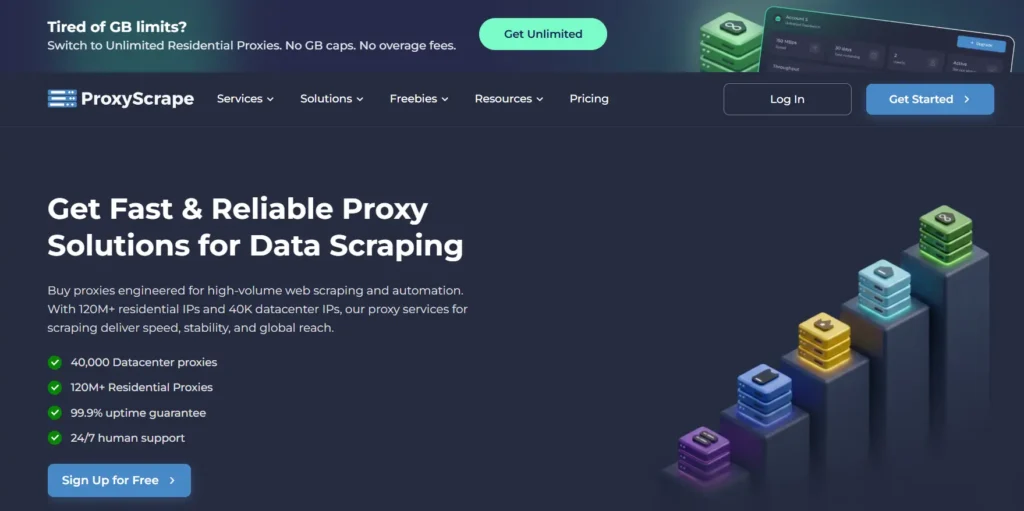
ProxyScrape is one of the clearer names in this category because it has a dedicated Unlimited Residential Proxies product. Its unlimited page states no GB caps, no overage fees, unlimited requests, 4M+ rotating residential IPs, and 180+ geo targets. That makes it one of the stronger fits for buyers who specifically want unmetered residential traffic rather than standard per-GB residential proxies.
The regular ProxyScrape residential product is different. That page mentions a much larger residential network, with 120M+ IPs across 195 countries, but that product is still positioned separately from the unlimited residential plan.
That distinction matters. If your main pain point is bandwidth cost, look at the unlimited residential product. If your main pain point is pool size, country depth, and broader availability, compare the regular residential product too.
Why ProxyScrape stands out
ProxyScrape is useful for teams running high-volume public data workflows where the per-GB model feels unpredictable. For example, if your crawler makes millions of small requests and retries often, a flat-rate model can be easier to budget than a usage-metered plan.
It also supports sticky sessions and country, state, and city targeting on residential proxies, which helps when your workflow needs a consistent location or short-term session identity.
Where it may fall short
The unlimited plan lists a smaller active residential IP pool than some premium enterprise competitors. That does not make it bad, but it does mean you should test IP freshness, target success rates, and peak-hour stability before moving your full workload.
Best use cases
ProxyScrape fits SEO rank tracking, high-volume market research, price monitoring, ad preview checks, and public web data tasks where bandwidth predictability is more important than having the biggest possible IP pool.
Pro Tip: Ask whether your target countries are strong in the unlimited product specifically, not just in the provider’s full residential network. A provider may advertise a huge total pool, while the unmetered plan uses a narrower subnet mix.
2. Proxyrack
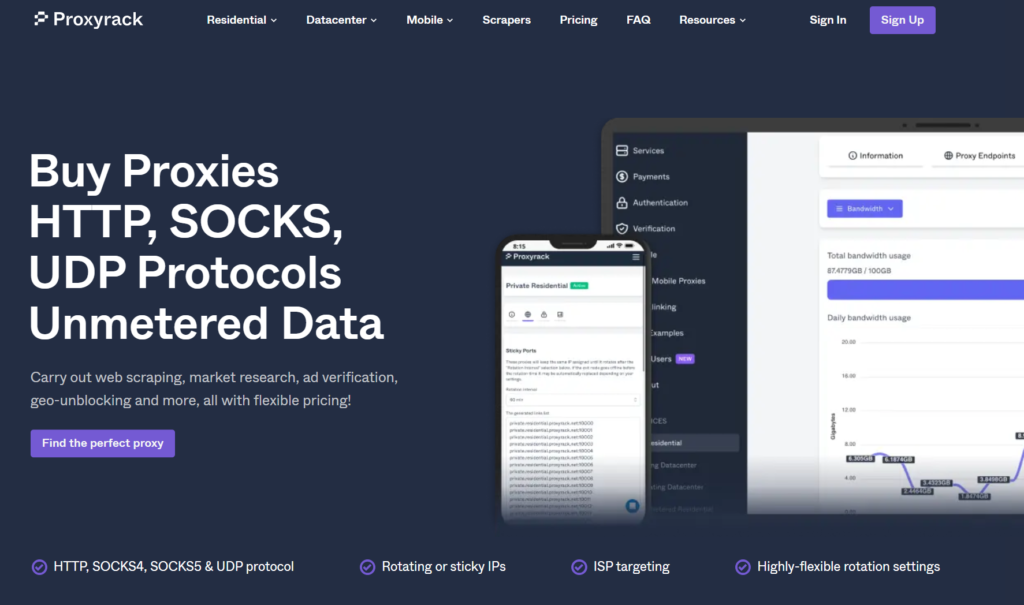
Proxyrack is another strong pick for buyers looking for unmetered residential proxies. Its residential proxy page promotes unlimited, unmetered, and rotating IP options, and its public pricing page lists residential plans with monthly tiers. It also mentions HTTP, SOCKS, and UDP protocol support, plus targeting by country, city, or ISP.
That combination makes Proxyrack attractive for users who need more protocol flexibility than a basic HTTP-only proxy plan.
Why Proxyrack stands out
Proxyrack is practical for technical teams that want a classic rotating residential setup without obsessing over every GB. The ability to target by ISP is also useful for ad verification, localized QA, and workflows where ASN-level behavior matters.
It is not trying to be a full scraping platform with datasets, APIs, and browser automation layers. It is more of a proxy infrastructure provider. That can be a good thing if you already have your own stack.
Where it may fall short
The public site gives broad plan and feature information, but buyers should still ask about fair usage, concurrency, port limits, and blocked target categories before committing. “Unmetered” rarely means “use the network however you want with no operational limits.”
Best use cases
Proxyrack is good for agencies, SEO teams, QA teams, and internal data teams that want unmetered residential access with multiple protocol options.
Pro Tip: If you need SOCKS or UDP, verify protocol support for the exact product plan before buying. Some providers advertise several protocols across their catalog, but not all protocols apply equally to every proxy type.
3. Webshare
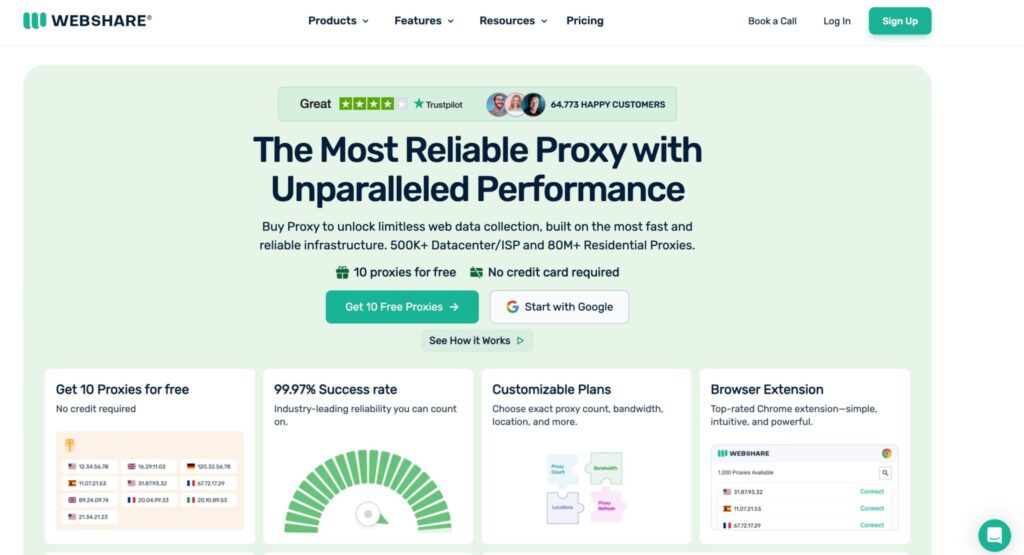
Webshare is especially interesting because it offers unlimited bandwidth options across proxy products, including static residential and residential proxy categories. Its unlimited bandwidth page lists unlimited proxy pricing, including static residential plans, while its fair usage policy says unlimited bandwidth plans are guaranteed 10 TB before throttling may be enforced.
That is the kind of detail buyers should appreciate. It is not “magic unlimited.” It is unlimited with a fair usage framework.
Webshare also states that static residential proxies use ISP-issued static IPs and support HTTP/SOCKS5, which is useful for account-safe, long-running, location-stable workflows.
Why Webshare stands out
Webshare is a strong option when you want predictable bandwidth but do not always need rotating peer residential IPs. Static residential proxies, also called ISP proxies, can be faster and more stable than rotating residential proxies because they behave more like dedicated ISP-linked IPs.
For workflows like account dashboards, QA testing, ad previews, browser sessions, and regional monitoring, that stability can matter more than constant rotation.
Where it may fall short
Unlimited bandwidth comes with fair usage rules. Once your usage passes guaranteed thresholds, throttling can apply. Also, static residential proxies are not the same as rotating residential pools. If your task depends on frequent IP rotation, check the rotating proxy product instead.
Best use cases
Webshare is a good fit for users who want static residential identity, predictable bandwidth, and a cleaner dashboard without enterprise pricing.
Pro Tip: For login-based workflows, static residential can be safer than aggressive rotating residential. Constant IP changes during a logged-in session can trigger security checks.
4. Storm Proxies

Storm Proxies is not the most advanced provider on this list, but it deserves a place because it keeps things simple. Its reverse backconnect rotating proxy page advertises unlimited bandwidth and three rotation options: fresh IP with every HTTP request, 3-minute proxies, and 15-minute proxies.
TechRadar’s review also describes Storm Proxies as a budget-friendly provider for individuals and small businesses, with backconnect rotating proxies that include automatic rotation and unlimited bandwidth.
Why Storm Proxies stands out
Storm Proxies is easy to understand. You are not buying a complex enterprise platform. You are buying access based on ports or threads, depending on the proxy type.
That makes it useful for smaller teams, niche SEO tasks, lightweight scraping, and users who do not want a steep learning curve.
Where it may fall short
The pool is smaller than premium networks. Targeting is less advanced. Support and reporting are more basic. If you need city-level precision in many countries, enterprise-grade compliance, or a modern scraping API layer, Storm Proxies may feel limited.
Best use cases
Storm Proxies is best for small SEO workflows, simple monitoring tasks, and users who want unlimited bandwidth without a complex dashboard.
Pro Tip: Rotation timing matters. Use per-request rotation for stateless public pages. Use 3-minute or 15-minute sessions when your workflow needs continuity, such as pagination, cart checks, or multi-step forms.
5. Bright Data
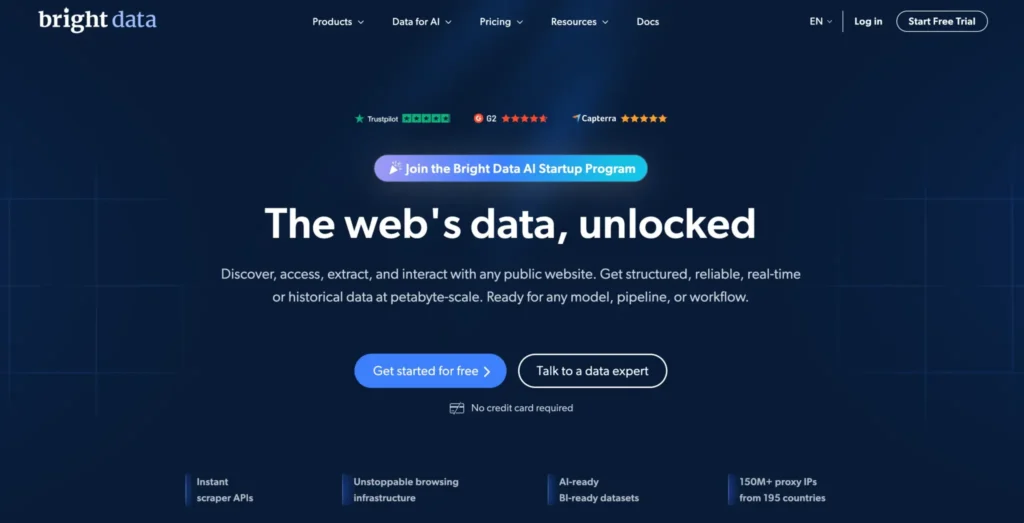
Bright Data is not the cheapest option, and it is not a pure “unlimited bandwidth” residential provider in the same way as ProxyScrape or Proxyrack. But it is one of the strongest choices for serious teams that need scale, targeting, compliance controls, and a broader data collection ecosystem.
Bright Data’s residential proxy page states access to 400M+ residential proxies from 195 countries, with targeting by city, state, country, ZIP code, and ASN. Its residential proxy pricing page lists residential pricing starting from $5.88/GB, which means buyers should treat it as premium, usage-based residential infrastructure rather than flat unlimited bandwidth.
Why Bright Data stands out
Bright Data is built for teams that care about compliance, governance, advanced targeting, dashboards, APIs, and reliable enterprise support. If your proxy workload is tied to a business-critical data pipeline, you may prefer a premium network over a cheap unlimited plan.
Where it may fall short
Cost. If you are pushing huge amounts of low-value traffic, per-GB pricing can become expensive. Bright Data makes more sense when success rate, reliability, legal clarity, and tooling matter more than raw bandwidth savings.
Best use cases
Bright Data fits enterprise web data collection, ad verification, brand protection, market intelligence, large-scale SERP work, and data teams that need governance.
Pro Tip: Do not compare Bright Data only on price per GB. Compare cost per successful result. If a cheaper provider burns retries, fails geo-targets, or causes noisy blocks, the cheaper plan may cost more in real operations.
6. Oxylabs
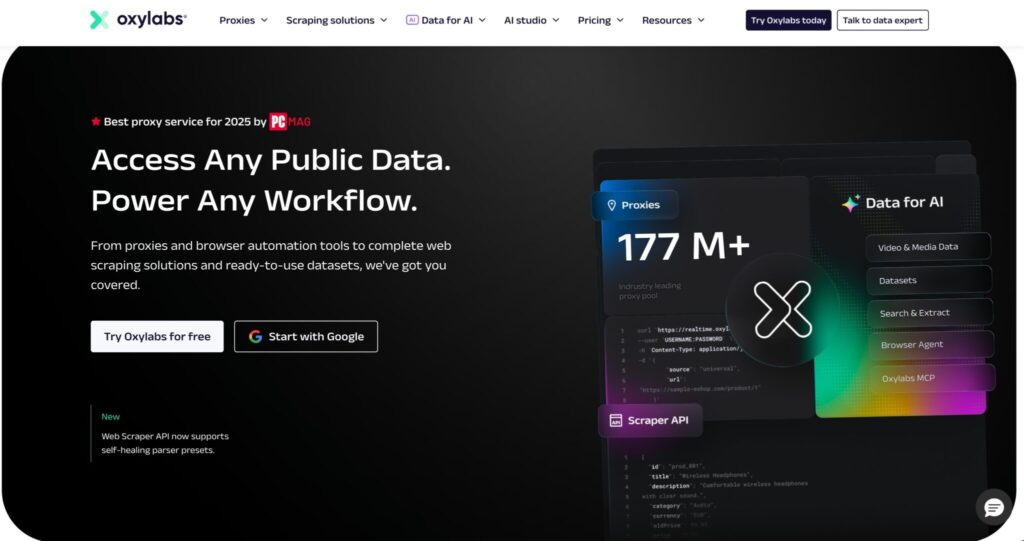
Oxylabs is another premium provider that should be judged as enterprise residential infrastructure, not a classic unlimited bandwidth option. Its residential proxy page mentions 175M+ IPs, city-level targeting, SOCKS5 support, and sticky sessions that can keep the same IP for up to 24 hours. It also states that monthly plans define the data transfer limit, even though there are no speed limitations.
Its pricing page also highlights unlimited concurrent sessions, flexible session control, global coverage across 195 locations, and ZIP-level geo-targeting.
Why Oxylabs stands out
Oxylabs is strong for teams running serious, long-term data operations. The network scale, session controls, SOCKS5 support, and enterprise positioning make it a better fit for high-value use cases than bargain scraping.
Sticky sessions up to 24 hours are especially useful for workflows that need session continuity without switching IPs too frequently.
Where it may fall short
It is not the right pick if your only buying question is, “How do I send the most traffic for the lowest flat price?” Oxylabs is more about quality, reliability, and enterprise-grade scale.
Best use cases
Oxylabs fits data aggregation, pricing intelligence, travel fare monitoring, review monitoring, ad verification, and business intelligence workflows.
Pro Tip: For enterprise providers, negotiate based on your target sites, required countries, monthly volume, concurrency, and success-rate expectations. The sticker price rarely tells the full story.
7. Decodo
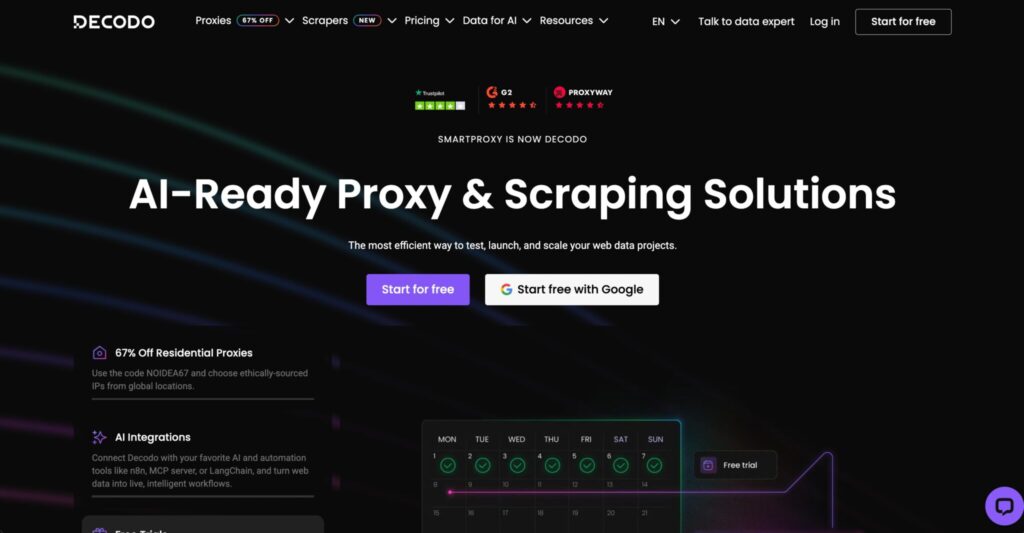
Decodo, formerly Smartproxy, is one of the best value options in the residential proxy market. Its official residential proxy page lists 115M+ IPs, advanced geo-targeting, unlimited concurrent sessions, and bandwidth-based pricing. Public pricing starts from entry-level per-GB tiers, with a 3-day free trial listed on the page.
This is not an unlimited bandwidth provider, but it belongs in this guide because many buyers searching for “unlimited residential proxies” actually need unlimited concurrency, flexible sessions, and affordable residential scale.
Why Decodo stands out
Decodo hits a useful middle ground. It is more polished than many cheap proxy sellers, easier to start with than some enterprise vendors, and still large enough for serious workloads.
It is a good pick for teams that care about usability. The dashboard, setup flow, targeting options, and trial availability make it friendly for buyers who want to test before making a larger commitment.
Where it may fall short
Because pricing is based on bandwidth, heavy traffic projects can still get expensive. If you are sending very high traffic with low revenue per request, compare Decodo against flat-rate or unmetered providers.
Best use cases
Decodo is strong for SEO monitoring, localized SERP checks, price scraping, brand monitoring, ad verification, and medium-scale data projects.
Pro Tip: Use Decodo-style metered residential proxies for high-value targets where quality matters. Use flat-rate unlimited plans for heavier, lower-value crawling where traffic volume is harder to predict.
8. SOAX
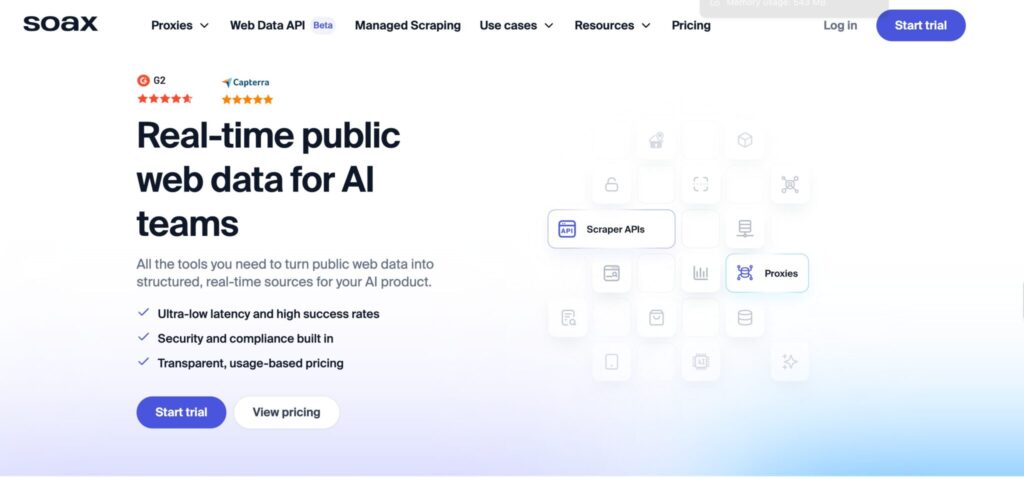
SOAX is known for clean residential pools and flexible filtering. Its residential proxy page lists 155M+ IPs in 195+ locations, with bundled residential proxy and Web Data API plans. Public pricing on that page starts with a 25 GB plan at $3.60/GB.
SOAX is not a no-GB-cap unlimited provider. It is better understood as a premium geo-targeted residential proxy provider for users who want control and cleaner sessions.
Why SOAX stands out
SOAX is a good option when geo precision matters. If you need traffic from a specific city, region, carrier, or location profile, provider quality matters more than bandwidth marketing.
SOAX also suits teams that do not want to patch together proxies and data access manually because its plans bundle proxy access with Web Data API options.
Where it may fall short
The starting plan may be too much for very small users, while massive traffic projects may find GB billing expensive. Also, buyers specifically looking for flat unlimited residential bandwidth should compare ProxyScrape, Proxyrack, Webshare, or Storm first.
Best use cases
SOAX is useful for localized price intelligence, classified monitoring, ad verification, social listening within platform rules, travel data, and research workflows that need cleaner geo-targeting.
Pro Tip: Clean IP quality beats raw pool size for sensitive targets. A smaller clean segment can outperform a huge but overused pool.
9. IPRoyal
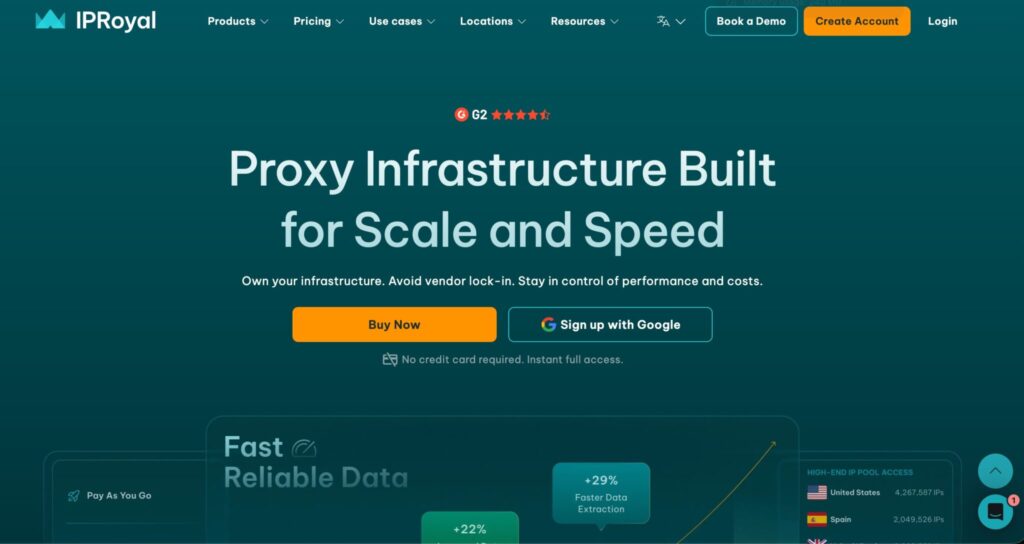
IPRoyal is a practical choice for budget-conscious users who want residential proxies without wasting unused bandwidth. Its official residential pricing page says traffic never expires, and its residential page lists pricing that starts at $7/GB and can drop as low as $1.75/GB in bulk.
That does not make it an unlimited bandwidth provider. But for buyers who hate monthly expiry, IPRoyal can feel more flexible than plans where unused traffic disappears at the end of the billing cycle.
Why IPRoyal stands out
The big draw is simple: non-expiring residential traffic. If your workloads are irregular, that is valuable. You can buy traffic, use it when needed, and avoid the pressure of consuming your quota before renewal.
IPRoyal is also approachable for smaller users who do not need enterprise contracts, custom onboarding, or complex dashboards.
Where it may fall short
It does not offer the same enterprise tooling as Bright Data or Oxylabs. Also, if you have steady high-volume workloads every day, a flat-rate unmetered provider may still be cheaper than pay-per-GB pricing.
Best use cases
IPRoyal works well for freelancers, small SEO teams, QA testers, low-to-medium volume scraping, and buyers who want flexibility over monthly commitment.
Pro Tip: Non-expiring traffic is great when your usage is bursty. If your traffic is predictable and constant, calculate monthly cost at expected GB volume and compare it against unmetered plans.
How to Choose the Best Unlimited Residential Proxy Provider
1. Define what “unlimited” means for your workload
Before comparing providers, decide which limit hurts you most.
- If your problem is unpredictable bandwidth cost, you want unmetered traffic.
- If your problem is parallel workload size, you want unlimited or high concurrent sessions.
- If your problem is account stability, you may need static residential or ISP proxies with higher bandwidth allowance.
- If your problem is location accuracy, you need large geo-targeted residential pools, even if pricing is per GB.
2. Look at IP pool quality, not just IP pool size
A provider with 150M IPs is not automatically better than a provider with 4M IPs. Pool quality depends on:
- IP freshness
- Consent and sourcing practices
- ASN diversity
- Country depth
- Session stability
- Block history
- Target compatibility
- Retry rate under real workloads
For example, Bright Data advertises a very large 400M+ residential proxy network across 195 countries, while Oxylabs lists 175M+ residential IPs and 195 locations. Those are massive pools, but they are also generally priced as premium traffic.
3. Match rotation style to the task
Rotation is where many proxy buyers make expensive mistakes.
Use per-request rotation when every request is independent. This works for basic public page collection, search result checks, and simple product page monitoring.
Use sticky sessions when the target expects continuity. This includes multi-page browsing, checkout flows, dashboards, location testing, and anything involving cookies.
Use long sticky sessions when you need a stable identity for hours. Oxylabs, for example, describes sticky residential sessions that can keep the same IP for up to 24 hours.
4. Check protocol support
HTTP and HTTPS are enough for many web scraping and browser tasks. SOCKS5 is more flexible because it can support more traffic types and tools. UDP support is less common and should be verified carefully.
Proxyrack publicly lists HTTP, SOCKS, and UDP support on residential plans, while Oxylabs states that residential proxies can use SOCKS5.
5. Read the fair usage rules
Unlimited bandwidth is rarely without boundaries. Webshare is a good example of transparency here. Its fair usage policy says unlimited bandwidth plans are guaranteed 10 TB before throttling is enforced, with speeds potentially reduced after that point.
That does not make the plan bad. It makes the plan clearer.
Always ask:
- Is there throttling after a threshold?
- Are there restricted targets?
- Are certain countries excluded?
- Are ports or threads limited?
- Are there daily request caps?
- Can the provider suspend unusual usage?
- Does “unlimited” apply to residential proxies or only datacenter proxies?
6. Test with your real target sites
Do not rely only on dashboard claims. Run a small controlled test with:
- Your actual URLs
- Your expected concurrency
- Your chosen countries
- Your preferred rotation interval
- Your normal headers and browser setup
- Your real retry rules
- Your expected daily volume
Track cost per successful page, not just cost per GB.
7. Avoid free residential proxies for serious work
Free residential proxies are risky for business use. They are often slow, unstable, overused, poorly sourced, or unsafe. For serious monitoring, SEO, QA, or data work, use paid providers with clear sourcing, rules, and support.
My Recommended Picks by Use Case
Best overall unlimited residential proxy: ProxyScrape
Choose ProxyScrape if you specifically want unmetered residential traffic with no GB caps and no overage fees. It is the cleanest match for the phrase “unlimited residential proxies.”
Best unmetered alternative: Proxyrack
Choose Proxyrack if you want unmetered residential proxies, flexible protocols, and country/city/ISP targeting.
Best static residential unlimited bandwidth option: Webshare
Choose Webshare if your workflow needs stable ISP-linked IPs, predictable bandwidth, and fair usage rules you can understand upfront.
Best budget unlimited bandwidth option: Storm Proxies
Choose Storm Proxies if your needs are simple, your target geography is not too complex, and you want basic unlimited bandwidth without enterprise features.
Best enterprise residential proxy network: Bright Data
Choose Bright Data if you need the biggest network, advanced targeting, compliance controls, and enterprise support.
Best enterprise session control: Oxylabs
Choose Oxylabs if you need large-scale residential infrastructure, sticky sessions, SOCKS5 support, and high concurrency.
Best value metered residential proxy: Decodo
Choose Decodo if you want a large residential pool, unlimited concurrent sessions, easy setup, and reasonable per-GB pricing.
Best clean geo-targeted sessions: SOAX
Choose SOAX if you care about precise targeting, clean sessions, and flexible filtering.
Best non-expiring traffic: IPRoyal
Choose IPRoyal if your usage is inconsistent and you do not want unused residential traffic to expire.
FAQs About Unlimited Residential Proxies
1. Are unlimited residential proxies really unlimited?
Sometimes, but not always. Some providers offer true unmetered residential bandwidth. Others use “unlimited” to describe concurrent sessions, pool access, or bandwidth on static residential plans. Always read the plan rules, fair usage policy, and product type.
2. What is the difference between unlimited residential and unlimited datacenter proxies?
Residential proxies use IPs associated with real ISPs and household connections. Datacenter proxies come from hosting infrastructure. Unlimited datacenter proxies are usually cheaper and faster, but residential proxies tend to look more natural for location-sensitive public web tasks.
3. Are static residential proxies the same as residential proxies?
Not exactly. Static residential proxies, often called ISP proxies, use ISP-issued IPs but remain stable. Rotating residential proxies usually rotate through a larger pool of residential IPs. Static residential is better for session stability. Rotating residential is better when you need IP diversity.
4. Which is better: per-GB pricing or unlimited bandwidth?
Per-GB pricing is better when quality matters and your traffic is controlled. Unlimited bandwidth is better when traffic volume is high, unpredictable, or retry-heavy. The best choice depends on cost per successful result.
5. Do unlimited residential proxies support SOCKS5?
Some do, but not all. Oxylabs states that its residential proxies support SOCKS5, and Webshare static residential proxies also list HTTP/SOCKS5 support. Always check the exact plan before buying.
6. Are unlimited residential proxies good for SEO monitoring?
Yes, they can be useful for rank tracking, SERP checks, localized search testing, and competitor monitoring, as long as your setup respects platform rules and avoids abusive request patterns. For SEO work, country, city, and ASN targeting often matter more than raw bandwidth.
7. What rotation interval should I use?
Use per-request rotation for stateless pages. Use 3 to 15 minute sticky sessions for browsing sequences. Use longer sticky sessions for account-based or multi-step workflows. The wrong rotation interval can trigger security checks or waste good IPs.
8. Why do some unlimited proxy plans throttle speed?
Because bandwidth still costs money. Providers use fair usage policies to keep one user from consuming network capacity in a way that hurts everyone else. Webshare, for example, publicly explains guaranteed bandwidth and throttling rules for unlimited bandwidth plans.
9. What is the safest way to test a residential proxy provider?
Start with a small plan or trial. Test your real target sites, locations, concurrency, rotation settings, and success rate. Measure failed requests, speed, CAPTCHA frequency, and cost per successful result. Do not judge a provider only by homepage claims.
Final Verdict
If you want the closest match to true unlimited residential proxies, start with ProxyScrape Unlimited Residential and Proxyrack. They are the most relevant choices for buyers who do not want to count every GB.
If you need static residential bandwidth predictability, look at Webshare. Just read the fair usage policy carefully.
If you need a simple budget option, Storm Proxies still has a place, especially for smaller workloads.
For serious enterprise work, Bright Data and Oxylabs are stronger, but they are not really “cheap unlimited bandwidth” choices. They are premium networks built for reliability, targeting, support, and scale.
For value-focused teams that can live with per-GB billing, Decodo, SOAX, and IPRoyal are worth comparing. They may not be unlimited in the strict bandwidth sense, but they can be smarter buys when quality, geo-control, and session stability matter more than raw traffic volume.