
Country-based proxies sound simple: pick a country, route traffic through that country, get localized data. In real projects, it is rarely that clean.
A proxy network can claim “195 countries” and still perform poorly in the exact country you need. India may be strong, but South Africa thin. The United States may have millions of IPs, while smaller markets rotate through a shallow pool. That difference matters when you are checking search results, testing localized ads, monitoring marketplace pricing, verifying content access, or collecting public data at scale.
The best country-based proxy networks are not just big. They give you usable country pools, stable rotation, clear session controls, and enough protocol support to fit your stack. Here are the providers worth shortlisting.
Quick Comparison Table
| Provider | Best For | Claimed IP Pool | Country Coverage | Targeting Depth | Rotation Control | Protocols | Main Trade-Off |
|---|---|---|---|---|---|---|---|
| Bright Data | Enterprise geo-data projects | 400M+ monthly residential IPs | 195+ countries | Country, city, ASN, ZIP, carrier options | Rotating and sticky sessions | HTTP, HTTPS, SOCKS5 | Premium pricing and stricter onboarding |
| Oxylabs | Large-scale scraping and compliance-heavy teams | 175M+ residential IPs | 195 countries | Country, state, city, coordinates on some products | Rotating, sticky up to long sessions | HTTP, HTTPS, SOCKS5 | Not the cheapest option |
| Decodo | Balanced value and ease of use | 115M+ residential IPs | 195+ locations | Country, state, city, ZIP, ASN | Per-request rotation and sticky sessions | HTTP, HTTPS, SOCKS5 | Advanced teams may outgrow basic tools |
| SOAX | Fine geo-filtering and clean dashboard control | 155M+ residential IPs | 195+ locations | Country, region, city, ISP | Automatic and custom session lengths | HTTP, HTTPS, SOCKS5 | Pricing can rise with heavier targeting |
| NetNut | Stable high-volume country routing | 85M+ residential IPs | 195 countries | Country and city options | Rotating and static residential | HTTP, HTTPS, SOCKS5 | Better for teams than casual users |
| IPRoyal | Affordable country-based residential proxies | 32M+ residential IPs | 195 countries | Country, state, city | Randomize IP or sticky sessions | HTTP, HTTPS | Smaller pool than enterprise vendors |
| Webshare | Budget-friendly global residential access | 80M+ residential IPs | Broad global coverage | Country and city targeting | Rotating residential endpoints | HTTP, SOCKS5 | Fewer enterprise scraping extras |
| Rayobyte | Ethical sourcing and hands-on support | 40M+ residential IPs | Global pool | Country, region, city | Sticky sessions and pool rotation | HTTP, HTTPS | Location depth varies by proxy type |
| DataImpulse | Pay-as-you-go country testing | 90M+ IPs | 195 countries | Country, region, city, ASN, ZIP | Rotating and sticky sessions | HTTP, HTTPS, SOCKS5 | Less polished than premium suites |
9 Best Country-Based Proxy Networks
#1. Bright Data
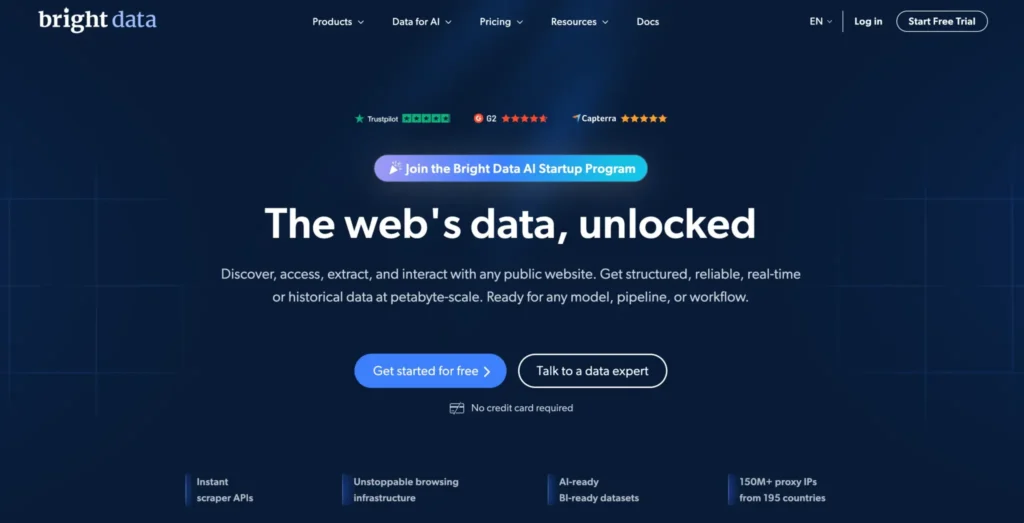
Bright Data is the heavyweight option for companies that need deep country coverage and strict control over how traffic exits. Its residential network is one of the largest listed in the market, and the platform supports residential, ISP, datacenter, and mobile proxies.
What makes Bright Data strong for country-based work is the control layer. You can target countries, cities, ASN, ZIP-level areas in supported markets, and carriers on mobile products. That helps when your task depends on how a local user sees a page, not just whether your IP appears in a country.
Rotation is flexible. You can rotate on request, keep sticky sessions, or configure country-specific zones. That matters for workflows like local SERP tracking, where each keyword request may need a new IP, while login-based QA needs longer sessions.
Pro-Tip: Use Bright Data when country accuracy matters more than saving a few dollars per gigabyte. It is overkill for small scraping jobs, but very strong for regulated, repeatable data operations.
#2. Oxylabs
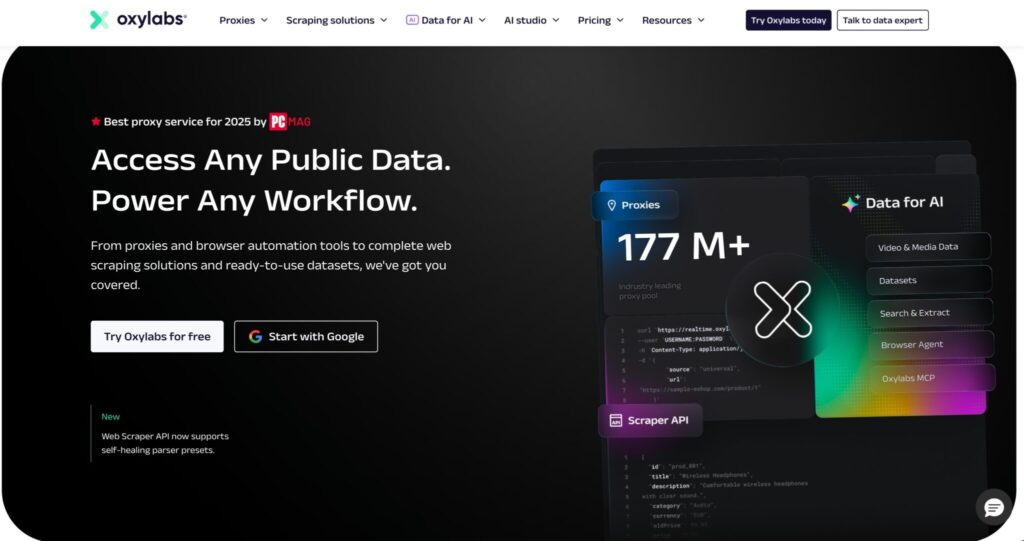
Oxylabs is built for teams that want scale without babysitting infrastructure. Its residential network is large, global, and backed by a mature dashboard, documentation, and account support.
For country-based proxy use, Oxylabs is especially good when you are running recurring jobs across many markets. Think ecommerce price monitoring in 20 countries, travel fare checks, ad verification, or public data collection where blocks can ruin reporting quality.
The provider supports SOCKS5, which is useful for tools that need more than basic browser-style HTTP traffic. Sticky sessions are available, so you can hold the same residential IP where session continuity is needed.
Pro-Tip: Oxylabs fits teams that want reliable country pools with fewer surprises. It is not always the cheapest, but the operational polish can save time.
#3. Decodo
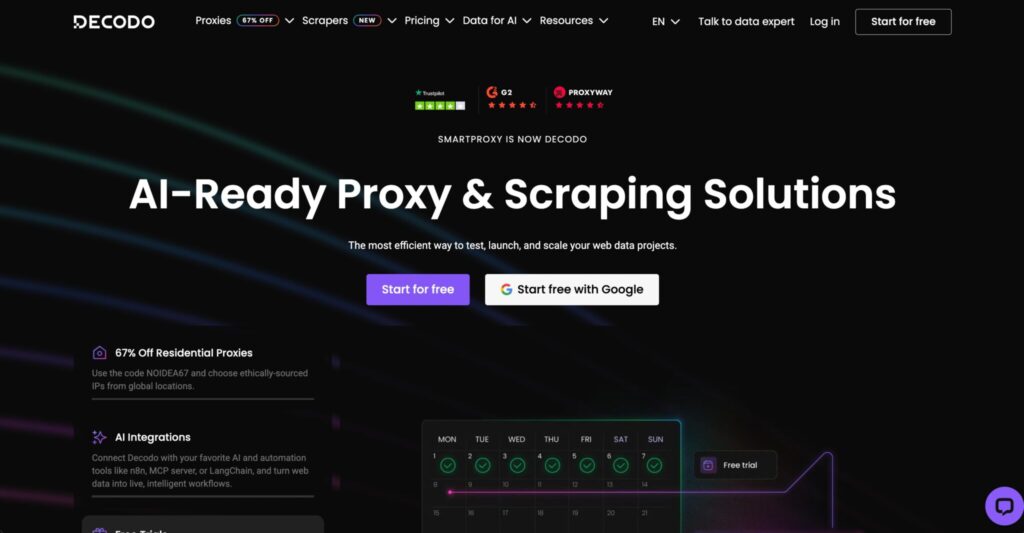
Decodo, formerly Smartproxy, hits a good middle ground: large pool, easy onboarding, clean pricing, and enough geo-targeting for most professional use cases. Its residential proxy network is big enough for serious work, yet the platform still feels approachable.
Country-based targeting is simple to set up, and the network supports deeper filters such as state, city, ASN, and ZIP targeting in supported areas. That makes it useful for SEO teams, affiliate publishers, price intelligence teams, and QA testers who need localized browsing without building custom proxy management.
Rotation can be per request or sticky. Sticky sessions are useful for keeping cart, login, or checkout flows stable during testing.
Pro-Tip: Decodo is a strong first pick when you need country targeting at scale but do not want an enterprise sales cycle before testing.
#4. SOAX
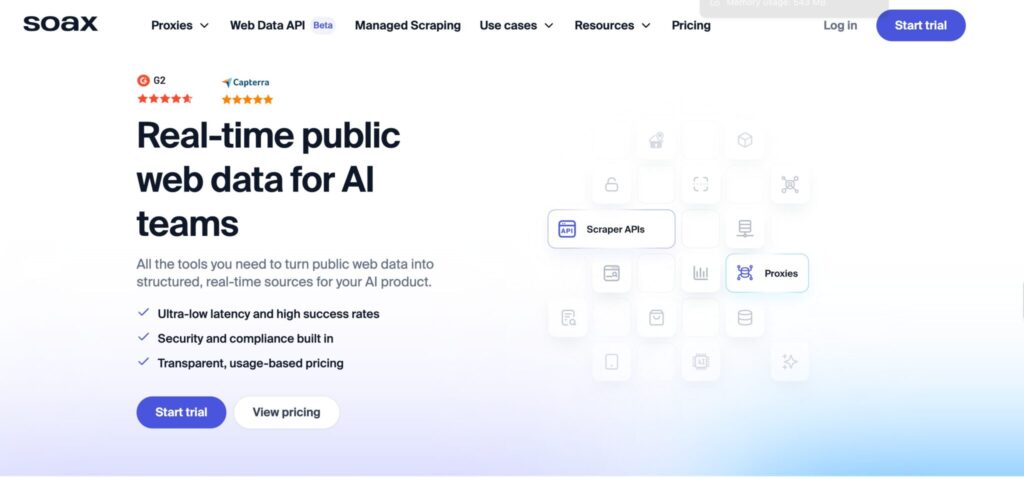
SOAX has become popular because it gives users very clear control over location filters and session behavior. For country-based proxy networks, that clarity is valuable. You can build sessions around a specific country, region, city, or ISP and then decide how aggressively IPs should rotate.
The dashboard is one of SOAX’s better selling points. Teams that are not deeply technical can still create targeted endpoints, manage traffic, and tune rotation. For local search checks, marketplace testing, and ad verification, that lower setup friction helps.
SOAX also emphasizes ethically sourced proxies, which is worth considering. Proxy sourcing has become a real buying factor, especially for agencies and brands that cannot risk shady infrastructure.
Pro-Tip: SOAX is a smart choice when you care about country and city filtering but want a simpler control panel than the enterprise giants.
#5. NetNut
NetNut focuses on performance and stability. Its rotating residential network covers many countries and is often positioned toward businesses doing larger-scale data collection.
The biggest reason to consider NetNut is consistency. Country-based proxy jobs often fail because the provider technically has IPs in a country, but the available pool is too unstable. NetNut’s pitch is that its architecture gives faster, more reliable routing than typical peer-heavy networks.
It supports rotating residential, static residential, mobile, and datacenter options, so you can mix proxy types depending on the job. Use rotating residential for broad collection, then static residential for accounts or flows that need the same identity.
Pro-Tip: NetNut is best when your traffic volume is high enough that cheap, thin country pools start creating failed requests and messy data.
#6. IPRoyal
IPRoyal is a value-focused option with a surprisingly practical feature set. It offers residential proxies across a wide country spread, with controls for random IP rotation or sticky sessions.
The standout benefit is affordability. Smaller agencies, solo SEO operators, affiliate teams, and testing teams can access country-based residential proxies without committing to expensive monthly enterprise plans.
The trade-off is pool depth. IPRoyal’s network is smaller than Bright Data, Oxylabs, Decodo, and SOAX, so you should test your priority countries before scaling. For common markets such as the US, UK, Canada, Germany, France, and Australia, it can be a cost-effective choice.
Pro-Tip: Buy a small amount of traffic first and test the countries you actually need. Global coverage does not always mean equal performance in every market.
#7. Webshare
Webshare is a good fit for users who want simple proxy access, transparent setup, and lower-cost residential options. It is not as feature-heavy as Bright Data or Oxylabs, but that is part of the appeal.
For country-based use, Webshare gives you rotating residential proxies with country and city-level targeting. It also supports HTTP and SOCKS5 endpoints, which gives it more flexibility than basic web-only proxy services.
Webshare works well for lighter scraping, localized research, rank checks, and testing. It is less ideal if you need built-in scraping APIs, managed unblockers, or dedicated enterprise workflows.
Pro-Tip: Webshare is useful when you need country coverage on a budget, but keep an eye on success rates in smaller regions.
#8. Rayobyte
Rayobyte has a long-standing reputation in the proxy market, especially with datacenter and ISP products. Its residential network is smaller than the largest providers, but it leans on ethical sourcing, support, and practical proxy setup.
Country-based targeting is available, and sticky sessions help for workflows that need continuity. Rayobyte can be a good fit for businesses that want more guidance and less self-serve confusion.
One thing to check closely is location depth by product. Some proxy types support broader geo-routing than others. Before buying, confirm whether your exact country and city needs match the product you plan to use.
Pro-Tip: Rayobyte makes sense when support quality and sourcing transparency are more important than chasing the biggest advertised IP number.
#9. DataImpulse
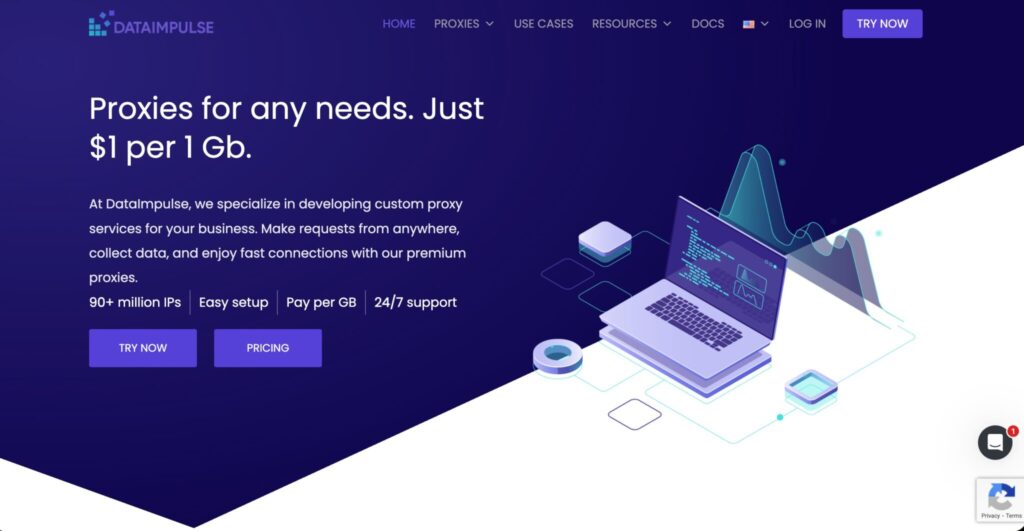
DataImpulse is attractive for buyers who want flexible pay-as-you-go proxy access. Its country coverage is broad, and its residential network supports rotating and sticky sessions.
The provider is useful for testing country-based campaigns, running smaller market research jobs, or adding extra IP supply when your main provider struggles in a specific location. It may not feel as polished as the biggest platforms, but the pricing model is friendly for experimentation.
Geo-targeting includes country-level access with deeper region, city, ASN, and ZIP options depending on plan and availability.
Pro-Tip: Keep DataImpulse as a secondary provider if you run multi-country projects. A backup country pool can save a campaign when your main network gets noisy.
How to Choose a Country-Based Proxy Network
Start with the countries that matter
Do not buy based on total countries alone. Make a list of your actual target markets. Then test each provider against those countries. A network with 195 countries can still be weak in smaller regions.
For each priority country, check success rate, response time, IP freshness, and block rate. Run tests during the hours your real tasks will run, because residential availability changes throughout the day.
Check pool depth, not just pool size
A huge global IP pool is useful, but local density is what matters. If you need Brazil, Japan, Germany, and UAE, ask how strong those pools are. The best providers will not always publish exact country-level IP counts, so your own testing matters.
For scraping, shallow pools cause repeated IPs and higher block rates. For ad verification, poor pool depth can show the wrong local creative or trigger security checks.
Match rotation to the workflow
Rotation is not always better. For large-scale public data collection, rotating on every request can reduce blocks. For account login, cart testing, form flows, or session-based QA, sticky sessions are safer.
Look for:
- Per-request rotation for scraping and SERP checks
- Sticky sessions for login and checkout testing
- Custom TTL for controlled sessions
- API or username parameters for automation
Pick the right proxy type
Residential proxies are best for realistic local traffic. Mobile proxies work well for app testing and carrier-specific checks. ISP proxies are useful when you need static, fast, residential-looking IPs. Datacenter proxies are cheaper and faster, but easier to detect on strict sites.
A serious country-based setup often uses more than one type.
Confirm protocols and tool compatibility
HTTP and HTTPS are enough for many web tasks. SOCKS5 is useful for apps, browsers, automation tools, and non-standard traffic. Before buying, confirm your crawler, browser profile tool, SEO software, or QA stack supports the provider’s authentication method.
Best Overall Picks: Best Country-Based Proxy Networks
For enterprise-grade country targeting, choose Bright Data or Oxylabs. For balanced price and usability, choose Decodo or SOAX. For budget-friendly residential coverage, choose IPRoyal or Webshare. For backup supply and flexible testing, choose DataImpulse. For support-led setups, Rayobyte deserves a look.
The right choice depends less on the logo and more on your countries, session rules, traffic volume, and tolerance for failed requests.
FAQs: Best Country-Based Proxy Networks
1. What are country-based proxies?
Country-based proxies route your connection through an IP address located in a selected country. They help users view public web pages, search results, prices, ads, or app experiences as they appear in that market.
2. Are residential proxies better for country targeting?
Usually, yes. Residential proxies come from real ISP networks, so they look more like normal local users than datacenter IPs. They are better for strict websites, but they cost more.
3. What is the difference between rotating and sticky proxies?
Rotating proxies change IPs automatically, often every request or session. Sticky proxies keep the same IP for a set time. Use rotation for scale and sticky sessions for workflows that need continuity.
4. Which proxy protocol should I choose?
Use HTTP or HTTPS for standard web scraping and browsing. Use SOCKS5 when your software needs broader traffic support, app-level routing, or more flexible connection handling.
5. Why do some countries perform worse than others?
Residential proxy supply depends on available real devices, ISP coverage, local demand, and provider sourcing. Smaller or stricter markets often have fewer stable IPs.
6. Can I use one provider for every country?
You can, but large teams often use two providers. A backup network helps when a specific country pool slows down, gets blocked, or lacks enough fresh IPs.
7. What should I test before buying a large plan?
Test your priority countries, target sites, rotation settings, response time, success rate, and cost per successful request. Do not judge a proxy plan only by price per GB.
8. Are country-based proxies legal?
Proxy use itself is generally legal, but what you do with them matters. Follow website terms, privacy rules, data protection laws, and the provider’s acceptable use policy.
Quick Links: